 Iranco Magazine Team
Iranian products with real trade flows in Pakistan — quarantine and labelling, tariff codes, landed cost, land routes and selection criteria for professional importers
Export Guide · Pakistan · Food
Iran Food Exports to Pakistan: Trade Opportunities and Advantage Products
Analysis of Iranian products with real trade flows in Pakistan, quarantine and labelling rules, tariff codes, landed cost, land corridors and selection criteria for professional importers
Introduction
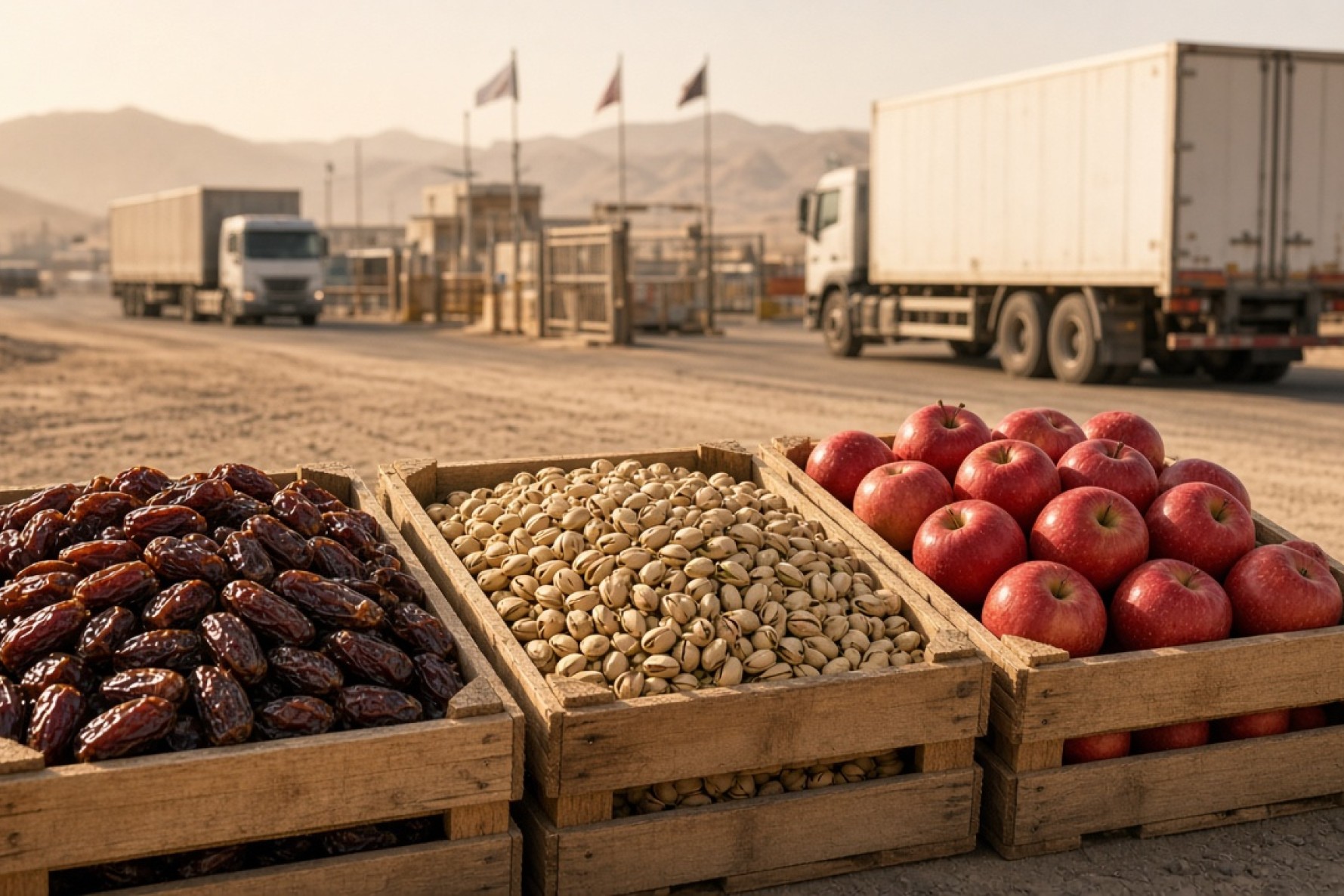
Pakistan is not a uniform market for Iranian food. Dates, pistachios, apples, raisins, fresh tomatoes, spice seeds and tomato paste show strong trade history; other lines depend on season, price and entry rules.
With over 241 million people, Pakistan is also a large agricultural producer — population size alone does not guarantee demand for every Iranian item. In 2025, fruit and nuts imports from Iran were about $59.53M, vegetables and roots about $29.03M, and coffee/tea/spices over $12.5M.
The Iran–Pakistan preferential trade agreement (operational since 2006) covers only part of tariff lines. Exporters must align product choice, PCT codes, plant quarantine, specs, packaging and land routes; Pakistani buyers comparing offers without those details risk quality disputes and unexpected customs costs.
1. Why Pakistan is practical for some Iranian foods
Advantage works at product level (recorded import flows), geography (land border; Taftan–Mirjaveh and Gabd–Remdan corridors; Gabd near Gwadar and TIR), and timing (seasonal windows for fresh produce).
Actual market means active importers and channels — dates, pistachios, raisins, apples, some vegetables and spices. Potential market may look attractive but lacks sustained trade evidence and needs market tests and a local partner.
2. Products with real trade advantage
| Product | Trade signal | Opportunity |
|---|---|---|
| Dates | $15.52M >67M kg in 2024 | Established; sensitive to variety & pack |
| Pistachios | $8.87M from Iran in 2024 | Strong Iranian share in imports |
| Raisins | ~$3.4M Iran; Afghanistan ~$9.76M | Real demand, regional competition |
| Fresh apples | $7.53M, >17.5M kg in 2024 | Seasonal; cold chain critical |
| Fresh tomatoes | ~$17.79M in 2025 | Seasonal; price & transit speed |
| Onion group | ~$6.80M in 2025 | Supply- and price-driven |
| Spice seeds | ~$12.42M in 2025 | Bulk, repack, industrial |
| Tomato paste (HS 200290) | ~$976k from Iran in 2024 | Industrial; tariff & specs matter |
3. Who buys in Pakistan?
Fresh produce goes to produce importers and wholesalers (fast delivery, strict sorting). Dry fruits to nut importers and repackers. Spice seeds to grinders and food plants. Tomato paste to sauce factories and food service — aseptic drums vs retail packs.
Land proximity allows smaller lots, but customs, quarantine, inland Pakistan freight and shrink must sit in the landed-cost model.
4. Technical specs & quality
Generic grades like “export dates” are not contract-ready. Approved samples must be referenced; COAs must trace to the shipment batch. For paste, align contract names with Codex definitions (natural soluble solids <24% = purée; ≥24% = paste).
5. Entry regulations
Pakistan’s Department of Plant Protection requires valid import permits for plant goods. Part of the workflow runs through Pakistan Single Window (PSW). Punjab retail-pack rules include Urdu labelling for imported foods — confirm the province you will sell into.
6. Tariff codes & cost
Preferential coverage is partial (~18% of lines). Check exact PCT, current CD/ACD/RD/ST/IT components and origin rules. Pistachios are split in current Pakistan lines (080251/080252) — do not copy legacy HS 080250 from old trade reports into new customs filings.
7. Packaging & transport
Taftan–Mirjaveh suits many central/eastern Iran loads to Quetta networks. Gabd–Remdan links to Gwadar and coastal N-10. Choose corridor by origin, destination, product and inland cost — not map distance alone.
8. Competition & pricing
Landed cost includes sorting, packing, border freight, clearance, duties/taxes, Pakistan inland haul and loss. Build one comparison baseline for all suppliers on identical specs and delivery terms.
9. Contracts, payment & barter
Pakistan operates an official firm-to-firm barter channel with Iran (2025 updates). Eligible firms need active taxpayer status, PSW membership and registered WeBOC contracts. Spell out specs, sampling, Incoterms and payment before production.
10. Importer checklist (17 points)
- Exact PCT — trade name is not enough.
- Preferential eligibility for that code.
- Written quality grade.
- Measurable limits (moisture, Brix, defects).
- Approved reference sample in contract.
- Pre-agreed tests (aflatoxin, MRL, etc.).
- Import permit & quarantine before loading.
- Net weight and pack format.
- Destination labelling (e.g. Punjab).
- Supplier capacity for repeat lots.
- Shipping window — critical for fresh.
- Border route before booking haulage.
- Full landed cost, not ex-works price only.
- Payment or barter fixed early.
- Accept/reject criteria in contract.
- Batch documents match physical goods.
- Sampling & lab reference for disputes.
11–12. RFQ & sourcing via Iranco
Professional RFQs list variety, grade, tests, pack, volume, Pakistan city/gateway, Incoterms and payment. Iranco lets buyers register the same detail so supplier options are compared on real purchase criteria.
Summary
Pakistan rewards product- and time-specific supply backed by trade data. Decisions should weigh PCT, preferences, quarantine permits, samples, tests, labels, border route and delivered cost — not kilo price alone.
FAQ
Which foods show the strongest advantage?
Dates, pistachios, apples, raisins, fresh tomato, onion group, spice seeds and tomato products — with different seasonal vs established profiles.
Is preferential duty automatic?
No. Verify each PCT on the preference list and origin rules.
Key plant-health documents?
DPP permit, phytosanitary certificate, invoice, packing list, transport doc and declaration; inspection may apply.
Is barter possible?
Yes, via the official firm-to-firm mechanism and WeBOC/PSW compliance.
Best land route?
Depends on origin/destination: Taftan–Mirjaveh or Gabd–Remdan; for perishables, cold chain and clearance time beat distance.
Featured Products








Related Articles



