 Iranco Magazine Team
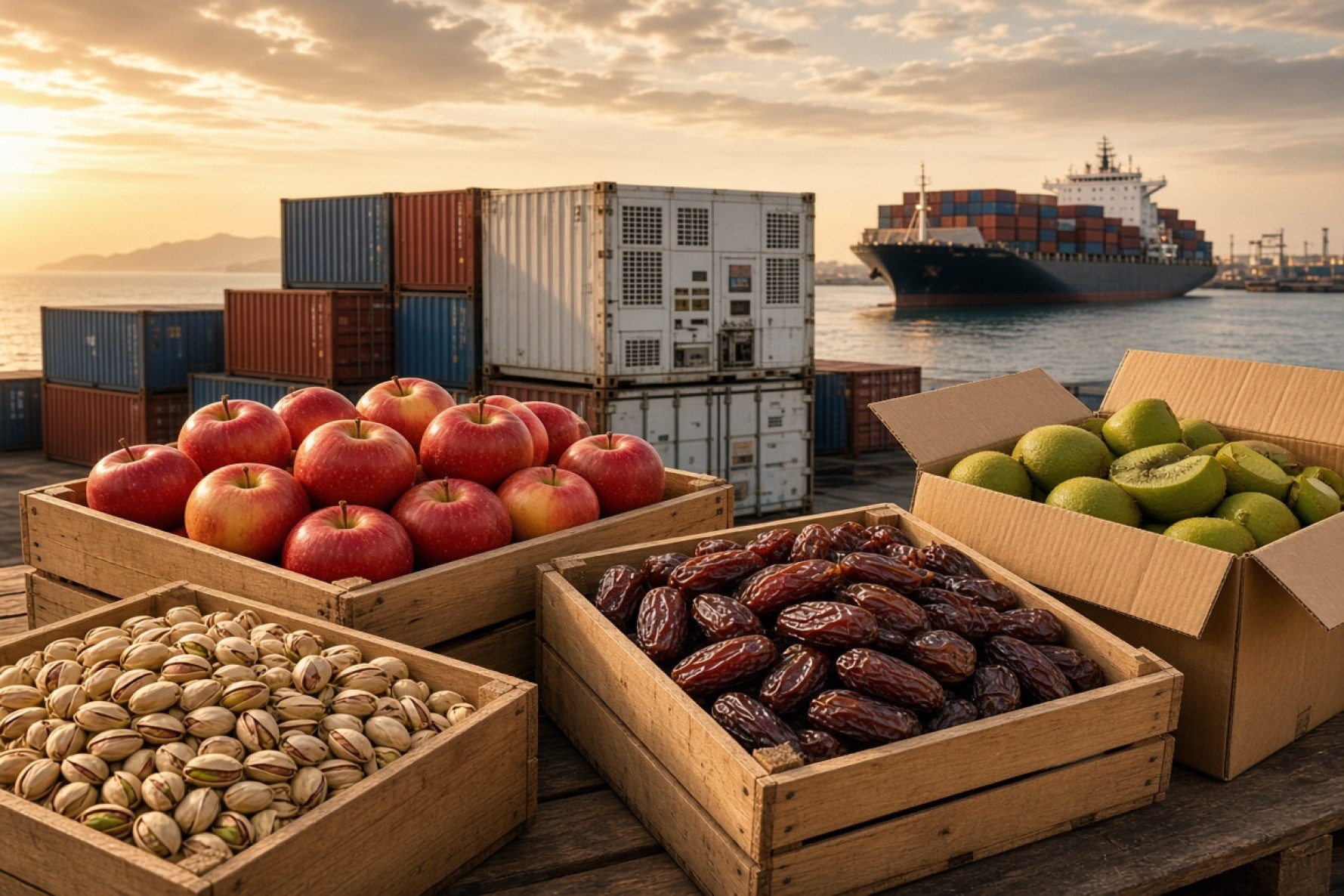
India market analysis for Iranian pistachios, apples, dates and kiwi — real sales capacity, competitors, standards, quarantine, packaging, quality control and market entry
Export Guide · India · Food Market
Iran Food Exports to India: Which Iranian Products Have the Strongest Sales Potential?
Pistachios, apples, dates and kiwi from Iran in the India market — 2024 trade stats, quarantine, FSSAI, HS codes, packaging, competitors, landed cost and a professional importer checklist
Introduction
India is not equally attractive for every Iranian food line. A population above 1.4 billion does not, by itself, guarantee sales — exporters must weigh supply gaps, delivered price, established trade position and entry requirements together. 2024 trade data show four groups — pistachios, fresh apples, dates and kiwi — accounting for roughly USD 277 million in direct imports from Iran with proven commercial flows.
By contrast, Iranian saffron — despite global reputation — registered only about 342 kg in India’s direct import statistics from Iran in 2024: a specialist niche, not a volume substitute for nuts and fruit. Dried figs and raisins have a more limited presence and should not be confused with the four main lines.
For Indian importers, professional decisions start with measurable specifications, COA, HS classification, FSSAI, IEC, NPPO quarantine and landed cost to warehouse (e.g. JNPT, Mumbai, Ahmedabad). For Iranian exporters, pack choice, approved kiwi packhouses and pistachio aflatoxin control determine customs acceptance.
This guide is written for B2B buyers. Iranco can receive purchase requests with the same detail level to compare supply options from Iranian producers for the India market.
1. Which Iranian foods have the strongest trade flows in India?
The table below contrasts the four core products with saffron and dried figs. Rational priority is to deepen lines that already show recorded value, weight and known import channels.
| Product | 2024 signal (Iran → India) | Market note |
|---|---|---|
| Pistachios | ~$123.5M · ~20.3M kg | Highest value; aflatoxin & HS sensitive |
| Fresh apples | ~$95.1M · ~157.1M kg | High volume; ~$0.61/kg unit value |
| Dates | ~$45.3M · ~105.1M kg | Iraq & UAE competition |
| Kiwi | ~$12.9M · ~23.9M kg | Cold treatment & approved packhouse |
| Saffron | ~342 kg direct | Niche; not a bulk nut substitute |
| Dried figs | Limited presence | Cultivar & moisture differentiation |
2. Pistachios — specifications, aflatoxin and tariff codes
Pistachios are Iran’s largest value line in India. “Grade-one pistachio” is not contract-ready: define in-shell (HS 080251) vs kernels (HS 080252), raw vs processed, sizing, open-shell percentage, moisture, defect caps and aflatoxin limits (B1/B2/G1/G2 totals).
Indian and bulk buyers typically match COA to each shipment batch. Loads sampled at port or warehouse above contract limits risk rejection or steep discounts. Packaging must protect against moisture and oxygen — liner bags or foil in cartons are common in B2B flows.
- HS split: 080251 (in-shell) and 080252 (shelled / kernels)
- Aflatoxin testing in spec and COA — non-negotiable for many importers
- Pre-shipment approved sample before large orders
- FSSAI for retail: registration and compliant labels
3. Fresh apples — volume, unit value and quarantine
Iranian apples reached about 157 million kg in 2024 — the heaviest line by weight — while unit value near USD 0.61/kg shows a volume and sorting-driven market rather than premium unit pricing alone.
Apple entry to India falls under NPPO quarantine rules. Freedom from Cydia pomonella (codling moth) is a key phytosanitary theme in origin protocols and inspection. Phytosanitary certificates, declared orchards and packhouses, cold chain and ventilated cartons must be planned together with ocean reefer scheduling.
Long dwell at west India ports or broken cold chain can erase initial sorting advantage — landed cost models should include post-arrival shrinkage.
4. Dates — Iraq/UAE competition and defect checklist
Iranian dates hold a significant India import share, but Iraq and the UAE (and regional re-exports) compete on price and access. Iran’s differentiation lies in cultivar (e.g. Mazafati, Piarom, Kabkab), uniformity, moisture and pack format.
Buyers should embed a defect checklist in the spec before ordering:
- Live or dead insects, larvae, webbing
- Mould, fermentation, off odours
- Crushed dates, torn skin, non-contract stickiness
- Mixed cultivars or grades in one batch
- Moisture above limit — mould risk in warm Indian storage
- Foreign matter (stones, twigs, string)
5. Kiwi — 13/14/18-day cold treatment and approved packhouse
Iranian kiwi exports to India depend on cold-treatment schedules and packhouses approved by plant-health authorities. Common protocol durations are 13, 14 or 18 days depending on declared temperature regimes — deviation from the registered protocol can stop the shipment in India.
Export Hayward and commercial grades should align with contract size, optional Brix or firmness limits, carton packs and logged reefer temperatures. Importers should confirm packhouse lists and south-Iran sea routing with forwarders before the season.
6. Saffron, dried figs and raisins — limited presence
Saffron at ~342 kg direct imports in 2024 is a niche line — suited to premium branding, adulteration testing and specialist retail, not a volume pistachio strategy. Dried figs and raisins may offer regional opportunity but do not compare in trade data to the four core products.
If the goal is a full dried-fruit portfolio, each line needs separate HS, FSSAI and landed-cost work — combined RFQs without split specs produce non-comparable offers.
7. Buyer specification table and COA
Professional contracts must make the following measurable per product. COA must trace to the same batch/lot as the shipment.
| Product | Order items | COA / control |
|---|---|---|
| Pistachios | 080251/080252, size, defects, moisture | Aflatoxin, pests |
| Apples | Cultivar, calibre, colour, firmness | PHYTO, Cydia freedom |
| Dates | Type, moisture, grade, net pack | Pests, mould, moisture |
| Kiwi | Variety, size, packhouse | Cold-treatment records |
8. FSSAI, IEC, 60% shelf life and labelling
Packaged food importers in India need an Importer Exporter Code (IEC) and FSSAI compliance. Retail-oriented packs typically must retain about 60% of labelled shelf life at import — critical for packed pistachios and some consumer date packs.
Labels should cover food name, net weight, batch/lot, manufacturing/expiry dates, importer name and address, FSSAI licence number where required, and allergen statements. Bulk B2B may repack in India — define the sales path from the start.
9. HS codes, packaging and sea route — south Iran to west India
HS verification at order booking and Indian customs clearance is essential. Packaging must match product and reefer/container type.
| Goods | HS (reference) | Pack / haul |
|---|---|---|
| In-shell pistachios | 080251 | Cartons/bags; dry |
| Pistachio kernels | 080252 | Vacuum / MAP |
| Fresh apples | 080810 | Ventilated cartons; reefer |
| Dates | 080410 | Cartons; moisture control |
| Kiwi | 081050 | Cartons; reefer + CT log |
Typical routing: load at southern Iranian ports (Bandar Abbas, Chabahar depending on season) — ocean to JNPT (Nhava Sheva), Mundra or Chennai — then inland haul to Mumbai, Delhi NCR or the south. Transit time and demurrage belong in landed cost.
10. Competition — US, Afghanistan, Turkey, Chile, New Zealand
| Product | Key rivals in India | Iran position |
|---|---|---|
| Pistachios | USA, Afghanistan | High share; direct US competition |
| Apples | Turkey, Afghanistan, USA, South Africa | Volume and competitive pricing |
| Dates | Iraq, UAE | Cultivar & quality led |
| Kiwi | New Zealand, Chile | Unit-value competition; CT mandatory |
11. Landed-cost factors and Iranco RFQ
Landed cost includes origin FOB/CFR/CIF, ocean freight, insurance, terminal handling, customs duty, GST, clearance, inland haul, cold storage and shrinkage. Comparing FOB Bandar Abbas alone is misleading — especially for apples and kiwi.
To receive comparable quotes from Iranco, RFQs should cover the fields listed in the next section. The Iranco team filters Iranian suppliers against the same spec baseline.
18-point importer checklist before placing orders
- Define product and cultivar/grade precisely.
- Confirm HS codes (080251, 080252, 080810, 080410, 081050).
- Verify IEC and FSSAI importer status.
- State Incoterms and destination port (JNPT, Mundra, …).
- Write measurable specs and defect limits.
- Pre-define COA tests (aflatoxin for pistachios).
- Obtain pre-shipment approved samples.
- For apples: check Cydia pomonella protocol and PHYTO.
- For kiwi: match approved packhouse and CT regime (13/14/18 days).
- For dates: contract moisture and defect checklist.
- Specify packaging and net weight per carton/bag.
- Plan labels and 60% shelf life for retail packs.
- Confirm insurance and reefer settings for fruit.
- Align Indian customs broker and import permits.
- Build landed-cost model (duty + GST + inland).
- Set accept/reject criteria and third-party lab reference.
- Assess exporter capacity for the next season.
- Document payment and shipment timeline in contract.
Suggested RFQ fields for Iranco
- Exact product name and HS code
- Volume (kg / MT) and container count
- Technical spec: size, moisture, defects, aflatoxin limit
- Pack type (bulk / retail) and label artwork
- Iran load port and India discharge port
- Incoterms (FOB, CFR, CIF)
- Shipment window and reefer need
- COA and accredited lab requirements
- Final delivery city in India
- Payment method and credit terms
Supply path for Iranian food into the India market
Professional sourcing starts with specs, then samples, then exporter comparison on COA, pack and delivery. Iranco routes B2B purchase requests for pistachios, apples, dates, kiwi and related lines to Iranian producers.
- Submit RFQ with specifications and Incoterms
- Coordinate packhouse and PHYTO for fruit lines
- Support COA and certificate of origin
- Align with forwarders on reefer routing south Iran → west India
Conclusion
Iranian food exports to India make the strongest case in pistachios, apples, dates and kiwi — nearly USD 277 million combined in 2024. India’s population opens opportunity, but product choice, market gaps, delivered price and compliance decide outcomes.
Saffron and figs are niche lines. Durable success comes when HS, FSSAI, quarantine, COA, packaging and sea routing align before loading — not from FOB price alone.
Frequently asked questions
Which Iranian foods sell best in India?
2024 data: pistachios (~$123.5M), apples (~$95.1M), dates (~$45.3M) and kiwi (~$12.9M). Direct saffron was only ~342 kg.
Is India’s large population enough on its own?
No. Supply gaps, price, rivals (Iraq, USA, Chile, …) and FSSAI/quarantine must be assessed together.
What HS codes and tests do pistachios need?
080251 (in-shell) or 080252 (kernels). Aflatoxin in spec and COA is mandatory for most buyers.
What quarantine applies to Iranian apples?
Phytosanitary certificates and Cydia pomonella control are core NPPO themes; reefer and proper cartons are essential.
What are India entry requirements for Iranian kiwi?
Cold treatment typically 13, 14 or 18 days per registered protocol and an approved packhouse — deviations can stop the shipment.
What role do FSSAI and IEC play?
IEC for the importer; FSSAI for packaged food sales. Retail packs often need ~60% remaining shelf life at import.
What is the usual sea route from Iran to India?
Southern Iran port → JNPT/Mundra/Chennai → inland delivery. Reefer for apples and kiwi.
How do I request pricing from Iranco?
Send an RFQ with product, HS, volume, spec, port and Incoterms via the contact form at iranco.com.
Food export advice for India and B2B sourcing from Iranian suppliers
Include technical specs, approximate volume, packaging and your India destination port in your request.
Contact Irancoinfo@iranco.com · WhatsApp: +98 913 104 4182 · Telegram: @irancofood
Featured Products















Related Articles



