 Iranco Magazine Team
Dates, raisins, saffron and processed lines — market demand, CFIA, SFCR, English/French labelling, QC, packaging, logistics, sanctions and Iranian pistachio entry restrictions
Export Guide · Food · Canada · CFIA
Iranian Food Exports to Canada: High-Potential Products and Market Conditions
From dates, raisins and saffron to processed foods — market demand, CFIA rules, quality control, packaging, logistics and trade constraints
Four key indicators
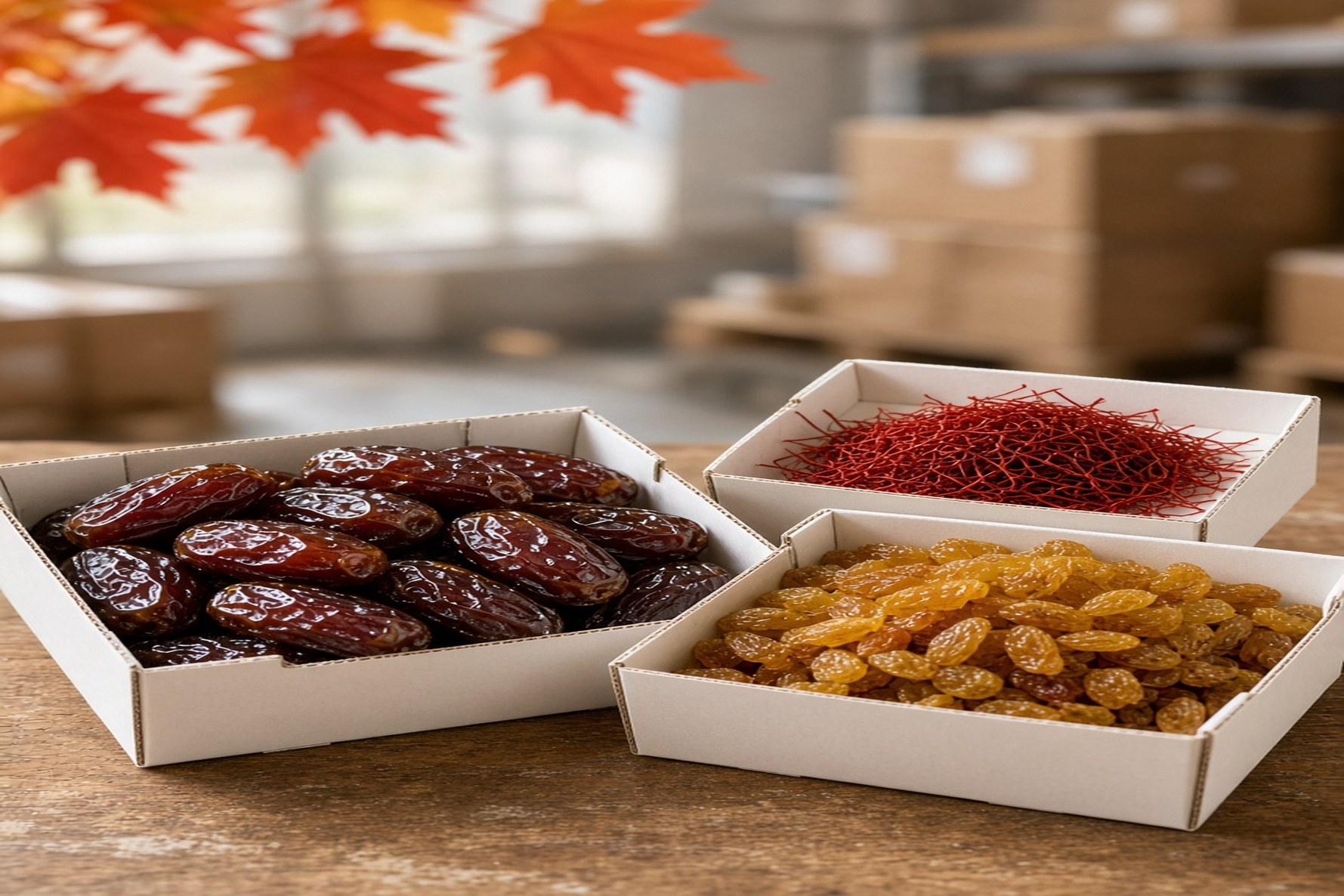
Canada imported over CAD 57.3 billion in food in 2024; Iran supplied about 2.35 million kg of dates while total raisin imports exceeded 22 million kg. A temporary CFIA ban on Iranian-origin pistachios and listed pistachio products remains — each SKU needs its own regulatory and access check.
Iran–Canada food trade is not large in bilateral volume, yet import data show real buyers for dates, raisins, saffron and selected plant-based processed lines. Total Canadian imports from Iran were about CAD 53.6 million in 2025, with fruit and dried fruit a major share.
Canada is not only Iranian grocery stores: specialty importers, ethnic wholesalers, bakery and confectionery users, nut repackers, retail chains and foodservice are key channels for dates, raisins, spices, saffron and fruit preparations.
Distance, freight, CFIA, Canada–Iran sanctions and banking/shipping sensitivity mean a product that ships easily to the Gulf may fail in Canada. Long shelf life, value per kilo, lab control and export-grade packaging perform better.
Canadian buyers ask more than “what is cheaper in Iran?”: tariff classification, SFC-licensed importer, microbiological and chemical risks, bilingual labels, origin proof and payable, compliant finance must be clear before PO.
1. How is the Canadian market structured for Iranian food?
Canada is a major food importer; fruit, processed goods, dried fruit, spices and industrial inputs are heavily sourced abroad.
Four layers matter for Iran: Iranian/MENA ethnic retail (familiar products, limited size), broader ethnic demand (dates and raisins beyond Iranians), food industry ingredient sales, and retail chains (stable supply, barcodes, full labels, track record).
Retail chains
Direct entry is hard; many foreign suppliers start with a licensed Canadian importer/distributor.
2. Which Iranian foods have more capacity in Canada?
Separate production capability, Canadian demand and legal/logistical access. Pistachios fail the third test today.
| Product | Canadian market demand | Potential Iran edge | Entry complexity | Commercial view |
|---|---|---|---|---|
| Dates | High and established | Product variety and supply capacity | Medium | High |
| Raisins | Large import market | Established export production | Medium | High |
| Saffron | Smaller market, high unit value | Heritage and production capacity | Medium | High in premium segment |
| Pickled & processed vegetables | Notable import market | Iranian product diversity | Medium | Medium to high |
| Jam, purée & fruit prep. | Retail and food industry | Diverse production | Medium | Medium |
| Dried herbs & spices | Ethnic and industrial | Distinct Iranian lines | Medium | Medium |
| Traditional sweets | Ethnic retail | Cultural differentiation | Medium to high | Selective |
| Fresh fruit & vegetables | Large market | Iran production diversity | High | Product-dependent |
| Pistachio & derivatives | Historically strong demand | Traditional Iran advantage | Very high | Not importable from Iran now |
Dates, raisins and saffron score highest; pickles, jam and dried herbs medium-high; fresh is SKU-specific; pistachios are blocked from Iran despite demand.
3. Dates — a practical export option
In 2024 Canada imported about 2.35 million kg of dates directly from Iran — a real chain, not a pilot.
RFQs need variety, pit, size, moisture, defects, pack type, net weight, storage and tests — soft dates may need controlled temperature.
| Parameter | What to specify | Why it matters |
|---|---|---|
| Date variety | Commercial name or exact type | Appearance, texture, price |
| Pit | With or without pit | Use and sales channel |
| Size | Weight band or count per unit | Lot uniformity |
| Moisture | Contract limit | Shelf life and mouthfeel |
| Defects | Insect, crush, cracks, sugar | Accept/reject rules |
| Packaging | Consumer or bulk | Channel fit |
| Net weight | Retail unit or carton | Pricing |
| Storage | Ambient or chilled | Logistics chain |
| Testing | Micro, pesticides, etc. | Importer program |
Competitors include Turkey, Jordan, UAE, Pakistan and Egypt; consistency, packaging and service matter alongside price.
4. Raisins — beyond the Iranian community
Canada imported ~22.15 million kg of raisins in 2024; Iran shipped ~575,000 kg — large market, modest Iran share.
US, Turkey, South Africa, China and Afghanistan compete; industrial buyers compare measurable specs, not origin alone.
Key raisin specs
- Type/colour, size, moisture, stems and foreign matter
- Damaged berries, stickiness, sulfite and processing oil
- Microbiology, pesticides, net weight, inner bag, lot code
Added sulfite at ≥10 ppm must appear in EN/FR ingredients/allergen statements. Industrial buyers want representative COAs.
5. Saffron — high value per kilo
High unit value eases freight. Canada imported ~USD 2.6M saffron; Iran’s direct share is smaller than Spain — competition is packaging and distribution.
Bulk contract metrics
- Thread shape, extraneous matter, moisture, colour/aroma/taste power
- Adulteration, micro, pesticides, metals, lot code, light/moisture pack
6. Processed foods and 2026 front-of-pack
Prepared fruit/vegetable imports from Iran ~USD 2.61M in 2025. Pickled in vinegar (HS 200190) is large but crowded.
Jams/purées need formula and claim alignment. From 1 Jan 2026 Canadian front-of-pack nutrition symbols apply when sodium/sugar/saturated fat thresholds are met.
7. Iranian pistachios — demand vs access
Since 2 Dec 2025 CFIA refuses listed Iranian-origin pistachio goods (Salmonella). Outbreak investigation closed in 2026 but import restriction remains.
Lesson for other nuts
- Farm/plant origin, lot codes, agreed sampling
- Batch-linked COA, Salmonella control program, traceability records
8. SFCR — SFC licence, PCP, traceability
Importers are responsible for lawful, safe entry. Most need an SFC licence and a Preventive Control Plan.
Expect requests for plant hygiene, supplier control, pest/allergen programs, water, sanitation, temperature, testing, traceability, recall and batch records — often kept two years.
9. EN/FR labelling
Gulf/MENA labels rarely work unchanged. Core mandatory text is English and French; Nutrition Facts must be Canadian format.
Ingredient order by weight; priority allergens and sulfites; imported-by and origin; lot codes.
| Label topic | Typical requirement |
|---|---|
| Common name | Mandatory |
| Net quantity | Mandatory |
| English & French core info | Usually mandatory |
| Canadian Nutrition Facts table | Most prepackaged foods |
| Ingredient list | Multi-ingredient foods |
| Priority allergens | When present |
| Lot code | Traceability |
| Responsible party | Required |
| Imported status / origin | Product-specific |
| Front-of-pack symbol | 2026 rules when triggered |
10. Pre-shipment QC
Define hazards before the contract and embed acceptance limits in the PO — not after production.
Dried fruit & raisins
- Salmonella, mould, moisture, aflatoxin (15 ppb edible nuts where applicable)
- Pesticides, metals, foreign matter, sulfites, net weight
Processed
- pH, Brix, salt, aw, seal integrity, thermal process, batch-linked COA
11. Packaging and shipping
Long haul needs moisture/O₂/odor/impact protection. Soft dates may need cold chain.
Glass jars add weight and breakage risk — reinforce cartons. Model retail pack in Iran vs repack in Canada economically.
| Model | Advantage | Limitation |
|---|---|---|
| Retail pack in Iran | Lower conversion cost | Label error risk |
| Bulk + pack in Canada | Brand flexibility | Higher local ops cost |
| Importer private label | Attractive to distributors | Tight spec control |
| Industrial bulk | Simple and economic | Not retail-ready |
12. Logistics, sanctions, landed cost
Food is not ‘sanction-free’ in practice — listed persons and financial channels matter. Screen seller, banks, carriers and importer.
Delivered cost includes
- Product, pack, inland and ocean/air freight, insurance, customs, duty
- Testing, storage, distribution, shrink, finance
13. HS codes
Classify on exact nature; processing or mixing can change HS.
| Product | Base HS code |
|---|---|
| Fresh or dried dates | 080410 |
| Raisins | 080620 |
| Saffron | 091020 |
| Pistachios in shell | 080251 |
| Shelled pistachios | 080252 |
| Vegetables/fruit in vinegar | 200190 |
14. Fresh produce
~CAD 13.8B fresh imports in 2024 but highest complexity: phytosanitary rules, approved origins, permits and cold-chain economics.
Check AIRS for the exact product and origin before marketing ‘exportable’ fresh SKUs.
15. Competition
Iran faces rivals in every group; product differentiation plus reliable supply wins.
| Competitor | Overlap with Iran | Typical edge |
|---|---|---|
| Turkey | Raisins, dates, processed | Western market access |
| United States | Raisins, tree nuts | Short haul to Canada |
| India | Pickles, spices | Large diaspora supply chains |
| Pakistan | Dates, ethnic lines | South Asian retail |
| Spain | Saffron | Established branding/re-export |
| North Africa | Dates | Francophone & MENA retail |
16. Pricing
‘Export price to Canada’ without specs is meaningless — grade, pack, volume, pallet, tests, temperature, Incoterms, PL, bilingual print, duty and finance all apply.
Compare offers to the same delivery point (e.g. Canadian warehouse) — EXW Iran vs delivered competitor is misleading.
Importer checklist before placing an order
Before contracting Iranian food, at minimum confirm:
- Product and detailed technical specs are defined.
- HS code matches actual composition and processing.
- Legal import of that SKU from Iran is confirmed.
- Importer status and SFC licence are verified.
- Seller and financial parties screened for Canadian sanctions.
- Commercial sample received and approved.
- Sample represents routine production, not hand-picked lots.
- Acceptance criteria written numerically and descriptively.
- Pre-shipment tests agreed before production run.
- Lab and sampling method agreed.
- English and French labels reviewed before print.
- Nutrition Facts table uses the Canadian format.
- Allergen and sulfite rules checked.
- Front-of-pack nutrition symbol (2026) assessed if triggered.
- Lot code and supplier traceability evaluated.
- Net weight and tolerance defined.
- Units per carton and cartons per pallet defined.
- Shipping temperature regime set.
- Route and transit points reviewed.
- Incoterms and risk transfer point in contract.
- Responsibility for destination re-testing assigned.
- Non-conforming shipment remedy defined.
- Remaining shelf life on arrival to Canada set.
- Customs documents checked before shipment.
- Payment only via workable, compliant financial structure.
What to send for an accurate quote
A generic “price for Canada” RFQ is not enough. A professional request should include:
- Exact product name and processing form
- Quality specs and commercial grade
- Order quantity; bulk vs consumer pack
- Net weight, units per carton, private label and label language
- Required tests and target shelf life
- Destination city/port, mode, Incoterms and delivery window
- Pre-order sample requirement
Example: “20 t raisins, 10 kg bags” beats “export raisin price” — also fix colour, moisture, sulfite status and inner bag type. Submit the same detail in an Iranco sourcing request.
Supply path for Iranian food into Canada
Two offers differ by more than FOB/kg: repeat supply, spec compliance, COA, packaging, remaining life, payment route and documentation drive outcome.
Importers should fix buying specs first, then compare suppliers. A great sample without container-scale repeatability has little commercial value.
Iranco accepts structured B2B food sourcing requests — state product, specs, quantity, packaging and Canadian destination for matched supplier review.
Conclusion
Exports make sense when real demand, legal access, Iran’s edge and logistics economics align. Dates and raisins are clear opportunities; saffron suits premium low-weight lanes; pickles, jams and fruit prep can grow with proper product and label design.
Pistachios show production capacity alone is insufficient: CFIA’s temporary ban since December 2025 on listed Iranian-origin pistachio goods remains in force.
Quality work starts at supplier selection. EN/FR labels, Canadian Nutrition Facts, allergens, 2026 front-of-pack symbols, lot codes, importer PCP and pesticide MRLs are part of selling — not post-production paperwork. The real benchmark is landed, sellable cost in Canada.
FAQ
Is food export from Iran to Canada possible?
Yes — dates, raisins, saffron and some processed lines have import history. Each product needs CFIA, tariff, safety and sanctions review.
Which Iranian product fits Canada best?
Dates, raisins and saffron lead; go-to-market differs. Processed goods suit ethnic and private-label channels.
Can Iranian pistachios enter Canada in 2026?
Not under the current CFIA temporary ban on listed Iranian-origin pistachio products.
Is Persian-only packaging enough?
No — mandatory information is usually English and French with Canadian Nutrition Facts format.
Must the Iranian factory hold an SFC licence?
Usually the Canadian licensed importer holds it; the foreign supplier provides compliance evidence and systems.
What matters most for raisin exports?
Moisture, uniformity, sulfites, micro, pesticides, pack and traceability — acceptance criteria in the PO before production.
How should prices be compared?
On delivered cost to Canada, not EXW Iran; freight, duty, testing and distribution shift economics.
Are all foods banned by sanctions?
No — but listed persons and some financial services are restricted; screen all parties and payment paths.
How do I submit a Canada sourcing request?
Define product, specs, quantity, pack, tests, destination and Incoterms — contact Iranco via the site contact form.
Featured Products








Related Articles



