 Iranco Magazine Team
Kuwait market analysis for Iranian food — from saffron and fresh fruit to Arabic labelling, export packaging, entry documents, QC and sea freight
Export Guide · Kuwait · Saffron · Fresh Fruit · Packaging
Iran Food Export to Kuwait: High-Demand Products, Packaging and Entry Requirements
Kuwait market analysis for Iranian food — from saffron and fresh fruit to Arabic labelling, export packaging, entry documents, quality control and sea freight
Kuwait is import-driven with fierce competition among regional and global suppliers. Iranian products must compete on quality, packaging, documentation and supply stability — not geography alone.
Analytical introduction
Food exports to Kuwait look simple at first: short distance and shared Gulf access. Sustainable trade is not built on cheap cargo or a single bulk buyer. Kuwaiti importers evaluate quality, shipment consistency, pack appearance, Arabic labels, health certificates, transport conditions, shelf life and smooth clearance together.
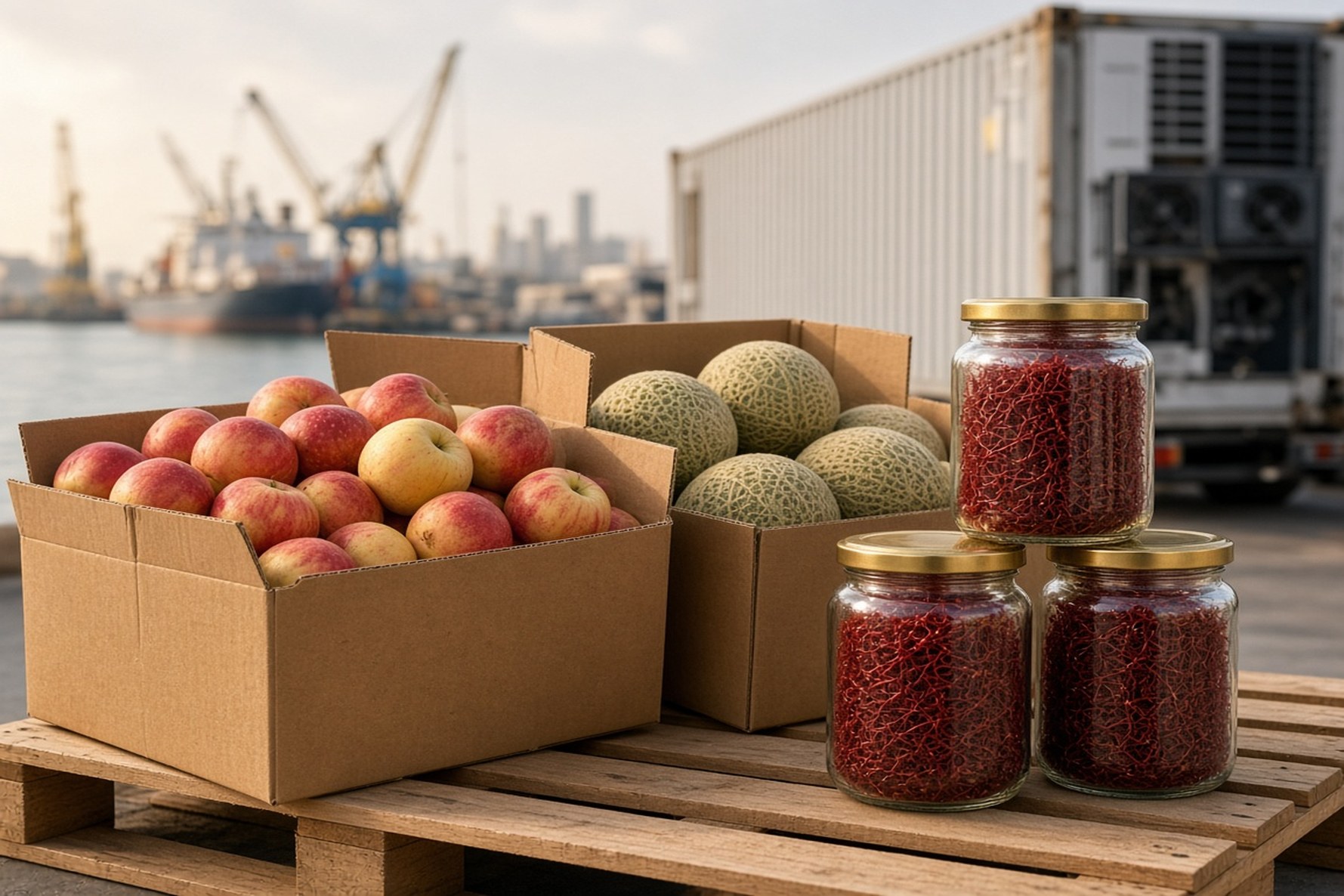
2024 trade data show uneven Iranian positions: dominant in saffron; registered trade in apples, melons, citrus and dates but heavy competition from South Africa, Egypt, Jordan, Oman, Turkey, China and Europe. Saffron needs small packs and authenticity control; apples and citrus need cold chain and strong cartons; melons depend on harvest timing and logistics; processed foods need compliant labels and formulations.
1. Kuwait food market structure and Iran’s role
Kuwait covers much of its food needs through imports; proximity alone is insufficient. Main channels:
- Modern retail: shelf-ready packs, Arabic labels, adequate shelf life, barcodes and repeat-order consistency.
- Fruit & vegetable wholesalers: size, colour, ripeness, firmness, appearance and post-transit durability.
- HORECA: predictable quality, true net weight and landed cost.
- Food industry & repacking: bulk saffron, nuts, dates and semi-processed inputs.
Iran’s presence is product-specific; saffron track record does not automatically transfer to apples or citrus.
2. Iranian foods with visible demand in Kuwait
| Group | Imports from Iran 2024 | Value | Note |
|---|---|---|---|
| Saffron | 2,736 kg | $3.88M | Strongest Iranian position |
| Fresh apples | 647,920 kg | $825K | Large but competitive |
| Melons & watermelons | 604,754 kg | $677K | Seasonal, logistics-driven |
| Citrus | 188,797 kg | $227K | vs South Africa & Egypt |
| Dates | 39,735 kg | $112K | Smaller Iran share |
| Fresh grapes | 13,862 kg | $40K | Limited presence |
Saffron
Iran supplied roughly 65% of Kuwait’s saffron import value in 2024. Buyers must define thread form, grade, lab results, net weight, packaging and private-label needs — “export grade one” alone is not enough.
Apples and fresh fruit
Kuwait imported nearly 25 million kg of apples; Iran’s share was about 648,000 kg. Uniform sorting, export cartons and temperature management matter. For melons, freight cost relative to product value is critical.
3. What Kuwaiti importers expect from Iranian suppliers
Professional buyers define measurable specs before pricing. Samples must represent the shipment and become contractual metrics.
| Group | Key specs |
|---|---|
| Saffron | Thread form, purity, breakage, COA, pack weight |
| Apples / citrus | Variety, size, colour, firmness, skin, carton weight |
| Dates / nuts | Type, moisture, texture, defects, aflatoxin where relevant |
| Processed | Formulation, net weight, additives, shelf life |
4. Packaging for the Kuwait market
Climate, sea transit, port handling and inland distribution make packaging part of product quality. Fruit needs crush-resistant cartons, ventilation, uniform weight and lot codes. Saffron needs moisture barriers, tamper evidence and light protection. Dates and nuts need moisture and oxygen barriers.
5. Arabic labelling
Labels must be designed before shipment. Mandatory Arabic information includes product name, ingredients in order of proportion, metric net weight, production and expiry dates, batch, manufacturer, country of origin and storage conditions. Multilingual labels are allowed but do not replace Arabic. Data must match invoice, certificate of origin, packing list and health certificate. Animal-derived ingredients need halal documentation defined before printing.
6. Entry conditions and core documents
Key framework: Ministerial Decision No. 6 of 2023 on imported food regulations (effective September 2023). Core documents include customs declaration, certificate of origin, delivery permit, trade/import licence, health certificate, packing list, halal certificate where applicable, temperature records and phytosanitary papers.
7. Product registration, COA and HS codes
Special foods may require Kuwait registration. COA must cover parameters the buyer actually needs. HS codes must reflect true product form — e.g. saffron 091020, apples 080810, melons 080710, dates 080410, citrus 0805. Many food lines show 5% duty in Kuwait’s tariff but rates vary; verify the exact code. Landed cost includes origin price, packaging, freight, insurance, duty, clearance, cold storage, demurrage and shrinkage.
8. Shipping from Iran to Kuwait
Sea freight is natural; Shuwaikh handled over 613,000 TEU in 2024. Dry stable goods in standard containers; fresh produce in reefers; high-value low-volume saffron may justify air freight. Temperature loggers help resolve cold-chain disputes.
9. Competitors and pricing
Low price alone does not secure repeat sales. Compare offers only when grade, size, season, volume, packaging, transport mode and Incoterms match.
10. Importer checklist (summary)
- Exact product description and HS code
- Measurable grade, representative sample and written acceptance criteria
- Arabic label approval before mass print
- Export-grade packaging for Gulf climate and sea transit
- Health, halal and quarantine documents before loading
- Batch and date alignment across packs and papers
- Written temperature regime and data loggers if needed
- Landed cost including duty, port, clearance and cold storage
- Incoterms and enough lead time for first orders
For comparable quotes, send product name, grade, volume, pack weight, packaging type, label language, tests, destination port and delivery terms. Iranco purchase requests can capture the same baseline for supplier comparison.
Conclusion
Repeatable Kuwait trade needs data-led product choice and spec-based selling. Saffron leads; fresh lines depend on sorting, cold chain and cartons; processed lines depend on labels as much as taste. Fixing documents before dispatch is cheaper than corrections after arrival.
FAQ
Which Iranian food has the strongest position in Kuwait?
Saffron in 2024 — Iran supplied about $3.88M of $5.95M imports. Define purity, COA, weight and packaging.
Is there room for Iranian fresh fruit?
Yes, but competition is intense; apples, melons and citrus need sorting, cartons, shelf life and aligned logistics.
Is Arabic labelling required?
Mandatory information must be in Arabic; approve artwork before bulk printing.
How important is the health certificate?
Core shipment document; certificate dating vs production must follow Kuwait practice.
Sea or air for fresh fruit?
Commercial volumes usually use reefer sea freight; temperature control matters more than mode alone.
How is export price set?
Depends on grade, season, volume, pack, freight and Incoterms — not kg price without matching specs.
Is all food taxed at 5%?
No — check the exact HS line.
How to source from Iran for Kuwait?
Define specs, volume, packaging and port; then sample and documents; use Iranco purchase requests to compare suppliers.
Request Iranian food supply for the Kuwait market
Include technical specs, volume, packaging, Arabic labels and destination port so quotes are comparable from the start.
Contact Irancoinfo@iranco.com · WhatsApp: +98 913 104 4182 · Telegram: @irancofood
Featured Products








Related Articles



