 Iranco Magazine Team
From dates, raisins, pistachios and saffron to JAKIM requirements, food safety, labelling, packaging and entry into Malaysia's import network
Export Guide · Malaysia · Halal · JAKIM · FoSIM · Port Klang
Iran Food Exports to Malaysia: Halal Standards and Market Opportunities
From dates, raisins, pistachios and saffron to JAKIM requirements, food safety, labelling, packaging and entry into Malaysia's import network
Malaysia is not merely a “Muslim market”; it is import-driven with layered oversight where quality, food safety, traceability and halal certificate credibility directly affect market access. This guide explains which Iranian food groups already have defensible trade presence and how export orders should be designed from product specs through clearance.
Four key indicators and commercial message
Official data shows Malaysia's food import value reached RM 93.8 billion in 2024, up 19.1% year on year. The 2020 census recorded 20.6 million Muslims — 63.5% of the population.
| Indicator | Value | Message for exporters |
|---|---|---|
| Food import value 2024 | RM 93.8 billion | Large, growing import market |
| Food import growth | 19.1% vs 2023 | Structural demand |
| Muslim population | 63.5% (20.6M, 2020) | Halal is commercial and legal |
| Imported IFSS | From 1 Mar 2027 | Recognised plant food-safety programme |
Analytical introduction
Iranian food exports to Malaysia work when you move beyond “Muslim country, so Iranian food fits.” Malaysia relies on imports across many food groups, has mature retail and processing, and runs one of the world's most structured halal systems.
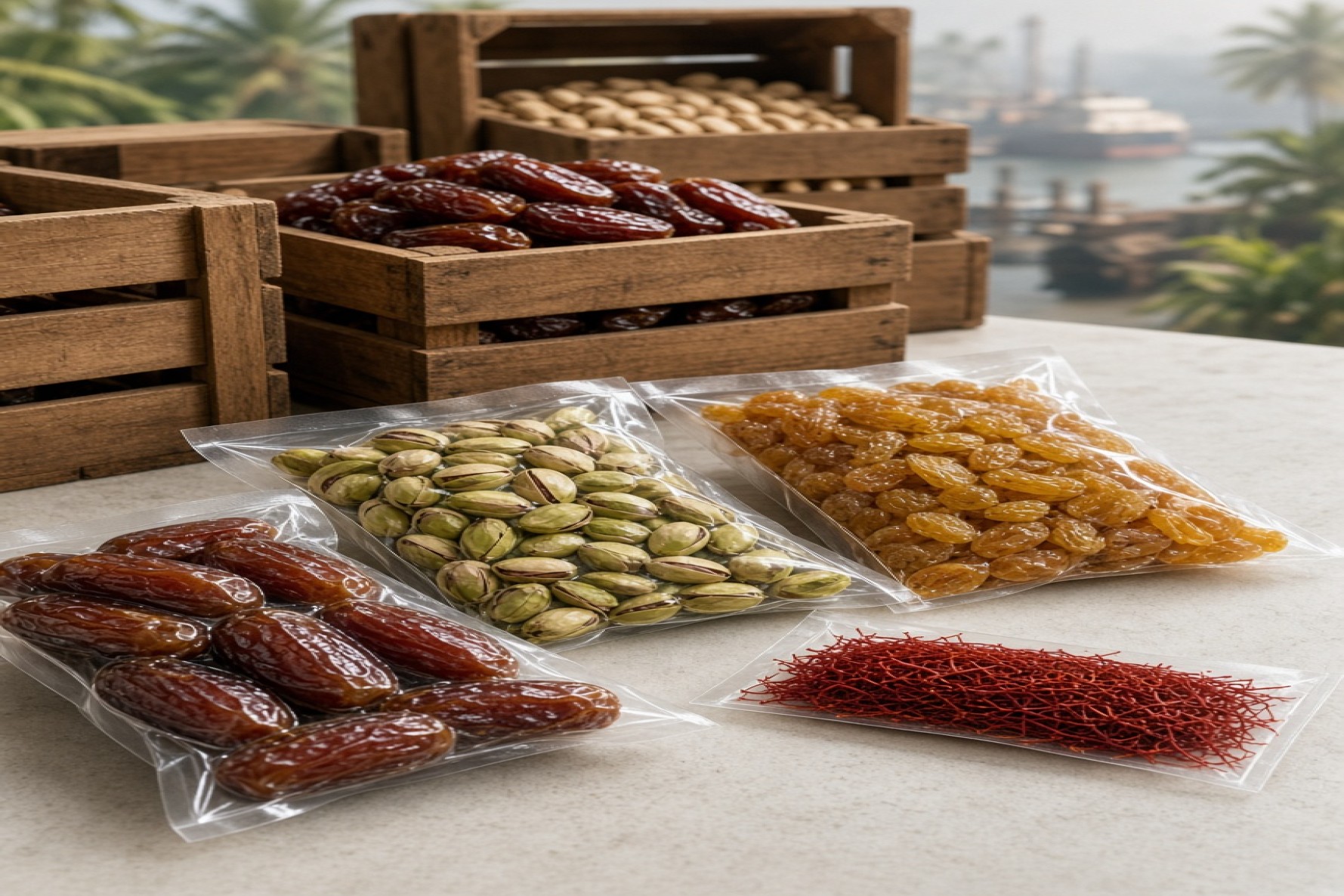
Opportunities differ. 2024 trade data shows Iranian dates, raisins, pistachios and saffron already enter Malaysia. Dates are a leading supply origin; raisins and saffron have direct imports; pistachios face strong US and Turkish competition but Iran remains visible.
Meat and animal products add plant approval, halal bodies and veterinary paths. For first-time exporters, dates, dried nuts, saffron and selected plant-based processed foods are usually simpler entry points.
1. Why does the Malaysia market matter for Iranian food?
Malaysia's food economy blends domestic production, strong processing and wide imports of inputs and finished goods. Import dependence is not limited to luxury niches — total food import value rose sharply in 2024.
For Iranian exporters this implies three points: the market is not only supermarket shelf; demand includes bakery, confectionery, beverages, HORECA and repacking. Raisins, pistachio kernels, saffron and pitted dates fit industrial channels.
Asia, the Middle East, Europe, North America and North Africa compete simultaneously. Iranian dates meet Tunisia and Saudi Arabia; pistachios meet the US and Turkey; raisins meet the US, India, China and Chile.
Halal is not mere marketing. When product is sold as halal, the certifying body and logo use carry legal weight — the difference between importable goods and goods that cannot credibly claim halal.
Who are the main buyers?
- Importers and distributors of packaged food
- Dried fruit and Ramadan / festive assortments importers
- Repackers and private-label brands
- Confectionery, bakery and dessert manufacturers
- Food service, hotels and restaurants
- Halal retail chains and specialty stores
- Food-industry ingredient distributors
2. Which Iranian foods have the most realistic opportunity in Malaysia?
2024 import data outlines four priority groups. Dates show the strongest existing Iranian footprint; pistachios sit in a large but competitive market; raisins are expandable; saffron is small but value-led.
Dates — clearest existing opportunity
Malaysia imported about 20.7M kg of dates worth USD 56.8M in 2024. Tunisia and Saudi Arabia lead; Iran exceeded 3M kg. Demand is proven — the task is matching variety to channel: Mazafati, Piarom, Zahidi, pitted industrial grades each need distinct specs on moisture, size, defects and pack.
Raisins — retail and industry
About 5.55M kg (~USD 14.9M) entered in 2024; Iran ~347k kg (~USD 786k). Industrial buyers focus on uniformity, stem count, foreign matter, moisture and residue panels more than premium appearance.
Pistachios — large market, tighter QC
Aggregate pistachio imports near USD 39.9M; Iran ~USD 1.74M. Buyers ask about in-shell vs kernel, split rate, stains, moisture and aflatoxin. Malaysia sets 15 µg/kg for processing grade and 10 µg/kg for ready-to-eat pistachios.
Saffron — niche and value
Total saffron imports ~USD 527k; from Iran ~USD 170k. Competition is on authenticity, colouring strength, aroma, moisture and credible COA — bulk HORECA and consumer packs are different commercial models.
Conditional opportunities
Tomato paste and other processed plant foods can be reviewed, but import volume alone does not grant Iran automatic advantage — e.g. preserved tomatoes >USD 23.5M imports with limited Iranian share vs China, Italy, Chile and Turkey.
| Product | World exports to Malaysia | From Iran | Takeaway |
|---|---|---|---|
| Dates | $56.81M; 20.7M kg | $6.75M; ~3.05M kg | Strong existing presence |
| Pistachios (aggregate) | $39.88M; 6.18M kg | $1.74M; ~195k kg | Large market; tough competition |
| Raisins | $14.91M; 5.55M kg | $786k; ~347k kg | Expandable |
| Saffron | $527k | $170k | Small; value-led |
3. Malaysia halal standards — what structure does an Iranian exporter face?
View Malaysia halal in three layers: law, technical standard and certification / recognition body.
The Trade Descriptions (Definition of Halal) Order 2011 governs imported food described as halal in Malaysia — requirements must be met or product certified by a JAKIM-recognised foreign body; the certifier's name must appear on relevant imported halal goods.
MS 1500:2019 sets general halal food requirements (third edition, reaffirmed 2024). Scope covers integrity, records, premises, equipment and logistics — not only pork/alcohol exclusion.
Islamic Halal World Institute (Tehran) appears on JAKIM recognition lists including the 30 January 2026 republication — verify body name and scope against the current JAKIM list before each shipment.
Law focuses on prohibiting “halal” claims without valid certification — distinguish general food entry from halal-labelled marketing. Meat and poultry require recognised foreign halal certification and related plant approvals.
| Level | Market position | Main requirement |
|---|---|---|
| 1 — General entry | B2B without halal claim on pack | Food Act, FoSIM, labelling |
| 2 — Muslim retail | Halal chains and supermarkets | JAKIM-recognised CB cert + cert body name on pack |
| 3 — Industrial inputs | Bakery, confectionery, HORECA | Halal often a buyer contract condition |
| 4 — Meat & derivatives | Specialist channel | Plant approval + recognised CB + veterinary docs |
4. Food safety rules and the import entry process
Imported food control rests on the Food Act 1983 and Food Regulations 1985; MOH oversees safety, standards and labelling.
Commercial food importers or clearing agents register in FoSIM; border release runs through this risk-based system linked to customs.
Non-compliance can mean rejection, re-export, destruction, label correction or stricter levels for future shipments from the same exporter.
Not every food needs a standalone MOH import licence — FoSIM is the default path — but plants, animals, fish and quarantine goods may need MAQIS, veterinary or other documents.
| Level | Treatment |
|---|---|
| 1 | Automatic release without conditions |
| 2 | Specified document check |
| 3 | Risk-based monitoring; sampling possible |
| 4 | Mandatory inspection and sampling |
| 5 | Hold until test result |
| 6 | Automatic rejection |
5. Labelling — a frequent point of non-compliance
Mandatory imported-food label information is generally in Bahasa Malaysia or English; other languages may be added but core information must comply.
Product name, fair description, ingredient list, additives and special ingredient rules must match Food Regulations. Final print artwork should be approved by the Malaysian importer before mass production — relabelling thousands of packs after arrival is costly.
MOH offers formal label review services on proposed layouts with COA and product data where required.
| Topic | Recommended action |
|---|---|
| Language | Bahasa Malaysia or English for mandatory information |
| Product name | Accurate; no misleading claims |
| Ingredients | Match actual formula |
| Halal | Only with accepted certificate; CB name on pack |
| Net weight | Matches actual contents |
| Importer label | Aligned with Malaysian partner |
6. Technical specs and quality control for core Iranian products
Professional Malaysian buyers want measurable specs, not vague “export grade” wording. Tighter written criteria reduce gap between approved sample and landed shipment.
Acceptance criteria must refer to the shipment, not only the negotiation sample. For nuts, lab sampling must come from the batch actually loaded; old aflatoxin reports do not substitute for new cargo risk.
Aflatoxin is a known MOH concern for nuts, cereals and spices. Pistachio control starts at orchard drying and storage — late harvest, damaged shells, slow drying and hot stores increase risk.
Pesticide residue limits in Food Regulations should be agreed in the spec with active substance panel, sampling method and laboratory before contract.
| Product | Order parameters | Key controls |
|---|---|---|
| Dates | Type, size, moisture, pit, uniformity | Pests, mould, moisture, pesticide residues |
| Raisins | Colour, moisture, stems, foreign matter | Residues, microbiology, FM |
| Pistachios | In-shell/kernel, size, split, moisture | Aflatoxin 10/15 µg/kg, sensory |
| Saffron | Cut, colour, floral waste, moisture | Authenticity, colouring strength, purity |
7. Tariff codes and documents — classify the product correctly
HS classification follows exact product form — in-shell vs kernel pistachios is a basic example.
Malaysia extends national tariff lines beyond six digits — confirm the importer's national code before final proforma. Duty and tax depend on final code, origin, product nature and current rules.
- Commercial invoice
- Packing list
- Bill of lading
- Certificate of origin
- Certificate of analysis when required
- Health certificate where applicable
- Phytosanitary certificate for quarantine plant goods
- MAQIS permits for controlled goods
- Valid halal certificate for halal-marketed product
- Veterinary documents for animal products
| Product | HS Code |
|---|---|
| Fresh or dried dates | 080410 |
| Pistachios in shell | 080251 |
| Pistachio kernels | 080252 |
| Raisins | 080620 |
| Saffron | 091020 |
8. Packaging and logistics — take Malaysia humidity seriously
Heat, humidity, ocean transit and container dwell time mean packaging is protection, not only branding. Moisture barriers, oxygen control and strong outer cartons matter for nuts and spices.
Nuts and pistachios
Multi-layer films, vacuum or appropriate oxygen management limit oxidative quality loss depending on fat content, target shelf life and channel.
Raisins
Moisture and stickiness drive clumping and spoilage risk — declare any surface treatment to the buyer.
Dates
Soft moist dates need more temperature control than drier grades — a single temperature rule for all Iranian dates is incorrect.
Saffron
Protect from light, humidity, odour and tampering — sealed consumer packs with accurate net weight beat decorative bulk look.
Ocean route
Port Klang is the main container gateway (14.64M TEU in 2024). Iran operational routes often run Bandar Abbas to Klang — transit time must follow actual line service, not a fixed day count.
9. How Malaysian buyers evaluate Iranian product
Effective selling answers buyer questions: exact product, specs, halal/document acceptability, pack fit for channel, supply capacity and landed price structure.
Retail
Pack appearance, consumer weight, correct label, trusted halal, shelf life and brand consistency dominate. Small packs add packaging and distribution cost share.
Repack / private label
Bulk sale to a Malaysian repacker is often practical — quality control on bulk lots must be tighter because the importer's name goes on the final pack.
Food industry
Plants accept defined breakage on kernels if aflatoxin, colour and particle size fit the formula — pitted dates, paste and industrial grades differ from retail SKUs.
10. How is export pricing to Malaysia determined?
There is no single “Malaysia export price” for dates, pistachios, saffron or raisins — compare offers only with identical specs and delivery terms.
Evaluate on sellable cost in Malaysia, not factory price alone — repacking waste, cold chain and QC can invert a cheap FOB quote.
Information for an accurate quote
Send exact product name, processing form, grade, moisture and defect limits, tests, halal needs, pack weight, bulk vs consumer pack, brand, volume, Malaysian port, Incoterms and target delivery window — Iranco purchase requests use the same structure.
- Product type and grade
- Season and Iran supply situation
- Size and uniformity
- Accepted defect limits
- Required testing and halal / production controls
- Pack weight and materials
- Private label vs producer brand
- Order volume and container type
- Malaysian port and Incoterms
- Freight, insurance and payment structure
11. Importer checklist before placing an order
Run these controls before major payment for Iranian food imports to Malaysia:
- Define product precisely — type, processing form and grade.
- Confirm HS code with Malaysian importer and customs broker.
- If marketed halal, verify certifying body is JAKIM-recognised.
- Review ingredients, additives and processing aids traceability.
- Approve final label artwork before mass print.
- Obtain a sample representative of commercial production.
- Write acceptance limits for moisture, defects, size and colour.
- Set test plan — chemical, microbiological, aflatoxin, residues as needed.
- Review factory capacity, batch traceability and food safety system.
- For contracts executing from March 2027, check IFSS status at manufacturing site.
- Choose packaging suited to humid transit and cartons for container stacking.
- Base contract on true net weight excluding container tare where agreed.
- Confirm quarantine documents for plant/animal goods before shipment.
- State Incoterms clearly for cost and risk transfer.
- Pre-load inspection — cartons, pallets, batch codes, dates, seals, container condition.
- Retain witness sample from loaded batch for dispute resolution.
12. Supply path for Iranian food for the Malaysia market
International sourcing differs by more than per-kilo price — halal files, batch testing and export-ready packs can change total landed cost.
Build the purchase request before supplier search: which date type, pistachio form, raisin grade or saffron spec, pack format and Malaysia documents are required.
Iranco lets buyers register supply requests on those specs so Iranian options are screened on a comparable basis. State halal and label intent early to avoid late factory or pack changes.
Summary
Iranian food exports to Malaysia are a real opportunity, but success depends on technical and commercial compliance more than slogans about “quality Iranian product.”
Trade data shows dates, raisins, pistachios and saffron already in market — dates are the clearest base. Halal via JAKIM-recognised certification, FoSIM, labelling and from 1 March 2027 IFSS at manufacturing sites must be built into export design.
Sustainable advantage combines real demand, measurable specs, acceptable documents and halal, and a supply chain that repeats approved quality every shipment.
Frequently asked questions
Is an Iranian halal certificate enough for food exports to Malaysia?
A domestic halal certificate alone is not enough. If product is sold as halal in Malaysia, certification must come from a JAKIM-recognised body and the certifier name must appear on imported halal goods as required.
Which Iranian food is the best starting point for Malaysia?
Dates have the clearest existing trade — Malaysia imported over USD 56M of dates in 2024 and more than USD 6.7M from Iran. Raisins, pistachios and saffron also have direct imports; final choice depends on supply capacity, margin, pack and channel.
Is a Persian-only label enough for imported food in Malaysia?
No. Mandatory information must be in Bahasa Malaysia or English per Food Regulations. Persian may be supplementary, not a substitute for required languages.
Do all foods need a separate import licence to enter Malaysia?
General foods under the Food Act are typically cleared via FoSIM rather than individual MOH import licences, but plant, animal, fish and special goods may need MAQIS, veterinary or quarantine documents.
What is the key test for pistachio exports to Malaysia?
Aflatoxin is central, with 10 µg/kg (ready-to-eat) and 15 µg/kg (processing) limits for pistachios under Malaysia's aligned rules. Testing must be on the actual shipment batch.
Can product be relabelled after arrival in Malaysia?
Relabelling paths exist in defined cases for mislabelled processed imports, but correct pre-shipment label design avoids storage, delay and rework cost.
What major change affects food exporters from 2027?
From 1 March 2027 imported food must come from manufacturing sites implementing MOH's recognised food safety assurance programme (IFSS).
What information is needed to price Iranian food for Malaysia?
Product name and type, grade, technical specs, volume, pack weight and type, private label needs, halal requirements, tests, Malaysian destination and delivery terms — submit via Iranco purchase request for comparable quotes.
Featured Products












Related Articles



