 Iranco Magazine Team
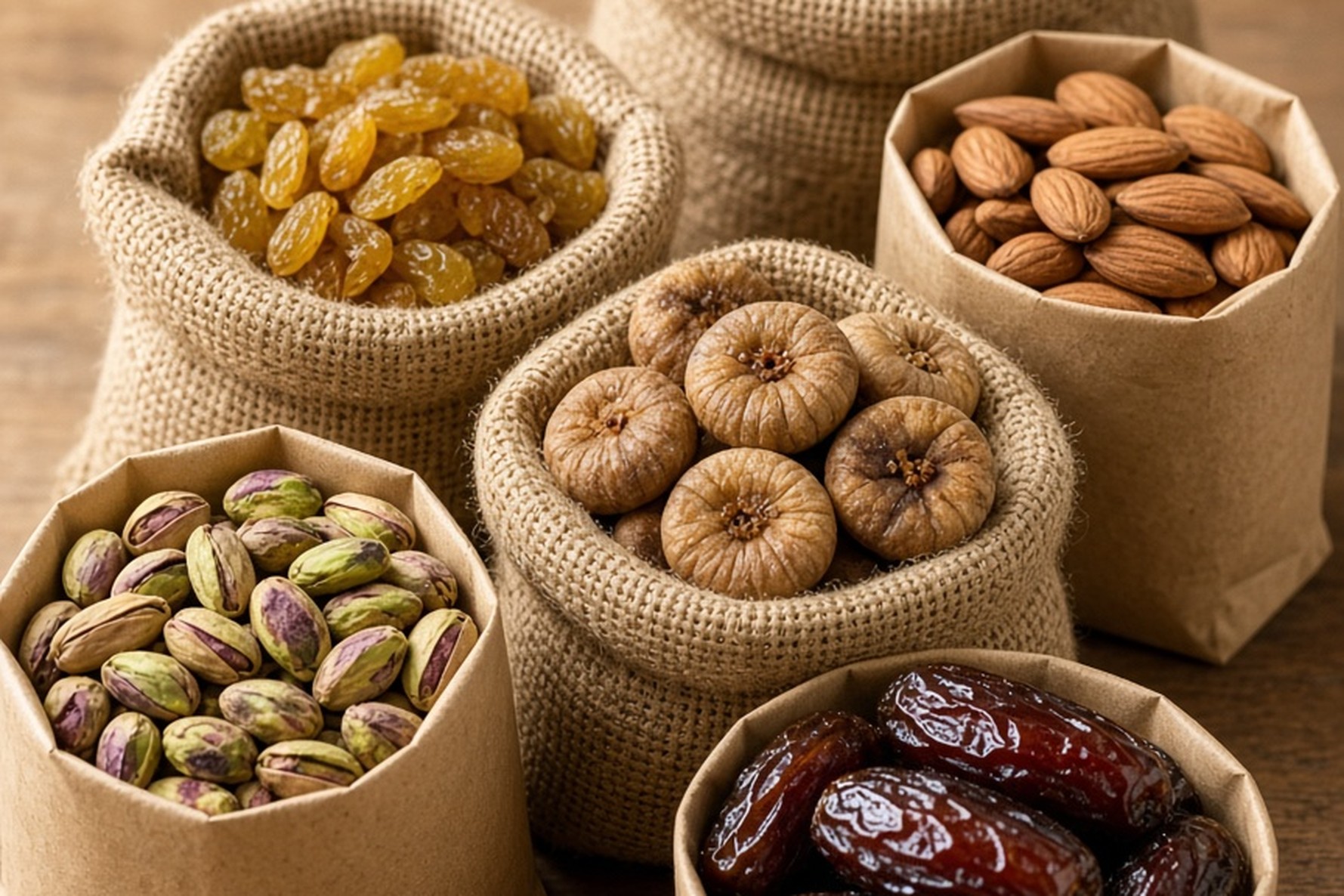
Specialist guide to Iranian pistachio, raisins, dates, dried figs, almonds, walnuts, barberries and dried fruits — from quality grades to aflatoxin control, packaging and export markets
Export Guide · Iranian Dried Fruits & Nuts · Types & Markets
What Types of Iranian Dried Fruits and Nuts Exist, How Do They Differ, and Where Are They Exported?
A specialist guide to Iranian pistachio, raisins, dates, dried figs, almonds, walnuts, barberries and dried fruits — from quality grades and differentiation to aflatoxin control, packaging and export markets.
Analytical introduction
Dried fruits and nuts are among the most diverse agricultural product groups in Iran. Within this category, products with entirely different commercial structures sit side by side — from pistachio, where price depends on size, split percentage, kernel colour and aflatoxin test results, to raisins, where drying method and sulphur dioxide level can change the target market, to dates, which are sold into very different markets depending on softness, moisture, colour, size and storage method.
For a wholesale buyer, the phrase "Iranian dried fruits and nuts" is not a purchase specification on its own. Even two shipments of the same product from the same region can differ significantly in size, colour, moisture, uniformity, breakage, foreign matter, fungal contamination, pesticide residues and shelf life. A professional contract must therefore define product specifications as measurable criteria.
In Iran's foreign trade, pistachio, raisins, dates and dried figs are the best-known items in this group. Almonds, walnuts, barberries, dried mulberries and various dried fruits are also traded at different scales. The market for each is not the same. China is an important market for Iranian pistachio and dried figs; India is a major buyer of Iranian dates; Turkey and European countries are active in pistachio and raisin trade; and for some products, Central Asia, the Middle East, East Asia and North America also matter.
Iran's real advantage in dried fruits and nuts lies in product diversity, varied production climates, long processing experience and the ability to supply from economic grades to premium products. In return, a professional buyer must review shipment uniformity, aflatoxin, pesticide residues, moisture, storage pests, nut oxidation and packaging quality before placing an order.
1. What products does Iran's dried fruits and nuts basket include?
In food trade, the term "dried fruits and nuts" can cover two main groups: edible nuts and dried seeds on one side, and dried or semi-dried fruits on the other. Iran's market structure covers both.
Pistachio is the best-known product in this basket and is produced in provinces such as Kerman, Razavi Khorasan, Yazd, Semnan and other dry and semi-arid regions. Iranian pistachio has wide diversity in shape, size and kernel characteristics, enabling supply to retail, mixed-nut, confectionery, ice cream and food industry channels.
Raisins are another traditional Iranian export item. Takestan and other parts of Qazvin province, parts of Azerbaijan, Hamadan, Zanjan and several other grape-growing regions play a role in producing grapes suitable for drying. The important difference among Iranian raisins relates not only to the original grape but also to drying method, use or non-use of drying accelerators and sulphur processing.
Dates are produced in southern and south-eastern Iran. Khuzestan, Hormozgan, Kerman, Sistan and Baluchestan, Bushehr and Fars create much of the country's date diversity. Some types suit fresh or semi-moist sale; others, with semi-dry texture, are better for long transport and industrial use.
Iranian dried figs are especially associated with Estahban and other parts of Fars province. Differences in size, colour, degree of opening, uniformity and defect level determine price and final market.
Alongside these four groups, almonds, walnuts, barberries, dried mulberries, dried apricot sheets, prunes, dried peaches, dried apples and other dried fruits also form part of Iran's commercial basket.
| Product group | Common commercial forms | Main buying criterion | Typical application |
|---|---|---|---|
| Pistachio | In-shell, kernel, green kernel, slivers | Size, split rate, kernel colour, aflatoxin | Mixed nuts, confectionery, ice cream |
| Raisins | Sun-dried, acid-treated, golden, currants | Colour, moisture, stems, sulphur dioxide | Retail, bakery, food industry |
| Dates | Soft, semi-dry, dry, pitted or with pit | Texture, moisture, size, skin, infestation | Retail and processing |
| Dried figs | Whole, open, closed, various grades | Size, colour, defects, aflatoxin | Mixed nuts, snacking, food industry |
| Almonds | In-shell and kernel | Size, bitterness, breakage, colour | Mixed nuts and confectionery |
| Walnuts | In-shell, whole kernel, halves and pieces | Kernel colour, kernel percentage, oxidation | Mixed nuts and food industry |
| Barberries | Puffy and pomegranate-seed type | Colour, moisture, foreign matter | Retail and cooking |
| Dried fruits | Rings, slices, halves, cubes | Moisture, colour, additives, texture | Snacking and food industry |
2. How do the main types of Iranian dried fruits and nuts differ?
Differences in dried fruits and nuts are not limited to product name. Four main factors separate commercial groups: raw material, processing method, physical grading and hygiene specifications.
For example, a large pistachio is not necessarily the best choice for an ice cream factory. The factory may need a kernel with strong green colour, high purity and a defined size. In contrast, a luxury mixed-nut importer may prefer large pistachio with light shell and uniform split.
In raisins, the golden product market is not the same as the sun-dried market. Golden product may undergo sulphur processing to preserve colour, while some buyers prefer natural product without sulphur treatment.
Soft dates also differ logistically from semi-dry dates. Mazafati is usually more sensitive than semi-dry types, and temperature control in the distribution chain becomes more important. Semi-dry types can offer simpler logistics for long routes and bulk orders.
| Criterion | Effect on product | Commercial importance |
|---|---|---|
| Size | Appearance, count per unit weight and processing yield | Defines grade and price |
| Moisture | Softness, shelf life and mould risk | Defines storage conditions |
| Colour | Visual appeal and industrial use | Very important in nuts and raisins |
| Breakage | Retail and industrial value | Defines final application |
| Drying method | Colour, aroma, texture and processing residues | Defines target market |
| Foreign matter | Safety and cleanliness | Shipment acceptance criterion |
| Aflatoxin | Food safety | Critical in pistachio and some dried products |
| Pesticide residues | Market access | Critical for export |
| Uniformity | Appearance and factory performance | Defines real shipment quality |
3. Iranian pistachio types and their different applications
Iranian pistachio is divided by appearance into elongated, round and large groups, with well-known commercial names such as Akbari, Ahmad Aghaei, Kalleh Ghouchi, Fandoghi and Badami in the market.
Akbari pistachio
Akbari usually has an elongated appearance and finds a strong position in large grades for retail packaging and premium markets. Product appearance matters greatly in this group; shell colour, split percentage, size uniformity and absence of closed or damaged kernels should be specified in the contract.
Ahmad Aghaei pistachio
Ahmad Aghaei also has an elongated structure and is well known in many export markets. Light shell and uniform appearance can matter in retail sale. Selection should not rely on name alone — actual size, split percentage and kernel quality must be checked.
Kalleh Ghouchi pistachio
Kalleh Ghouchi has a relatively round appearance and a bulkier look in large grades. This makes it suitable for some premium mixed-nut packaging. However, size and kernel count per unit weight must be defined in the order.
Fandoghi pistachio
Fandoghi is usually rounder and smaller and, because more kernels can be supplied per unit weight, plays an important role in volume trade. This type has wide use in mixed nuts, roasting and bulk export.
Badami pistachio
Badami has an elongated form and, depending on production region and grade, can serve different markets. Size uniformity and post-harvest processing conditions matter greatly in its evaluation.
Under the UNECE commercial standard for in-shell pistachio, sizing can be based on count per ounce, count per 100 grams or screening by diameter. The same standard sets a maximum moisture of 6.5% for in-shell pistachio. Phrases such as "large pistachio" without a defined measurement method are therefore insufficient for an international contract.
| Type | Typical shape | Suitable market | Key order criterion |
|---|---|---|---|
| Akbari | Elongated, premium large grades | Premium packaging | Size and uniformity |
| Ahmad Aghaei | Elongated | Retail and mixed nuts | Shell appearance and split rate |
| Kalleh Ghouchi | Round and bulky | Premium mixed nuts | Size and defect percentage |
| Fandoghi | Round and smaller | Volume trade and roasting | Count per unit weight |
| Badami | Elongated | Bulk and regional markets | Size and uniformity |
For ice cream, chocolate or confectionery production, pistachio type name matters less than kernel colour, degree of shelling, broken-piece percentage and purity. A factory needing green kernel must specify expected colour and grading method separately.
4. Iranian raisins, dates and dried figs — three products with different commercial behaviour
Iranian raisins, dates and dried figs are three products with distinctly different commercial behaviour. Each has its own quality criteria, processing requirements and destination markets.
Sun-dried raisins
Sun-dried raisins are produced by natural grape drying and usually have brown to darker colour. This group matters for buyers wanting simpler processing. Natural colour, absence of excessive stickiness, uniformity and stem and foreign-matter levels should be checked.
Acid-treated raisins
In acid-treated processing, common drying aids are used to speed moisture removal. This product usually has different colour and texture from sun-dried raisins. An industrial buyer should obtain processing type and materials used from the supplier.
Golden raisins
Golden raisins are produced to create or preserve light colour, and sulphur dioxide control is important. Codex CXS 67-1981 for bleached raisins sets a maximum of 1500 mg/kg sulphur dioxide immediately after processing. Destination market law and buyer specifications can be different or stricter.
The same Codex standard sets a maximum moisture of 18% for most raisin forms, with separate exceptions for some types. Declaring actual shipment moisture in the certificate of analysis is therefore more reliable than relying on the commercial product name alone.
Currants
Currants are made from larger grapes and can be supplied with or without seeds. Size, colour, softness, seed presence and stickiness are main price factors. The currant market is mainly linked to retail, mixed nuts and some food uses.
Mazafati dates
Mazafati is a soft, dark-coloured product and is more sensitive to storage conditions than semi-dry dates. The buyer should define softness level, percentage of separated skin, size uniformity, fermentation status and required temperature conditions before transport.
Piarom dates
Piarom belongs to the semi-dry date group and has an elongated shape and dark colour. These features have made it used in parts of the premium retail market. Uniformity, size and skin condition are important buying criteria.
Sayer (Estamaran) dates
Sayer, or Estamaran, belongs to the semi-dry date group and can be used in bulk trade and food industries. Greater texture firmness compared with soft dates can make transport simpler.
Zahedi dates
Zahedi is known for lighter colour and relatively drier texture. Besides direct consumption, it can be used in some processing applications such as date paste or confectionery raw material.
Kabkab and Rabbi dates
Kabkab has softer texture and brown colour; Rabbi usually has a more elongated and darker appearance. As with other dates, product name alone is not enough for purchase — size, moisture, ripeness stage and defect percentage must be defined independently.
Iranian dried figs
The dried fig market is mainly classified by size, colour, degree of opening, shape, uniformity and defects. In Iran, grade names such as 101AA, 101A and 101B appear in trade, but the precise definition of each grade should be written into the sales contract because commercial specifications can differ between sellers.
Larger, lighter and more uniform figs are usually suitable for premium retail. Smaller figs or product pieces can be used in food industries, paste production, bakery products or secondary processing.
5. Iranian almonds, walnuts, barberries and dried fruits
Although Iran's dried fruits and nuts export focus is mainly on a few core products, other opportunities exist for specialist importers.
Almonds
Almonds are supplied as in-shell and kernel. In almond kernel purchase, size, skin colour, breakage percentage, bitter kernel presence, insect damage and rancid flavour matter. For confectionery, appearance size sometimes matters less than flavour uniformity and processing yield.
Walnuts
Walnuts are supplied in-shell or as whole kernel, halves and pieces. One of the most important walnut kernel market indicators is colour. Lighter kernel usually has higher retail value, while sound pieces with darker colour can suit food industries.
Walnuts and other high-fat nuts are sensitive to oxidation. Rancid odour or sharp taste is an important sign of quality loss. Packaging with an appropriate oxygen barrier and cool storage therefore matter for long-term shipments.
Puffy barberries
Puffy barberries are produced by slower drying of product on the branch or cluster and usually have a puffier appearance and lighter colour. This product is more suitable for premium and retail markets.
Pomegranate-seed barberries
Pomegranate-seed barberries undergo faster drying and are usually a more economical product. Colour, moisture, stems and leaves, stones and other foreign matter should be controlled.
Mulberries and dried fruits
Dried mulberries, apricots, prunes, apples, peaches and other dried fruits can be supplied whole, halved, sliced or in pieces. In this group it must be defined whether the product is natural or sweetened, whether it contains preservatives and whether sulphite compounds were used to preserve colour.
In industrial dried fruit, slice thickness and moisture matter greatly. Thickness variation can make some pieces soft and others very dry, reducing pack uniformity and causing problems on the buyer's production line.
6. Technical specifications and export quality control for dried fruits and nuts
A professional dried fruits and nuts shipment should be purchased through measurable specifications. Phrases such as "grade one", "export quality" and "super" without a specification table are not reliable technical criteria.
| Parameter | Application | Importance for buyer |
|---|---|---|
| Moisture | Most dried fruits and nuts | Shelf life and mould control |
| Water activity | Sensitive products | Microbiological stability prediction |
| Size | Pistachio, almond, date, fig | Grade and uniformity |
| Breakage percentage | Kernels | Defines retail value |
| Colour | Pistachio, walnut, raisin, barberry | Appearance and industrial use |
| Aflatoxin | Pistachio, fig and some nuts | Safety and market acceptance |
| Pesticide residues | Agricultural products | Destination market compliance |
| Sulphur dioxide | Golden raisins and some dried fruits | Legal compliance and labelling |
| Foreign matter | All products | Cleanliness and safety |
| Live pests | All dried fruits and nuts | Shipment acceptance |
| Mould and yeast count | Dried fruits | Processing control |
| Salmonella | Especially kernels | Food safety |
Aflatoxin — the most important issue in pistachio export
Aflatoxin is produced by certain moulds and its control is especially important in pistachio. Sampling for this contaminant must be done correctly because contamination is usually not evenly distributed in a shipment, and testing a small amount without an appropriate sampling plan can give misleading results.
Under EU regulations, for pistachio and almonds placed directly on the market for final consumption or use as a food ingredient, maximum aflatoxin B1 is 8 µg/kg and total aflatoxins 10 µg/kg. For product to be sorted or physically processed before consumer sale, the limits for B1 and total are 12 and 15 µg/kg respectively.
For dried figs, EU regulations set a limit of 6 µg/kg for aflatoxin B1 and 10 µg/kg for total aflatoxins.
These figures show that a seller intending to export to Europe cannot rely on product appearance alone. Orchard management, harvest, rapid hull removal, proper drying, removal of suspect kernels, dry storage and laboratory sampling are all part of the control chain.
Pesticide residues
Maximum permitted pesticide residues are not the same across markets. A product acceptable in one country may be rejected in another because of a specific active substance or a lower limit. Testing should therefore be designed around the destination market's substance list, not merely a fixed general panel.
Sulphite
In golden raisins and some light dried fruits, sulphur dioxide presence must align with destination country law, labelling and contract specifications. The buyer should know processing type as well as test results.
Oxidation
In pistachio, almond and walnut, product fat oxidises gradually in contact with oxygen, heat and light. Off-odour, rancid taste and quality loss are the consequences. Appropriate packaging and warehouse temperature control therefore gain greater importance in long-term orders.
Sample vs shipment mismatch
One common risk in dried fruits and nuts trade is that the initial sample has high quality but the final shipment is blended from several lots. To reduce this problem, the contract should define lot, sampling method, size tolerance, defects, breakage, moisture and rejection or acceptance criteria.
7. Which countries does Iran export dried fruits and nuts to?
Each product's export market differs, and a general country list should not be applied to the whole dried fruits and nuts category. Import data reported by destination countries in 2024 gives a clearer picture of each group's actual trade route.
Pistachio
In 2024, China was the largest reported buyer of Iranian pistachio in the import data reviewed, reporting about $268.5 million of pistachio from Iran. After that, markets such as Turkey, India and the European Union were highly important. Germany, Italy, Spain, Jordan, Lebanon and Canada also recorded Iranian pistachio imports.
China is a large market for direct consumption and dried fruits and nuts trade. India also has significant capacity because of mixed-nut and confectionery consumption. In Europe, food safety control and especially aflatoxin form a major part of export cost and risk.
Raisins
The European Union reported about $34.7 million of raisin imports from Iran in 2024. Turkey, Germany, Azerbaijan, Algeria, Kazakhstan, Ukraine, the Netherlands, Brazil and Pakistan were also among reported markets.
The European market pays special attention to uniformity, pesticide residue control, contaminants and labelling. Some regional markets are more sensitive to price competition and purchase volume.
Dates
India reported about $45.3 million of date imports from Iran in 2024. Pakistan, Turkey, Kazakhstan, Azerbaijan and EU countries were also among reported buyers of Iranian dates.
The preferred date type differs by market. Soft dates suit retail and some direct-consumption markets, while semi-dry types can be more attractive for economical packaging or industrial processing.
Dried figs
China imported more than $19 million of figs from Iran in 2024 and had a notable gap from other reported markets. Germany, Japan, Canada, South Korea and Australia also reported Iranian fig imports.
In dried figs, size, colour and aflatoxin are highly important. East Asian markets can be sensitive to appearance and uniformity, while food industries may accept different grades.
| Product | Important reported markets for Iran | Main competitive axis |
|---|---|---|
| Pistachio | China, Turkey, India, Germany, Italy, Spain | Quality, size, aflatoxin |
| Raisins | EU, Turkey, Germany, Azerbaijan, Algeria, Kazakhstan | Colour, price, moisture, sulphite |
| Dates | India, Pakistan, Turkey, Kazakhstan, Azerbaijan, Europe | Product type, texture and price |
| Dried figs | China, Germany, Japan, Canada, South Korea, Australia | Size, colour, aflatoxin |
| Almonds | Turkey, Kyrgyzstan, Bahrain, Pakistan, Qatar | Price and kernel quality |
| Walnuts | Turkey and some more limited markets | Kernel colour and freshness |
A distinction must be made between "large global market" and "actual market for the Iranian product". A country may be a very large almond importer but Iran's share may be small. Target market selection should be based on actual imports from Iran, tariff conditions, safety requirements, freight cost and product competitiveness.
8. Tariff codes and entry requirements for dried fruits and nuts in foreign markets
Dried fruits and nuts do not have a single tariff code. Each product and even its form of supply can have an independent code.
| Product | Six-digit HS code |
|---|---|
| In-shell pistachio | 080251 |
| Pistachio kernels | 080252 |
| In-shell almonds | 080211 |
| Almond kernels | 080212 |
| In-shell walnuts | 080231 |
| Walnut kernels | 080232 |
| Dates | 080410 |
| Fresh or dried figs | 080420 |
| Raisins and dried grapes | 080620 |
| Dried apricots | 081310 |
| Dried prunes | 081320 |
| Dried apples | 081330 |
| Other dried fruits in relevant group | 081340 |
| Mixed nuts or dried fruits | 081350 |
Classification must match the actual product form. Raw pistachio, processed pistachio, mixed dried fruits and pistachio paste do not necessarily fall under one code.
Entry of Iranian pistachio into the European Union
In the consolidated EU implementing regulations until 30 June 2026, Iranian pistachio remains on the list of goods subject to special conditions because of aflatoxin risk. For in-shell pistachio, pistachio kernels and some pistachio-containing products of Iranian origin, identity and physical check frequency is set at 50%.
Shipments on this list must enter the EU with sampling and test results and the related official certificate. Required tests under this framework must be performed by a laboratory accredited to ISO/IEC 17025.
This creates cost beyond testing for the Iranian exporter. Border delay, detention cost, warehousing, re-sampling and shipment rejection risk should be considered when pricing and choosing delivery terms.
Phytosanitary certificates and commercial documents
Depending on product and destination country, documents may include certificate of origin, health or phytosanitary certificate, commercial invoice, packing list, certificate of analysis, transport documents and buyer-agreed certificates.
Phytosanitary certificate requirements or declaration type must be checked for that country and that product. EU regulations cannot be applied to Russia, India, China or GCC countries without separate verification.
Labelling
In consumer-packaged product, items such as product name, net weight, country of origin, dates, batch number, producer or packer details, importer information, allergens and ingredients used may be subject to destination market law.
In bulk product, part of the information may appear on cartons, bags, pallet labels or shipment documents. Label design should be approved by the importer before printing.
9. Export packaging, storage and transport of dried fruits and nuts
Although dried fruits and nuts are more resistant than fresh fruit, they are not risk-free in logistics. Moisture absorption, oxidation, storage insects, odour uptake and mechanical damage can reduce shipment quality.
Pistachio and kernel packaging
For in-shell pistachio, bags or cartons with an appropriate protective layer can be used. Pistachio kernels, almonds and walnuts need greater protection because the edible part is in direct contact with air.
For high-value kernels, vacuum packaging or protective atmosphere can reduce oxidation and secondary contamination. Choice should align with transport time and warehouse conditions.
Raisins
Bulk raisins are usually supplied in cartons with a suitable inner bag or industrial packs. A moisture barrier liner matters because increased moisture can worsen stickiness and spoilage.
For retail raisins, smaller packs must resist moisture and oxygen ingress as well as appearance.
Dates
Date packaging depends on product type. Soft dates usually need packaging that prevents pressure and crushing. Semi-dry dates can be transported in cartons and bulk packs with higher density.
Unsuitable packaging for soft dates can cause compression, syrup leakage, stickiness and loss of appearance.
Dried figs
Dried figs must be protected from moisture and insect contamination. In premium grades, orderly product arrangement in packaging is part of commercial value. For industrial use, bulk packaging is more economical.
Container and moisture
One important sea transport risk is container condensation. Dry product can be sound at origin but, if water droplets form during the journey, face mould, staining and pack damage.
The container must be dry, clean, free of foreign odour and leak-free. Product should not be loaded alongside goods whose odour or volatiles could be absorbed by dried fruits and nuts.
On long routes, temperature and humidity monitoring and container moisture-control solutions can help. Refrigerated containers are not needed for all dried fruits and nuts and should be decided by product, season, route and transit time.
| Product | Main transport risk | Packaging priority |
|---|---|---|
| In-shell pistachio | Moisture and pests | Moisture barrier and strength |
| Pistachio kernels | Oxidation | Oxygen barrier |
| Walnuts | Stronger oxidation | Protective packaging |
| Raisins | Moisture uptake and stickiness | Suitable inner liner |
| Soft dates | Crushing and spoilage | Pressure and temperature control |
| Dried figs | Moisture and insects | Fully protective packaging |
| Barberries | Breakage and colour change | Protection from pressure and light |
10. How is Iranian dried fruits and nuts pricing determined, and who are the main competitors?
Iranian dried fruits and nuts prices cannot be compared on product name alone. Two pistachio offers may differ significantly in price, but one may include large product, controlled aflatoxin, vacuum packaging and destination-market testing while the other is lower grade without the same quality commitments.
The most important price factors are crop year, supply level, size, colour, breakage percentage, pistachio split rate, kernel colour, moisture, defect percentage, required tests, packaging form, order volume, delivery point and Incoterms.
In kernels, usable yield is also very important. A lower-priced product with more breakage, defective kernel or unsuitable colour is not necessarily more economical for a factory.
Iranian pistachio vs competitors
The United States and Turkey are important pistachio competitors for Iran. The United States has large volume in global pistachio trade and is present in many markets with standardised supply. Turkey, besides domestic production, has a strong market in the region and in confectionery and pastry industries.
Iran's advantage is wide diversity of pistachio shape and size and access to different kernel types. The sensitive point in export is continuous aflatoxin control and quality uniformity across shipments.
Raisins
Turkey, the United States, South Africa, Chile, China and Uzbekistan are important players in global raisin trade. Turkey is a serious competitor to Iran in the European market.
To compete, Iran must manage not only price but also colour uniformity, moisture, stem and foreign-matter control, sulphite and pesticide residues.
Dates
Saudi Arabia, Tunisia, Egypt, Pakistan and several other countries have strong presence in the global date market. Competition in this product depends largely on date type, packaging quality, size, appearance and market positioning.
Iranian dates have the advantage of high product diversity from soft to semi-dry types. This allows retail and food industry markets to be targeted separately.
Dried figs
Turkey is a very large player in the global dried fig market. For Iran, product differentiation based on Estahban fig, size, colour and quality can matter, but aflatoxin control and uniformity remain essential.
| Product | Main competitors | Usable Iran advantage | Sensitive issue |
|---|---|---|---|
| Pistachio | USA, Turkey | Wide type and kernel diversity | Aflatoxin |
| Raisins | Turkey, USA, South Africa, Chile, China | Processing diversity | Uniformity and residues |
| Dates | Saudi Arabia, Tunisia, Egypt, Pakistan | Soft and semi-dry diversity | Packaging and quality consistency |
| Dried figs | Turkey | Estahban product | Aflatoxin and appearance |
| Almonds | USA, Australia, Spain | Regional production and nearby markets | Scale and uniformity |
| Walnuts | China, USA, Chile | Quality of some domestic production | Colour and oxidation |
11. Importer checklist before placing an order
Before buying dried fruits and nuts from Iran, the following should be finalised in writing. In export orders, gaps between buyer expectations and actual product specifications usually arise when technical criteria were not defined precisely from the start.
- Exact product name and form of supply: in-shell, kernel, whole, half, piece, slice or powder.
- Required type — for example Akbari or Fandoghi in pistachio, or a specific date variety.
- Size and the measurement method used.
- Harvest or production year.
- Maximum acceptable moisture.
- Permitted percentages for breakage, defects, foreign matter and damaged product.
- Expected colour and evaluation method for sensitive products.
- Need for aflatoxin, pesticide, sulphite, microbiological or other tests.
- Obtain a truly representative sample from the lot or supply available.
- Define laboratory and sampling method in case of dispute.
- Confirm net weight per pack and carton weight.
- Confirm liner material, inner bag and master carton.
- Define need for vacuum, protective atmosphere or standard packaging.
- Specify batch number and product traceability.
- Define language and information required on labels.
- Review phytosanitary documents and destination-market certificates.
- Define order volume and possibility of supply from one homogeneous lot.
- Define preparation time and approximate loading date.
- Define transport method: road, sea or air.
- Agree delivery terms under Incoterms.
- Define acceptance criteria for pre-loading inspection.
- Specify disposition of shipment in case of test or grade mismatch.
This checklist is especially important for pistachio, dried figs and kernels, because a small difference in grade or test result can create a large commercial difference.
12. What information is needed for an accurate quote?
A price request for dried fruits and nuts without technical specifications usually leads to offers that are not comparable. One supplier may quote smaller Fandoghi pistachio and another premium large pistachio — both may use the name "export pistachio".
To receive comparable offers, the buyer should send at least the following information:
- Product name
- Product type
- In-shell or shelled
- Required grade
- Size or size range
- Target moisture
- Expected colour
- Permitted breakage and defect limits
- Destination market standard or specification
- Required tests
- Weight per pack
- Packaging type
- Private label requirement
- Total order volume
- Destination country
- Delivery port or city
- Transport method
- Required delivery terms
- Required loading timing
For example, a request for "1 container of pistachio" is not enough for professional pricing. A proper request must specify whether the product is in-shell or kernel, which type, what size, what split percentage, what defect level, what tests and what packaging are required.
Buyers reviewing Iranian suppliers can enter these specifications in an Iranco purchase request so supply options are reviewed against real buyer need.
Sourcing Iranian dried fruits and nuts to buyer specifications
In international dried fruits and nuts buying, the difference between two offers is usually not price alone. Pistachio size, kernel breakage percentage, walnut colour, raisin processing method, date texture, fig grade, moisture, test results and packaging can all change the real value of a shipment.
The first sourcing step should therefore be converting buyer need into a clear technical specification. Only then can samples and different offers be compared on a common standard.
Iranco (iranco.com) allows buyers and importers to submit dried fruits and nuts purchase requests with information such as product type, grade, size, order quantity, packaging and destination country so reviewable supply options in Iran are evaluated on that basis. Sample specifications and packaging requirements can also be defined in the request from the start.
If you need pistachio, raisins, dates, dried figs, almonds, walnuts or other Iranian dried fruits and nuts for your market, it is better to define the product, quality specifications, approximate volume, pack type and destination before requesting price. This enables real comparison of supply options.
Conclusion
Iranian dried fruits and nuts are not a single product group with fixed specifications. Pistachio, raisins, dates, figs, almonds, walnuts, barberries and dried fruits each have different buying logic, quality standards, storage conditions and export markets.
In pistachio, size, split rate, kernel colour and aflatoxin are decisive. In raisins, drying method, moisture, colour and sulphite gain greater importance. For dates, product type, texture, moisture and transport conditions must be reviewed. In dried figs, size, colour, defects and aflatoxin control play the main role.
2024 trade data shows that Iran's dried fruits and nuts market is also product-specific: China matters greatly for pistachio and figs; India is among the important date markets; and Iranian raisins are traded in Turkey, Europe and a diverse set of regional and global markets.
For importers, the best way to reduce risk is to convert purchase specifications into measurable parameters before requesting price. The sample must represent deliverable product, tests must be chosen for the destination market and acceptance criteria must be written into the contract.
In professional dried fruits and nuts trade, the difference between a successful purchase and a problematic shipment often lies in these details: precise product definition, correct sampling, food safety control, appropriate packaging and real compliance with destination-country regulations.
FAQ
What is the best type of Iranian dried fruits and nuts for export?
There is no single answer. Pistachio has major commercial value and wide international market presence, but raisins, dates and dried figs also have established markets. Product choice should be based on destination country, sales channel, price level, hygiene requirements and supply capacity. Premium retail and a confectionery factory, for example, need completely different specifications.
Which Iranian pistachio is more suitable for export?
Akbari, Ahmad Aghaei, Kalleh Ghouchi and Fandoghi all have export potential, but their applications differ. Large uniform pistachios suit premium retail, while Fandoghi can be attractive for volume trade and roasting. Final choice should be based on size, split rate, defects, aflatoxin and price — not type name alone.
Which countries does Iran export dried fruits and nuts to most?
Destination depends on product. In 2024 trade data, China, Turkey, India and European countries were important markets for Iranian pistachio. Iranian raisins appear in Turkey, Europe, Azerbaijan, Algeria and many other markets. India is a major buyer of Iranian dates, and China was the largest reported market for Iranian dried figs in the data reviewed.
What is the most important test for export pistachio?
Aflatoxin is one of the most important tests, especially for the EU market. In addition, pesticide residues, moisture, pests and microbiological status may be reviewed depending on destination and buyer request. Sampling is extremely important because aflatoxin may be unevenly distributed in a shipment.
What is the difference between golden and sun-dried raisins?
The main difference is processing method and appearance. Sun-dried raisins are dried naturally and usually have darker colour. Golden raisins undergo different processing to preserve light colour, which can include sulphur dioxide use. In golden product, sulphite control and alignment with destination-country law therefore have special importance.
Why do two price offers for Iranian dried fruits and nuts differ so much?
Price differences can come from size, grade, crop year, breakage percentage, colour, moisture, packaging type, tests and delivery terms. In pistachio, split rate and size have large effect; in walnut, kernel colour matters; in fig, size and appearance; in dates, type and texture are decisive. Prices are comparable only when technical specifications match.
How should export dried fruits and nuts be packaged?
Packaging type depends on product and market. High-fat kernels need protection against oxygen; raisins must be protected from moisture uptake; soft dates need packaging that reduces pressure and crushing. In bulk transport, carton quality, inner bag, pallet strength and container condition matter as much as consumer pack design.
How can dried fruits and nuts be sourced directly from Iran?
Product, type, grade, order volume, packaging, required tests and destination must first be defined. Samples and specifications from different sellers should then be compared on a common standard. International buyers can send this information as an Iranco purchase request so reviewable supply options in Iran are evaluated against their need.
What information is needed to receive a dried fruits and nuts price quote from Iran?
At minimum, specify product name, type, form of supply, grade, size, order volume, packaging type, destination country and delivery terms. For pistachio and figs, aflatoxin requirements should also be defined from the start. For raisins and dried fruits, moisture and sulphite matter. The more precise the specifications, the more valid the offer comparison will be.
Featured Products












Related Articles



