 Iranco Magazine Team
A specialist guide to Iranian cakes and biscuits for wholesale buyers — from formula and texture differences to quality control, packaging, tariff codes and export markets
Export Guide · Cake & Biscuit · Destination Markets
Industrial Iranian Cake and Biscuit Types: Buyer Specs, Export Markets and HS Codes
A comprehensive importer guide covering Iranian industrial biscuit and cake categories, technical buying specifications, quality evaluation, export destinations, HS codes, packaging and import checklist.
1. Industry structure and export position
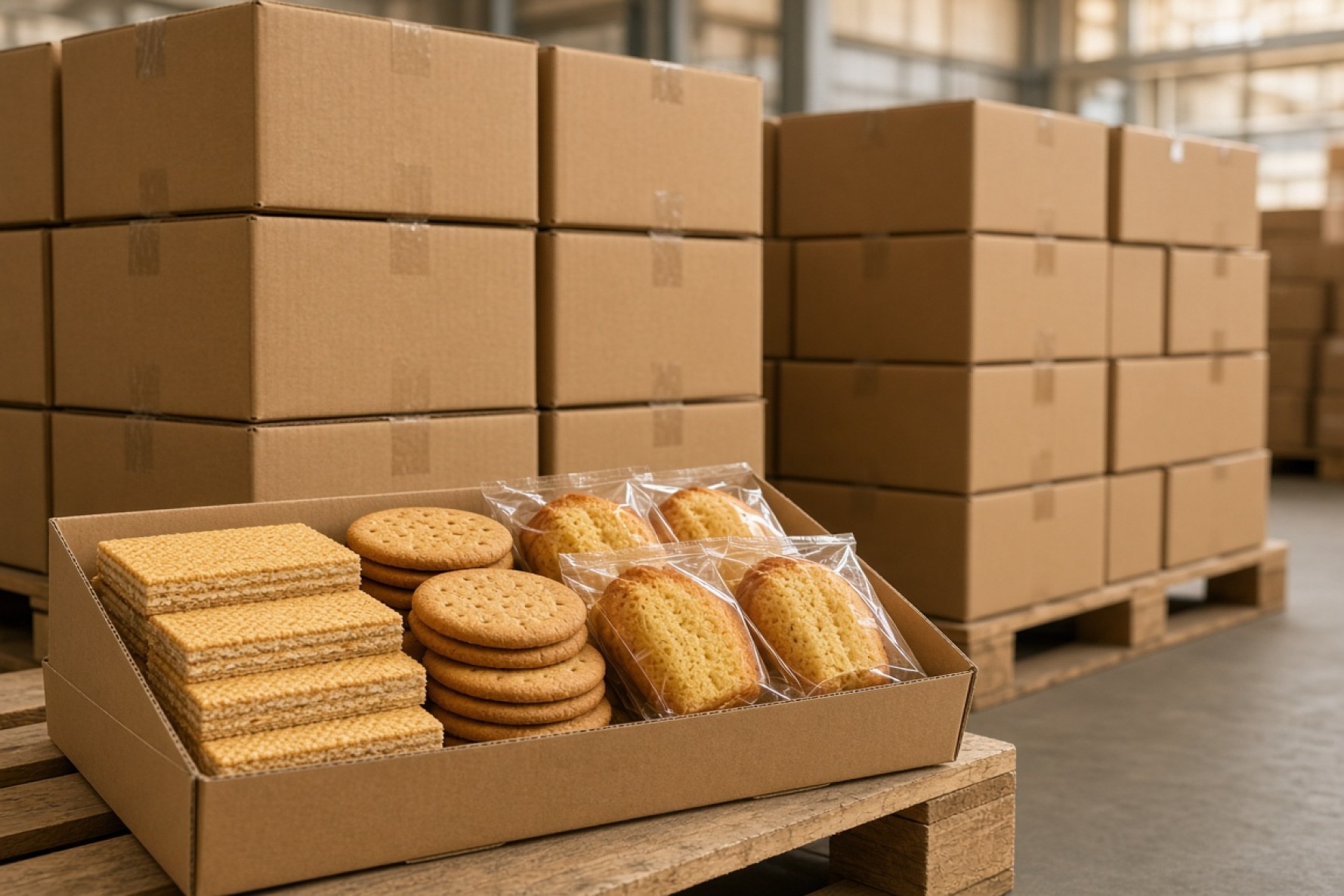
Iran's biscuit and cake industry is a major segment of the country's packaged food sector. Factories in Tehran, Alborz, Qazvin, Isfahan and other provinces produce plain, cream-filled, digestive, cookie, coated, cracker and wafer biscuits plus sponge, layered, roll, coated, multilayer and muffin cakes.
From a foreign trade perspective, these products fall under HS Chapter 19 (bakery, biscuit and confectionery). Trade data shows Iraq, Azerbaijan, Yemen, Oman, Ivory Coast, Germany and several Asian and African markets as observed destinations.
For professional importers, success depends on more than factory price: pack weight, formula, moisture-resistant packaging, correct tariff code, destination labelling, acrylamide testing for the EU market and local distribution networks all matter.
2. Main Iranian industrial biscuit types
Iranian industrial biscuits cover a wide product range. Each group differs in texture, transport sensitivity and target market.
Plain biscuits
Plain or sandwich biscuits are the volume backbone. Dry crisp texture, low moisture and good shelf life. Main sensitivity is moisture uptake in transit. Export pack weights of 35 to 360 g are common.
Cream-filled biscuits
Two biscuit layers with a cream centre (vanilla, chocolate, orange, etc.). Cream must stay stable in heat without transferring moisture to the biscuit. Common in mass retail and impulse channels.
Digestive biscuits
Dense biscuits with wholemeal or oat flour. Digestive shipments to Uganda appear in export records. Fat oxidation and crispness retention are key.
Cookies
Softer products with higher fat and sugar. Suited to gift and premium retail. Moisture control and shelf life are more critical.
Coated biscuits
Biscuits with chocolate or cocoa coating. Sensitive to heat and temperature swings in transit. Packaging must prevent coating melt and sticking.
Crackers
Dry savoury biscuits. EU acrylamide benchmark is 400 µg/kg for crackers (higher than sweet biscuits). Snack and cheese pairing market.
Wafers
Thin crisp layers with cream filling. Light and bulky; main sensitivity is moisture between layers. One of the highest-volume export groups to Iraq and Azerbaijan.
| Product group | Dominant texture | Main sensitivity | Market use |
|---|---|---|---|
| Plain biscuit | Dry and crisp | Moisture uptake | Value and economy retail |
| Cream-filled biscuit | Crisp with soft layer | Moisture and cream stability | Mass retail and shelf |
| Digestive biscuit | Dense and crisp | Fat oxidation | Breakfast and snack |
| Cookie | Soft to semi-crisp | Moisture and fat | Gift and retail |
| Coated biscuit | Crisp with coating | Heat and coating melt | Impulse and gift |
| Cracker | Dry and savoury | Moisture uptake | Savoury snack |
| Wafer | Light and crisp | Moisture between layers | Mass retail |
3. Industrial cake types
Iranian industrial cakes include powder, sponge and coated products for immediate or short-to-medium shelf-life consumption.
Sponge cake
Light aerated structure. Key buying criteria: softness, even moisture and crush resistance. Risk of deformation in weak cartons.
Layer cake
Sponge layers with cream filling. Cream stability in heat and layer separation in transit are the main challenges.
Swiss roll
Rolled sponge with cream or chocolate filling. Sensitive to shape change and bending. Shape-protective packaging is essential.
Coated cake
Sponge with chocolate or cocoa coating. Like coated biscuits, sensitive to heat.
Multilayer cake
Multiple sponge and cream layers. Higher packaging complexity and layer-slip risk.
Muffin / cupcake
Denser products with higher moisture. Pack weights of 38–60 g seen in exports. Mould-release and mould risk sensitivity.
| Product | Structure | Key buying criterion | Main shipping risk |
|---|---|---|---|
| Sponge cake | Light and aerated | Softness and moisture | Crushing and deformation |
| Layer cake | Soft layers with cream | Cream stability | Heat and layer separation |
| Swiss roll | Rolled sponge with filling | Filling uniformity | Shape deformation |
| Coated cake | Sponge with coating | Coating stability | Coating melt in heat |
| Multilayer cake | Complex layers | Layer adhesion | Slip and collapse |
| Muffin / cupcake | Dense and moist | Mould release | Moisture and mould |
4. Buyer specifications to define in the order
A quote request for "Iranian biscuits" or "export cake" is not enough to compare two offers. Buyers must define measurable parameters.
Pack weight is a primary price variable. Export records show 35, 90, 130, 200, 240 and 360 g for biscuits and 38, 40, 47, 50 and 60 g for cakes.
For cream-filled or coated products, cream/coating type and amount must be specified. Two similarly named cream biscuits can differ greatly in formula and price.
| Parameter | How to define | Buyer importance |
|---|---|---|
| Exact product name | Plain, cream-filled, wafer, sponge cake, etc. | Trade group and HS code |
| Product group | Biscuit or cake and subgroup | Production line and pricing |
| Net pack weight | 35, 90, 130, 200, 240 or 360 g biscuits; 38–60 g cakes | Shelf pricing |
| Units per pack | Pieces or pairs per wrap | Consumer value control |
| Master carton | Units per carton and dimensions | Logistics and warehouse |
| Sensory evaluation | Colour, aroma, crispness, taste, uniformity | Shipment acceptance |
| Moisture | Agreed limit by product type | Shelf life and texture |
| Fat | Type and percentage in formula | Flavour and oxidation |
| Microbial | Tests required by destination | Clearance and safety |
| Acrylamide | Destination benchmark (EU: 350 µg/kg biscuits/wafers) | Regulatory compliance |
| Allergens | Wheat, milk, egg, soy, nuts | Labelling and law |
| Shelf life | Per test and manufacturer declaration | Distribution chain |
| Label language | Arabic, English or destination language | Clearance and sales |
5. Quality evaluation for export products
Quality control must be designed around product type and destination market regulations.
Sensory evaluation
Colour, aroma, crispness, taste, appearance uniformity and breakage. An approved reference sample should be kept on file.
Moisture
High moisture softens biscuits and reduces shelf life. In cakes, very low moisture makes the product seem dry.
Fat
Fat type and level affect flavour and oxidation. In cream products, cream fat stability in heat matters.
Microbial testing
Dry high-sugar products have different microbial profiles, but raw materials, production lines and packaging still require HACCP control.
Acrylamide
For the EU market, the benchmark level is 350 µg/kg for sweet biscuits and wafers and 400 µg/kg for crackers. Exporters must manage baking process and ingredient selection.
Allergens
Wheat, milk, egg, soy, almonds, pistachios and other nuts must be reflected in labelling and risk assessment.
6. Export destination countries
Destination markets depend on product group. HS 190530 (biscuits and wafers in some databases) and 190590 (cakes) should be analysed separately.
Iraq
Largest market: approx. USD 75.3 million and 16.75 million kg in 2024. Bulk demand, competitive pricing and heat-resistant packaging.
Azerbaijan
Approx. USD 8 million and over 8.4 million kg. Competition from Turkey and Russia; pack design and supply consistency matter.
Yemen
Approx. USD 4 million. Retail and wholesale demand at price-sensitive levels.
Ivory Coast
Over USD 1.2 million. Emerging African market with growth potential.
Europe
Germany over USD 1 million. Labelling, allergens, acrylamide and food safety documentation are critical.
Pakistan, Uzbekistan and Malaysia
Cake shipments to these markets are documented. Each country has different customs and labelling rules.
| Market | Trade evidence | Commercial note |
|---|---|---|
| Iraq | Approx. USD 75.3M and 16.75M kg (HS 190530) | Largest market; bulk consumption and competitive price |
| Azerbaijan | Approx. USD 8M and over 8.4M kg | Competition with Turkey and Russia; pack and brand matter |
| Yemen | Approx. USD 4M | Retail and wholesale price-sensitive demand |
| Ivory Coast | Over USD 1.2M | Emerging African market |
| Germany / Europe | Over USD 1M | Labelling, allergens and acrylamide compliance |
| Oman | Approx. USD 1M | Gulf market; GSO standards |
| Pakistan | Documented cake shipments | Neighbour market with price demand |
| Uzbekistan | Documented cake shipments | Central Asian market |
| Malaysia | Documented cake shipments | Southeast Asian market |
| Uganda | Digestive biscuits in export records | African market with niche demand |
7. HS tariff codes
Correct tariff code selection is critical for pricing, duty and clearance.
HS 190531 — sweet biscuits
Packaged sweet biscuits: plain, cream-filled and many industrial cookies.
HS 190532 — waffles and wafers
Wafer and waffle products; among the highest-volume groups exported to Iraq and Azerbaijan.
HS 190590 — other bakery products
Includes many industrial cakes, some powder products and other Chapter 19 bakery items.
Older statistical databases use code 190530 jointly for biscuits and wafers; Iraq and Azerbaijan 2024 data often appears under this code.
8. Labelling and standards
Labels must comply with Codex CXS 1-1985 and destination country rules. In the EU, Regulation 1169/2011 requires allergen, net weight, shelf-life and responsible operator information.
For the EU market, acrylamide benchmark levels of 350 µg/kg (biscuits/wafers) and 400 µg/kg (crackers) must be built into sourcing plans. GCC markets also follow GSO 9:2022 for prepacked food labelling.
Domestic Iranian labels alone are not sufficient for export; destination-language or supplementary labels must be approved before final production.
9. Export packaging
Export packaging has three layers: retail wrap, inner tray/divider and master carton.
Biscuit wrap
Metallised OPP or multilayer film with low water-vapour transmission. Strong seals and abrasion-resistant print.
Cake wrap
Higher oxygen and moisture barrier; extra protective layer for coated products.
Master carton
Five-ply carton or solid board with international shipping print. Units per carton must match destination pallet patterns.
10. Transport, shelf life and pricing factors
Biscuits and wafers usually need no cold chain, but container humidity and heat are quality enemies. Cakes are more temperature-sensitive.
Shelf life varies by formula, packaging and storage; it must be contractually defined based on real testing.
Price drivers: product type, pack weight, formula (cream/coating), packaging, order volume, destination, transport mode (road/sea) and payment terms.
Comparing two prices without aligning weight, formula and packaging is largely meaningless.
11. 20-point importer checklist
- Define exact product name (plain, cream-filled, wafer, sponge cake, etc.).
- Specify product group and subgroup (biscuit or cake).
- Confirm expected HS code (190531, 190532 or 190590) with customs broker.
- Record net pack weight (e.g. 35, 90, 130, 200, 240, 360 g).
- Specify pieces or pairs per pack.
- Define cream, coating or filling type where applicable.
- Include moisture and fat ranges in the contract.
- Set sensory acceptance criteria (colour, aroma, crispness, taste).
- List microbiological tests required by destination market.
- Review EU acrylamide limits (350 µg/kg biscuits/wafers; 400 µg/kg crackers).
- Prepare allergen list based on actual formula.
- Define shelf life and storage conditions.
- Specify inner wrap type (OPP, metallised, multilayer).
- Define master carton spec (units, dimensions, print).
- Confirm label language and destination requirements.
- Obtain and approve reference sample before bulk order.
- Specify delivery city and location in destination country.
- Choose transport mode (road, sea, container) and Incoterm.
- Write acceptance/rejection criteria in the contract.
- Specify one-off or recurring delivery schedule.
12. Information needed for accurate pricing
- Exact product name and type (biscuit or cake subgroup)
- Net weight per pack
- Units per pack and per master carton
- Formula or cream/coating type where applicable
- Expected moisture and fat ranges
- Sensory criteria and reference sample
- Required tests (microbial, acrylamide, allergens)
- Target shelf life
- Inner wrap and carton type
- Label language and requirements
- Destination country and city
- Transport mode and Incoterm
- Order volume (cartons, pallets or containers)
- Delivery schedule
- Private label or OEM requirement
13. Sourcing cake and biscuits from Iran
Exporting biscuits and cakes from Iran to Iraq, Azerbaijan, Yemen, Oman and other destinations requires product alignment with buyer specs, robust packaging and correct documentation.
Iranco is a B2B purchase-request channel for packaged food from Iran. Importers can enter biscuit or cake type, pack weight, order volume and destination at iranco.com.
For comparable quotes, specify product type (plain, cream-filled, wafer, sponge cake, etc.), pack weight, units per carton and destination city in the first enquiry.
Iranco advisors can help align technical specs, labelling and transport with destination market requirements.
14. Conclusion
Iran's biscuit and cake industry has high-volume capacity with broad product diversity. Iraq and Azerbaijan are the largest reported markets for biscuits and wafers.
Product group separation (plain, cream-filled, wafer, cake, etc.) is essential for pricing, HS codes and quality control.
Importers must define pack weight, formula, tests (including acrylamide for the EU), labelling and packaging before ordering.
Moisture- and breakage-resistant packaging and heat control for coated products determine distribution success.
For B2B enquiries and comparable supply options, submit full specifications at iranco.com.
15. Frequently asked questions
What is the main export difference between Iranian biscuits and cakes?
Biscuits and wafers typically have lower moisture, longer shelf life and higher sensitivity to moisture uptake; they are classified under HS 190531 and 190532. Industrial cakes have higher moisture, softer texture and greater transport risk, often under 190590. Buying specs, packaging and tests differ by group.
What is Iran's largest biscuit export market?
2024 data under HS 190530 shows Iraq as the largest market at approx. USD 75.3 million and nearly 16.75 million kg. Azerbaijan follows at approx. USD 8 million and over 8.4 million kg.
What HS codes apply to biscuits, wafers and cakes?
Under newer classification: 190531 for sweet biscuits, 190532 for waffles and wafers, and 190590 for other bakery including many industrial cakes. Older databases may use 190530 jointly for biscuits and wafers.
What is the EU acrylamide benchmark for biscuits?
For sweet biscuits and wafers the EU benchmark is 350 µg/kg. For crackers and savoury biscuits it is 400 µg/kg. European importers must factor these into sourcing plans.
What are common export pack weights for Iranian biscuits and cakes?
Export records show 35, 90, 130, 200, 240 and 360 g for biscuits and 38, 40, 47, 50 and 60 g for cakes. Pack weight should match destination shelf strategy.
What is Azerbaijan's market like for Iranian biscuits?
Azerbaijan is competitive; Turkey and Russia are strong rivals. Success depends on pack design, quality consistency, retail weights and regular supply as well as price.
Which countries receive Iranian cake exports?
Besides Iraq and Azerbaijan, cake shipments to Pakistan, Uzbekistan and Malaysia are documented. Each market has different labelling and price requirements.
What are export packaging requirements for biscuits?
Inner wrap must resist water vapour and light; trays or dividers reduce breakage; master cartons must survive international transport. Cream-filled or coated products may need extra protection.
Which quality tests matter for exported biscuits?
Sensory evaluation, moisture, fat, microbiological tests, acrylamide (for EU) and allergen declaration are key. Tests must match destination regulations.
How do I get an accurate price?
Price depends on product type, pack weight, formula, packaging, volume, destination and transport. Submit full specs at iranco.com so offers are compared on the same product definition.
Related Articles



