 Iranco Magazine Team
From grade, colour and calibre to waste %, net weight, firmness, packaging and delivered cost — an economic framework for Iranian export greenhouse bell peppers
Export Guide · Fresh Produce · UNECE FFV-28
How to Compare Iran Bell Pepper Prices Against Real Quality
Bell peppers cannot be compared on quoted price per kilo alone. This guide helps buyers, importers and procurement managers use effective price instead of nominal price — from grade and colour to waste %, net weight, firmness, packaging and delivered cost.
The gap between “price on the proforma” and “real cost of sellable goods” can be very large. A cheaper lot may arrive with weak sorting, size variation, softness, wrinkling, bruising or poor cartons; a higher initial quote may be more economical due to better uniformity and lower waste.
UNECE FFV-28 evaluates sweet peppers for health, appearance, firmness, uniformity, defects and quality class. Iran produces coloured greenhouse bell peppers for regional markets; Isfahan, Chaharmahal-Bakhtiari and Qazvin are major sorting and export hubs.
1. The main mistake in price comparison
Compare on one kilo of sellable product at destination, not declared weight at origin. If grade, colour, calibre, defect %, net vs gross weight, carton type, delivery terms and haul distance differ, direct per-kilo comparison is unreliable.
- Are both offers for the same colour or colour mix?
- What grade/class and allowed defect % apply?
- Is price based on net or gross carton weight?
- Where is delivery? Who pays cold-chain haul and inspection?
What is effective price?
Effective price per kg sellable = Total delivered cost ÷ Actual sellable product weight
Total delivered cost includes packaging, domestic haul, cold storage, inspection, main freight and other attributable costs. Sellable weight excludes rot, softness, out-of-grade fruit and non-saleable defects.
2. Grade — align before price
UNECE FFV-28 classifies sweet peppers as Extra, Class I and Class II. Terms like “super export” or “grade one” without measurable criteria are not purchase standards.
| Parameter | Impact on real price |
|---|---|
| Class / grade | Defines acceptable defect level |
| Colour & uniformity | Affects market and ripeness stage |
| Calibre | Direct retail impact |
| Firmness & skin condition | Shelf life and waste |
| Carton uniformity | Higher sell-through |
3. Colour, calibre and wall thickness
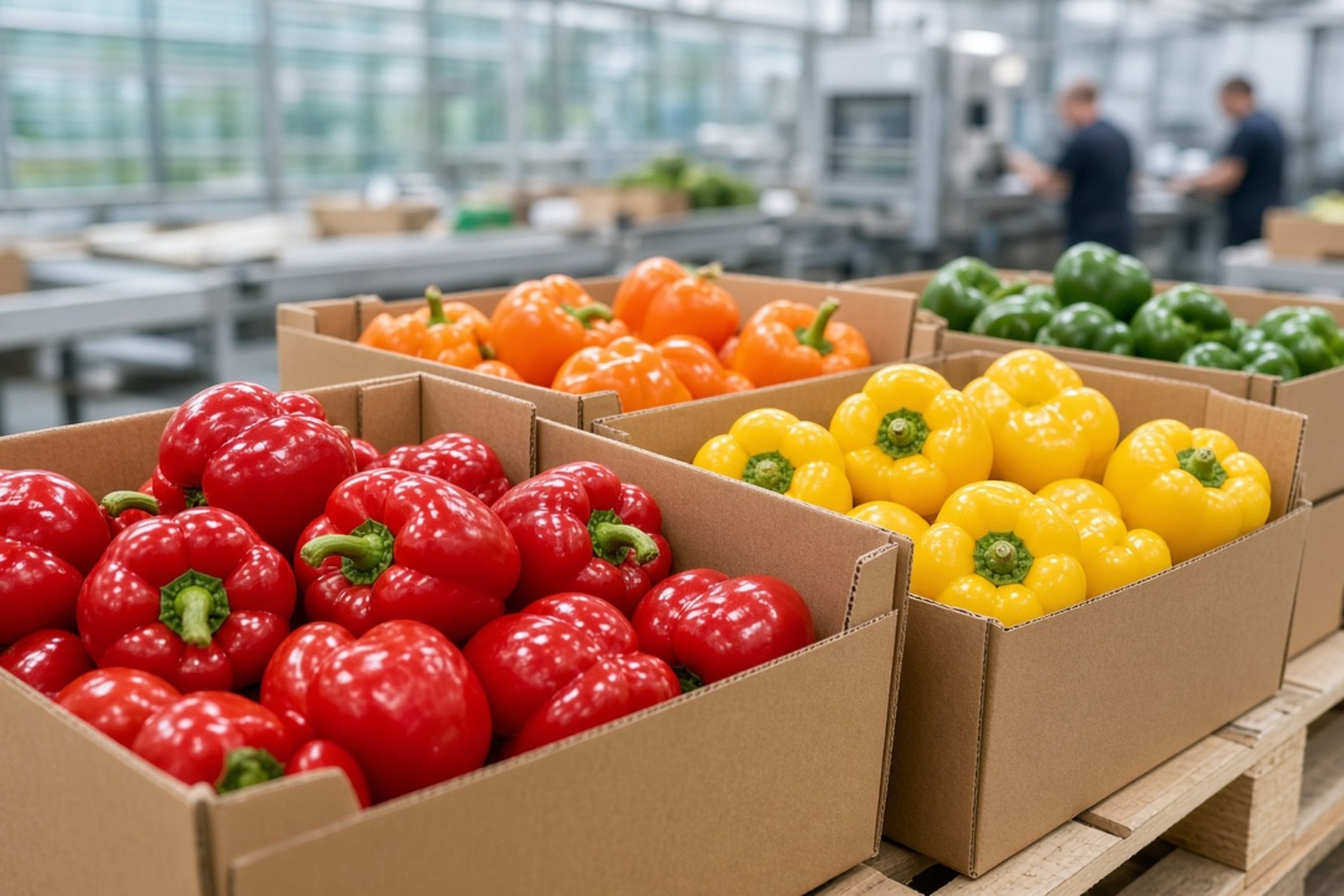
Green peppers are usually picked before full colour break. For coloured fruit, colour development must be defined upfront — preferably with reference photos. Calibre needs a defined method and numeric range; share per calibre and tolerance for out-of-size fruit.
Wall thickness matters for some professional buyers; if relevant, define sampling method and acceptance limits in the product spec.
4. Firmness and freshness
Storage at about 7.5°C with RH above 95% maximises shelf life (reported 3–5 weeks). Green peppers are chilling-sensitive. Two loads may look identical at loading but differ in post-harvest age and temperature history — that is part of economic value.
- Gentle pressure for firmness; check wrinkling around the calyx
- Bruises, skin cracks, sunscald and calyx wounds
- Cut samples for internal condition and seed cavity
5. Waste percentage
Sellable yield shows what share of delivered net weight meets the target market grade. Split waste into non-saleable, grade-down and weight loss.
Real cost per sellable kg = Total delivered cost ÷ Sellable weight in target grade
6. Net weight, cartons and ventilation
Proforma must state net vs gross weight, carton tare and weight tolerance. Good export cartons need strength, ventilation and pallet-compatible stacking.
| Packaging factor | Economic risk if wrong |
|---|---|
| Weak carton | Crushing and grade-down |
| Poor ventilation | Reduced shelf life |
| Irregular net weight | Higher real price per kg |
| Bad stacking | Calyx punctures and waste |
7. Technical specs to request
Professional buying needs a product specification sheet: product name, colour, grade, calibre, firmness, colour uniformity, surface defects, net carton weight, carton type, pre-cooling, loading temperature and labelling.
8. Pre-loading quality control
- Sample across the batch — not only show cartons
- Random weight checks with packaging tare separated
- Visual check and internal cuts
- Pulp temperature; loading warm fruit into a reefer is unreliable
- Residue testing per destination market — not a generic lab sheet
9. Iran bell pepper export market
Fresh peppers fall under HS 070960 — not always identical to “coloured bell pepper” in trade statistics. Export competition is not only farm gate price; grading, packaging and logistics matter. Regional markets with geographic access and land transport suit Iran’s supply structure.
| Channel | Uniformity sensitivity |
|---|---|
| Modern retail | Very high |
| Wholesale | Medium |
| Value market | Lower |
10. Delivered cost
Separate four levels: nominal price, net product price, delivered price and effective sellable price. For procurement, the fourth number matters most.
11. Professional two-offer comparison
Build an adjustment sheet per supplier: colour, grade, calibre, uniformity, net weight, carton type, delivery point, freight, sellable yield and effective price. Use real historical data for the same route — not generic waste assumptions.
12. Importer checklist (summary)
- Define colour, grade and calibre in contract terms.
- Get representative samples from real production and final packaging.
- Confirm net weight, defect tolerance and cartons.
- Plan pre-shipment inspection across multiple batch points.
- Record delivery point and destination acceptance criteria.
- Track supplier waste history to adjust future quotes.
13. Common mistakes
- Choosing lowest per-kilo price only
- Approving a tiny hand-picked sample
- Undefined colour and vague “grade one”
- Ignoring real cartons and pulp temperature
- Not deducting carton weight or grade-down loss
14. Supply path from Iran
Start with product specification, not price. Harvest, sorting, pre-cooling, packing and transport all shape the deal. When quality matters, agreeing a spec sheet before the commercial order beats collecting quotes without technical detail.
Summary
Real decisions use cost of product that is actually sellable at destination in the ordered grade. After several shipments, buyers measure true cost per sellable kilo — that shifts procurement from price-based to value-based buying.
FAQ
Is cheaper pepper always more economical?
No. Higher waste or grade-down can make the real sellable cost exceed a nominally more expensive offer.
Best storage temperature?
About 7.5°C with RH above 95% is reported as optimal for maximum shelf life.
HS code for fresh bell pepper?
Fresh or chilled Capsicum/Pimenta fruit is classified under HS 070960.
What to send for a price request?
At minimum: colour, grade, calibre, order volume, net carton weight, packaging, destination and delivery point, transport mode and QC requirements.
Featured Products










Related Articles



