 Iranco Magazine Team
Comprehensive analysis of oil assay, industrial formulation behaviour, lab authenticity tests, bulk packaging standards and procurement engineering
Industrial rose water · Confectionery · Ice cream · Beverages · INSO 5759
Rose Water for the Food Industry: Factory Procurement Guide for Confectionery, Ice Cream and Beverages
Comprehensive analysis of oil assay, industrial formulation behaviour, laboratory authenticity tests, bulk packaging standards and procurement engineering.
Factory procurement of rose water for food-processing lines requires technical understanding of essential-oil composition, thermal stability and physicochemical indices. This guide analyses grade structures, instrumental adulteration tracing, oil behaviour in confectionery, dairy and beverage matrices, plus customs clearance and bulk-tank logistics — an analytical base for procurement managers and food-industry specialists.
Clean-label demand has elevated traditionally distilled flavourings. Damask-rose hydrosol, rich in polar aromatic alcohols and monoterpenes, is a cornerstone flavour base in confectionery, dairy and beverage plants. Moving from traditional workshops to continuous mechanised lines brings challenges: oil-grade variability, thermal loss during industrial baking, adverse interactions with milk proteins and turbidity from volatile lipid separation.
Iran’s vast damask-rose plains and historic water-distillation systems make it the primary source of concentrated hydrosols for Middle East and global markets. Year-round flavour stability requires moving beyond empirical criteria to instrumental tests, national and international standards, and transparent certificates of analysis.
1. Production ecosystem, supply capacity and industrial distillation regions in Iran
Damask-rose acreage in Iran reaches about 60,000 hectares, yielding more than 60,000 tonnes of fresh flowers and buds annually and nearly 50,000 tonnes of rose water across traditional, semi-industrial and industrial scales. About 90% serves domestic consumption and processing plants; annual export value of rose water and dried buds is around USD 20 million.
Kashan zone (Qamsar, Niasar, Barzok and Joshaghan)
With annual output near 15,000 tonnes, Kashan has Iran’s most advanced industrial and traditional distillation infrastructure. High-altitude Barzok orchards flower latest and extend distillation into late May/June. The hydrosol shows outstanding olfactory balance between volatile alcohols and lasting esters.
Fars province (Meymand, Darab and Shiraz)
Meymand produces over 12,000 tonnes yearly and is the historic cradle of Iranian hydrosol distillation. Darab’s rain-fed Layzangan plain adds more than 3,000 tonnes with higher phenolic oil content — an advantage for halva and baklava formulation.
2. Technical classification of industrial rose-water grades by oil assay
Trade vernacular uses “ayar” for fresh-flower weight per distillation batch with a set water volume. Food engineering and Iran National Standard INSO 5759 instead accept total dissolved oil in a defined product volume. Mismatch between vernacular and lab data causes dosing errors on production lines.
Light rose water (grade two)
Distilled from about 10–15 kg fresh petals to yield ~40 L. Minimum oil: 15 mg/100 ml. Suited to mild beverages and compound juices without severe thermal baking.
Heavy / premium rose water (grade one)
Factory baseline: 30–35 kg fresh damask rose per 40 L batch. Standard minimum: 35 mg oil per 100 ml. Delivers balanced rose aroma, mild transient bitterness and astringency with strong stability in food matrices.
Double- and triple-distilled (do-atasheh / se-atasheh)
Double-distilled replaces still water with first-pass hydrosol; oil rises to 60–85+ mg/100 ml. Ideal where water load must stay low — chocolate, traditional high-fat ice cream, cream fillings and qottab. Triple-distilled is mainly for lab flavour work and concentrated medicinal extracts.
Spent-pomace hydrosol (pas-ab)
Oil below 8 mg/100 ml with burnt-herb notes. No permitted food-industry value; causes turbidity, watery taste and organoleptic failure.
| Attribute | Light | Heavy premium | Double-distilled | Pas-ab |
|---|---|---|---|---|
| Fresh flowers / 40 L | 10–15 kg | 30–35 kg | 60–70 kg (two-stage) | Pomace only |
| Min. total oil | 15 | 35 | 60–85 | < 8 |
| Taste & mouthfeel | Light, no lasting bitterness | Mild bitterness, brief astringency | Clear bitterness, strong astringency | Watery, cooked-straw |
| Thermal-shock stability | Low | Medium–high | Very high | Negligible |
| Best industrial use | Dilute beverages | Cake, cookie, syrups | Ice cream, chocolate, halvah | Not factory-permitted |
3. Technical identity and COA under INSO 5759
Accepting rose-water shipments into plant tanks requires COA alignment from accredited food-and-drug and national-standards labs.
Physicochemical specifications
- Appearance: clear liquid, free of sediment, foreign matter or haze
- Colour: colourless; yellowing or darkening indicates oxidised metal contact or overheating
- Relative density: 0.985–1.000 at 20°C
- Acidity (pH): 4.0–5.5 — above 5.5 warns of alkaline process water or bacterial breakdown; below 4 suggests acidic fermentation of petals
- Evaporation residue: max 0.1% by mass
- Heavy metals: Cu ≤ 0.2 mg/kg, Pb < 0.05 mg/kg, As < 0.01 mg/kg
Microbiology (INSO 5272 / 3270)
| Index | Limit | Test method |
|---|---|---|
| Aerobic mesophilic count | Max 100 CFU/ml | INSO 5272 |
| Enterococcus faecalis | Absent in 100 ml | Selective culture / filtration |
| Total coliforms | Absent in 100 ml | INSO 7725 |
| Sulphite-reducing clostridia | Absent in 100 ml | INSO 5353 |
| Mould & yeast | Absent in 100 ml | INSO 4207 |
| Pseudomonas aeruginosa | Absent in 100 ml | INSO 8869 |
4. Aroma biochemistry, advanced lab methods and adulteration tracing
GC-MS hydrocarbon profiling is the definitive authenticity path for high-tonnage lots. In pure hydrosol, phenylethyl alcohol forms 60–80% of volatile aroma; citronellol 20–35%; geraniol and nerol supply floral-citrus notes; eugenol and phenolics drive lasting bitterness and astringency.
Industrial adulteration patterns
- Synthetic oils (petrochemical phenylethyl alcohol, lab geraniol) — revealed by solvent peaks (dichloromethane, ethanol, propylene glycol) and chiral columns
- Distorted citronellol/geraniol ratio via geranium or lemongrass oil
- Dilution with deionised water or reboiling spent pomace
| Fraud | Sensory effect | Definitive technique |
|---|---|---|
| Synthetic chemical oil | Soapy odour, tongue sting | Chiral GC-MS |
| Water dilution | Watery taste, rapid aroma fade | Solvent extraction & gravimetry |
| Pas-ab / pomace reboil | Darkening, cooked-straw smell | Volatile acidity & spectroscopy |
| Geranium oil blend | Harsh grassy notes | Citronellol/geraniol ratio |
5. Formulation engineering for industrial cake, cookie and confectionery
In sponge cakes and cookies, crumb centre temperature reaches ~95–100°C and surface exceeds 180°C. Phenylethyl alcohol boils near 219°C, yet co-distillation with dough moisture drives major aroma loss through oven exhaust.
Flavour-retention tactics
- Post-baking syruping: blend hydrosol into invert syrup and spray after cooling below 65°C — aroma retention above 85%.
- Oil-phase encapsulation: emulsify heavy rose water with shortening/margarine and mono/diglycerides to shield volatiles.
- Double-distilled selection: cuts aqueous load to about one-third and preserves flour–water balance.
Typical doses: baklava syrup 3–5% v/v; cookie filling 1–1.5%; industrial cake batter 1.2–2%.
6. Rheology and phase balance in ice cream, desserts and dairy
In super-premium ice cream with 8–12% milk fat, non-polar terpenes bind the fat phase and aroma is trapped at −18°C; melting fat globules at mouth temperature release rose notes abruptly. Heavy or pure double-distilled grades supply polar top notes (phenylethyl alcohol) and fat-soluble persistence.
- Never add rose water before raw-milk pasteurisation (casein flocculation risk at ~pH 4.5).
- Best injection: after mix cooling to 4°C in aging tanks, before continuous freezer.
- Traditional cream ice cream dose: 2–3 L heavy rose water per 100 kg base.
7. Clarity, stability and filtration in beverage plants
Neck-ring oil films in clear bottles come from stearoptenes (mp ~33°C) crystallising when cold. Demand heat-stabilised hydrosol filtered at 0.45 µm after cooling to 5°C; for Brix < 10, micro-doses of refined gum arabic or sucrose esters help. HTST flash pasteurisation (15 s at 72°C) sterilises without thermally degrading terpene alcohols.
| Industry | Suggested grade | Dose | Line entry | Challenge fix |
|---|---|---|---|---|
| Cake & cookie | High-assay double-distilled | 0.8–1.2% w/w | Final mix / oil phase | Margarine encapsulation |
| Baklava / syruped sweets | Premium heavy | 3–4% in syrup | After syrup cools to 65°C | Cold syrup spray |
| Ice cream & dairy desserts | Pure double-distilled | 2–3% of base | Aging tank pre-freezer | PEA-rich grade |
| Carbonated / still drinks | Filtered light or heavy | 0.5–1% v/v | Syrup tank pre-carbonator | Sub-1 µm membrane |
| Concentrated traditional syrups | Wax-free heavy | 6–8% v/v | Ambient after sugar cook | Invert sugar + cartridge filter |
8. Bulk packaging, oil stability and warehousing
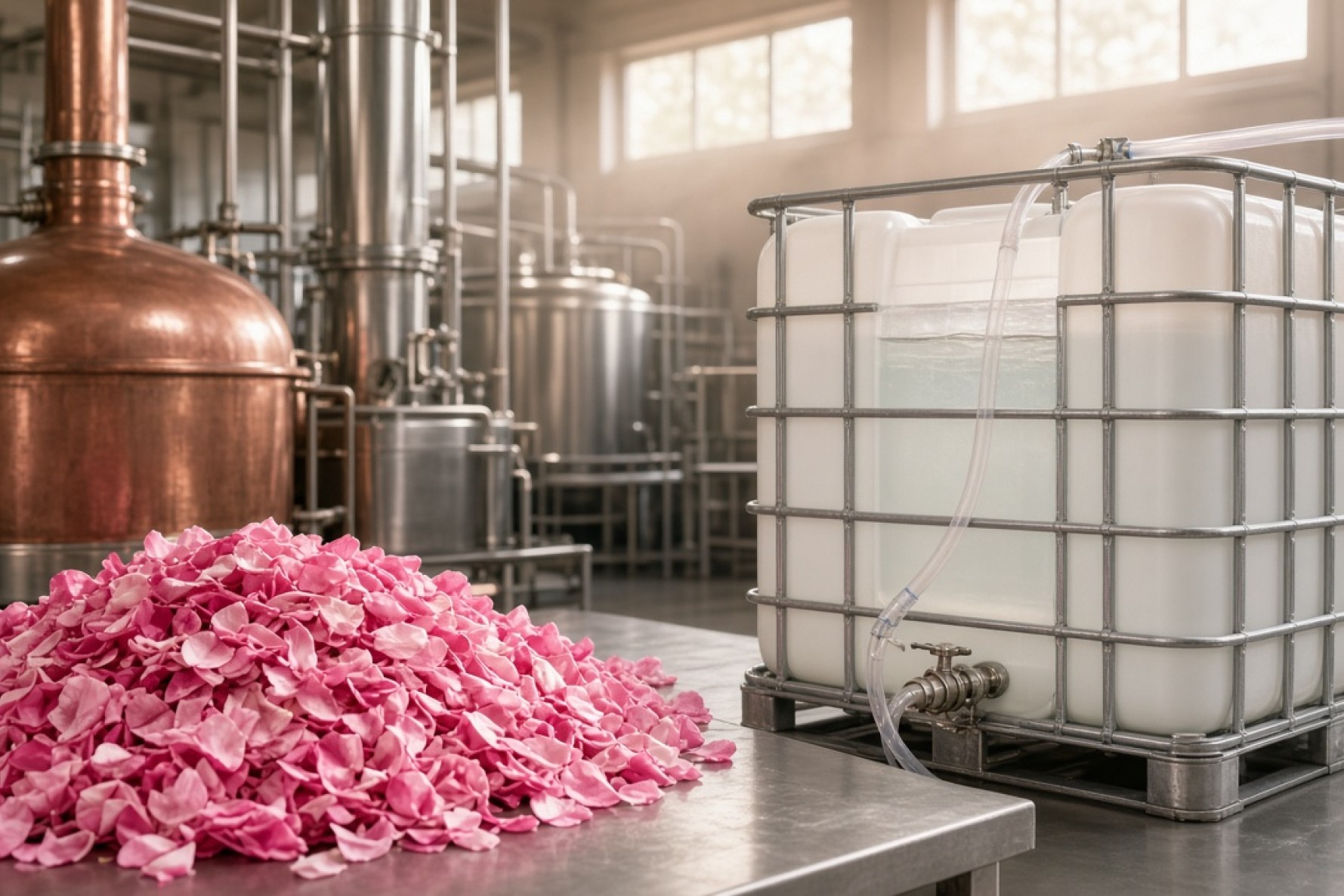
The industrial standard is 1,000 L palletised caged IBC totes in food-grade HDPE 3840 with galvanised steel cages: UV-resistant polymer, butterfly discharge valve with PTFE gaskets and intact seals, metal/composite pallet for forklifts.
- 220 L closed-head polymer drums with metal safety rings
- 20 L jerrycans with body weight ≥ 900–1,100 g for three-high stacking
- Nominal shelf life 18–24 months sealed; ideal store 10–22°C
- Nitrogen headspace blanketing on large tanks to cut dissolved oxygen
| Format | Capacity | Operational benefit | Delivery check |
|---|---|---|---|
| IBC tote | 1,000 L | Pump discharge, dense storage | Lead seal, liner cleanliness, leaks |
| Food-grade drum | 220 L | Transit impact resistance | Closure threads, polymer odour |
| Industrial jerrycan | 20 L | Manual weighing for small batches | Cap seal, fill-level clarity |
| Road tanker (SS) | 10,000–20,000 L | No disposable packaging cost | CIP wash certificate |
9. Export markets, international transit and customs documents
- 33019011: damask rose hydrosol — official export identifier
- 33019012: other traditional herbal distillates
- 330300: perfumes/toilet waters — misdeclaration triggers luxury duties and non-food cosmetics testing
A 20 ft FCL holds 18–20 IBC totes. In hot seasons (May–October), Gulf and Iraq corridors need reefers set to 15–20°C. Documents: ISO 17025 COA, phytosanitary certificate, MoH health certificate, Halal, B/L and packing list with batch numbers.
| Destination | Preferred grade | Packaging | Key requirement |
|---|---|---|---|
| UAE | Heavy & double-distilled | IBC / 220 L drum | Halal, Dubai Municipality |
| Oman | Premium > 40 mg | 20 L / drum | Arabic/English label |
| Iraq | Economy light & heavy | 20 L / 1 L bottle | Border QC inspection |
| EU | Organic pure | Aseptic drum + N₂ | MRL, chiral GC-MS |
10. Cost structure, wholesale pricing and factory contracts
- Fresh damask rose accounts for ~65–75% of distillation cost
- Producing 35-assay premium costs more than twice 15-assay light grade
- Buyer-circulated IBC totes cut per-unit cost 8–15% versus new jerrycans
- Forward contracts after harvest season (late spring) lock annual rates
Importer checklist before order
- State grade and minimum total oil (mg/100 ml) in the contract
- Density (0.985–1.000) and pH (4.0–5.5) tolerances
- Mandatory GC-MS for phenylethyl alcohol, citronellol/geraniol ratio and synthetic rejection
- Microbiology certificate INSO 5272: < 100 CFU, mould/yeast absent
- Confirm food-grade new IBC or odour-free drum with barcode seals
- Retain 1–5 L sealed witness sample before main loading
- Correct HS 33019011 on B/L and proforma
- ≥ 18-month shelf life and Incoterms aligned with reefer transit in hot seasons
- Phytosanitary, export health and Halal certificates
Information required for accurate quoting
- Industrial grade (light, heavy 35 or double-distilled) and target oil
- Order volume (tonnes/litres; single lot or annual programme)
- Pack format (IBC, 220 L, 20 L or road tanker)
- End-use on the line (for wax filtration if needed)
- Delivery point (EXW, FOB Bandar Abbas, CFR/CIF)
- Special tests (GC-MS, pesticide panel, INSO 5759)
Summary
Industrial rose-water buying is a process-engineering decision that shapes aroma, texture and shelf life. Smart choice among light, heavy and double-distilled grades, reliance on total oil and GC-MS instead of folklore, and UV-protected food-grade bulk tanks keep quality stable from still to export destination.
FAQ
How does heavy rose water differ from double-distilled in industrial processes?
Heavy grade has at least 35 mg total oil per 100 ml and is the baseline for cake, cookie, beverage and syrup lines. Double-distilled re-distils fresh flowers in hydrosol, reaching 60–85 mg oil — ideal for moisture-sensitive matrices such as high-fat ice cream, chocolate and halvah.
How can synthetic-oil adulteration be detected in bulk lots?
Chiral GC-MS is the most reliable method: it resolves natural phenylethyl alcohol, citronellol and geraniol ratios and flags synthetic solvent residues. Artificial hydrosols taste soapy and sting the tongue tip.
Does industrial oven heat damage rose aroma?
Yes — co-distillation with steam strips much of the aroma. Best practice is post-bake addition in syrup below 65°C or encapsulation in a margarine fat phase.
What causes turbidity and oily films in rose drinks?
Petal stearoptene waxes (mp ~33°C) crystallise in cold water and rise to the surface. Clear-beverage lines should buy 0.45 µm filtered hydrosol.
What bulk standards apply for Middle East sea and road freight?
Food-grade 1,000 L polymer IBC totes with galvanised cages are preferred. In hot months, reefers at 15–20°C prevent oil hydrolysis on transit routes.
How long does industrial-pack rose water keep?
In sealed food-grade tanks, away from sun, at 10–22°C, product stays stable 18–24 months. Nitrogen headspace minimises aromatic-alcohol oxidation.
What information is needed for an accurate industrial quote?
Grade, total-oil target, lot volume, pack type, line application and Incoterms. On Iranco you can file an RFQ against these same indices.
Featured Products


Related Articles



