 Iranco Magazine Team
Entry routes, veterinary and feed requirements, shipment specs, cold chain, rendering and Thailand aquaculture feed demand
Export Guide · Chicken Skin · Thailand
Frozen Chicken Skin Export to Thailand — Health Regulations and Aquaculture Feed Applications
Entry routes for frozen chicken skin into Thailand, veterinary and animal-feed requirements, shipment specifications, cold chain, industrial processing and demand from aquaculture feed industries — published in Iranco Magazine.
Four Key Indicators — Thailand Market
Official Thai fisheries statistics show the country produced nearly one million tonnes of brackish and freshwater aquaculture in 2023. The Thai Feed Industry Association estimate for 2024 indicates consumption of more than 21.1 million tonnes of feed, including fish and shrimp rations. Marine farmed shrimp at 392,470 tonnes was the largest brackish aquaculture group.
Exporting frozen chicken skin to Thailand is meaningful when the product is defined not as "cheap waste" but as an industrial animal raw material with technical specifications, traceable origin and a clear industrial use. Thailand has both a large poultry processing industry and one of Southeast Asia's major animal and aquaculture feed production centres. A foreign supplier therefore cannot enter this market on low price alone; it must also demonstrate raw material quality, compositional consistency, health status, traceability and facility compliance.
Chicken skin differs materially from chicken meat in composition. Its fat content is high, which gives it value for rendering units, fat extraction and poultry by-product processing. In aquaculture feed manufacturing, raw skin is usually not added directly to finished feed formulas. The standard industrial route is thermal processing and rendering of poultry by-products into poultry fat or poultry by-product meal (PBM). Aquaculture nutrition research shows PBM can replace part of marine protein sources in some fish and shrimp diets, provided protein quality, amino acids, fat and digestibility are controlled.
For an Iranian exporter, the main issue is not merely freezing and shipping chicken skin. Thailand places animal-origin products and feed raw materials under control of the DLD. Poultry disease status in the country or region of origin, approval of the foreign production facility, official health certificates, import permits and precise end-use specifications can all affect clearance.
A successful transaction must therefore begin with precise product definition: Is the shipment entering as an edible product? Is it raw material for rendering? Will it be processed in an animal or aquaculture feed plant? The answer can change the permit route, tariff classification and buyer specifications.
{-- 1. How should the Thailand market for frozen chicken skin be analysed? --}1. How should the Thailand market for frozen chicken skin be analysed?
The potential market for chicken skin in Thailand cannot be assessed from import statistics for a single tariff line alone. Depending on edibility, processing form and final use, the product may fall under different classifications. Real market analysis must start with consuming industries.
Three important demand groups
- Poultry by-product rendering and processing units;
- Animal fat and feed ingredient producers;
- Animal feed, pet food and aquaculture feed mills consuming processed poultry materials.
Why Thailand's aquaculture sector matters
In 2023 Thailand recorded about 541,166 tonnes of brackish aquaculture and nearly 459,980 tonnes of freshwater aquaculture. Marine farmed shrimp at 392,470 tonnes was the largest brackish aquaculture group. Tilapia at more than 266,000 tonnes was the leading reported freshwater species.
This structure shows Thailand's aquaculture feed industry serves a large market of shrimp, freshwater fish and marine fish. However, the link to chicken skin must be understood correctly: feed mills usually do not grind and add raw frozen skin directly to feed. Raw material must first become a more stable, standardised, formulating-ready ingredient.
Value creation pathway
Fresh chicken skin → hygienic collection → freezing → cold transport → rendering → fat/solids separation → standardisation → use in feed
In this chain, the buyer of chicken skin may not be an aquaculture feed mill at all. The direct buyer may be a rendering unit converting the product into poultry fat or a protein material usable in feed manufacturing.
This distinction matters greatly for marketing. An exporter targeting only fish feed plants may miss the real buyer of its raw product. Identifying rendering units, slaughter by-product processors and feed ingredient producers is a more accurate approach.
2. What specifications should chicken skin meet for Thailand's industrial market?
"Frozen chicken skin" is not sufficient wording for an international contract. It must be converted into measurable specifications.
Depending on separation method, chicken skin may contain varying amounts of subcutaneous fat, muscle tissue, bone particles, feathers, blood, connective tissue and water. These variations directly affect rendering yield and economic value.
Commercial grades by raw material condition
| Commercial grade | Dominant characteristic | Likely application |
|---|---|---|
| Clean skin with limited attached tissue | Lower impurities, higher uniformity | Specialised processing and fat extraction |
| Skin with subcutaneous fat | Higher fat yield | Rendering and poultry fat production |
| Skin with controlled attached meat | Fat and protein together | Processed by-product production |
| Irregular mix of skin and slaughter offal | Variable composition | Only for buyers explicitly accepting such material |
Contracts should avoid undefined terms such as "pure chicken skin". The buyer must know which components are permitted and which are prohibited.
Suggested technical specifications for purchase requests
| Parameter | What must be specified | Importance to buyer |
|---|---|---|
| Origin | Industrial slaughter chicken | Veterinary traceability |
| Product state | Raw frozen or processed | Determines regulations and use |
| Allowed components | Skin and agreed fat or meat levels | Yield control |
| Prohibited components | Feathers, foreign matter, visible contamination | Quality and safety |
| Freezing method | Timing and method after production | Reduces initial spoilage |
| Product temperature | Agreed temperature at loading | Cold chain integrity |
| Block size | Buyer-seller agreement | Thaw and processing speed |
| Pack weight | Specified in contract | Storage and line handling |
| Production date | Marked per batch | Shelf-life control |
| Batch number | Mandatory in traceability system | Quality follow-up |
| Production facility | Slaughter or processing unit details | Veterinary approval |
| End use | Rendering, feed ingredient or other | Permit pathway |
In industrial orders, shipment uniformity matters as much as average quality. If one container is nearly pure skin and the next is a mix of skin, fat, meat and other components, the buyer cannot predict production yield.
3. Chicken skin in aquaculture feed — raw material or processed ingredient?
In short: raw frozen chicken skin is usually not a direct aquaculture feed formulation ingredient; its main value lies in industrial conversion to poultry fat and rendered by-products.
This distinction is essential for any exporter viewing Thailand as an aquaculture feed market.
Role of poultry fat
Chicken skin is a significant fat source. Rendering heat releases and separates the fat fraction. After refining and standardisation, the resulting fat can serve as an energy source in animal or some aquaculture feed formulas.
For feed mills, origin alone is not the main issue; indicators such as oxidative stability, free fatty acids, impurities, moisture and storage quality matter. Oxidised fat can reduce raw material quality and feed acceptance.
Role of poultry by-product meal
After rendering a suitable mix of poultry by-products and separating a significant fat fraction, dried and ground solids can become poultry by-product meal.
Recent scientific reviews present PBM as a usable protein source in aquaculture feeds. A meta-analysis of 47 papers across 33 aquatic species showed species responses to replacing fish meal with poultry by-products are not uniform. No fixed substitution rate can be recommended for all species.
Example use in shrimp feed
Nutrition studies on Pacific white shrimp and tiger shrimp show quality PBM can have significant digestibility. In one Pacific white shrimp study, large-scale fish meal replacement with PBM was possible under trial conditions; however, results depend on raw material quality and complete diet formulation and must not be extrapolated directly to raw frozen skin.
The commercial message for a chicken skin exporter is clear: product value rises when it can be shown that the raw material suits production of a uniform, predictable rendered product.
4. Health regulations for poultry product entry into Thailand
The main barrier to exporting frozen chicken skin to Thailand is not finding a buyer; it is establishing legal entry eligibility from the country of origin.
Thailand's Department of Livestock Development (DLD) controls imported livestock and poultry products for animal disease status, origin facility approval, health certification and quarantine conditions.
Pre-shipment import permit
Under current DLD procedures, importers of animal products must submit permit requests in the relevant system before goods arrive. For animal products and carcasses, document review, foreign facility assessment and origin disease status are part of permit issuance.
This is critical for Iranian sellers. Signing contracts and loading before entry eligibility is confirmed carries high risk. The Thai buyer must first clarify product acceptance, origin country and production unit for the intended classification.
Poultry disease controls
Thailand applies regulations related to highly pathogenic avian influenza risk for poultry-origin materials and products. DLD regulations separately address imports of feed or feed materials and poultry products in connection with avian influenza risk.
Exporters must not extrapolate a health certificate for another product — such as poultry powder, pet food or edible meat — to raw chicken skin.
Foreign facility approval
For some imported feed raw materials, DLD evaluates production units in the country of origin. Documents requested for foreign facility review may include:
- Trade name and product description;
- Product use and target animal species;
- Raw material composition;
- Packaging form and size;
- Chemical and nutritional specifications;
- Preservatives or additives used;
- Production unit information.
This structure shows that for products entering as feed raw materials, precise end-use definition has both legal and technical importance.
5. Thailand's Animal Feed Control Act and its impact on chicken skin
If chicken skin or its derived product enters Thailand for animal or aquaculture feed production, quarantine rules alone are not enough. Thailand's feed quality control law must also be considered.
The main law in this area is the Animal Feed Control Act, B.E. 2558 (2015). It sets the framework for production, import, sale and control of feed and feed materials.
- In which legal class does the raw product fall?
- Will it be registered as a controlled feed ingredient?
- Does the importer hold the required licence?
- Must the foreign facility be approved?
- Do chemical specifications match the standard for that feed ingredient?
- Must the product be rendered before entry, or is raw entry permitted?
Thailand has separate standards and requirements for controlled feed ingredients, and for some animal-origin materials foreign source approval is part of the regulatory mechanism.
Practical outcome for the exporter
Before final pricing, the Thai importer should be asked for the exact registered product class name.
If the importer registers the product as "raw frozen chicken skin for rendering" but the seller issues documents as "chicken by-product for feed", document mismatch can create entry problems.
6. HS tariff code for frozen chicken skin — why end use is decisive
A definitive tariff code for chicken skin cannot be declared without knowing edibility status, processing form and final use.
In the Harmonized System, heading HS 0207 covers edible poultry meat and offal, fresh, chilled or frozen. For domestic fowl, subheading 020714 covers frozen edible cuts and offal.
However, Chapter 2 of the Harmonized System is dedicated to edible meat and offal. Products unsuitable for human consumption or classified as non-edible are not necessarily classified within that same framework.
| Product status | Classification consequence |
|---|---|
| Edible frozen chicken skin | Review under edible poultry product group |
| Non-edible raw skin for rendering | Requires appropriate non-edible product line |
| Poultry by-product meal | Processed product with different classification |
| Finished feed containing poultry materials | Classified under prepared feed group depending on composition |
For customs declaration, the eight-digit Thai code must be confirmed by the importer or customs broker based on exact product specifications before contract signing.
Using a code taken only from a similar shipment or another country is not a reliable approach for this product.
7. Quality control for export chicken skin
Frozen chicken skin quality depends more on pre-freeze production conditions than on the appearance of a frozen block.
If raw material remains in a warm slaughterhouse environment too long, subsequent freezing cannot restore initial quality. Freezing stops or greatly slows many microorganisms but does not convert contaminated product into sound product.
Acceptable shipment characteristics
- Clear, traceable origin;
- Supplied from a registered slaughter or processing unit;
- No visible contamination with foreign matter;
- Feather content within agreed limits;
- Relatively uniform composition between packs;
- No abnormal odour or pre-freeze spoilage signs;
- No repeated thaw-freeze cycles;
- Clear batch number and production date;
- Sound packaging suitable for the cold chain.
Tests that may become contract-critical
| Test | Reason for importance |
|---|---|
| Moisture | Effect on true dry matter yield |
| Crude fat | Rendering yield estimate |
| Crude protein | Solid fraction and nutritional value |
| Ash | Mineral and bone contamination control |
| Microbial load | Hygiene assessment |
| Salmonella | Feed raw material safety control |
| Fat oxidation indices | Fat freshness and stability |
| Foreign matter | Physical quality control |
| Drug residues if requested | Buyer control programme compliance |
Test results are useful only when sampling method is also defined. A small surface sample from one block cannot necessarily represent an entire container.
Sample versus shipment mismatch
One of the main commercial risks in slaughter by-products is difference between the approved sample and the final shipment. Contracts should specify:
- Which batch the reference sample belongs to;
- Permitted product components;
- How impurity limits are measured;
- Sampling method at inspection;
- Which test governs acceptance or rejection;
- Which laboratory is reference in case of dispute.
8. Packaging and cold chain for export to Thailand
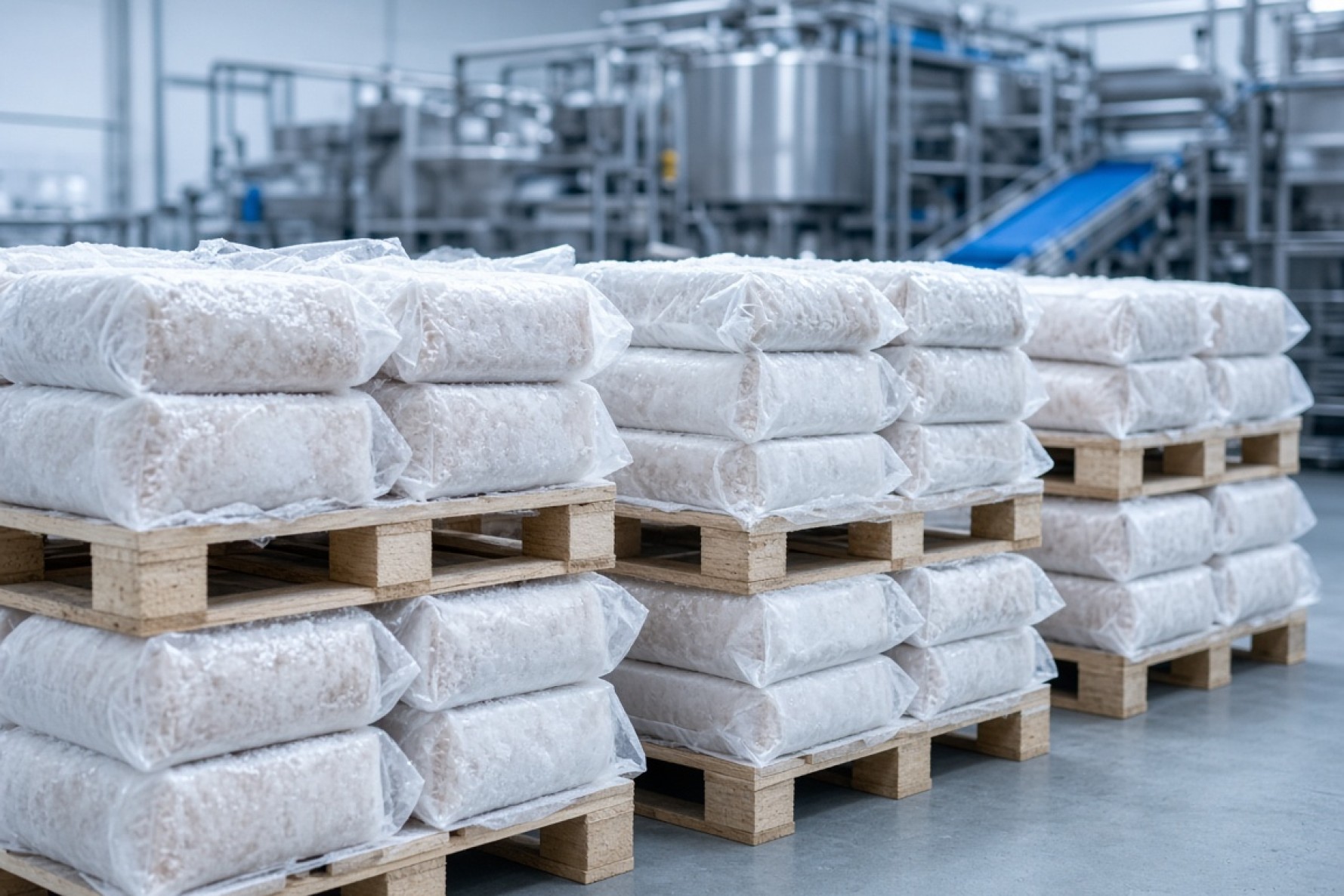
Fat-rich products such as chicken skin are sensitive to temperature rise and oxidation. Packaging quality and the cold chain therefore directly affect rendering value.
General Codex standards for quick-frozen products treat reaching a product core temperature of -18°C or lower, and maintaining that temperature with minimal fluctuation during storage and transport, as the technical basis of the cold chain.
Bulk packaging requirements
- Prevent liquid leakage;
- Remain intact at freezing temperature;
- Limit product contact with cartons;
- Avoid severe deformation in pallet or container stowage;
- Preserve batch number and product information.
Very large blocks are not always an advantage
Heavy blocks may speed loading but create problems for some processing units. If the buyer lacks block-breaking equipment, thaw or break-up time increases.
Pack weight should therefore be agreed with the buyer, not chosen solely for producer convenience.
Reefer container checklist
- Pre-cooling of the container;
- Refrigeration system in working order;
- Cleanliness and absence of odour;
- Floor condition and air circulation path;
- Stowage without blocking cold air flow;
- Loading temperature record;
- Seal number;
- Temperature logger if agreed.
Freezer burn and oxidation
Surface moisture loss can reduce product quality. In chicken skin, fat oxidation also matters. Poor packaging, air ingress, long storage or temperature fluctuation can cause off-odour and reduced fat quality.
9. Required documents and shipment information alignment
In animal product trade, "almost correct" documents are not enough. Information on the certificate, invoice, packing list, transport document and label must match.
Under DLD procedures, official health certificate, invoice, packing list and transport document are primary documents reviewed at entry of animal products.
Information to align before final document issuance
- Exporter name;
- Importer name;
- Exact product description;
- Frozen status;
- Final use;
- Country of origin;
- Production facility;
- Facility registration code or number;
- Batch number;
- Production date;
- Number of packages;
- Net weight;
- Container number;
- Seal number;
- Port of loading;
- Port of entry;
- Invoice number;
- Buyer-confirmed tariff code.
A common error is a health certificate describing "poultry by-product" while the invoice states "edible frozen chicken skin". This may seem minor to the seller but can indicate two different goods to the import authority.
10. Bulk buyer structure in Thailand
To find a buyer, first determine which stage of the chain the chicken skin targets.
Rendering unit
- Fat content;
- Output yield;
- Raw material uniformity;
- Delivered price;
- Processing energy cost;
- Continuous supply volume;
- Health status;
- Legal import eligibility.
Feed ingredient producer
Some companies render in-house or buy semi-processed material. These buyers review post-processing specifications as well as raw price.
Aquaculture feed mill
Aquaculture feed mills usually prefer standardised product, not raw skin with variable composition. For such customers, PBM or poultry fat with specified analysis certificates is more comparable.
An Iranian exporter must therefore decide whether to sell only frozen skin or move higher in the value chain.
11. When can Iranian chicken skin attract a Thai buyer?
Competitive advantage does not come from cheap raw material alone.
Purchase price + freight + permits and inspection + cold storage + quality loss + processing yield + cost of disposing unwanted fractions
Suppose two sellers offer different prices. The cheaper seller supplies higher impurity and irregular composition, while the more expensive product has higher recoverable fat and greater uniformity. The second option may be more cost-effective on true production cost.
Factors affecting commercial value
| Factor | Effect on value |
|---|---|
| Recoverable fat | Higher rendering yield |
| Shipment uniformity | Lower production fluctuation |
| Low impurity | Lower waste |
| Full traceability | Easier health control |
| Continuous production | Suitable for industrial contracts |
| Rapid freezing | Better quality retention |
| Stable cold chain | Less oxidation and spoilage |
| Facility approval | Entry condition in many scenarios |
Iran's large broiler industry can support a continuous by-product stream; however, export becomes professional only when collection moves from irregular status to a traceable production line.
12. How is export frozen chicken skin priced?
There is no single global price for frozen chicken skin. It is a variable-quality secondary raw material and price must reflect true value to the industrial buyer.
- Fat percentage;
- Attached meat level;
- Moisture content;
- Cleanliness;
- Feather and foreign matter level;
- Freezing method;
- Product age;
- Packaging type;
- Shipment volume;
- Supply continuity;
- Facility approval status;
- Reefer freight cost;
- Destination port;
- Delivery terms;
- Required tests;
- Inspection and document costs.
Price comparison must use one specification set
Comparing "per tonne of chicken skin" without technical specs can be completely misleading. Buyers should compare offers using this template:
| Criterion | Seller A | Seller B |
|---|---|---|
| نوع ماده خام | ||
| درصد چربی اعلامی | ||
| میزان ناخالصی | ||
| وزن بسته | ||
| دمای بارگیری | ||
| حجم ماهانه | ||
| گواهی بهداشتی | ||
| وضعیت تأیید کارخانه | ||
| شرایط تحویل | ||
| قیمت نهایی تحویلشده |
If one offer is only a price figure and another includes analysis, sample, pack specs and delivery terms, the two offers are not yet comparable.
Importer checklist before placing an order
- Define exact product end use: rendering, fat production, feed ingredient or other.
- Confirm legal product class with the competent Thai authority (DLD).
- Determine tariff code based on that use and edibility status.
- Verify origin country poultry disease status is acceptable at time of import.
- Check exporter facility approval status with DLD.
- Specify exact wording required on the health certificate.
- Obtain a representative sample before commercial order.
- Define required fat, protein, moisture and microbiological tests.
- Write permitted and prohibited shipment components in the contract.
- Specify acceptable feather, bone, blood or other attached material levels.
- Match pack weight and block size to plant equipment.
- Define product temperature at loading and in transit (-18°C).
- Review batch number and traceability system.
- Define pre-shipment inspection sampling method.
- Specify dispute resolution method for laboratory non-conformance.
- Confirm port of entry and related quarantine station before shipment.
- Align invoice, packing list, health certificate and transport document before final issuance.
- Compare true delivered plant cost rather than raw material price alone.
- Review supplier monthly capacity against production records.
- Consider trial shipment before long-term contracts.
What information should be sent for an accurate price quote?
- Exact product name;
- Raw or processed status;
- Intended use;
- Expected fat level or composition;
- Impurity limits;
- Required tests;
- Weight per pack;
- Pack or block form;
- Trial order volume;
- Monthly volume under long-term contract;
- Destination country;
- Destination port in Thailand;
- Required delivery terms;
- Pre-shipment inspection requirement;
- Health certificate requirements;
- Import permit number or status.
At Iranco, purchase requests can also be registered on these specifications so sourcing review is based on one technical definition, not merely the generic name "frozen chicken skin".
Sourcing frozen chicken skin from Iran
In international poultry by-product procurement, two offers differ in more than price. One supplier may collect directly from the slaughter line, freeze quickly and pack by defined batch; another may aggregate from several sources. That difference affects traceability, uniformity, fat quality and certificate issuance.
For procurement from Iran, the request should from the outset include product use, desired composition, order volume, pack weight, transport temperature and destination country requirements. Supply options can then be compared on capacity, origin facility, sampling capability, laboratory specs and packaging.
Iranco can serve as a channel for registering purchase requests from Iranian suppliers. Buyers can state product form, volume, packaging and destination so available options are reviewed on that basis. Before any shipment plan, eligibility for Thailand-accepted veterinary documents and production unit acceptance must be clarified.
Conclusion
Exporting frozen chicken skin to Thailand is a real commercial opportunity when the product is defined as a standard industrial raw material. Potential demand comes from Thailand's large rendering, animal feed and especially aquaculture sectors; but a large feed industry alone does not mean any chicken waste can be imported.
Transactions must start with final use definition. Edible skin, non-edible raw material for rendering and processed PBM are not one product for regulatory and tariff purposes. That difference determines permits, tariff codes and certificate types.
Technically, professional buyers should focus on compositional uniformity, fat percentage, impurity level, freezing conditions, microbial load, traceability and cold chain integrity. For aquaculture feed use, chicken skin value mainly comes from processing it. Standardised poultry fat and PBM have clearer formulation roles, supported by aquaculture nutrition research.
For Iranian exporters, the best market entry is not the cheapest product but raw material whose yield the buyer can predict, whose origin can be traced and whose documents align with Thailand import regulations.
Frequently asked questions
Can raw frozen chicken skin be used directly in fish or shrimp feed?
In industrial feed chains, the logical route is rendering poultry skin and other by-products. The output can include poultry fat and processed protein fractions with measurable, formulating-ready specifications. Direct use of raw skin is not a standard industrial feed option because of moisture, high fat, spoilage risk and compositional variation.
Why is chicken skin valuable for aquaculture feed production?
Its value comes mainly from fat and nutrients in the tissue. After processing, skin contributes to poultry fat production and to rendered by-product blends. PBM has been studied in numerous aquaculture nutrition papers as a partial replacement for marine protein.
What permits are required to export chicken skin to Thailand?
Because the goods are animal-origin, importers must comply with DLD requirements. Depending on classification, import permit, origin facility approval, origin disease review and official health certificate apply. If entering as feed raw material, feed control regulations may also apply.
What is the HS code for frozen chicken skin?
If classified as edible frozen chicken cuts or offal, six-digit subheading 020714 in the HS structure is relevant. For non-edible skin for rendering, that code cannot automatically be used. The Thai code must be confirmed by importer or customs broker.
What is the appropriate transport temperature?
For quick-frozen product chains, maintaining product at -18°C or lower is a recognised technical basis. More important than machine setting is actual product temperature and stability throughout transport.
What are the main pricing criteria?
Price must be evaluated with quality. Fat percentage, moisture, attached meat, impurity, pre-freeze freshness, pack weight, order volume, cold freight, tests and legal document capability all change price. For rendering units, true fat yield can matter more than nominal per-tonne price.
Which pre-purchase tests matter most?
For many industrial orders, moisture, crude fat, crude protein, ash and microbiological tests are key indicators. Salmonella, fat oxidation indices or other controls may also be requested depending on use and regulations. The test programme should be fixed before order together with sampling method.
How can frozen chicken skin be sourced from Iran?
First define product specifications, use, expected composition, pack weight, purchase volume, destination port and Thailand health requirements. Buyers can register the same information as an Iranco purchase request.
Can any Iranian abattoir export to Thailand?
Product presence at an abattoir alone is not enough. Thailand reviews foreign facility status, origin country and veterinary requirements for commercial animal products.
Is frozen skin or PBM better?
These suit different buyers. Frozen skin is mainly raw material for a rendering unit, while standardised by-product meal is a processed feed ingredient for feed mills. If the final customer is an aquaculture feed plant, processed product with fixed nutritional specs is usually easier to compare and formulate.
Featured Products
Related Articles



