 Iranco Magazine Team
A practical guide to frozen edible chicken offal in Oman — technical specs, halal certification, veterinary permits, packaging, temperature control, and importer delivery
Export Guide · Chicken Offal · Oman
Frozen Chicken Heart & Liver Export to Oman: Cold Chain & Halal Standards
A practical guide to entering Oman’s market with frozen edible chicken offal — from technical specifications and halal certification to veterinary permits, packaging, temperature control, and delivery to the importer.
Four Key Indicators — Oman Market
The trade statistics above relate to broad customs classifications and should not be interpreted as the standalone market size for chicken heart or liver alone. Even so, Oman’s high import volume in poultry meat and edible offal groups shows a market that relies heavily on regional and international poultry supply flows.
Frozen chicken heart and liver differ from whole chicken meat in one important commercial respect: their value depends on precise product separation, slaughter hygiene, cleaning quality, freezing speed, cold-chain stability, and alignment of health documents. For export to Oman, simply having frozen product is not enough. The importer must be able to trace origin, halal slaughter conditions, abattoir health status, product temperature, and veterinary documentation through to clearance.
This guide reviews the main commercial and technical requirements for exporting frozen chicken heart and liver from Iran to Oman from the perspective of exporter, importer, and quality manager — and shows what must be confirmed before pricing and final loading.
Oman is not merely a geographically close market for frozen chicken heart and liver. Product must pass several filters at once: human-edible status, religious slaughter, veterinary approval, product and label compliance, stable cold chain, origin documents, and acceptance by the Omani importer.
This matters even more for edible offal. Heart and liver require faster separation, cleaning, chilling, and controlled freezing after slaughter than many muscle cuts. Residual blood, gall bladder, excess tissue, surface contamination, or temperature rise during packing can affect both sensory and microbiological quality. Professional buyers therefore rarely order only “frozen chicken liver” or “frozen chicken heart”; they also specify slaughter origin, cleaning form, packaging, net weight, freezing method, loading temperature, and test results.
Oman uses the Gulf Cooperation Council framework for food and halal standards. Standard GSO 986:2015, currently cited as the active edition, covers frozen chicken, cuts, and edible internal organs. Islamic slaughter requirements are linked to GSO 993:2015, while GSO 2055-1:2015 sets the general halal food framework. A GSO 993:2026 revision project is under way, but the Gulf Standardization Organization presents it as an update to the 2015 standard rather than an immediately operative replacement.
For an Iranian producer, the commercial opportunity appears when product is designed for export from the start. Separating heart and liver from the domestic line and adding an export label at the end is usually insufficient for a sustainable export programme. Product specifications, halal process, testing, packaging, and documentation must be aligned with Omani importer requirements in advance.
1. What is the Oman market for frozen chicken heart and liver?
Oman meets a significant share of its poultry needs through imports. 2023 foreign trade data show Oman’s imports in the broad HS 0207 group — fresh, chilled, or frozen poultry meat and edible offal — exceeded USD 217 million in value and about 116 million kg in quantity. The United Arab Emirates and Brazil were major supply origins in this group.
In an older customs line grouping “frozen chicken parts and offal except liver”, Oman recorded about 44.6 million kg of imports worth roughly USD 95.3 million in 2023. Brazil, the UAE, the United States, and Thailand were important suppliers. That line includes chicken heart alongside other parts, so it cannot be read directly as heart-only market volume.
The commercial point is clear: an Iranian exporter does not face a market where similar product is scarce. Competition is against large supply chains, export abattoirs, and companies whose packaging and documents are already standardised for the Gulf market.
Who are the potential customers?
For frozen chicken heart and liver, several purchase channels are possible:
- Frozen food importers and distributors;
- Meat and poultry wholesalers;
- Restaurant and food-service suppliers;
- Meat processing and ready-meal manufacturers;
- Retail stores and chains where consumer packaging is used;
- Distributors of economy products and bulk packs.
For an Iranian producer, bulk sale to a specialist importer is usually a more logical entry point than attempting direct retail access. The local importer controls cold storage, clearance, distribution, and the packaging format best suited to Oman.
2. How should export heart and liver be defined?
One of the first export negotiation mistakes is using the broad term “chicken offal”. For a professional contract, heart and liver must be defined as two separate products.
| Parameter | Frozen chicken heart | Frozen chicken liver |
|---|---|---|
| Commercial definition | Edible chicken heart after cleaning | Edible chicken liver after separation |
| Main sensitivity | Residual blood, excess tissue, incomplete cleaning | Tearing, gall contamination, colour change, tissue damage |
| Suitable supply form | Separated and uniform | Separated, not mixed with other organs |
| Key sensory control | Colour, odour, cleanliness, no foreign matter | Colour, odour, tissue integrity, no gall staining |
| Contract control | Out-of-spec percentage, net weight, freezing conditions | Damaged-piece percentage, gall contamination, net weight, freezing conditions |
| Main use | Food service, cooking, processing | Food service, cooking, processing |
A contract that only states “export-grade frozen chicken heart” leaves too much room for dispute. Terms such as “Grade 1” have limited contractual value without numeric or descriptive definition.
Expected appearance characteristics
Product should have a natural appearance appropriate to the organ and show no signs of spoilage, abnormal odour, severe freezer burn, foreign matter, or visible contamination.
For liver, gall contamination is especially important. Gall bladder damage during evisceration can contaminate the liver surface and create bitter flavour as well as colour change. “No visible gall contamination” can therefore be written clearly into purchase specifications.
For chicken heart, cleaning quality and the amount of residual blood are important. The buyer should specify the cleaning level required and how attached tissue is assessed.
Mixing heart and liver
For professional export, each product should be packed and coded separately unless the buyer explicitly orders a defined mix. Combined packs without precise specification can create problems in weight control, pricing, customs classification, and quality assessment.
3. Technical specifications expected by an Omani importer
In a professional transaction, technical specifications should be fixed before the final proforma invoice is issued.
| Parameter | Specification for purchase request | Importance |
|---|---|---|
| Product | Chicken heart or chicken liver | Avoids commercial ambiguity |
| Status | Frozen | Defines storage and transport conditions |
| Origin | Iran | Origin and veterinary documents |
| Halal status | Valid certificate | Essential for meat and poultry |
| Processing form | Cleaned and ready for consumption or processing | Defines quality and price |
| Primary packaging | Food-grade bag or pack | Hygiene and freezer-burn control |
| Unit pack weight | As ordered by buyer | Distribution and warehouse planning |
| Master carton | Defined pack count and weight | Warehouse and transport control |
| Net weight | Explicit and verifiable | Prevents delivery dispute |
| Freezing status | Fast frozen with continuous cold chain | Quality retention |
| Storage temperature | -18°C or lower | Product stability |
| Microbiological testing | Per destination and contract requirements | Food safety |
| Dates | Production and expiry | Inventory management |
| Traceability code | Batch or production lot | Traceability |
| Label language | Compliant with Oman requirements | Clearance and sale |
Under Codex technical guidance, frozen product should be held at -18°C or below at all points in the cold chain. Transport equipment must be capable of maintaining that product temperature, and the container or transport unit should be pre-cooled before loading.
4. Halal standard — a paper certificate alone is not enough
For export of meat and poultry products to Oman, halal is part of the import file. Oman’s official import veterinary permit requirements list halal certification alongside veterinary health and certificate of origin for meat and poultry.
From a technical standpoint, halal must be traceable within the production process itself.
GSO 993:2015
This standard addresses slaughter requirements under Islamic law and includes poultry. In poultry trade with GCC member states, it is one of the key references for designing and evaluating slaughter systems.
The 2026 edition was still presented as an update project at the time this article was prepared, with the 2015 standard remaining the prior operative reference. Exporters should not assume that seeing “2026” means the new edition has definitively replaced the current standard.
GSO 2055-1:2015
This standard covers general halal food requirements. For a producer seeking a long-term relationship with Oman, halal must extend beyond shipment-level certification to control of ingredients, slaughter, separation, washing, processing, storage, packaging, and cross-contamination prevention.
GSO 713:2021
Standard GSO 713:2021 covers hygienic requirements for poultry slaughterhouses and staff. Its scope includes establishments that slaughter, prepare, and pack poultry as whole carcasses, cuts, or edible components. This is directly relevant to heart and liver, because final quality is shaped at evisceration and organ separation.
GSO 986:2015
This standard covers frozen chicken, cuts, and edible internal organs and forms part of the GCC product framework relevant to Oman’s frozen poultry trade.
What must be traceable on an export halal line?
- Origin of live birds;
- Flock health status per supporting records;
- Slaughter in an approved establishment;
- Slaughter process under halal rules;
- Product separation on the processing line;
- Equipment and surface hygiene;
- Production identification;
- Production and freezing time;
- Shipment number;
- Link between shipment number, halal certificate, and health certificate.
A certificate that cannot be linked to production batch, abattoir, and shipment is weaker from a commercial risk-management standpoint.
5. Cold chain from abattoir to Oman port
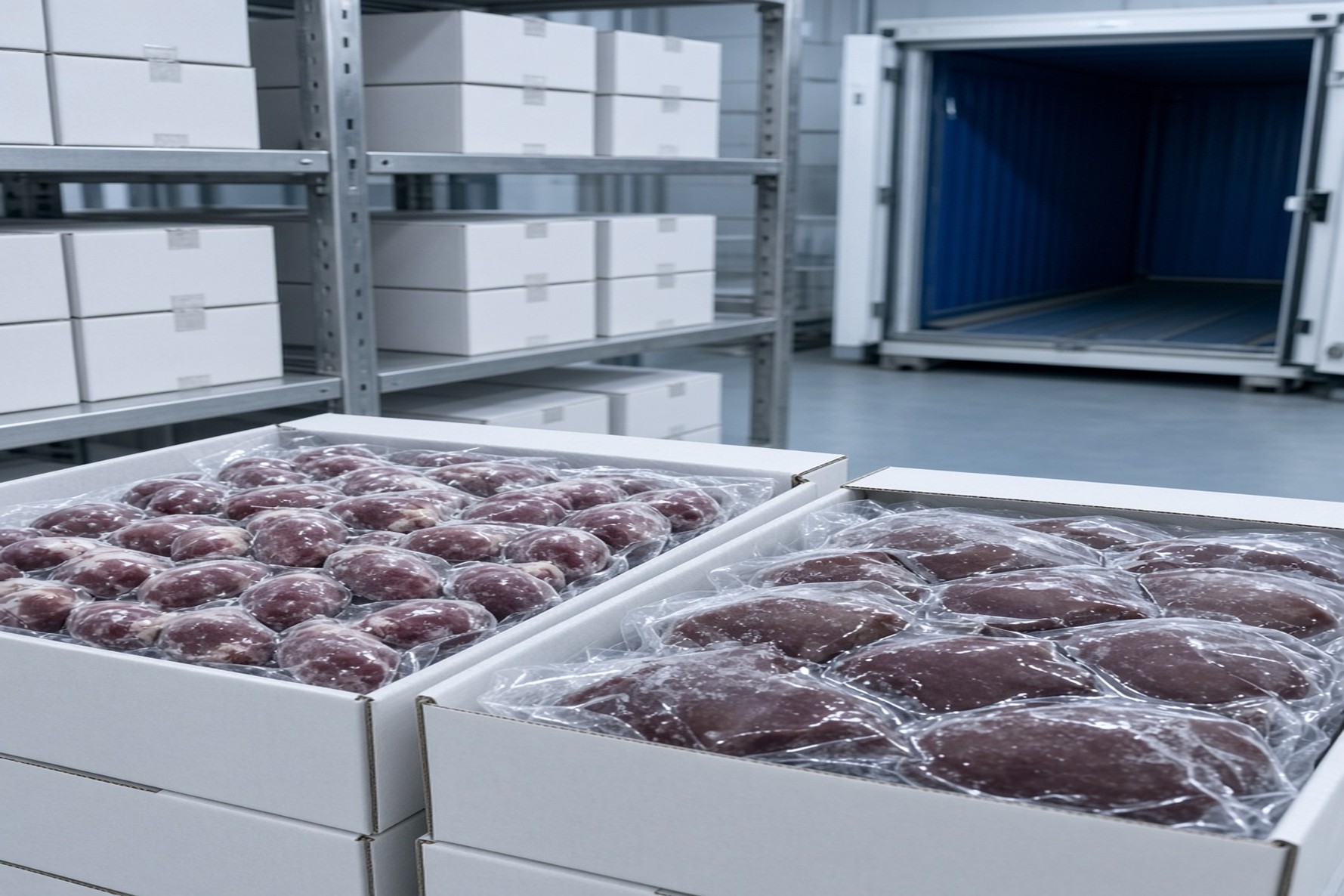
The most important principle in poultry offal export is that a reefer container is not designed to freeze product. Its main job is to maintain product that has already reached target temperature.
For quick-frozen products, Codex uses -18°C or below throughout the cold chain and requires product to reach target temperature at the thermal centre as well. Storage and transport must maintain those conditions with minimum fluctuation.
Stage 1: Organ separation
After slaughter and evisceration, heart and liver must be separated from inedible material and unwanted parts. Extended time in a warm environment or operational congestion on the line increases temperature and contamination risk.
Stage 2: Cleaning and inspection
At this stage foreign matter, damaged organs, and out-of-spec pieces must be removed.
For liver:
- Gall contamination must be controlled;
- Abnormal tissue must be removed;
- Severely damaged pieces must be separated.
For heart:
- Cleaning must meet buyer specifications;
- Clots and excess blood must be controlled;
- Attached tissue beyond contract tolerance must be removed.
Stage 3: Chilling
The process should move product to freezing with minimum delay. The abattoir HACCP plan should cover biological, chemical, and physical hazards relevant to this stage.
Stage 4: Freezing
Speed through the major ice-crystal formation zone affects texture quality. Slow freezing can create larger crystals and, after thawing, increase drip loss and texture deterioration.
“Frozen product” alone is therefore not enough technical specification. An industrial buyer may ask about freezing method, final core temperature, and transfer time to cold storage.
Stage 5: Cold storage
Product temperature must be maintained at -18°C or below. Repeated temperature fluctuation can cause recrystallisation, surface drying, colour change, and packaging damage.
Stage 6: Loading
Loading is one of the highest-risk points. Product must not remain on a warm platform for long periods.
Practical measures include:
- Pre-cooling the container according to transport instructions;
- Checking refrigeration unit performance;
- Measuring product temperature before loading;
- Fast loading;
- Maintaining air circulation path in the container;
- Not blocking air-distribution channels;
- Recording seal number;
- Using temperature recorders for sensitive shipments.
Stage 7: Sea transport and clearance
At destination the cold chain does not end when the vessel arrives. The interval between container discharge, inspection, clearance, and transfer to the importer’s cold store must be planned in advance.
| Control point | Main risk | Recommended control |
|---|---|---|
| After processing | Microbial load increase | Rapid transfer to chilling and freezing |
| End of freezing | Core still above target | Core temperature measurement |
| Cold store | Temperature fluctuation | Continuous temperature logging |
| Loading | Surface warming | Fast loading and suitable container |
| Transport | Refrigeration failure | Temperature records and equipment checks |
| Port delay | Clearance delay | Complete documents before arrival |
| Delivery | Dispute over transport conditions | Temperature report and delivery record |
6. Suitable packaging for frozen chicken heart and liver for Oman
Packaging must serve both the cold chain and the distribution model. Poor packaging causes drying, odour ingress, tearing, leakage, surface ice formation, and higher waste.
Bulk packs
For importers or food-service distributors, bulk packs are usually more efficient for transport and warehouse operations. Exact pack weight must be defined in the contract, and master cartons must withstand cold-store stacking.
Consumer packs
If product is ordered for retail, label design, pack size, mandatory information, and seal quality become more important.
Primary pack requirements
The primary pack should:
- Be suitable for direct food contact;
- Not become brittle at sub-zero temperature;
- Have a reliable seal;
- Protect against freezer burn;
- Prevent secondary contamination;
- Allow production ID and date marking.
Master carton
Cartons must retain sufficient strength in cold, humid conditions. Outer-carton information must match inner packs.
Practical items include:
- Product name;
- Net weight;
- Number of packs;
- Country of origin;
- Producer;
- Production batch;
- Production date;
- Expiry date;
- Storage conditions;
- Required halal information;
- Importer-agreed details.
7. Documents and permits required for entry into Oman
Export should not begin with production alone. First, the Omani importer must review entry requirements for that product from that origin country.
Oman’s official system states that applications for veterinary import permits for animal products must be submitted before the consignment leaves the exporting country. The issued permit is valid for one month, and the competent authority may require additional documents or conditions depending on product type, origin, or other factors.
Main documents listed for this permit include:
- Veterinary health certificate;
- Halal certificate for meat and poultry;
- Certificate of origin.
For inspection of incoming consignments, Oman also requires prior veterinary import approval. Documents cited for that stage include the official veterinary health certificate, certificate of origin, halal slaughter certificate for meat and meat products, and other relevant health documents. Official guidance also states that certificates must be authenticated by accepted methods.
Food product registration
For registration of imported food products, Oman may request documents including:
- Product image;
- Label artwork;
- Nutritional information report;
- Invoice and packing list;
- Laboratory report confirming compliance;
- Health certificate from the country of origin for the imported product.
Oman’s official food product registration service published these requirements in 2026 for review of product conformity with approved standards.
Exporters should therefore send label files to the importer before mass printing so regulatory review can be completed at destination.
8. Tariff code and the importance of precise classification
Chicken heart and liver fall in Chapter 02 of the Harmonized System. In current HS structure, heading 0207 covers poultry meat and edible offal, and subheading 020714 covers frozen edible chicken cuts and offal.
Final shipment classification must be determined from Oman’s current integrated tariff and the exact product description. This is especially important when one declaration includes several products such as heart, liver, gizzard, or other chicken parts.
Historical international trade data may be published on older HS versions. For example, 2023 data include an older line 020741 for frozen chicken parts and offal “other than liver”. That code should not be copied directly into today’s declaration; the tariff version in force in Oman at import must be used.
Oman Customs made the 2026 integrated tariff and duty calculation tools available for that year. Import duty must be calculated from the precise code, country of origin, value, and any applicable preferential regime — not from a single fixed percentage.
9. Quality control and pre-export testing
Testing is not only for obtaining a laboratory sheet. The purpose is to ensure shipped product matches the quality approved in the sample.
Microbiological control
Raw poultry products inherently require rigorous microbiological control. The test programme should be designed from product standard, Oman requirements, and agreed buyer specifications.
Items that may matter in hazard control and product testing include:
- Salmonella;
- Microbial counts relevant to process hygiene assessment;
- Hygiene indicator organisms;
- Other microbiological factors required by regulation or contract.
Acceptance limits should not be copied from another product. They must come from the valid standard for the product and destination regulations.
Sensory control
Sensory inspection remains highly important:
- Abnormal colour;
- Abnormal odour;
- Foreign matter;
- Freezer burn;
- Surface drying;
- Crushed or abnormal pieces;
- Gall marks on liver;
- Excess blood or incomplete heart cleaning.
Weight control
Net weight must match the contract. If product carries glaze or special conditions, the weight calculation method must be agreed before the deal so two suppliers are not compared on different units.
Sample-to-shipment alignment
The sample must represent actual production. Specifications approved on the sample should transfer to the order specification document.
To reduce dispute, the following can be recorded:
- Photo of approved sample;
- Sample date;
- Production ID;
- Test result;
- Pack specification;
- Visual defect criteria;
- Shipment sampling method.
10. Iran’s competitors in the Oman market and competitive logic
Oman import data show strong international suppliers in the broad poultry market. Brazil and the UAE supplied a significant share of Oman’s 2023 imports. In the older statistical line for frozen chicken parts and offal except liver, Brazil, the UAE, the United States, and Thailand were among the main suppliers.
This competitive structure sends several messages to an Iranian exporter.
| Competitive factor | Large international suppliers | Potential Iranian supplier opportunity |
|---|---|---|
| Production scale | High | Harder to compete on very large orders |
| Gulf export track record | Often strong | Needs documented history |
| Geographic distance | Can be long depending on origin | Iran has regional distance advantage |
| Order flexibility | May be more limited | Room to negotiate tailored orders |
| Custom packaging | Generally available | Can be developed by Iranian producer |
| Halal documentation | Established export structure | Must be fully aligned and traceable |
| Final price | Affected by scale and freight | Must be compared on delivered basis |
Iran’s advantage should not be sold only as “proximity”. Shorter distance becomes a commercial advantage only when sailing schedule, reefer container access, port cost, clearance time, and production stability are also suitable.
Competing on price or on specification?
For poultry offal, the cheapest offer is not necessarily the best. If a rival supplier offers cleaner product, stronger packaging, more accurate net weight, or a better documented cold chain, the importer’s real cost may be lower.
Comparison should therefore be based on “deliverable and sellable product price”, not origin price per kilogram alone.
11. How is export price for frozen heart and liver determined?
There is no fixed public price for this product. Even two offers for frozen chicken liver may not be technically comparable.
Main pricing factors include:
- Product: heart or liver;
- Cleaning level;
- Out-of-spec percentage;
- Appearance quality;
- Freezing form;
- Pack weight and design;
- Carton and pallet;
- Testing cost;
- Export certificates;
- Order volume;
- Production schedule;
- Delivery port;
- Reefer freight;
- Incoterms delivery basis;
- Destination costs if borne by seller.
Correct price comparison
Suppose the first seller offers a lower price but packs have variable weight and a higher damaged-piece rate. The second seller quotes higher but offers more accurate net weight, better cleaning, and more uniform quality.
The importer should calculate the final cost per kilogram of sellable product. Waste, weight shortfall, and customer returns are part of purchase cost.
12. Importer checklist before placing an order
Before issuing a purchase order, the importer or trading company should confirm at least the following:
- Confirm whether the product is heart or liver and avoid broad titles.
- Define cleaning specifications for each product.
- Obtain and evaluate a real commercial-production sample.
- Review abattoir status and ability to issue veterinary documents.
- Confirm halal certificate validity and Oman acceptance conditions.
- Review label artwork before mass printing.
- Define net weight per pack and master carton.
- Record visual defect acceptance criteria in the contract.
- Agree required tests before final shipment production.
- Define product temperature at container handover.
- Include temperature recorder use in the contract if needed.
- Define pre-shipment sampling and inspection method.
- Obtain Oman veterinary import permit before goods leave the exporting country.
- Match health, origin, and halal certificates to the shipment.
- Review current Oman tariff code against exact product description.
- Define remaining shelf life on arrival in Oman.
- Review sailing schedule and possible port delay or transhipment.
- Clarify delivery terms and who pays port and demurrage costs.
- Review cargo insurance and cold-chain failure coverage.
- Align final document set with importer and customs broker before vessel departure.
The clearer these points are before production, the lower the risk of dispute after the container arrives.
What information should be sent for an accurate price request?
A proper price request for frozen chicken heart or liver should include:
- Exact product name: heart or liver;
- Required cleaning form;
- Quality and acceptance criteria;
- Approximate order quantity;
- Weight per pack;
- Number of packs per carton;
- Consumer or bulk packaging requirement;
- Producer brand or buyer private label;
- Required tests;
- Halal conditions;
- Destination country: Oman;
- Delivery port;
- Preferred delivery terms;
- Number of containers or order tonnage;
- Planned purchase schedule.
A request stating only “price for one container of chicken liver to Oman” is not enough for professional comparison. Differences in packaging, net weight, cleaning quality, and delivery terms can completely change the outcome.
International buyers can submit these specifications through an Iranco purchase request so supply options in Iran can be reviewed against product, packaging, quantity, and destination.
Sourcing frozen chicken heart and liver from Iran for the Oman market
In export purchasing of poultry offal, the issue is not simply finding a plant that can produce the product. The supplier must be able to repeat the agreed specifications at commercial volume and deliver product with acceptable documents.
To evaluate a supply option, start with a short technical file covering product name, cleaning method, freezing form, pack weight, order volume, testing requirements, destination, and halal conditions. Then review sample and producer documents on that basis.
Iranco can be used to submit purchase requests for Iranian food-industry products at this stage. Importers can include frozen chicken heart or liver specifications, required volume, packaging, destination, and other commercial terms so suitable supply options can be reviewed against the same request.
For orders intended for Oman, halal certificate, veterinary certificate, label, net weight, transport temperature, and destination port should be defined from the first negotiation. That approach allows pricing to be issued from the start against a defined, comparable product rather than a generic title.
Conclusion
Export of frozen chicken heart and liver to Oman can become sustainable trade only when three subjects are managed together: hygienic and halal compliance, precise product definition, and cold-chain integrity.
From a regulatory standpoint, the Omani importer must obtain the veterinary import permit for animal products before the consignment leaves the exporting country. For meat and poultry, halal certificate sits alongside veterinary health certificate and certificate of origin as key documents. Product registration, labelling, laboratory reports, and other entry requirements should also be aligned before final packaging production.
From a technical standpoint, the most important operational number in the cold chain is -18°C or below for frozen product. But temperature control is not only setting the container display to that figure. Product must be fully frozen before loading, cold store and container must be capable of maintaining conditions, and time on the quay and during loading must be minimised.
Commercially, heart and liver should be traded separately with clear specifications. Cleaning, visual defects, gall contamination, net weight, packaging, test results, traceability codes, and delivery terms must all transfer into the contract.
For an Iranian supplier, competition in Oman depends above all on the ability to repeat quality and document credibility. Iran’s geographic proximity becomes an advantage only when product is delivered with stable standard, documented cold chain, and a complete export file.
Frequently asked questions
Does export of frozen chicken heart and liver to Oman require a halal certificate?
Yes. Under Oman’s official requirements for veterinary import permits on animal products, meat and poultry must be accompanied by a halal certificate. Veterinary health certificate and certificate of origin are also among the main listed documents. Halal status should therefore be confirmed with the Omani importer before production and shipment.
What is the correct transport temperature for frozen chicken heart and liver?
The technical baseline for quick-frozen products is storage at -18°C or below. That temperature must apply to the product itself, not only the number shown on the container unit. Measuring product temperature before loading and recording transport conditions greatly reduces dispute at destination.
Can a reefer container freeze fresh product in transit?
In a professional export programme, a reefer container should not be treated as the primary freezing device. Product should reach target temperature at the plant before entering transport. The container’s main role is to maintain frozen temperature and remove heat ingress within its design capacity.
What is the most important defect in export chicken liver?
Gall contamination is one of the key defects. Gall bladder damage during evisceration can cause abnormal staining and bitter taste. Abnormal colour, off odour, severe freezer burn, major tissue tearing, and foreign matter should also be controlled during inspection.
Can heart and liver be mixed in one master carton?
Commercially, each product should be packed and coded separately unless the importer explicitly orders a defined mixed pack. Separation simplifies weight control, pricing, traceability, inventory management, and quality assessment and reduces delivery disputes.
What is the shelf life of frozen chicken heart and liver?
Shelf life should not be set by one generic number for all plants. Production process, freezing speed, packaging type, storage temperature, producer validation, and applicable standards all play a role. The buyer should define the producer’s declared shelf life and remaining life on arrival in Oman in the contract.
Can any Iranian halal certificate be used for export to Oman?
The words “halal certificate” alone are not enough. The certificate must align with the product, production unit, and shipment, and its acceptance must be reviewed by the importer and Omani authority. This should be confirmed before production, not after arrival at an Omani port.
What information is needed to buy frozen chicken heart or liver from Iran?
At minimum, specify exact product name, cleaning level, pack weight, order volume, packaging type, required tests, destination, delivery terms, and halal requirements. Buyers can enter these details in an Iranco purchase request so available supply options in Iran can be reviewed on the same basis.
Does frozen heart and liver price depend only on order weight?
No. Cleaning quality, product uniformity, pack type, carton cost, testing, export certificates, transport conditions, reefer freight, destination port, and delivery terms all affect final price. Two offers should be compared only on identical technical specifications and delivery basis.
What is the most important action before loading for Oman?
One of the most important steps is ensuring the veterinary import permit is issued before the consignment leaves the exporting country. At the same time, final versions of health, halal, and origin certificates, packing list, invoice, and label information must match the shipment. A complete file reduces the risk of unnecessary hold at destination.
Featured Products
Related Articles



