 Iranco Magazine Team
Commercial guide to Saudi Food and Drug Authority (SFDA) rules, GSO standards, export packaging and cold-chain logistics
Export guide · Saudi Arabia · SFDA · FIRS · GSO · Fasah
Iran Food Export to Saudi Arabia: Market Opportunities and Food Product Entry Requirements
Commercial guide to Saudi Food and Drug Authority (SFDA) rules, GSO standards, export packaging and cold-chain logistics
Introduction — why this SFDA guide for Iranian food exports?
Saudi Arabia is a top Gulf destination for Iranian food producers: large population, strong purchasing power, steady demand for nuts, saffron, tomato paste and packaged foods, plus modern retail alongside a huge HRI sector (hotels, restaurants and industrial catering).
This article has ten technical–commercial sections: market structure and key cities, product basket and HS codes, lab specifications, SFDA/FIRS/halal and contaminants, GSO 9 labelling, tariffs and VAT, export packaging, logistics, competitors and industrial buyers. It closes with a summary, 12-step importer checklist, RFQ fields, eight FAQs and Iranco contact.
Iranco (iranco.com) supports Iranian exporters with Saudi importers for SFDA compliance and repeat orders — not one-off introductions only.
1. Market structure — retail, HRI and Riyadh / Jeddah / Dammam
Final sales compete across modern and traditional retail, HRI (hotels, restaurants, catering and industrial kitchens) and direct supply to food factories. Define upfront whether the pack is consumer shelf, HORECA bulk or industrial — FIRS, labels and QC differ.
Geography clusters around Riyadh (central/east), Jeddah (west, Hajj and Red Sea ports) and Dammam/Khobar (east, industry and Gulf ports). Entry port should match the buyer’s warehouse city.
| Channel / city | Chain role | Compliance pressure |
|---|---|---|
| Retail (Riyadh, Jeddah) | Shelf, brand, promo | GSO 9, FIRS, barcode, 50% shelf life |
| HRI & catering | Repeat volume, bulk pack | COA, batch uniformity, halal if needed |
| Dammam / east | Ocean entry, regional DC | Fast Fasah, standard pallets |
| Jeddah / west | Hajj and western distro | Arabic label, haul temperature |
- Retail: Panda, Tamimi, Danube and regional chains — listing and remaining shelf life
- HRI: 4–5 star hotels, pilgrim catering and institutional contracts
- Industry: paste, beverage, confectionery and nut packing lines
2. Iranian product basket — HS codes, priorities and dates note
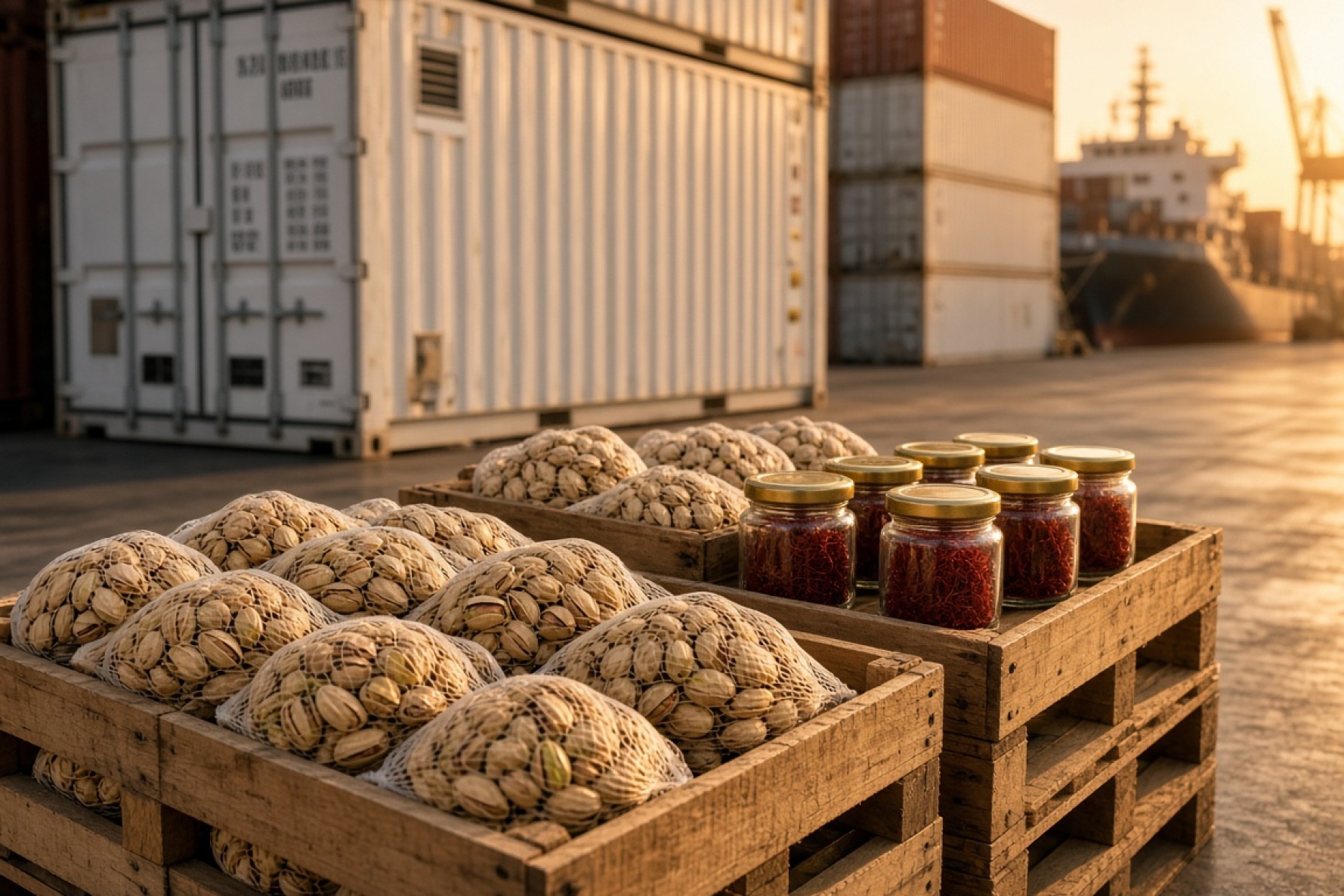
Iran holds supply advantages in pistachios, saffron, raisins, tomato paste, concentrates and selected spices. Processed food imports into KSA (est. ~USD 10.8B) show opportunity for packaged goods and industrial inputs — not only bulk.
Always confirm the 12-digit GCC HS code with the importer; duty depends on the subheading.
| HS (chapter) | Iranian product | Target channel |
|---|---|---|
| 0802.51 | Pistachios in shell | Retail / HRI / nuts |
| 0910.20 | Saffron | Premium retail & restaurants |
| 2002.90 | Tomato paste | Factory & retail |
| 0806.20 | Raisins | Shelf & confectionery |
| 2103.90 | Sauces & preparations | HRI & plants |
3. Laboratory specifications — pistachio, saffron and paste
B2B contracts without clear lab parameters cause disputes at the port. SFDA may re-sample; exporter COA must match the same batch and agreed limits.
For pistachios, a 10 ppb total aflatoxin cap (B1+B2+G1+G2) is a common reference in Saudi retail contracts — above that risks rejection or rework.
| Product | Parameter | Reference / note |
|---|---|---|
| Pistachio | Aflatoxin total | ≤ 10 ppb (typical contractual) |
| Pistachio | Moisture, kernel % | Per grade & nut GSO |
| Saffron | ISO 3632-2 | Colour, taste, aroma |
| Saffron | Heavy metals, dyes | Border rejection risk |
| Tomato paste | Brix, pH, lycopene | Industry & retail |
| Paste / canned | Microbiology, hermetic seal | Sterile / aseptic |
- Accredited lab and COA with batch number before loading
- Retention sample 6–12 months for potential disputes
- Align units (ppb, mg/kg) on invoice and COA
4. SFDA, FIRS platform, halal and contaminants
Commercial food imports go through importers registered with the Saudi Food and Drug Authority (SFDA). Establishment and product registration in the FIRS (Food Import Registration System) is required before cargo arrives — Iranian exporters do not register directly but must confirm registration ID, trade name on labels and product category before mass print.
Clearance runs through Fasah with consistent documents. Products with animal origin need halal certificates from bodies accepted by the Saudi Halal Center (SFDA.FD/GSO 2055-1 framework).
- FIRS: HS, formula, Arabic label image, GTIN barcode — update after material changes
- Fasah: COO, invoice, BL, health/phytosanitary, COA, halal if applicable
- Halal: meat, poultry, gelatin, some flavours — not all dried nuts
- Contaminants: aflatoxin, metals, pesticide MRL — GSO and SFDA.FD limits
5. Labelling — SFDA.FD/GSO 9 and shelf life
Mandatory consumer pack information must be in Arabic; other languages are supplementary and must match Arabic. Saudi retail often requires at least 50% remaining shelf life on warehouse receipt — build production and expiry dates accordingly.
- Product name and ingredient list — accurate Arabic
- Allergens, net weight, manufacturer/packer name and address
- Production and expiry (or BB), batch, storage conditions
- Country of origin Iran, EAN-13 barcode
- Nutrition and health claims only under SFDA.FD 2333
Align artwork with the importer and FIRS record before print — Iranco can request approved label samples from prior suppliers in the RFQ.
6. 12-digit GCC duty and 15% VAT
From 2025 the unified GCC tariff is 12-digit. Standard Saudi VAT is 15% and must be modelled separately from customs duty in landed cost. The importer confirms the final rate; the exporter must show the correct HS on documents.
| Item | Rate / value | Note |
|---|---|---|
| Customs duty (CIF) | 5% example (packaged food) | Depends on HS subheading |
| VAT | 15% | On customs value + duty |
| Fasah & port fees | Variable | Per importer agreement |
| SFDA testing | If sampled | Exporter/buyer per PI |
| Inland haul | Dammam–Riyadh / Jeddah | Importer or CFR |
7. Export packaging — MAP, aseptic, saffron and pallets
Heat and coastal humidity make packaging decisive. Pistachios and nuts: 5-ply cartons, inner moisture control or MAP for retail. Paste and puree: aseptic or sterile packs with hermetic seals. Saffron: glass or tin with inner seal, light protection and authenticity marking.
- EUR/ISO pallets, stretch film, corner boards — Dammam/Jeddah handling
- Carton marks: Arabic name, batch, weight, this-way-up
- Retail: consumer-facing Arabic and scannable barcode
- Saffron: small packs with QR or serial against adulteration
8. Logistics — routes from southern Iran to Saudi ports
Iran has no direct land border with Saudi Arabia; the main lane is ocean from Bandar Abbas, Bandar Lengeh or Chabahar to King Abdulaziz (Dammam) or Jeddah. Saffron and urgent samples may fly to Riyadh or Jeddah.
| Route | Approx. time | Best for |
|---|---|---|
| Bandar Abbas → Dammam | 3–5 days ocean | Pistachios, paste, dried fruit to east/Riyadh |
| Bandar Abbas → Jeddah | 5–7 days | West, Hajj, planned saffron |
| Chabahar → Dammam | Variable | South-east Iran origin |
| Air (via hub) | 1–3 days | Saffron, samples, urgent |
9. Shelf and B2B competitors — Iran vs other origins
Pistachios compete with the US and Turkey, saffron with Spain and Afghanistan, paste with China and Italy. Iran’s durable edge is often batch quality, geographic proximity and SFDA-ready documentation — not lowest FOB.
| Product | Main competitors | Iran edge |
|---|---|---|
| Pistachio | USA, Turkey | Flavour, natural grades, short sea lane |
| Saffron | Spain, Afghanistan | ISO 3632, premium pack |
| Tomato paste | China, Italy | Brix, industrial contracts |
| Raisins | Turkey, Chile | Golden colour, B2B price |
10. Industrial and HRI buyers — long-term contracts
Confectionery, beverage, sauce and industrial catering plants need stable supply, fixed COA and 10–25 kg packs. SFDA-registered importers are usually intermediaries; Iranian exporters should state monthly capacity and technical documents clearly in the RFQ.
- Processing plants: paste, puree, concentrate — Brix and microbiology specs
- Catering & HORECA: shelled pistachios, spices, oils — bulk packs
- Retail private label — higher MOQ, earlier FIRS filing
- Iranco: matches RFQs to ISO plants with Gulf export track record
Summary
Successful Iranian food exports to Saudi Arabia combine market choice (retail, HRI, industry), compliance (FIRS, GSO 9, Fasah, halal), testing (10 ppb aflatoxin for pistachios in common contracts) and logistics (Dammam vs Jeddah).
Importers who receive 50% shelf life, valid COA and approved labels on the first shipment repeat faster — Iranco supports RFQ, samples and producer coordination.
12-step importer / exporter checklist
- Confirm sales channel (retail, HRI or industry)
- Select importer active in FIRS and SFDA
- Align 12-digit HS and duty with importer
- Agree COA (aflatoxin ≤ 10 ppb for pistachios if applicable)
- Approve Arabic GSO 9 label artwork before print
- Review halal for animal-origin products
- Minimum 50% remaining shelf life for retail
- MAP/aseptic/pallet packaging per product
- Choose port (Dammam / Jeddah) and Incoterms
- Fasah document set (COO, invoice, BL, health, COA)
- Pre-load QC and matching batch numbers
- Submit RFQ or order via Iranco for B2B support
RFQ fields — enquiry via Iranco
- Product name and grade (pistachio / ISO saffron)
- Proposed HS and target channel (retail / HRI / industry)
- Monthly quantity, pack type and MOQ
- Test parameters and aflatoxin cap
- Minimum shelf life on arrival in KSA
- Destination port, Incoterm, brand or private label
Iranco routes complete requests to Iranian producers with Gulf export history and SFDA-friendly documentation.
Frequently asked questions
What is FIRS and what does the Iranian exporter do?
FIRS is SFDA’s food import registration system. The Saudi importer registers company and product; the exporter must align labels, formula and COA with the FIRS record.
Can we export to Saudi Arabia without FIRS registration?
For local market sale, product registration is mandatory. Confirm registration status in writing before loading.
What is the pistachio aflatoxin cap in Saudi Arabia?
See GSO/SFDA legal limits; B2B contracts often reference 10 ppb total for export-grade pistachios.
What minimum remaining shelf life does retail require?
Commonly 50% of shelf life at buyer warehouse receipt — state in the PI.
Dammam or Jeddah from Bandar Abbas?
Dammam for Riyadh and east; Jeddah for west and Hajj networks. Model freight and demurrage for both.
Is English labelling alone sufficient?
No. Mandatory information must be Arabic under SFDA.FD/GSO 9.
How are VAT and duty calculated?
Duty on CIF per 12-digit HS; then 15% VAT — importer runs final calculation.
How do I enquire via Iranco?
Send technical specs, volume, packaging and port; use iranco.com contact or route('contact').
Iranco — bridge for Iranian food exports to Saudi Arabia
Iranco (iranco.com) connects Iran’s B2B food export network with Saudi importers for FIRS, GSO 9, laboratory QC and Dammam/Jeddah logistics.
- Pistachios, saffron, paste, dried fruit and packaged foods
- COA, COO and Fasah document alignment support
- Samples, MOQ and repeat B2B contracts
Featured Products












Related Articles



