 Iranco Magazine Team
A complete guide to RFQs, export proforma invoices, quality specs, Incoterms 2020 and container logistics in international food trade
Price inquiry · Proforma · Incoterms · Cold chain
How to Prepare a Professional Price Request for Selling Food Products to Foreign Importers
A comprehensive guide to drafting price inquiries, export proforma invoices, quality specifications, Incoterms rules, and container logistics in international food trade
Preparing a price inquiry and export quotation in the food industry is a technical, legal, and logistics document that determines deal profitability and the durability of commercial relationships with foreign buyers. This practical guide examines laboratory specification methods, Incoterms rules, proforma structure, customs error control, and cold-chain management to provide a clear path for structuring commercial offers in global markets.
Cross-border trade in food products and agricultural goods in international markets is a multifaceted process operating under direct oversight from health authorities, standards organizations, quarantine agencies, and border customs. In this fast-moving environment, sending a simple quote consisting of a raw number and product name is widely seen as a lack of awareness of foreign-trade rules and removes the offer from review by professional purchasing managers and importers. Importers, distributors, and overseas processing plants receive dozens of offers daily and prioritize quotes that, at first glance, clarify technical dimensions, laboratory indicators, logistics commitments, cargo securing methods, and legal foundations.
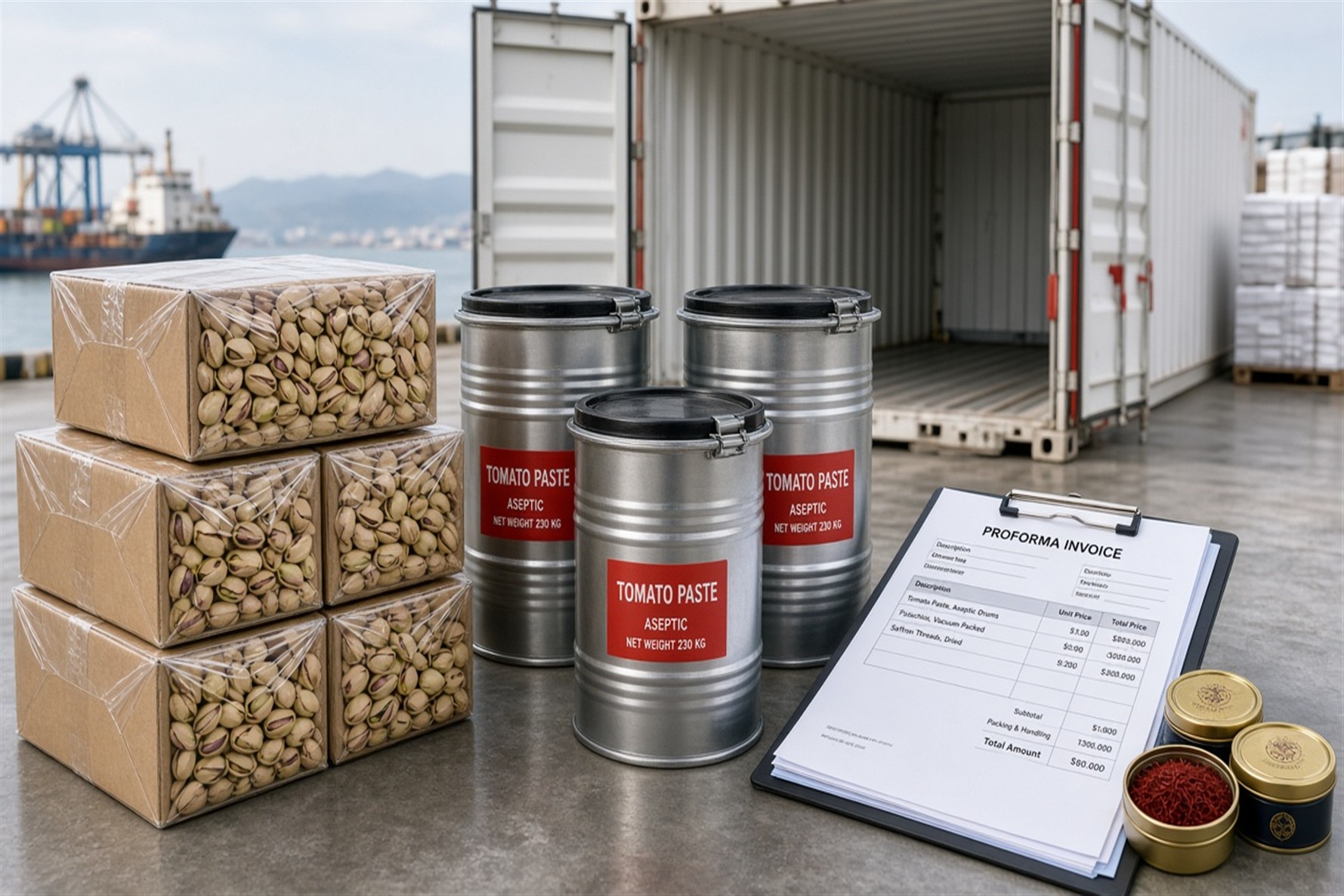
Iranian producers and exporters benefit from climatic diversity, access to open waters, and competitive production of strategic items such as pistachios, dates, saffron, tomato paste, and fruit concentrates—creating exceptional opportunities in Gulf countries, the Eurasian Economic Union, East Asia, and Europe. Turning that production capacity into stable financial contracts, however, requires mastery of international price-inquiry and proforma drafting. An expert price quote must protect the exporter’s margin while giving the importer the operational transparency needed to control inspection risk, clearance costs, freight volatility, and sanitary requirements as precisely as possible. This report dissects the step-by-step structure and rules for preparing export price offers.
1. Nature and document cycle of price inquiry and quotation in international food trade
Document flow in foreign food trade follows defined stages; neglecting any step can lead to legal deadlock or financial loss. The formal process begins with the buyer’s request for quotation (RFQ) and ends with issuance of a price quote, exchange of technical specifications, and final confirmation of the proforma invoice.
Fundamental difference between initial quote and formal proforma
A commercial quote or quotation sheet is treated as an initial, legally non-binding evaluation document. Its purpose is to state a base price range based on order volume, packaging type, delivery terms, and minimum order quantity (MOQ). By contrast, the proforma invoice is a more binding document issued after the parties reach preliminary agreement. It contains full banking details, precise technical specifications, firm delivery timing, and legal conditions. The importer uses this formal document to obtain foreign-exchange allocation in the destination country’s banking system, register government import orders, and secure health and quarantine permits. Any change to proforma content after issuance can block import clearance in the destination country.
Commercial offer lifecycle and validity period
Food, grains, and agricultural products are directly tied to harvest seasons, commodity exchange volatility, fuel costs, and regional supply and demand shifts. Accordingly, including a “price validity period” clause in the quote or proforma is a core element of financial risk management. Price-offer validity in food trade is generally set at 3 to 5 business days. This short window protects the exporter against sudden rises in raw-material purchase prices in local markets, FX spikes, and changes in shipping line tariffs. In large bulk deals, exporters often add a clause making validity conditional on the seller’s final confirmation after receipt of advance payment.
Foreign buyer validation and sales-channel segmentation
Before drafting a price offer, a precise analysis of the buyer’s sales channel is mandatory. Pricing structure, product grade, and packaging model differ fundamentally for an industrial processor versus a chain supermarket or traditional wholesaler:
- Processors and conversion industries: Require chemical stability, functional indicators such as cooking behavior or heat stability, a valid certificate of analysis, and cost-effective bulk packaging such as aseptic drums or bulk bags.
- Chain stores and retailers: Focus on attractive design, multilingual nutrition labeling, destination-country health approvals, ambient shelf life, and small consumer pack weights.
- Wholesalers and regional market stockists: Are sensitive to delivery speed, available tonnage, packaging resistance to repeated handling, and competitive price per kilogram.
Document flow in international trade from price inquiry to deal closure is sequential. First, the buyer’s inquiry is received and production feasibility and quality alignment are assessed. Second, an initial quote is prepared and sent based on logistics cost and the chosen Incoterm. Third, after the buyer confirms terms and physical samples are exchanged, a formal proforma is drawn up to open bank import registration. Finally, upon receipt of foreign-currency advance payment, loading begins and definitive commercial documents are issued.
2. Technical specification structure and laboratory parameters expected by foreign buyers
The largest technical gap in price offers from inexperienced companies is failure to define quality indicators using numerical and laboratory criteria. Describing goods with generic qualitative terms such as “high quality” or “grade one” has no expert value in foreign trade and prevents purchasing specialists from evaluating the product correctly.
Essential physicochemical indicators for food products
The price offer should disclose the technical specification and allowable ranges for physicochemical properties. Before any negotiation, buyers verify alignment with their formulation or end-use requirements:
- Brix: Indicates the weight percentage of dissolved solids in liquid; used in tomato paste, fruit concentrates, and industrial purées. For export tomato paste, Brix 36–38 for bulk aseptic loads and Brix 28–30 for retail cans are the main indicators for concentration and price alignment.
- Moisture: A primary variable for texture, mold risk, and microbiological spoilage in grains, pulses, and dried nuts. For example, maximum pistachio moisture should not exceed 6%; dry Piarom dates are typically around 15–18%, and moist Mazafati dates around 28–32% as industrial standards.
- Acidity and pH: Baseline parameters for thermal process control and prevention of anaerobic bacterial spore growth. In tomato paste, total acidity on a citric-acid basis is usually controlled in the 2–2.5% range and pH in the 4.1–4.3 range.
- Fat and protein content: In pulses, oilseeds, and industrial milk powder, dry protein percentage and total fat percentage are primary quality and pricing indicators.
Certificate of Analysis (COA) and document consistency
The Certificate of Analysis (COA) is a specialist document reflecting laboratory test results for a specific sample or production batch. It is issued by the plant’s qualified laboratory or independent accredited testing centers. Commercial correspondence should state whether the attached sheet relates to a laboratory sample or reflects definitive results for the export batch. Matching product trade name, batch code, and test types on the COA with the final invoice and packing list is a customs necessity; even minor mismatches in names or identifiers will halt import clearance.
Maximum residue limits (MRL), mycotoxins, and heavy metals
The most sensitive checkpoint in global trade in food and agricultural products is maximum residue limits (MRL) for pesticides and toxins. Destination market regulatory standards differ significantly. For example, total aflatoxin in pistachios for entry to EU member states is 4 ppb and aflatoxin B1 is 2 ppb, while markets such as China or Russia may accept up to 10 ppb. Exporters must therefore ensure laboratory compliance of the shipment with the destination country’s official standards before issuing a firm quote.
Food safety management systems and halal certification
A professional quote should disclose production facility health standards and accreditations. Implementation of ISO 22000 and Hazard Analysis and Critical Control Points (HACCP) reflects hygienic discipline in processing. For exports to Islamic countries in the Gulf and North Africa, valid halal certification from centers recognized by the importer’s official bodies—such as Saudi Arabia’s SFDA—is a non-negotiable requirement.
| Product category | Key technical indicators on the quote sheet | Mandatory certificates and tests | Importance for international buyers |
|---|---|---|---|
| Pistachio | Variety, ounce size, natural open-shell ratio, moisture below 6%, misshapen kernels below 2% | Total and B1 aflatoxin, pesticide residues, phytosanitary certificate | Safe passage through health inspections at destination clearance ports |
| Saffron | Crocin (coloring strength > 220), picrocrocin, safranal, moisture below 12% | ISO 3632, color purity testing, heavy metals | Assurance of purity grade and no adulteration for food and pharmaceutical use |
| Tomato paste | Brix (36–38 bulk aseptic or 28–30 cans), acidity, pH, color stability | Howard mold count, heavy metals testing, HACCP | Suitability for dilution, sauce production, and direct industrial use |
| Dates | Variety (Mazafati, Piarom, Zahedi), moisture level, weight calibration, no sugar crystallization | Quarantine certificate, live/dead storage pest inspection, fumigation card | Assurance of sound texture in distribution networks and shelf life |
3. Product classification with HS Code and controlling clearance risk
In foreign-trade correspondence, the Harmonized System (HS Code) is the common language among traders, customs officers, and insurers. The tariff code not only defines the legal identity of the product but directly determines import duty rates, import taxes, eligibility for preferential tariffs, and the need for special technical permits in the buyer’s country.
International code structure and national extensions
The first six digits of the tariff code are fully uniform across World Customs Organization (WCO) member countries:
- The first two digits identify the chapter.
- The next two digits indicate the main heading.
- Digits five and six define the product subheading.
Countries extend national tariff codes from the seventh digit onward for finer tax and statistical tracking. For example, the European Union uses 8-digit combined codes and 10-digit TARIC codes, and the United States applies a 10-digit Harmonized Tariff Schedule. Omitting the tariff code or entering an incorrect code on the proforma distorts the buyer’s duty calculations and can lead at clearance to penalties, mandatory container unloading for forensic inspection, or cancellation of the customs declaration.
Tariff hierarchy for agricultural products has many legal nuances. For example, in Chapter 08 of the customs nomenclature (edible fruit and nuts), heading 0802 covers other nuts. Subheading 080251 denotes pistachios in shell and 080252 covers shelled pistachio kernels. Swapping these two codes because of large differences in value added and duty is treated as customs violation and misdeclaration at import ports.
| Export product category | Global 6-digit HS code | Example national subcodes | Technical and customs notes |
|---|---|---|---|
| Pistachios in shell | 080251 | 08025100 | Clear separation from kernels to avoid inflating the customs value base |
| Shelled pistachio kernels | 080252 | 08025200 / 08025220 | Highly moisture-sensitive; full microbiological load testing required |
| Fresh or dried dates | 080410 | 08041040 (Mazafati) / 08041030 (Piarom) | Moisture difference between soft and dry dates affects import duty |
| Saffron | 091020 | 09102010 (Sargol/Negin) / 09102020 (powder) | Tariff line varies with retail pack weight |
| Tomato paste | 200290 | 20029010 / 20029090 | Separation of industrial bulk aseptic containers from metal can retail packs |
4. Smart use of Incoterms 2020 and managing risk transfer points
Quoting a selling price without an explicit international commercial term (Incoterms 2020) is one of the most common sources of dispute in food transactions. Incoterms define the boundaries of freight cost and responsibility, customs permits, inspection documents, and—most importantly—the exact moment physical loss or quality deterioration transfers from seller to buyer.
Sea and inland waterway terms are most widely used for commodity sales:
- FOB — Free on Board: The seller must pack goods at the factory, manage inland haulage to the port of loading (such as Bandar Abbas), complete export customs clearance, and load cargo onto the ship’s rail or deck. Once goods are on board, physical loss risk and ocean freight costs pass to the buyer.
- CFR — Cost and Freight: The seller also bears ocean freight to the agreed destination port (such as Jebel Ali, Mumbai, Mersin, or Shanghai). However, the risk transfer point for damage remains the port of loading.
- CIF — Cost, Insurance and Freight: The seller must arrange marine cargo insurance for the buyer’s benefit and pay the premium. Under Incoterms 2020, CIF requires minimum insurance coverage under Institute Cargo Clauses C. Given food spoilage risk, buyers often request upgrade to Clause A (all-risks); the extra cost should be reflected in the quote formula.
For high-value air shipments such as saffron, or goods moved in refrigerated container trucks overland to Russia, Turkey, or Iraq, traditional sea terms are legally inappropriate. Multimodal rules should be used:
- FCA: Delivery at a land border terminal, bonded warehouse, or airport after export clearance is complete.
- CPT: Payment of road, rail, or air freight to the agreed airport or border warehouse in the destination country.
- CIP: Freight plus high-level insurance (Clause A) to the named destination—the strongest security for valuable air shipments.
| Commercial term | Seller carriage obligations | Export clearance | Cargo insurance | Physical risk transfer location |
|---|---|---|---|---|
| EXW | No carriage obligation | Buyer’s responsibility | None | Seller’s warehouse or factory at origin |
| FCA | To terminal or warehouse at origin | Seller’s responsibility | None | When delivered to first carrier |
| FOB | To ship’s rail/deck at origin | Seller’s responsibility | None | After full placement on vessel at origin |
| CFR | To discharge port at destination | Seller’s responsibility | None | After full placement on vessel at origin |
| CIF | To discharge port at destination | Seller’s responsibility | Minimum Clause C | After full placement on vessel at origin |
| CIP | To destination terminal (multimodal) | Seller’s responsibility | Comprehensive Clause A | When delivered to first carrier |
| DAP | To agreed place at destination | Seller’s responsibility | None | On arriving means of transport ready for unloading at destination |
| DDP | To buyer’s final warehouse | Seller (origin and destination) | Seller’s responsibility | After clearance and entry to warehouse at destination |
5. Cost engineering and base-price formula with currency conversion
Final export pricing for food products cannot be built on trial and error or casual reference to domestic spot rates. A professional trader must break down cost of goods sold and include hidden costs such as capital tie-up, exchange fees, mandatory inspections, and natural weight loss during storage in the financial model.
The export cost aggregation formula on an FOB basis is structured as follows:
If the importer requests a quote on CFR basis (delivery at their country’s discharge port), container freight per ton or per container is added. When CIF is requested, marine insurance cost based on the standard coverage factor (usually 110% of cargo value) is included in the formula. Applying these relationships precisely prevents hidden losses from FX deductions and differing insurance calculation bases.
6. Standard structure and mandatory fields of the formal export proforma invoice
The formal proforma is the document that sets out the legal and commercial terms of the deal. Any inconsistency in drafting it can cause the buyer’s banking process to stall, documentary credit rejection, or prolonged customs clearance delays.
Mandatory information fields
- Party identification: Full legal name of the exporting company, registration number, tax ID, exact address, official email, phone number, and buyer or nominated agent details.
- Document serial number and issue date: A unique internal reference number with issue date and explicit validity period.
- Commercial description and product grade: Precise Latin product name with grade, kernel dimensions, physical specs; avoid generic or vague titles.
- Harmonized tariff code (HS Code): At least the first six digits for verification in destination customs systems.
- Weights and packaging: Clear separation of net cargo weight, gross weight including packs and pallets, number of packages, and cubic volume.
- Unit price and currency basis: Explicit unit rate per kilogram or ton, foreign currency (EUR, USD, AED, or CNY), Incoterm, and exact named port or delivery point.
- Payment terms and full banking details: Settlement formula plus SWIFT code, IBAN, exact account holder name, and intermediary or correspondent bank details.
Supplementary legal and protective clauses
- Force majeure: Relief of civil liability for war, natural disaster, closure of international waterways, or sudden export/import bans by governments.
- Weight and quantity tolerance: Allowance of ±5% deviation in total weights and loading specifications due to terminal operational tolerance and natural moisture loss in agricultural products.
- Dispute resolution and arbitration: Designation of competent courts or ICC arbitration before litigation.
- Finality of pre-shipment inspection certificate: Statement that quantity and quality inspection by reputable international firms at the port of loading is the definitive compliance document and basis for final settlement.
| Information block | Mandatory fields | High-risk supplier error | Consequence of error |
|---|---|---|---|
| Header and date | Document number, issue date, validity period | No quote expiry date | Obligation to deliver at prior rate during raw-material price spikes |
| Buyer identity | Full company name, registration ID, address, email | Informal names used | Document rejected in import registration and destination bank clearance |
| Product technical specs | Scientific name, grade, Brix/moisture, HS code | Generic qualitative titles | Non-compliance with industrial or destination standard requirements |
| Shipment weights | Net, gross, carton and pallet counts | Failure to separate net and gross | Customs manifest mismatch and severe port penalties |
| Incoterms rules | 2020 edition + terminal/port name | Abbreviation without named port | Disputes over port charges, THC, and transit risks |
| Financial and banking data | IBAN, SWIFT, exact account holder name | Beneficiary name differs from seller | Foreign correspondent banks block funds |
7. Packaging standards, container securing, and cold-chain management
In food export, packaging does more than physical protection; it is a biochemical barrier against oxygen, water vapor, light, and microbiological contaminants and improves container loading efficiency.
Industrial bulk packaging versus retail consumer packs
- Industrial and bulk packaging: For inputs such as tomato paste and fruit purée, 220-liter aseptic metal drums with multilayer impermeable bags (aluminum–polyethylene) are the global standard. For pistachio kernels and dates, sturdy 5-layer cartons with vacuum bags help prevent oil rancidity and pest infestation.
- Consumer and retail packaging: Includes glass jars, lacquered food-grade metal cans, and impermeable bags under modified atmosphere (MAP) with neutral gases such as nitrogen. Label design must meet nutrition information, target-market official language, dates, and importer details.
Standard palletization and wood treatment
At international terminals, wooden pallets must be heat treated (HT) or methyl bromide fumigated under ISPM 15 and bear the official phytosanitary mark on the feet. Cartons on standard export pallets (100×120 cm or 80×120 cm) should be secured with corner boards, multiple layers of heavy stretch film, and robust strapping so they do not collapse in sea motion.
Cold-chain logistics and sensitive cargo
For fresh produce, vegetables, and moist date varieties such as Mazafati, uninterrupted cold chain until delivery to the buyer is the main quality condition. Transport requires reefer containers with independent gensets during road legs. Quotes and shipping documents should state set temperature, ventilation, and relative humidity in the container.
| Product type | Standard export packaging pattern | Container conditions and transport temperature | Capacity in 20-foot container |
|---|---|---|---|
| Pistachios in shell/kernels | 25–50 kg bulk bags or 10 kg vacuum cartons | Standard dry container, ambient humidity below 60% | 16–18 tons palletized |
| Export saffron | 1–5 kg bulk metal cans or retail packs under 10 g | Commercial air freight, ventilated cabin | Order-dependent (air shipment) |
| Tomato paste | 220 L metal drum with aseptic liner on 4-drum pallets | Standard dry or chilled reefer | 80 drums (approx. 18–19.5 tons) |
| Moist Mazafati dates | 550–650 g consumer boxes in printed master cartons | Reefer at −5°C to 0°C | Approx. 16–18 tons palletized |
8. International payment mechanisms, third-party inspection, and document alignment
Buyer acceptance of a price quote leads to contract only when settlement protocols and product compliance inspections are fully clarified.
Common payment patterns in cross-border food trade
- T/T advance: Sellers typically require 30–50% of invoice value as deposit before sourcing and sorting begin, with balance tied to bill of lading copies and inspection certificate.
- Irrevocable at-sight letter of credit (L/C): In large agricultural deals, the issuing bank guarantees payment after the exporter presents compliant shipping documents. This structure requires strict UCP 600 ICC rules.
- Documents against payment (D/P): The correspondent bank in the destination country releases original title documents only after the buyer pays in full.
Third-party inspection at origin (SGS and peers)
Major importers want authenticity, quantity, and quality verified at the port of loading by international inspection companies (such as SGS, Cotecna, or Bureau Veritas). Independent inspectors witness palletization and container stuffing, take random samples, and send them to reference labs for aflatoxin, residue, and moisture tests. Upon acceptance, a Clean Report of Findings is issued and the container is sealed. The quote should state clearly whether inspection cost is borne by the buyer or included in the selling price.
Coherent export document chain
- Phytosanitary Certificate: Official confirmation that agricultural loads are free of diseases, quarantine pests, and invasive weed seeds.
- Veterinary Health Certificate: For animal-origin products, meat, and dairy.
- Certificate of Origin: Chamber of commerce document proving country of manufacture for preferential tariff benefits.
- Fumigation Certificate: Proof of container treatment with phosphine or methyl bromide to destroy larvae and hidden insects in dried nut shipments.
- Packing List: Document with quantity, net and gross weight per package, dimensions, and container serial numbers.
9. Critical quote errors and approaches to competitive advantage
Analysis of failed commercial negotiations shows that a large share of export inquiries fail due to inadequate trade language, technical ambiguity, and information mismatch.
| Critical error | Structural root cause | Operational and financial damage | Standard corrective approach |
|---|---|---|---|
| Price quoted without Incoterm | Weak grasp of international law basics | Disputes over freight, discharge, and demurrage | State rule explicitly, e.g. FOB with named delivery port |
| Hand-picked commercial sample sent | Attempt to close deal without backing | Full container rejected at destination and claims | Provide average sample matching industrial sorting line |
| No price validity period | Ignoring inflation and raw-material volatility | Loss from freight or product rate spikes | 3–5 day validity plus rate adjustment clause |
| Silence on pack and pallet dimensions | Weak logistics chain design | Buyer mis-estimates clearance cost | Provide stowage plan, dimensions, weight, and container footage |
| Inconsistent titles across documents | No integrated clearance document control | Long container hold at destination customs | Align product title and HS code on all official documents |
Mismatch between sent sample and full container load
The most common reason for deal cancellation and cargo detention is quality mismatch between the approval sample and the container load delivered. If the exporter sends a uniform, blemish-free sample with premium ounce size but loads broken, immature, or mold-stained kernels in industrial shipment, destination labs will reject the cargo based on sample-matching tests. The sample must represent the real average of production lines and processing tolerances.
Slow response to incoming inquiries
In highly competitive global trade, the response window for foreign buyers is very short. Professional buyers send parallel inquiries to suppliers in Iran, Turkey, China, India, and Egypt. Delay beyond 24–48 hours in issuing a price sheet pushes buyers toward competitors with automated response systems. Speed, sending a product data sheet, and transparent price basis are important competitive advantages in winning orders.
10. Importer checklist before placing an order
To ensure technical, logistics, and legal soundness of the deal, bulk buyers and international trade managers should evaluate the following ten-point checklist before signing the final proforma and paying advance:
- Exact match of commercial title and 6-digit HS code with the destination customs tariff book to confirm import eligibility.
- Alignment of COA parameters with national standard limits in the buyer’s country, especially MRL, heavy metals, and aflatoxin.
- Confirmation of pre-shipment physical sample by the buyer’s QC unit and recording exact specs as contract acceptance reference.
- Verification of price unit, currency, Incoterms 2020 rule, and named terminal or port of delivery.
- Review of net and gross weights, conventional ±5% weight tolerance, and official weighing location.
- Validation of packaging specs, 5-layer carton strength, pallet securing, and ISPM 15 wood treatment marks.
- Container type (dry or reefer) and contract recording of temperature, relative humidity, and fresh-air exchange rate.
- Named third-party inspection firm (such as SGS) at port of loading and party responsible for inspection fees.
- Format alignment of phytosanitary, veterinary, and certificate of origin with destination customs requirements.
- Bank channel validation, IBAN, SWIFT, and full match of exporter company name with account holder to avoid settlement blocks.
11. What information should be sent to receive an accurate price?
For suppliers to calculate the most accurate and competitive quote, the buyer’s RFQ must contain sufficient technical and logistics data. Buyers should include the following components in detail:
- Exact title, variety, and grade: For example, pistachio variety (Akbari, Kalleh Ghouchi, Ahmad Aghaei, or Fandoghi), kernel ounce and open-shell percentage, or date variety (Mazafati, Piarom, or Zahedi).
- Target physicochemical indicators: Acceptable Brix ranges (e.g. aseptic tomato paste Brix 36–38), maximum moisture, and specific laboratory requirements.
- Exact demand volume and MOQ: Requested tonnage, container count, single shipment or phased delivery schedule.
- Packaging pattern: Industrial bulk (aseptic drums, vacuum cartons) or final retail packs with custom design and labels.
- Delivery terms and chosen Incoterm: Preference for FOB origin port (such as Bandar Abbas) or CFR/CIF destination port (such as Jebel Ali, Doha, Mumbai, Mersin, or Shanghai).
- Required certificates: Explicit need for halal, pre-shipment inspection, or special pesticide residue tests.
12. Sourcing export food products from Iranian producers
Sourcing export food products from the Iranian market requires linking domestic production capacity with foreign-market standard requirements. The difference between two commercial offers is rarely base price alone; grade alignment, uniform sizing, strict moisture control, packaging quality, mode of transport, and origin QC shape the economic and legal outcome. Many foreign importers face multiple intermediaries lacking documentary and sanitary expertise, which increases clearance delay and order cancellation risk.
Iranco provides a specialized platform to evaluate, verify, and connect international buyers with Iranian food producers. Foreign buyers can register commercial demand based on technical parameters, required grade, packaging type, laboratory standards, and port of delivery. This mechanism lets purchasing managers document shipment specs, assess credible production options operationally, coordinate official sample dispatch, and complete proforma issuance under expert oversight. To explore export sourcing aligned with destination market requirements, register purchase specs and order volume on Iranco.
Preparing a professional export price offer for food industry products combines food technology knowledge, international trade law, and logistics financial modeling. In today’s competitive markets, exporters who respond to inquiries with complete technical data, valid COAs, correct tariff codes, and precise Incoterm selection secure deal financial safety and international buyer trust. Mastery of proforma drafting, weight tolerance forecasting, standard packaging conditions, and cold-chain stability in container transport is an effective way to prevent commercial disputes, reduce port costs, and strengthen exporters’ position in regional and global markets.
Frequently asked questions
1. What is the standard validity period for an export food price offer?
Because of seasonal agricultural pricing, FX volatility, and container freight tariff changes, standard price validity is usually 3 to 5 business days. For large volumes, a clause making the rate conditional on receipt of deposit protects the supplier from loss.
2. Why should food prices not be quoted without an Incoterm?
Quoting without an Incoterm (such as FOB or CIF) creates ambiguity over inland haulage, origin clearance, international freight, and insurance, and does not define when physical loss or moisture loss transfers to the buyer.
3. What is the difference between a proforma invoice and a final commercial invoice?
The proforma is an initial document to set sale terms, open bank import registration, and obtain import health permits; the commercial invoice is issued after final packing and loading based on actual manifest weights for customs clearance.
4. Which laboratory documents and certificates should accompany the quote?
A product data sheet and COA from accredited laboratories are required. These should cover Brix, moisture, mycotoxins, heavy metals, and safety and halal certifications.
5. How can food products be sourced directly from Iranian producers?
Foreign buyers should first define technical specs—grade, size, moisture, packaging type, order volume, and destination port. Requests can be registered through Iranco to coordinate supplier evaluation, sample dispatch, and expert quoting.
6. What information is needed for an accurate price from Iranian suppliers?
Buyers should state product variety, quality grade, laboratory specs, requested tonnage, bulk or retail pack type, Incoterm, and discharge port. Iranco processes price requests on the same technical components.
7. What is the purpose of weight tolerance in a food proforma?
Agricultural products lose some moisture through physiological respiration and climate change in transit. Stating ±5% weight tolerance as allowable operational deviation helps prevent legal disputes and importer claims.
8. Who pays for third-party inspection (such as SGS)?
Payment obligation depends on agreement in the proforma. Under FOB, inspection cost is usually the buyer’s unless the exporter under CIF accepts third-party inspection as a competitive commitment.
Featured Products













Related Articles



