 Iranco Magazine Team
From thread integrity to moisture and aroma control — how export packaging for bunch saffron is designed by shipping route, destination market and sales channel.
Export Guide · Bunch Saffron · Packaging
Export Packaging Engineering for Iranian Bunch Saffron: Short vs. Long Transit Routes
A specialist guide to packaging bunch saffron (dokhtar pich / Bunch Saffron) for export — from technical characteristics and ISO 3632 to material selection, land/air/sea logistics, and decision models for importers.
1. Analytical Introduction
Bunch saffron — known in Iran's export literature as "dokhtar pich," "Bunch Saffron," or "Saffron in Bunch" — is one of the most traditional and visually distinctive forms of saffron offered in international markets. Unlike sargol (tip-cut), negin, or powder, in this form whole saffron threads (including stigma, style, and part of the stem) remain bundled and are typically tied together with cotton or silk thread. This physical structure, beyond its cultural and display value, creates unique packaging engineering challenges: greater bulk than negin, sensitivity to stem breakage, moisture uptake from the environment, and loss of colouring power (crocin) on long transit routes.
Decisions on pack type, protection level, and secondary layers (master carton, pallet, desiccant) should not be driven by visual appeal alone. The logistics route — short (land to Turkey, Iraq, Afghanistan; air to Dubai/Doha in 24–48 hours) versus long (sea to Europe, North America, or East Asia in 3–6 weeks) — directly affects packaging material choice, moisture control, and final cost per gram. This article provides a practical framework for exporters, packers, and importers to turn packaging into a competitive export advantage.
2. Iran's Bunch Saffron in Export Markets
Iran produces more than 300 tonnes of dried saffron annually and accounts for over 90 percent of global output, making it the world's largest exporter of this luxury spice. Khorasan Razavi, South Khorasan, and North Khorasan provinces (especially Qaenat, Ferdows, Gonabad, and Zaveh) are the main production hubs. Among the various supply forms, bunch saffron holds a smaller share of bulk export volume but occupies a distinct position in premium channels — luxury retail, gifting, Michelin restaurants, and traditional Mediterranean markets.
Primary export destinations for Iranian saffron include the UAE, Iraq, Spain, Italy, Hong Kong, China, Germany, and the United States. Packaging expectations differ by market: GCC buyers emphasise transparent gift packs and luxury branding; Europe requires batch traceability, ISO 3632, and food-contact materials; the US focuses on COA, FDA compliance, and bans on artificial colourants. Because of its traditional shape, bunch saffron enjoys steady demand in Italy, Spain, and France (mainly for paella and risotto) and across the Middle East for gifting and hospitality.
- Export advantage: Visual differentiation, authenticity proof (traditional bunch form), and higher pricing than powder and some processed forms.
- Challenge: Greater physical sensitivity, need for tighter hand-sorting, and engineered packaging for long routes.
- Market trend: Growth in private label and luxury e-commerce; demand for 1–5 g packs with brand story and quality certification.
3. Technical Characteristics of Bunch Saffron and Packaging Requirements
Bunch saffron consists of whole threads comprising the red section (stigma), the orange section (stigma and part of the style), and the white or cream stem (style). Each bunch typically weighs 0.5 to 2 g and is sold in export packs of 1, 2, 5, or 10 g. Compared with negin, this structure has greater surface area exposed to air; without adequate barrier protection, relative humidity (RH) above 60% can push product moisture above the ISO 3632 limit (≤10%) within 48–72 hours.
| Parameter | Grade I value/limit | Packaging impact | Engineering solution |
|---|---|---|---|
| Crocin (440 nm) | ≥220 (typical: 230–270) | Sensitive to UV light and oxygen | Dark container, aluminium foil, storage ≤25°C |
| Picrocrocin (257 nm) | ≥70 | Bitterness indicator; degrades at high moisture | Desiccant, hermetic pack |
| Safranal (330 nm) | 20–50 | Aroma; volatilises in heat | Avoid >35°C in warehouse and transit |
| Moisture and volatiles | ≤10% | Water uptake = mould and colour loss | Warehouse RH <50%; silica gel 1–2 g/pack |
| Foreign matter | Zero | Thread, leaf, dust | Clean room, gloves, air filtration |
| Bunch shape | Uniform, stem attached | Breakage on impact | Internal foam, fixed cavity in container |
| Net pack weight | 1–10 g common | High value per unit volume | Air freight economical; tamper/theft resistance |
4. Short vs. Long Route in Packaging Design
A "short route" means shipment from the packaging line to the importer's warehouse in under 7–10 days: land border (Turkey, Iraq, Afghanistan, Pakistan), direct air (Dubai, Doha, Muscat, Istanbul), or land plus air combination. A "long route" includes sea freight (FCL/LCL to Rotterdam, Barcelona, Los Angeles) with 21–45 days transit, or air with multiple transshipments. The main differences lie in moisture accumulation, temperature cycling (sea containers can reach 55°C in summer), and stacking pressure in port warehouses.
| Criterion | Short route (<10 days) | Long route (3–6 weeks) |
|---|---|---|
| Primary pack material | Glass/metal/clear PET acceptable | Hermetic metal + Al foil or dark glass + closure |
| Desiccant | Optional (0.5 g) | Mandatory (1–2 g food-grade silica gel) |
| UV protection | Matte outer carton sufficient | Dark box + Al layer in wrap |
| Master carton | Standard 5-ply | 5–7 ply BC flute + corner protectors |
| Temperature control | Cool storage (<25°C) recommended | Reefer 15–20°C or thermal insulation |
| COA / inspection | Single pre-shipment stage | Pre-shipment + sampling at transshipment ports |
| Packaging cost/unit | Low to medium | Medium to high (+30–80%) |
| Primary risk | Impact, labelling | Moisture, heat, crocin loss |
5. Moisture, Temperature, and Pressure: Three Critical Transit Factors
Saffron is hygroscopic: at RH above 65%, rapid water uptake raises water activity (aw) — a precursor to mould growth and spectrophotometric degradation. In an uncontrolled sea container, internal temperature on the Persian Gulf–Europe lane can reach 50–60°C and volatilise safranal. Stacking pressure on a standard pallet (up to 1,500–2,000 kg on the bottom layer) can crush glass containers and delicate bunches.
- Moisture: Target RH inside pack <40%; packaging warehouse 45–55%; desiccant with indicator (orange→green) for long routes.
- Temperature: Ideal 15–25°C; avoid freezing (<0°C) and heat >40°C — both damage stigma structure.
- Pressure: Maximum 4–6 master carton layers on pallet for luxury packs; use corner boards and stretch wrap with controlled tension.
6. Pack Material and Structure: Glass, Metal, Flexible, and Plastic
Primary pack material selection for bunch saffron involves trade-offs among visual display (transparency), barrier performance (OTR/WVTR), cost, and food-contact regulatory compliance. Four main families are used in export:
- Glass: Borosilicate or soda-lime jars with metal or wooden closures — excellent visibility, odour-neutral, moderate barrier; fragile and heavy. Suitable for short routes and luxury retail.
- Metal (tin / aluminium): Press-fit or screw-lid tins, often with induction foil seal — best barrier, UV protection with internal coating; higher cost. Standard for long routes and European private label.
- Flexible: Laminate sachets (PET/Al/PE) or stand-up pouches — lightweight, excellent print quality; multi-layer structure required for long routes. Common in e-commerce and wholesale.
- Rigid plastic: PET, PP, or PS with closure — balance of weight and transparency; higher OTR than metal. Use with desiccant and matte carton for medium routes.
| Material | OTR/WVTR | UV protection | Relative cost | Recommended route | Sales channel |
|---|---|---|---|---|---|
| Glass + metal cap | Medium | Medium (with carton) | $$$ | Short | Luxury retail, gifting |
| Metal tin + seal | Excellent | Excellent | $$$$ | Short + long | Private label, EU |
| Al-laminate sachet | Excellent | Excellent | $$ | Long | Wholesale, e-commerce |
| PET/PP rigid | Weak–medium | Weak | $$ | Short | GCC retail |
| Wood/khatam box | Depends on inner pack | Good | $$$$$ | Short | Souvenir, VIP gifting |
7. Layout, Master Carton, and Pallet
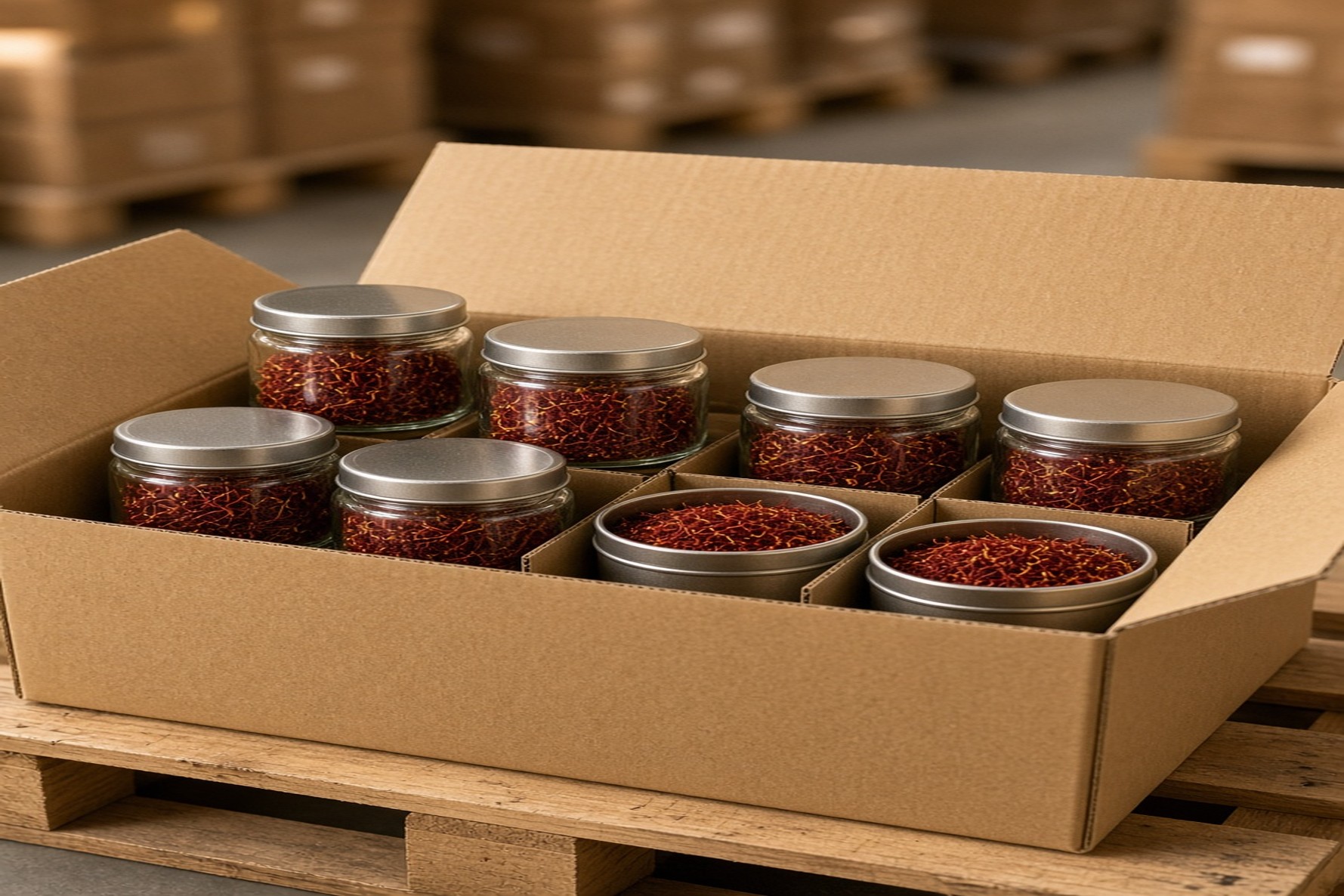
The primary pack is only the first layer. Master cartons and pallet configuration prevent transit damage. For bunch saffron in glass containers, each unit should sit in a foam or die-cut cardboard cavity to prevent movement and bunch-to-bunch contact.
- Internal layout: 12, 24, 48, or 96 units per master carton — depending on 1 g or 5 g pack size; cardboard dividers between rows.
- Master carton: 5–7 ply board, BC or EB flute; print "Fragile," "Keep Dry," "This Side Up"; GS1 barcode and batch code.
- Pallet: EUR pallet 120×80 cm; maximum height 1.2 m for air freight; strapping + stretch film; ISPM-15 label for wood.
- Mixed SKU: In private label, separate batch and expiry by pallet layer for FIFO at destination.
8. Land, Air, and Sea Freight
Land freight
Routes such as Bandar Abbas–Basra, Mehr–Herat, or rail to Turkey (within applicable regulations) are economical for shipments of 500 kg to several tonnes. Transit time 2–7 days. Packaging: standard master carton + tarpaulin cover on truck; avoid opening at border without supervision. COA and container seal recommended.
Air freight
Because of saffron's high value density (each kilogram may be worth USD 1,000–4,000), air freight to Dubai (DXB), Doha (DOH), Istanbul (IST), and Frankfurt (FRA) is common. Transit 1–3 days. IATA restrictions apply to lithium in some desiccant indicators — use non-lithium types. AWB, all-risk cargo insurance, and packaging drop test (ISTA 1A) reduce disputes.
Sea freight
For orders above 100 kg to Europe or the Americas, LCL/FCL with reefer or dry container plus container-wide desiccant. Transit 21–45 days. B/L, invoice, CO, phytosanitary certificate, ISO 3632 COA. Before loading, container moisture content <65% RH. For luxury shipments, LCL with 110% CIF cargo insurance is recommended.
9. Sales Channels and Packaging Alignment
Wholesale
Sachet or tin 10–50 g, minimal label, batch and COA; pallet-ready robust packaging; long route with Al-laminate.
Private Label
Custom design, metal tin or glass, artwork per GSO/EU; MOQ 500–5,000 units; seal and QR traceability.
Luxury Retail
Gift box, khatam inlay, ribbon, story booklet; 1–5 g; visual focus; short route or premium air freight.
E-commerce
Impact-resistant pack (ISTA 3A), unboxing experience, hermetic sachet inside cardboard box; insurance and tracking; destination-country label compliance.
10. Pre-Packaging Quality Control (ISO 3632)
Poor packaging can downgrade Grade I product to Grade II/III in transit. Before entering the packaging line, bunch saffron must pass the filters below. ISO 3632-1 (specification) and 3632-2 (test methods) with UV-Vis spectrophotometry at λ=257, 330, and 440 nm is the international reference.
| Stage | Test/criterion | Grade I acceptance limit | Frequency |
|---|---|---|---|
| Raw receipt | Visual inspection, odour | No mould, no off-odour | 100% of lot |
| Bunching | Bunch uniformity, weight | ±5% of declared weight | 5% sample |
| Laboratory | ISO 3632 spectro | Crocin ≥220 | Every batch |
| Moisture | Oven / Karl Fischer | ≤10% | Every batch |
| Artificial colour | HPLC / spot test | Negative | Random + on complaint |
| Heavy metals | ICP-MS (EU destination) | Per Reg. 2023/915 | Seasonal/on request |
| Post-packaging | Seal integrity, leak | Zero leak | AQL 1.0 |
11. Common Packaging and Transit Defects
| Defect | Likely cause | High-risk route | Prevention |
|---|---|---|---|
| Crocin loss | Light, moisture, heat | Dry sea | Al seal, reefer, dark storage |
| Mould / clumping | RH >65% | Long + ports | Desiccant, hermetic pack |
| Stem breakage | Impact, stacking | Land, LCL | Foam, layer limit |
| Seal leak | Inadequate closure | All routes | Induction seal test |
| Glass breakage | No divider | Air/handling | ISTA drop test |
| Label detachment | Inadequate adhesive | Heat | Heat-resistant BOPP label |
| Weight variance | Manual bunching | — | Calibrated scale, SOP |
12. Decision Model: Four Practical Scenarios
Scenario A — GCC short-term (Dubai/Doha, air)
Product: 1–2 g gift glass. Pack: metal cap + gold cardboard box. 24-unit master carton. Desiccant optional. ISO 3632 COA + halal. Incoterm: CIF DXB.
Scenario B — Europe private label (reefer sea)
Product: 5 g Al tin + induction seal. Secondary inner sachet. 7-ply carton, 48 units. Desiccant 2 g + RH indicator. EU food contact, bilingual label. SGS pre-shipment inspection.
Scenario C — Iraq/Turkey wholesale (land)
Product: 10–50 g Al-laminate. Simple 5-ply master carton. Container seal. Batch on each roll. FOB border + transit insurance.
Scenario D — US e-commerce (express air)
Product: 1 g tin in foam mailer box. ISTA 3A certified. FDA listing and nutrition-style facts if retail. Tracking + insurance. Route <5 days.
13. Importer Checklist (18 Items)
- Confirm Grade I ISO 3632 with valid ISO 17025 COA for shipment batch
- Verify moisture ≤10% and COA sampling date (maximum 30 days before shipment)
- Match net weight per unit to invoice (±5%)
- Inspect bunch shape uniformity and absence of stem breakage in 10% sample
- Seal integrity test (leak test) on 5 random units
- Confirm food-grade pack materials (EU 10/2011 or FDA CFR if USA)
- Food-grade desiccant present on long routes with colour indicator
- Labelling: origin, importer, batch, date, net weight, storage instructions
- Halal certificate (if required by GCC destination)
- Iranian phytosanitary / plant health certificate
- Chamber of commerce certificate of origin
- Cargo insurance (110% CIF for shipments above USD 50k)
- Incoterm and packaging responsibility in contract (seller vs. buyer)
- ISTA or drop test report for e-commerce channel
- Temperature log if reefer (download from data logger)
- Return clause if crocin drops >10% vs. COA
- Retention sample 6 months in seller warehouse for dispute
- Preferred route and transit time documented in PO
14. Requesting a Quote
Final price for packaged bunch saffron depends on ISO 3632 grade, unit weight, pack material, MOQ, custom artwork, and destination. Prepare the following for an accurate inquiry:
- Unit weight (1 g, 2 g, 5 g, 10 g)
- Pack type (glass, metal, sachet, khatam)
- Route (short/long) and Incoterm (FOB Mashhad, CIF Rotterdam, DDP Dubai)
- MOQ and channel (wholesale, private label, retail)
- Need for COA, PSI, private label design
Iranco provides B2B importers with a single inquiry covering product, packaging, and logistics — without multiple intermediaries and with batch and COA transparency.
15. Packaging Cost Factors
| Pack type | Unit cost (USD) | Typ. MOQ | Lead time | Optimal route |
|---|---|---|---|---|
| PET rigid + lid | 0.15–0.35 | 5,000 | 2–3 weeks | Short |
| Glass jar + metal cap | 0.40–0.90 | 2,000 | 3–4 weeks | Short, luxury |
| Al tin + seal | 0.50–1.20 | 3,000 | 4–6 weeks | Short + long |
| Al-laminate sachet | 0.08–0.20 | 10,000 | 2–3 weeks | Long, wholesale |
| Gift box + inlay | 1.00–3.50 | 1,000 | 4–8 weeks | Luxury retail |
| Private label artwork | 500–2500 (one-time) | — | 1–2 weeks | All routes |
| Desiccant + indicator | 0.02–0.08 | — | — | Long route |
Figures are approximate and depend on exchange rate, order volume, and design. Grade I saffron (product) cost is typically 15–40 times the unit pack cost — investing in appropriate packaging for long routes is cheaper than returns.
16. Turning the Traditional Form into an Export Advantage
Bunch saffron is a symbol of Iranian authenticity — unlike powder or tablets, importers and consumers see the "real product." This differentiation, combined with storytelling (cultivation in Qaenat, hand harvesting, dokhtar pich weave), supports premium pricing. The key is pairing tradition with modern standards:
- Preserve bunch shape in transparent or semi-transparent packs for retail
- QR code linking to traceability page (farm, batch, ISO 3632)
- Bilingual booklet with steeping instructions and history
- Alignment with ISO 3632 Grade I — tradition without quality does not build sustainable exports
Compared with negin, luxury packaging margin for bunch saffron is reported 120–200% higher than bulk in GCC and EU channels — provided packaging is engineered and transit loss is avoided.
17. Sourcing Bunch Saffron from Iran via Iranco
Iranco (iranco.com) provides B2B infrastructure for inquiry, sourcing, and export of Grade I bunch saffron with custom packaging for traders, luxury retailers, and private label brands.
- Bunch saffron with crocin ≥230 and ISO 3632 Grade I parameters
- Packaging: glass, Al tin, hermetic sachet, gift box, and khatam
- Private label, artwork, and labelling per GSO/EU/FDA
- ISO 17025 COA, certificate of origin, quarantine, and pre-shipment PSI
- Air/sea/land logistics to GCC, Europe, Americas, and Asia
- Pack selection consulting for short or long routes
18. Summary
Export packaging for Iranian bunch saffron is a logistics and engineering decision, not merely an aesthetic one. Short routes allow more display-oriented packs with moderate barrier properties; long routes require hermetic seals, desiccant, temperature control, and robust master cartons. ISO 3632 Grade I before packaging, a valid COA, and the 18-point importer checklist prevent returns and value loss. The traditional dokhtar pich form, combined with modern standards, builds a lasting competitive edge in wholesale, private label, luxury retail, and e-commerce.
To select Scenario A/B/C/D suited to your destination and budget, Iranco's trade team is ready to provide technical consulting and pricing inquiries.
19. Frequently Asked Questions
How does bunch saffron packaging differ from negin?
Bunch saffron has greater bulk and surface contact, with fragile stems; it needs fixed cavities and impact protection more than negin. Flat sachets are more common for negin; bunch saffron is better preserved in deep containers (jar/tin) with inlay.
Is desiccant enough for a 3-week sea route?
1–2 g desiccant per unit plus hermetic seal is usually sufficient; for dry containers in summer, reefer at 15–20°C or container desiccant poles are recommended.
What is the minimum private label MOQ from Iran?
Depends on container type: sachets from 10,000 units; tin/glass from 2,000–5,000 units. Pre-production samples before the main run are typically 5–10 units.
Is ISO 3632 sufficient for EU clearance?
Yes for saffron quality; additionally require food-contact materials, labelling per Reg. 1169/2011, and REACH for pack materials where applicable. Artificial colour is prohibited — spot tests at customs.
Air or sea for 50 kg to Germany?
50 kg (~USD 80–150k value) is often shipped air CIF Frankfurt for 2–3 day transit; reefer sea if 4–6 week lead time is acceptable and freight cost is the priority.
How can we ensure crocin is preserved in transit?
Al hermetic seal, warehouse <25°C, avoid UV exposure, pre-shipment COA plus contractual clause for minimum 440 nm absorption at destination; retention sample for dispute testing.
Is glass suitable for GCC export?
Yes for short air routes and luxury retail; use foam dividers, "Fragile" cartons, and insurance. For shelf life above 12 months in Dubai's high RH, hermetic tin is preferred.
What export documents are required from Iran?
Invoice, packing list, CO, phytosanitary certificate, ISO 3632 COA, halal certificate (GCC), B/L or AWB. Iranco coordinates documentation per agreed Incoterm.
How do I request samples and pricing from Iranco?
Use the contact form at iranco.com — send weight, pack type, destination, and MOQ specifications. Samples of 5–10 g with COA are typically shipped within 5–10 business days (sample and freight cost separate).
Featured Products
Related Articles



