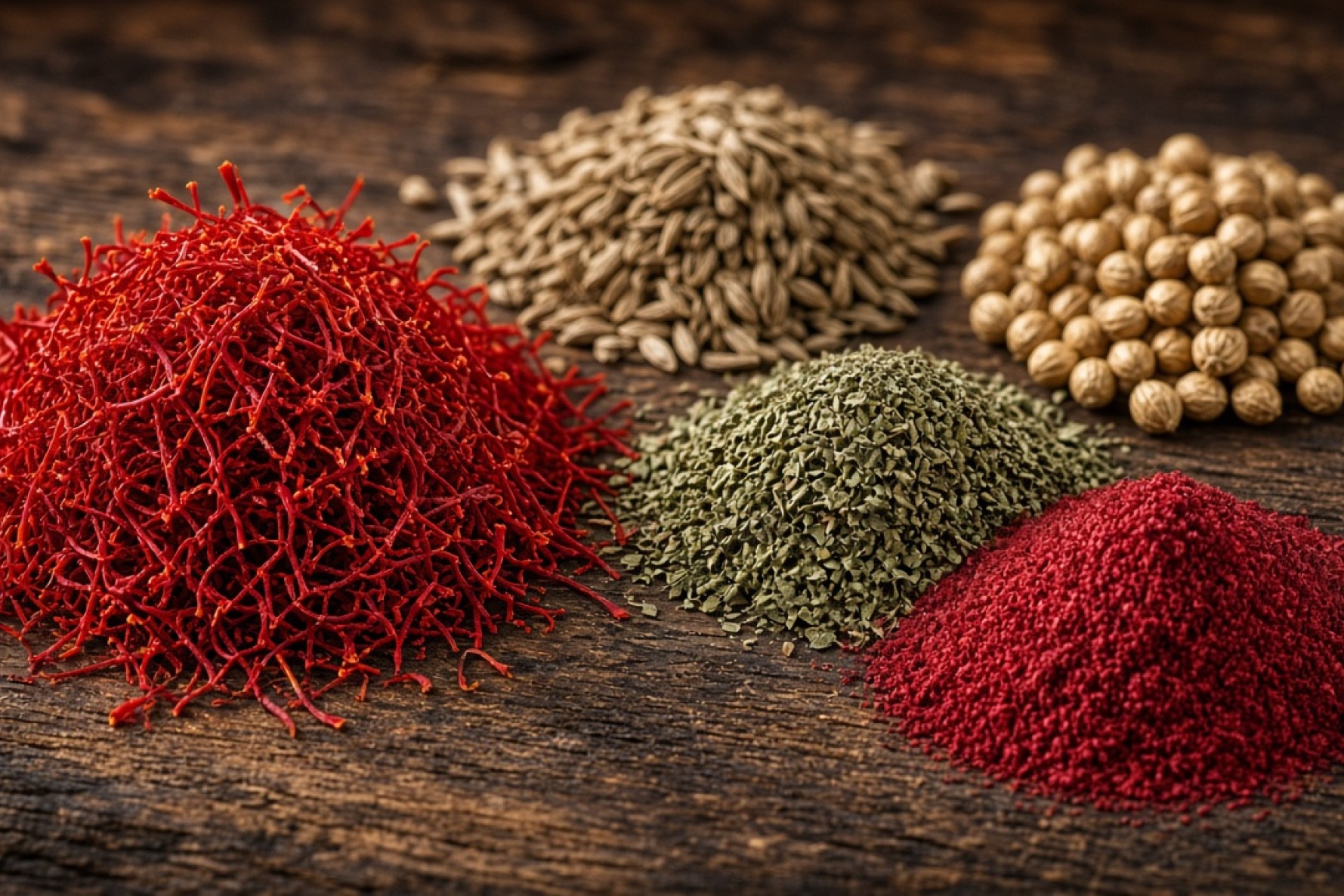
 Iranco Magazine Team
Commercial analysis, technical specs, quality-control requirements, international standards and export ordering guide
Spices · Aromatic Herbs · ISO · Export · Quality Control
Exporting Iranian Spices and Aromatic Herbs: Market Opportunities and Quality Standards
A comprehensive commercial analysis covering technical specifications, quality-control requirements, international standards and an export-order guide.
This specialist report provides a full review of export opportunities for Iranian spices and aromatic herbs, quality requirements, customs tariff codes, international standards and contaminant regulations. Trade managers and importers can use these technical data and operational checklists to reduce commercial risk and make more precise procurement decisions.
Analytical introduction
Global trade in spices and aromatic herbs is among the most dynamic growth segments of the food, pharmaceutical and cosmetics industries. Iran’s climatic diversity, numerous microclimates and abundant solar radiation in cultivation zones create exceptional conditions for synthesising the densest essential oils and natural aromatic compounds. High extraction yields, intense aroma and flavour, and elevated levels of active constituents are hallmark traits of Iranian spices and aromatic herbs.
Iran’s commercial advantage in spice exports extends beyond any single product. Items such as green and black cumin, coriander seed, thyme, liquorice root, sumac, tarragon, mint and fennel enjoy structural demand on international markets. At the same time, shifting global trade patterns and rising sanitary requirements in destination countries have made it unavoidable to move beyond traditional export methods toward laboratory quality control, pesticide-residue management and industrial-grade packaging.
Specialist procurement in this sector requires precise knowledge of physicochemical parameters, contaminant limits and international tariff codes. Differences in essential-oil content, moisture, microbial load or physical impurities can materially change commercial value and clearance readiness. With an analytical and practical approach, this report offers a comprehensive guide to market assessment, quality-standard alignment and streamlined commercial ordering.
1. Iran’s position in the global spice and aromatic herb market
Iran’s strategic geography and historic place on the Silk Road provide valuable natural and commercial infrastructure for spice production and export. Controlled temperature stress in the country’s arid and semi-arid climates stimulates plant defence mechanisms and raises levels of phenolic compounds, terpenes and flavonoids. As a result, Iranian spices and aromatic herbs typically outperform crops grown in wetter, high-rainfall regions in aroma and flavour intensity.
The main production hubs for spices and aromatic herbs in Iran include Razavi and South Khorasan provinces (saffron and cumin), Fars and Kerman (thyme, chamomile and liquorice root), Hamadan and Golestan (coriander seed and mint), and East and West Azerbaijan (sumac and tarragon). This regional spread supports continuous supply and a wide export assortment throughout the year.
Actual export markets for Iranian spices and aromatic herbs include GCC countries (such as the UAE, Oman and Qatar), Eurasian Economic Union members, India, China and selected EU markets. Regional demand focuses more on direct consumption and export packaging, while European and East Asian buyers mainly seek raw grades with high laboratory standards for processed foods, pharmaceuticals and essential-oil production. Iran’s principal challenge in potential markets remains inconsistent finished packaging and the need to strengthen sanitary certificates at the loading origin.
2. Specialist review of Iran’s main export spices and aromatic herbs
Iranian spice and aromatic herb exports cover multiple plant parts, including seeds, leaves, roots and gums. Understanding the characteristics of each product is essential for purchasing and commercial contracting.
Saffron (Crocus sativus)
Saffron is the world’s most valuable commercial spice, and Iran accounts for the majority of global production. Quality assessment is based on specialist parameters including crocin (colouring strength), picrocrocin (taste) and safranal (aroma intensity).
Cumin (Cumin Seeds)
Iranian green cumin (Cuminum cyminum) has a strong, distinctive aroma due to its high cuminaldehyde content. The product is exported both as whole seed and as powder for food processing and blended spice formulations.
Coriander Seeds
Iranian coriander seed is shipped in high volumes to markets such as India and Pakistan as a key aromatic seed. The high linalool content of Iranian coriander essential oil makes it highly suitable for canning, confectionery and beverage industries.
Thyme
Shirazi thyme and Denai thyme are widely used in pharmaceuticals, herbal teas and spice formulations thanks to their high concentrations of thymol and carvacrol.
Licorice Root
Iranian liquorice root and extract, valued for high glycyrrhizin content, rank among the most important export raw materials to Europe and Asia for chocolate, pharmaceutical and tobacco industries.
| Product | Scientific name | Harvest season | Key active constituent | Common export form | Main target markets |
|---|---|---|---|---|---|
| Saffron | Crocus sativus | Autumn | Crocin, picrocrocin, safranal | Negin, Sargol, Pushal, powder | UAE, Spain, China, Qatar |
| Green cumin | Cuminum cyminum | Spring | Cuminaldehyde | Whole seed, powder | India, Pakistan, Oman, Iraq |
| Coriander seed | Coriandrum sativum | Summer | Linalool | Whole seed, powder | India, UAE, GCC countries |
| Thyme | Thymus spp. | Spring and summer | Thymol, carvacrol | Crushed leaf, powder, essential oil | European countries, GCC |
| Liquorice root | Glycyrrhiza glabra | Autumn and winter | Glycyrrhizic acid | Dried root, powder, extract | Germany, China, India |
| Sumac | Rhus coriaria | Summer | Malic acid, tannin | Powder, dried berry | Turkey, Iraq, European countries |
3. Customs tariff codes (HS Code) and international classification
Accurate customs classification under the Harmonized System (HS Code) is mandatory for calculating import duties, commercial declarations and phytosanitary clearance. Tariff codes for spices and aromatic herbs mainly fall under Chapters 9, 12 and 13 of the Harmonized System.
- 09041000: Black pepper (neither crushed nor ground)
- 09042000: Red pepper and paprika (crushed or ground)
- 09081000: Cardamom
- 09092100: Coriander seeds (neither crushed nor ground)
- 09093100: Cumin seeds (neither crushed nor ground)
- 09095100: Fennel seeds
- 09102000: Saffron
- 09109900: Ginger and turmeric
- 09109991: Sumac and black seed (Nigella)
- 12119000: Thyme, mint, chamomile and other plants used in herbalism and pharmaceuticals
- 12119090: Liquorice root
- 13019000: Tragacanth and other natural gums and resins
4. International quality standards and laboratory parameters
Industrial buyers and international traders assess shipment quality against International Organization for Standardization (ISO) and Codex Alimentarius standards. A Certificate of Analysis (COA) issued by accredited laboratories is the primary basis for acceptance.
ISO 3632 (saffron-specific)
This international standard classifies saffron quality into three grades (Class I, II, III):
- Colouring strength (Crocin): minimum 200 for Class I, minimum 170 for Class II and minimum 120 for Class III by spectrophotometry.
- Aroma strength (Safranal): between 20 and 50 units.
- Flavour and bitterness (Picrocrocin): minimum 70 for Class I.
- Moisture and volatile matter: maximum 12 percent.
Other international spice standards
- ISO 6465: Technical specifications for cumin seeds
- ISO 5562: Technical specifications for turmeric
- ISO 7925: Technical specifications for dried thyme and oregano
Key physicochemical parameters in analysis
- Essential Oil Content: oil yield in millilitres per 100 g of dry matter.
- Moisture Content: keep moisture below 12% to prevent mould spoilage and mycotoxin formation.
- Total Ash: indicates the overall mineral content of the shipment.
- Acid-Insoluble Ash: primary indicator of sand, grit and dust in the lot.
| Analysis parameter | Preferred range (premium grade) | Reference test standard | Importance for the importer |
|---|---|---|---|
| Moisture content | Maximum 8% to 12% | ISO 939 / ISO 3632 | Shelf-life retention and mould prevention |
| Acid-insoluble ash | Maximum 1.0% to 1.5% | ISO 930 / ISO 3632 | Purity check; absence of soil and sand |
| Volatile oil content | Minimum 2.5% to 4.5% | ISO 6571 | Determines aroma, flavour strength and extract yield |
| Extraneous Matter | Maximum 0.5% to 1.0% | ISO 927 / ISO 3632 | Absence of stalks, stems and foreign plant matter |
| Particle size (powders) | 100% pass through 60 to 80 mesh | ISO 2591-1 | Powder uniformity for industrial applications |
5. Sanitary requirements, contaminant limits and pesticide residues (MRL)
The most stringent part of spice import rules in developed markets (especially the EU and GCC) concerns management of pesticide residues (MRL), heavy metals and mycotoxins.
Aflatoxin limits
Aflatoxins are hazardous fungal toxins that form when processing or storage conditions are inadequate. Under EU regulations:
- Aflatoxin B1: maximum 5.0 micrograms per kilogram (μg/kg).
- Total aflatoxins (B1+B2+G1+G2): maximum 10.0 micrograms per kilogram (μg/kg) in spices such as pepper, turmeric, nutmeg and spice mixes.
Agricultural pesticide residues (MRL)
European importers enforce pesticide residue limits under very strict MRL standards (often a default of 0.01 mg/kg). Laboratory analysis confirming the absence of organophosphate pesticides and banned fungicides is mandatory.
Microbial contaminants and alkaloids
- Salmonella spp.: absolute absence in 25 g of sample.
- Escherichia coli (E. coli): fewer than 10 colonies per gram.
- Pyrrolizidine Alkaloids: precise testing in medicinal and aromatic plants under EU rules to prevent hepatotoxicity.
- Heavy metals: lead maximum 2.0 mg/kg and cadmium maximum 1.0 mg/kg in dried spices.
6. Quality detection methods and common frauds on international markets
Because of high economic value, adulteration in spice and aromatic herb supply chains remains a commercial challenge. EU research shows that spices such as oregano, cumin, turmeric and saffron face the highest fraud rates.
1. Addition of artificial colours
Use of unauthorised chemical dyes (such as Sudan or annatto) to mask weak quality in saffron or in sumac and turmeric powders.
- Detection method: high-performance liquid chromatography (HPLC) and spectrophotometry.
2. Blending with low-cost plant material
Adding olive leaves to thyme and oregano, or adding colourless stamens and styles to saffron filaments.
- Detection method: microscopic evaluation, essential-oil assay and DNA analysis.
3. Weight increase with mineral impurities
Adding starch, flour or fine sand to cumin and cinnamon powders.
- Detection method: acid-insoluble ash test and iodine test for starch identification.
4. Essential-oil extraction and sale of spent residue
Extracting the plant’s volatile oil and milling the low-value spent residue for sale.
- Detection method: measuring volatile oil percentage with a Clevenger apparatus.
7. Export packaging technologies and quality retention over shelf life
Packaging for spices and aromatic herbs plays a key role in preventing evaporation of volatile oils, ambient moisture uptake, oxidation of aromatic compounds and pest ingress.
Bulk Packaging
- Multi-layer aluminium and polypropylene (PP) bags: suitable for whole seeds such as cumin and coriander.
- Vacuum packs and inert-gas flushing (Nitrogen Flushing): for leafy herbs sensitive to oxidation, such as thyme and mint.
- Fibre and metal drums with food-grade liners: suitable for powders, extracts and liquorice root.
Retail Packaging
- Glass jars and stainless metal tins: aroma retention and chemical inertness.
- Stand-up zipper pouches (Doypack) with aluminium foil layer: excellent protection against light and oxygen.
- Crystal containers and industrial vacuum packs: for export saffron in small weights.
| Product form | Recommended export packaging | Common pack weight | Technical packaging feature |
|---|---|---|---|
| Saffron | Metal tin, polycarbonate jars, vacuum foil pouches | 0.5 to 50 g / 1 kg | Light- and oxygen-impermeable, sealed |
| Whole cumin and coriander | Laminated PP woven bags or aluminium bags | 25 kg / 50 kg | Tear-resistant with moisture barrier |
| Thyme and dried leaves | Master carton with vacuum or MAP polyethylene liner | 5 to 15 kg | Nitrogen flush to limit crushing and oxidation |
| Spice powders | 3-layer aluminium foil bags in 5-ply cartons | 10 to 25 kg | Prevents caking and aroma loss |
| Liquorice extract | Fibre drums with double food-grade liner | 25 to 50 kg | Resistant to pressure and temperature swings |
8. Logistics, supply chain and international transport management
Transport of spices and aromatic herbs requires defined environmental conditions so that shipments do not lose quality or suffer microbial damage in transit.
Environmental transport requirements
- Temperature: cool and stable between 15 and 20 °C. For some sensitive leafy herbs, a refrigerated Reefer Container with controlled temperature is recommended.
- Relative humidity (RH): maximum 55% to 60%. Humidity swings cause container sweat and mould growth.
- Ventilation: containers should be adequately ventilated, or sufficient desiccant bags should be used.
Transport modes
- Air Freight: the fast option for saffron, high-value essential oils and fresh aromatic herbs.
- Ocean Freight (FCL/LCL): suitable for bulk whole-seed shipments (cumin, coriander) and roots. Cargo should be stacked on ISPM 15-certified treated wooden pallets.
- Road Freight: tarpaulin or reefer trucks for exports to neighbouring and Eurasian markets.
9. Target-market analysis and Iran’s competitive position versus rivals
Understanding demand patterns and competitor capabilities in target markets is essential for a successful export strategy.
1. GCC (UAE, Oman, Qatar)
Strong demand for premium saffron, cumin, sumac and spice blends. Focus on visual quality, luxury packaging and Halal certification. The UAE acts as the region’s re-export hub.
2. European Union (Germany, Spain, France)
High demand for organic products, liquorice root, thyme and Class I saffron. Strict requirements on pesticide residues, aflatoxin and genetic authenticity testing.
3. Indian subcontinent and East Asia
India is a major importer of coriander seed, cumin and liquorice root from Iran. Demand is concentrated on raw material for industrial processing and extraction.
| Competitor country | Main competitive advantage | Limitation / weakness | Price level | General quality | Main target markets |
|---|---|---|---|---|---|
| Iran | High essential-oil concentration, climatic diversity, unmatched saffron | Weak finished packaging and modern marketing | Competitive / mid | High (premium raw material) | GCC, Eurasia, China, India |
| Turkey | Modern packaging, strong marketing, trade agreements | Higher production cost than Iran | Mid to high | Good | EU, USA, GCC |
| India | Very large volume, high diversity, low price | Residue challenges and lower oil content | Low / competitive | Medium | Global, Middle East, USA |
| Egypt | Competitive pricing on leafy herbs (mint and chamomile) | Less quality consistency on some lots | Low | Medium | Europe, GCC |
| Vietnam | Dominance in black pepper and tropical spices | Limited dry and semi-arid crop range | Low | Medium | Europe, USA, Asia |
10. Industrial applications of spices and aromatic herbs across sectors
- Meat processing and ready meals: cumin, coriander and thyme powders for flavouring and natural shelf-life extension.
- Confectionery, chocolate and bakery: liquorice extract, saffron and aromatic seeds in finished-product formulations.
- Pharmaceuticals and dietary supplements: extraction from liquorice root (glycyrrhizic acid) and thyme (thymol) for cough remedies and digestive supplements.
- Cosmetics and personal care: pure turmeric, saffron and mint essential oils in skin creams and fragrance formulations.
Importer checklist before placing an order
To reduce financial and quality risks in international purchases, importers and procurement managers should execute the following checklist step by step:
- Define precise technical specifications: full plant name, scientific name, visual specs, quality grade and required purity.
- Request a Pre-Shipment Sample: obtain a real sample from the same export lot together with a preliminary COA.
- Check destination legal requirements: review MRL rules, contaminant limits and labelling standards in the buyer’s country.
- Set acceptance criteria and defect tolerances: agree maximum allowed moisture, weight loss, extraneous matter and breakage.
- Select food-grade packaging: confirm bag, carton or container material, layer count, net weight per pack and palletisation type.
- Appoint an accredited third-party laboratory: choose an independent international or approved domestic lab for sampling and COA issuance before loading.
- Verify sanitary and quarantine documents: confirm the supplier can provide a phytosanitary certificate, certificate of origin and Halal certificate.
- Define delivery terms (Incoterms 2020): specify the exact term (FOB, CFR, CIF, EXW) and cargo insurance responsibility.
- Set Pre-Shipment Inspection (PSI) rules: define qualitative and quantitative inspection criteria at origin customs and container sealing.
- Draft a comprehensive legal contract: payment method, delay penalties, return conditions if the lot fails the COA, and dispute-resolution forum.
What information should be sent to receive an accurate price?
To obtain accurate, comparable pricing for spices and aromatic herbs, buyers should include the following details in their formal enquiry:
- Product name and scientific name: (for example: green cumin / Cuminum cyminum)
- Physical form: (whole seed, crushed leaf, powder, extract)
- Quality grade and required analysis: (essential-oil %, moisture limit, saffron crocin level)
- Order quantity: (in tonnes or kilograms / specify FCL or LCL)
- Packaging type and weight: (25 kg PP bags, 500 g vacuum packs, etc.)
- Destination country and port: (for accurate freight calculation)
- Preferred delivery terms (Incoterms): (such as FOB or CIF)
- Mandatory standards and certificates: (phytosanitary certificate, contaminant analysis, organic certificate)
Conclusion
Exporting Iranian spices and aromatic herbs is a standout opportunity in high-value-added agricultural and food commodity trade. Iran’s natural climatic advantage in producing crops with intense aroma and high essential-oil concentration creates exceptional commercial potential. Sustained success on international markets, however, depends on full adherence to quality-control standards, contaminant management (especially aflatoxin and pesticide residues), modern export packaging technologies and transparent laboratory reporting. Professional buyers and exporters who understand tariff codes, quarantine requirements and specialised purchase checklists can manage commercial risk and fully leverage the unmatched capacity of Iranian spices.
Frequently asked questions
1. What are the main quality indicators for export saffron?
Saffron quality is measured under ISO 3632 by three chemical factors: crocin (colouring strength), picrocrocin (taste) and safranal (aroma intensity). Shipment moisture must also not exceed 12 percent. Premium Class I saffron has a crocin factor above 200.
2. What is the aflatoxin limit for spice exports to the European Union?
Under EU contaminant rules, the maximum limit for aflatoxin B1 is 5.0 micrograms per kilogram (ppb), and the maximum for total aflatoxins (B1, B2, G1, G2) is 10.0 micrograms per kilogram in most dried spices.
3. What is the best packaging method to preserve aromatic herb oils during long transit?
Multi-layer aluminium foil vacuum bags or nitrogen-flushed (MAP) packs are the most effective. This packaging blocks oxygen and light and prevents evaporation of volatile aromatic compounds and essential-oil oxidation.
4. What are the HS Codes for cumin seed and coriander seed?
The customs tariff code for cumin seed is 09093100 and for coriander seed is 09092100. Both codes fall under Chapter 9 of the international spice classification.
5. How can common adulterations in ground spices be detected?
Adulterations such as artificial colour, flour or spent extracted residue can only be identified through laboratory tests including HPLC chromatography, volatile oil assay (Clevenger), acid-insoluble ash measurement and microscopic examination.
6. What are the standard temperature and humidity conditions for containerised spice transport?
Preferred temperature is between 15 and 20 °C with relative humidity below 60 percent. Desiccant bags in the container are essential to prevent container sweat and mould.
7. What information is needed to receive an accurate export spice quotation?
The buyer should specify technical details including scientific name, quality grade, essential-oil content, moisture percentage, packaging type and weight, order volume, delivery term (Incoterms) and destination port.
8. How can Iranian spices and aromatic herbs be sourced directly to standard?
International buyers can register their technical specifications and required order volume as a purchase request on the Iranco platform so that available supply options from verified Iranian producers can be assessed against analysis and packaging requirements.
Featured Products




Related Articles



