 Iranco Magazine Team
Physicochemistry of cooking, lab indices, supply chain and commercial guidance for wholesale buying and export of northern Iran’s finest native rice
Export Guide · Sadri Dom-Siah Rice
Dom-Siah Rice: Why It Ranks Among Iran’s Finest — Wholesale Buying and Export Market Guide
A comprehensive analysis of cooking physicochemistry, laboratory indices, the supply chain, and a commercial guide to wholesale purchase and export of northern Iran’s finest native rice.
Introduction: Dom-Siah in long-grain trade
Dom-Siah rice — with rare elongation, lasting aroma and a soft texture — is the leading traditional northern Iranian rice in wholesale trade and export markets. This specialist guide sets out quality specs, standards, authenticity checks, pricing drivers and supply-chain requirements for trade managers, importers and exporters so commercial decisions carry the least risk.
Iran’s rice market covers a wide range of grains, yet among Caspian-fringe paddy production Dom-Siah has long sat at the top of rial valuation and quality ranking. It belongs to the Sadri group — a family historically tied to formal banquets, diplomatic hospitality and discerning consumers. Unlike improved high-yield types bred for tonnage and mass demand, Dom-Siah’s growing cycle has always prioritised authentic aroma, exceptional length expansion on cook and endosperm softness after cooling.
From an international trade view, limited production on Gilan’s irrigated lands and suitable parts of Golestan, plus the plant’s acute climate sensitivity, make this rice scarce and premium in regional exchange. Recent demand among consumers in the Persian Gulf, Europe and North America for Middle Eastern native crops has opened attractive export opportunities. Success in bulk buying and sustained entry to these specialist markets requires mastery of grain morphology, authentic geographic origins, contaminant limits under official standards and control of blending at loading points. To file technical specs and receive supply options, contact Iranco.
1. Ecological origin, agronomic traits and scarcity in northern paddies
History and place of Dom-Siah in the Sadri family
Sadri is one of the oldest rice groups grown on the southern Caspian shore. In Iranian agronomic records, Sadri varieties are the symbol of quality long-grain rice, grouped into three main types: Dom-Siah, Dom-Zard and Dom-Sorkh. The name comes from a slender black awn at the tip of the paddy, while the milled kernel is ivory-cream and translucent. Among the three Sadri types, Dom-Siah has earned the strongest commercial reputation for cook performance, crystalline structure under boiling water and balanced gelatinous texture in both traditional and modern markets.
Geographic distribution across Gilan plains and Golestan lowlands
Successful cultivation needs fertile alluvial soils, surface water rich in river minerals and controlled humidity at heading. Gilan — especially Sefidrud catchment lands in Astaneh-ye Ashrafiyeh, Rasht, Lahijan and Kuchesfahan — are the historic centres of the finest Dom-Siah. Astaneh’s lighter soil and balanced moisture give a mild aroma and even grain structure.
In Golestan, Minudasht, Kalaleh and Azadshahr have become production hubs. Golestan’s climate — stronger sun, concentrated heat and cool nights late in the season — yields denser, more bony Dom-Siah grains from Minudasht. That density raises mechanical resistance in milling and supports elongation stability in cooking. Parts of Fereydunkenar in Mazandaran, with marsh soils rich in wetland sediment, also produce a smaller share of this crop.
Plant physiology challenges and yield limits per hectare
A key driver of Dom-Siah’s price premium is structural agronomic constraint. Plant height at maturity reaches 130–140 cm. Tall stems with thin internodes leave the crop highly vulnerable to lodging in heavy summer rain. Growers cannot push tonnage with heavy nitrogen, because excess vegetative growth bends the plant and destroys panicles in muddy plot water.
- Growth period from nursery to mechanised harvest: 120–130 days.
- Paddy yield: 3.2–3.8 t/ha — versus 6–8 t/ha for high-yield varieties.
- That yield gap is the fundamental reason Dom-Siah wholesale prices diverge sharply from other rices.
2. Grain physicochemistry, cooking morphology and starch structure
Raw-grain geometry and linear elongation
Raw Dom-Siah grain has an elongated, pen-like longitudinal section. Mean raw length in sorted lots is 7.4–7.8 mm, with width typically under 2.0 mm. Length-to-width ratio above 3.7 places it in the extra-long-grain class under international standards.
The defining trait is linear expansion under moist heat. During boiling, length reaches 12.5–13.5 mm and, in aged processed samples, over 14 mm, while width barely changes. That 1.65–1.80× elongation ratio gives steamed polo a distinctive needle-like appearance.
Polysaccharide structure: amylose and gelatinization temperature
- Amylose: 20–22% — optimal for stable texture; below 18% sticky and pasty; above 24% dry and firm after cooling.
- Gelatinization temperature: 68–72 °C (intermediate group) — balanced water uptake and resistance to longitudinal splitting.
- Gel consistency: soft to medium — cooked-grain softness retained for hours after steaming.
Volatile compounds and sensory aroma profile
Dom-Siah aroma comes from a complex synergy of volatile organics — aldehydes, esters and especially 2-acetyl-1-pyrroline. Unlike basmati’s earthy or popcorn-like note, Dom-Siah scent is buttery, floral and free of harsh sharpness. Natural fat (about 2% in outer endosperm layers) also creates a silky mouthfeel and keeps grains from sticking on the serving dish.
| Physicochemical trait | Premium Dom-Siah | Gilan Hashemi | Local Mazandaran Tarom | Shiroudi (high-yield) |
|---|---|---|---|---|
| Raw grain length (mm) | 7.4–7.8 | 7.2–7.5 | 7.0–7.3 | 7.1–7.3 |
| Cooked grain length (mm) | 12.5–13.5 | 11.5–12.2 | 11.0–11.8 | 10.5–11.2 |
| Raw length-to-width ratio | 3.7–4.0 | 3.3–3.5 | 3.1–3.3 | 3.2–3.4 |
| Amylose (%) | 20–22% | 21–23% | 20–22% | 24–26% |
| Gelatinization temperature (°C) | 69–71 | 70–72 | 68–70 | 74–76 |
| Texture after cooling | Very soft and flexible | Soft | Soft to medium | Firm and brittle |
| Natural aroma depth | Deep with long persistence | Good and popular | Strong with high volatility | Very weak and limited |
3. Analytical comparison with other Iranian quality and high-yield rices
Dom-Siah vs Hashemi
Hashemi is the most abundant quality rice of northern Iran, covering wide areas of Gilan and Mazandaran paddies. Visually, raw Dom-Siah is narrower and more elongated than Hashemi. During cooking Dom-Siah elongates more vertically, while Hashemi also expands somewhat in width. On texture stability, Dom-Siah polo holds softness longer after cooling — an advantage that fades slightly in Hashemi after about 24 hours. Still, more reliable Hashemi production and lower agronomic risk keep its wholesale price below Dom-Siah.
Dom-Siah vs local Tarom
Local Mazandaran Tarom is known for a penetrating initial aroma. Entering a Tarom warehouse, the scent fills the space quickly, but those aroma compounds are more volatile than Dom-Siah’s. For industrial catering cook endurance, Dom-Siah endosperm tolerates long boils in hotel kettles better, with lower risk of grain breakage or cloudy starch leach. After steaming, Dom-Siah grains stay separate on the dish.
Fundamental difference from high-yield types
Types such as Shiroudi, Fajr, Neda and Khazar are grown for higher bulk output. Although modern sorting plants polish them to a bright, clear look, they lack enough free fatty acids and 2-acetyl-1-pyrroline. High amylose in types such as Shiroudi also makes polo firm hours after cooling, losing the quality of fine chelo.
| Commercial evaluation index | Sadri Dom-Siah | Grade-one Hashemi | Aromatic Fajr | Bony Shiroudi |
|---|---|---|---|---|
| Classification group | Traditional native Sadri | Unimproved native Tarom | Improved high-yield | Improved high-yield |
| Formal cook endurance | Exceptional, separate grains | High and standard | Medium (boil-time sensitive) | High against mushiness |
| Aroma shelf life in store | 12–18 months | 6–9 months | 4–6 months | Negligible |
| Wholesale market price | Premium tier | Upper-mid tier | Mid economy tier | Base / low-cost tier |
| Primary use | Export and luxury restaurants | Household and hospitality | Institutional and office use | Budget catering |
4. Standard technical specs, defect tolerances and laboratory tests
Wholesale deals and export rice shipments require full alignment with national standard ISIRI 127 (“Rice — specifications and test methods”) and Codex international rules. Professional buyers should assess lot specs against precise laboratory tests.
Allowed moisture and physical grain indices
- Internal moisture: max 14.0% for domestic wholesale stores; 12.5–13.0% for ocean export.
- Super-premium broken: under 2%; for standard export purchases max 5%.
Visual defects and damaged grains
- Chalky and white-belly grains: max 2.0% in top-grade lots.
- Yellowed and heat-damaged grains: max 0.5%.
- Pest-damaged and spotted grains: max 0.5% in export grade.
- Paddy, red lines and foreign matter: under 0.05% after cleaning, gravity table and colour sorting.
Food-safety tests: contaminants and pesticide residues
Per national standard ISIRI 12968 and current National Standards Organization of Iran revisions:
- Inorganic arsenic: max 0.15 mg/kg (150 ppb).
- Lead: max 0.15 mg/kg.
- Cadmium: max 0.06 mg/kg.
- Aflatoxin for Europe: B1 max 2 µg/kg; total B1+B2+G1+G2 under 4 µg/kg.
- Pesticide residues: diazinon and tricyclazole within Codex Alimentarius MRL limits.
| Technical / sanitary parameter | Premium export acceptance | Grade-one commercial acceptance | Reference test method |
|---|---|---|---|
| Final moisture (%) | 12.5–13.0% | ≤ 14.0% | Oven thermal moisture (ISIRI 127) |
| Broken grains (%) | ≤ 2.0% | ≤ 5.0% | Trieur mechanical separation and weight measure |
| Chalky and immature grains | ≤ 1.5% | ≤ 3.0% | Optical scan and visual count on graded board |
| Variety uniformity purity (%) | ≥ 98.0% | ≥ 93.0% | Morphometry and DNA fingerprinting |
| Arsenic metal contaminant | < 100 ppb | < 150 ppb | Graphite-furnace atomic absorption (AAS) |
| Total aflatoxins | < 4 µg/kg | < 10 µg/kg | High-performance liquid chromatography (HPLC) |
5. Fraud detection, commercial authenticity and genetic tests
Common blending practices in bulk markets
The large price gap between Dom-Siah and high-yield or cheap imported rice creates room for opportunistic behaviour in traditional trade. The most common fraud is blending sorted Dom-Siah with 10–40% cheaper types such as Shiroudi or Fajr. To mask the aroma difference, some unauthorised workshops apply synthetic water-soluble essences during polishing. Another method mixes freshly harvested grain with aged, discoloured stock from prior years to balance unit cost.
Field and sensory tests at wholesale purchase
- Palm friction rub: rub 10–15 seconds; authentic grains release a mild buttery aroma; synthetic essence smells soapy or sharp.
- Bite hardness test: raw Dom-Siah snaps bony and hard; chalky or non-authentic grains powder easily.
- Cold-water immersion: dense grains sink quickly; surface floaters signal chalkiness or uneven moisture.
- Sealed-jar watch: 50 g sample in a glass jar for 24 hours; stale, sour or alcoholic odour signals high moisture or improper processing.
Instrumental tests and genetic fingerprinting
For large commercial and high-value export lots, definitive tests are run in accredited laboratories. Microsatellite or SSR genetic fingerprinting can determine genetic purity. Comparing sample DNA with the standard Sadri Dom-Siah database identifies even 2–3% genetic impurity from blending with high-yield types. Beyond DNA, the alkali spreading test — immersing grains in 1.7% potassium hydroxide — reveals Dom-Siah starch behaviour versus high-yield types and pinpoints gelatinization timing.
6. Pricing economics, wholesale market structure and seasonal swings
Calendar cycle of supply and demand
Harvest in the northern provinces starts in late Mordad (mid–late August) and continues through Shahrivar (September). From Shahrivar to Aban (September–November), heavy paddy inflow into mills and small growers’ need to settle debts push the price index to its annual floor. From early winter, as major wholesalers warehouse stock and Nowruz banquet demand begins, prices trend upward. From Ordibehesht to Tir (April–July), as warehouses empty and the crop year ends, prices reach their annual peak.
  Dom-Siah rice price index across the crop year
  (price peak) ▲                     /▔▔▔▔\
               │                    /      \
               │       /\          /        \
               │      /  \        /
  (price floor) ▼ ────/────\──────/───────────────
                Sep     Nov     Feb       Jul
Value add from controlled grain aging
Unlike many farm products where age cuts trade value, aged Dom-Siah (at least 4–6 months after milling) prices above fresh rice. Enzymatic processes and gradual moisture exchange with the environment firm hydrogen bonds in amylose molecules. Aged rice resists breakage in cook, absorbs more water and lifts linear elongation by up to 15%. International hotels and banquet halls therefore prefer prior-year lots at a 10–20% price premium.
Processing loss and laser sorting costs
Dom-Siah’s long, slender grain takes more mechanical damage than round or short types in husking, separation and whitening. Converting Dom-Siah paddy to polished rice carries high loss. Dual-channel colour sorters for spotted grains and waste add depreciation and weight-loss cost. Cutting broken grains below 2% removes substantial half-grain and brokens from the premium stream, feeding directly into unit cost.
For buyers seeking bulk, hand-selected northern Iranian lots, Iranco can validate quality, analyse landed cost and register orders by requested grade.
| Landed-cost driver | Direction on price | Change range per tonne | Technical / structural root |
|---|---|---|---|
| Dual optical sorting | Upward | 2–4% | Removal of defective, spotted and foreign particles |
| Broken separation under 2% | Upward | 6–10% | Half-grain exit and lower final lot recovery |
| Warehousing and grain age | Upward | 10–20% | Starch structure stabilisation and higher elongation index |
| Geographic origin (Astaneh) | Upward | 5–15% | Regional brand value and stable aroma |
| Order scale (over 50 t) | Downward | 3–6% | Logistics and processing cost spread |
7. International export markets and foreign-trade map
Iranian rice export is not a million-tonne volume trade — limited production and strong domestic demand make it a value-added specialty and luxury food segment. Dom-Siah, as the flagship of that offer, has the strongest reach into affluent markets and diaspora communities.
Regional target markets in West Asia
- Iraq: largest export volume share; Erbil, Sulaymaniyah, Baghdad and Najaf for diplomatic banquets and luxury halls.
- United Arab Emirates: Dubai as redistribution hub and five-star hotel centre; premium packs in top chain stores.
- Kuwait, Qatar and Oman: high sensitivity to cooked length and natural aroma; ready to pay competitive prices for hand-selected lots.
Europe, North America and Oceania markets
- Germany: main gateway for Iranian rice into Europe; EFSA heavy-metal and pesticide compliance is mandatory.
- Canada and Australia: diaspora markets; ocean transit over 40 days needs premium processing and packaging.
Customs tariff code analysis
- 1006.10 — Rice in the husk (paddy)
- 1006.20 — Husked (brown / cargo) rice
- 1006.30 — Semi-milled or wholly milled rice, polished or glazed (main Dom-Siah export code)
- 1006.40 — Broken rice and half-grains from cleaning
| Destination country | Common packaging | Preferred broken tolerance | Regulatory / standards body | Market status and competition |
|---|---|---|---|---|
| Iraq | 10 and 20 kg laminated bags | ≤ 5.0% | Central Organization for Standardization and Quality Control of Iraq | Highest-volume market with strong demand elasticity |
| United Arab Emirates | 5 and 10 kg sanitary calico bags | < 2.0% | Dubai Municipality and Gulf Standards (GSO) | Focus on aroma, ceremonial cook and luxury packaging |
| Germany | 1 and 2.5 kg vacuum packs | < 2.0% | European Food Safety Authority (EFSA) | Strict control of arsenic, lead and aflatoxin |
| Canada | 5 kg vacuum packs | < 3.0% | Canadian Food Inspection Agency (CFIA) | Preference for aged sorted rice with guaranteed cook |
| Kuwait | Rigid or laminated 5 kg packs | < 2.0% | Public Authority for Food and Nutrition (PAFN) | Accepts premium pricing for uniform lots |
8. Packaging specs, shelf life and global labelling compliance
Packaging materials and aromatic compound retention
Export Dom-Siah packaging must do two jobs: block ambient moisture and protect volatile 2-acetyl-1-pyrroline molecules. Plain polypropylene or jute sacks, with open pores, quickly strip aroma — especially in humid origin ports.
- Three-layer metallised composite bags (BOPP/PE/AL): full barrier to oxygen, UV and moisture; essential for ocean lots.
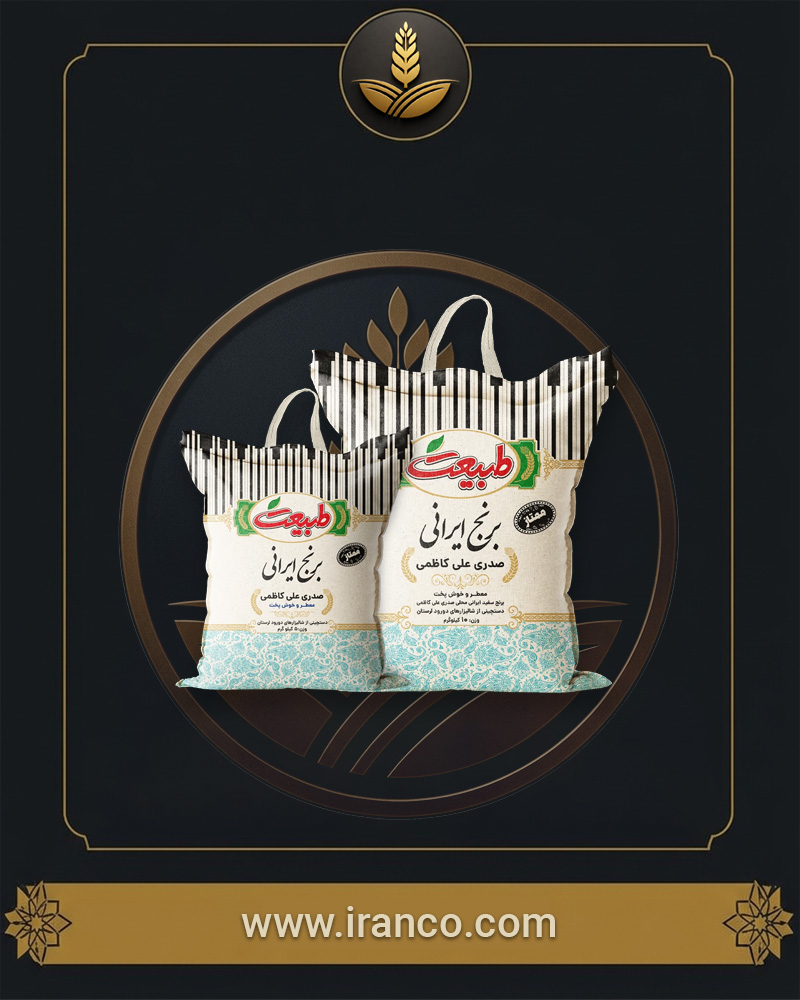
- Cotton fabric bags with food-grade polyethylene liner: classic look popular in the Gulf; reduces grain abrasion in trailer vibration.
- Modified atmosphere (MAP) and vacuum: nitrogen flush in 2.5 and 5 kg packs; stops grain respiration, lipid oxidation and warehouse pest egg-laying.
Export laminate packaging layers:
┌────────────────────────────────────────────────────────┐
│ Outer layer: printed biaxially oriented PP (BOPP)      │
├────────────────────────────────────────────────────────┤
│ Middle layer: aluminium foil or metallised (O₂ barrier) │
├────────────────────────────────────────────────────────┤
│ Inner layer: food-grade HDPE (product contact)         │
└────────────────────────────────────────────────────────┘
Mandatory international marking rules
- Full product name: “Grade-one polished white Sadri Dom-Siah rice”
- Clear country of origin: “Product of northern Iran paddies”
- Nutrition facts table per 100 g (calories, protein, carbohydrate, total fat, trans fatty acids, sodium and gluten-free)
- Net weight in kg or lb with allowed weight tolerance
- Health manufacturing licence, operating permit and international product tracking code
- Exact production, processing, packing and expiry dates (commercial shelf life for white rice typically 24 months)
- Storage conditions: “Store in a dry, dark, cool place below 20 °C”
9. Logistics, warehouse chain and risk control in container transport
Bulk warehousing principles at origin
Paddy and white rice are hydrocolloidal, moisture-absorbing grains. Storage in northern sheds must continuously monitor relative humidity and temperature. Ideal storage is 15–18 °C with warehouse relative humidity always below 60%. Crossing 65% RH accelerates rice weevil breeding and trichothecene or aflatoxin formation. Bags should sit on plastic or disinfected wooden pallets at least 20 cm off the floor and 0.5 m from side walls for continuous airflow.
┌─────────────────────────────────────────────────┐
│   Optimal warehousing: 15–20 °C                  │
│           Relative humidity below 55–60%         │
└─────────────────────────────────────────────────┘
                         │
            ┌────────────┴────────────┐
            ▼                         ▼
Floor clearance: 20 cm         Wall clearance: 50 cm
(standard pallets)             (airflow circulation)
Dew-point and container-sweat management in ocean transit
On long ocean container routes, cargo crossing the Persian Gulf toward Europe or Canada faces sharp thermal gradients. As the metal container shell cools at night, warm moist air inside reaches dew point and drips onto bags. To prevent this commercial loss:
- Set grain moisture before loading below 12.8%.
- Place at least 25–30 industrial calcium chloride desiccant bags on walls and ceiling.
- Fit full insulated liner bags and breathable covers on top pallets.
| Transport mode | Typical transit time | Quality risk level | Cargo infrastructure needs | Commercial use range |
|---|---|---|---|---|
| Road (curtained transit truck) | 3–8 days | Low | Waterproof floor mats, trailer curtain sealing | Neighbouring regional markets (Iraq, Turkey, Armenia) |
| Ocean (dry FCL container) | 20–45 days | Medium to high | Palletising, moisture desiccant, in-container liner bag | Distant international markets (Europe, Canada, Australia) |
| Air (air cargo unit) | 24–72 hours | Very low | Packing in strong five-ply master cartons | Commercial samples, diplomatic hospitality lots |
10. Yield and economics of Dom-Siah in ceremonial foodservice
Using Dom-Siah in luxury restaurants, airline catering and institutional banquets looks costlier at first glance, but elongation ratio and plated polo volume make the economics work. One kilogram of premium aged Dom-Siah, properly processed and soaked 3–5 hours in lukewarm brine, can yield 6–7 large formal chelo dishes. Ordinary rice yields about 4.5–5 portions per kilogram.
Professional cook economic yield:
1 kg premium Dom-Siah   ─── proper process ───►  6–7 long-grain formal chelo portions
1 kg non-authentic rice ─── standard process ───►  4.5–5 ordinary chelo portions
Beyond volume, Dom-Siah’s oily texture and physical grain strength are an operational advantage on restaurant holding lines. Polo on buffet tables and warming trays stays dry and non-sticky for hours while retaining clarity. In traditional mixed polos such as baghali polo and tahchin, grains do not shatter against other ingredients and give a premium plate look. Importers and foodservice chain managers can submit required specs — storage age, packaging type and destination — via Iranco so coordinated supply from advanced national mills can be assessed.
Importer checklist before order placement
To control financial risk, avoid quality mismatch and manage destination customs clearance, wholesale buyers and trading firms should complete the checklist below before final contract:
Information needed for a price inquiry
Valid quotes and official proformas in grain trade need precise technical detail. Purchasing managers should provide the following before requesting a price:
- Variety and geographic origin: Gilan Dom-Siah (e.g. Astaneh-ye Ashrafiyeh) or Golestan (e.g. Minudasht)
- Broken grade: half-grain and broken tolerance (under 2%, 3% or 5%)
- Grain age status: same-year fresh harvest or aged warehoused with stable cook
- Total order volume: final tonnage and delivery schedule (uniform lots or single shipment)
- Packaging type and capacity: calico, three-layer laminate or vacuum at 1, 5, 10 or 20 kg
- Branding requirements: mill parent brand or importer private label
- Delivery port, border or city and trade rule (EXW, FOB, CIF and similar)
- Destination-specific sanitary and quarantine tests
On Iranco, price inquiries are also registered against these structured details so northern production-hub supply options can be evaluated.
Export Dom-Siah supply to buyer specifications
In international grain and premium agricultural trade, the gap between two commercial offers is not only the proforma number. Genetic purity, cook elongation ratio, storage age, broken rate, pack type and grain moisture control are decisive factors that shape deal economics.
Iranco links buyers, trading firms and mills with modern sorting lines in Gilan and Golestan into a reliable chain-management platform. Traders can register expected specs — grade, order volume, pack material and destination — so matching supply options are assessed and sealed laboratory sample review is professionally coordinated.
If you need pure Sadri Dom-Siah for regional or international markets with quality assurance and export standards, submit technical specs, approximate tonnage and final destination via contact Iranco so supply against your requirements can be reviewed.
Summary and wholesale buying decision strategy
Dom-Siah holds the top value and quality tier among Iranian grain crops. Traits such as ~1.8× linear elongation, balanced ~21% amylose and a stable gelatinous texture that keeps polo soft for hours after cook give it an exclusive place in ceremonial halls and luxury restaurants. This product does not chase low-price mass markets; it targets high-spending buyers and the premium segment.
For wholesale buyers and trade managers, durable profit in this market rests on three pillars: first, physical tests, alkali assays and genetic fingerprinting to control blending with cheap varieties; second, accounting for grain age and using sorted aged rice with moisture controlled under 13%; and third, multi-layer protective packaging and dew-point management in the container chain to retain aroma and block pests. Decisions grounded in these principles minimise commercial risk and protect purchase returns in domestic and export markets.
Frequently asked questions
1. Why is this product called “Dom-Siah,” and is the milled kernel dark?
No — milled white grain is bright ivory and translucent. The name comes from a needle-like black awn at the tip of the paddy husk on the panicle, which is fully removed after milling and bran separation.
2. Why is Dom-Siah priced far above Hashemi and Tarom?
The main reason is the traditional Dom-Siah plant’s very low agronomic yield (3.2–3.8 t paddy/ha) versus other types. Tall, slender stems also make the crop wind-vulnerable and block nitrogen push for higher tonnage, keeping annual supply tight against strong demand.
3. How does Gilan Dom-Siah differ in quality from Golestan Dom-Siah?
Gilan Dom-Siah (e.g. Astaneh-ye Ashrafiyeh) has a penetrating, delicate aroma and thinner bran from climate moisture and soils. Minudasht Dom-Siah in Golestan, under hotter sun, produces denser, bonier grains with higher milling breakage resistance and strong elongation.
4. Why do luxury restaurants prefer aged Dom-Siah?
Grains months past harvest lose free tissue moisture and amylose starch bonds stabilise. That rice absorbs more water, does not disintegrate in the boil and raises plated polo volume per kilogram by about 15–20%.
5. What broken-grain limit applies in bulk export contracts?
Super-premium export lots set broken under 2%, achieved with modern colour sorters. For grade-one commercial domestic and banquet purchases, broken is usually agreed up to 5%.
6. How can purity and absence of high-yield blending be confirmed?
At scale, hand-friction tests are not enough. Alkali spreading, morphometric grain dimensions and, ultimately, DNA fingerprinting with SSR markers in a reference lab guarantee variety purity.
7. What packaging is best for ocean Dom-Siah shipments to Europe?
Best practice is three-layer metallised laminate composite bags or vacuum packs. They block moisture exchange, aromatic oxidation and container contamination from roof sweat during ocean transit.
8. How can international buyers source bulk orders through Iranco?
Importers and trading firms can register purchase specs — quality grade, broken tolerance, packaging type and destination — on the Iranco platform. Iranco organises authenticity checks from reputable northern mills, sealed sample matching and commercial coordination.
Featured Products




Related Articles



