 Iranco Magazine Team
Physicochemistry, authenticity tests, milling and optical sorting, national standards and commercial protocols for native Gilan rice
Export Guide · Gilan Sadri Rice
Dom-Sefid Rice: Quality Specs, Authenticity Checks and Trade Guide
Dom-Sefid ranks among the finest cultivars in the Sadri family and holds a distinct position in Iran’s and the region’s premium grain markets. This technical guide covers biochemical indices, visual traits, authenticity testing, ISIRI 127 requirements, export warehousing and packing, and wholesale strategies for domestic and international buyers.
Introduction: Dom-Sefid in long-grain trade
Long-grain trade in the Middle East separates high-yield commercial rice from specialty aromatic cultivars. In Iranian agriculture, rice splits into high-output varieties and landrace types with exceptional cooking quality. At the top of the quality tier sits the Sadri family, of which Dom-Sefid has long been the flagship of Gilan’s paddies.
Strong climate dependence, a long growing season and limited paddy yield make Dom-Sefid scarce and high-value — shifting it from a staple to a premium grain for fine dining, ceremonial catering, luxury retail and overseas buyers. That price gap also raises the risk of blending with cheaper varieties along the distribution chain.
Winning large purchase contracts requires mastery of physicochemical indices, modern milling, standards compliance and destination quarantine rules. To file technical specs and receive supply options, contact Iranco.
1. Origin, geography and agronomic traits
Dom-Sefid is an indica subspecies within the Sadri group. Lowland paddies on the southern Caspian fringe in Gilan — alluvial soils, stable relative humidity and mild light during heading — suit this cultivar. The name comes from a slender white awn (the “tail”) at the tip of the yellow paddy, distinct from the darker awns of Dom-Siah or Dom-Sorkh.
Main growing belts in Gilan
Production concentrates in central Gilan — especially Rasht, Kuchesfahan, Khomam and parts of Lahijan and Langarud. Clay-loam sedimentary soils with good aeration support mineral uptake and dense grain texture. Scattered plantings exist in Mazandaran, but the commercial pedigree origin remains the central plains of Gilan.
Growth cycle and paddy yield
- Plant height 125–145 cm with slender stems; high lodging risk in late-season storms.
- Calendar: nursery in Farvardin (March–April), transplanting in Ordibehesht (April–May), harvest in Mordad (July–August); growth period about 120–130 days.
- Paddy yield under favourable conditions: 2,800–3,800 kg/ha — versus over 6,000–8,000 kg/ha for high-yield varieties.
2. Physicochemistry, starch structure and cooking behaviour
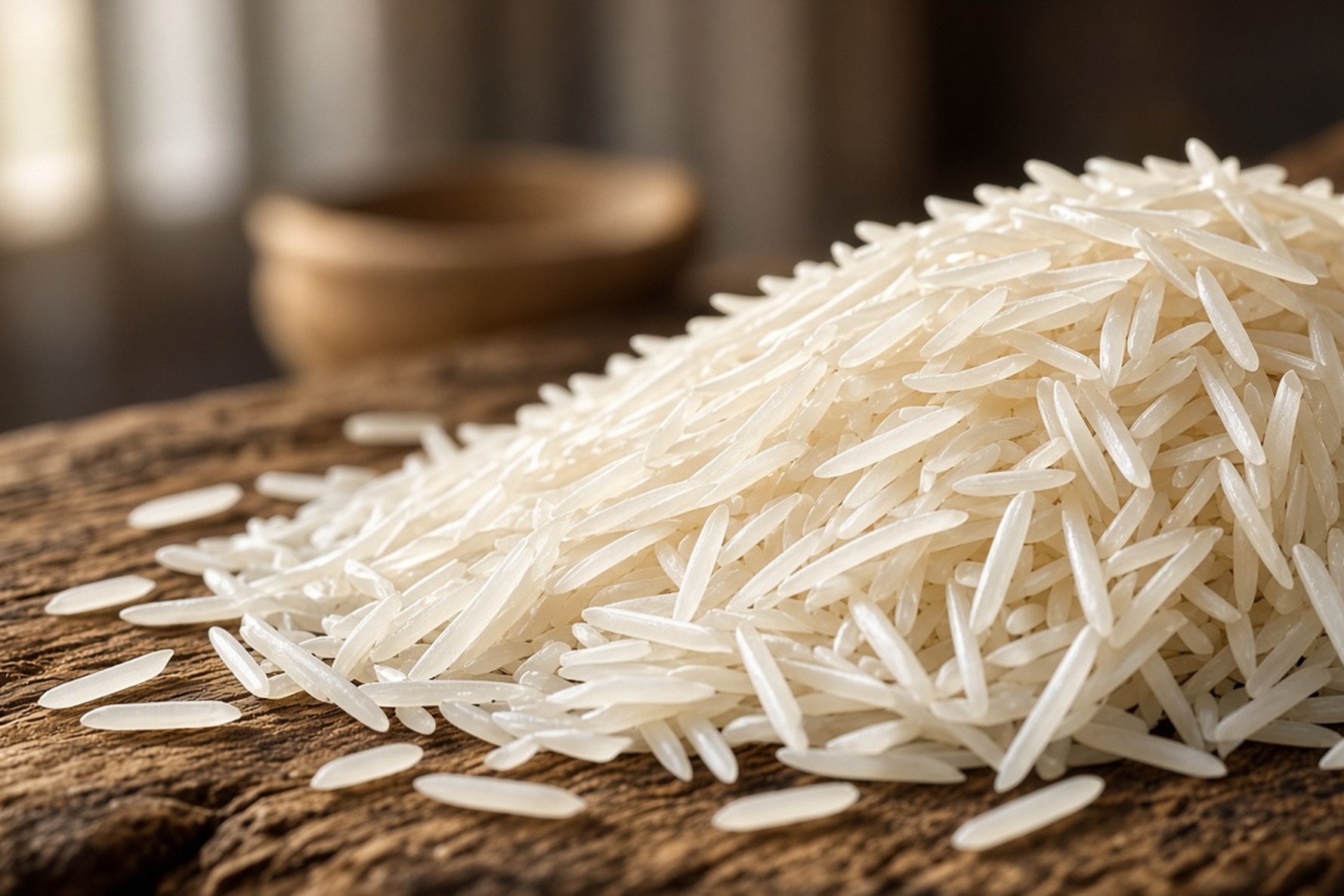
Dom-Sefid valuation rests on cooking behaviour and endosperm biochemistry. Milled grain is elongated, slender, without lateral bulge and with a tapered tip. Raw length 7.3–7.5 mm, width about 1.8–1.9 mm and length-to-width ratio 3.8–4.1 place it in the premium long-grain class. Thousand-kernel weight after milling is 24–26 g.
- Elongation ratio: cooked length 12–14 mm; cooked-to-raw length ratio in aged lots 1.6–1.9×; grains remain separate without surface stickiness.
- Amylose: 21–23% (intermediate) — shape retained after steaming; below 20% becomes pasty and sticky; above 25% turns hard and dry when cold.
- Gelatinization temperature: 70–74 °C (intermediate group) — even core and surface cooking.
- Gel consistency: above 60 mm (soft) — softness retained up to 48 hours after cooking.
- Aroma: 2-acetyl-1-pyrroline is the main scent compound; a slight fatty slip on the hand is a traditional authenticity cue.
| Physicochemical factor | Dom-Sefid value | Quality standard range | Commercial relevance |
|---|---|---|---|
| Raw grain length | 7.3–7.5 mm | > 7.0 mm | Premium long-grain marketability |
| Cooked grain length | 12–14 mm | > 11 mm | Formal hospitality presentation |
| Linear elongation ratio | 1.65–1.90 | ≥ 1.50 | Catering cook yield |
| Amylose content | 21.0–23.5% | 20–25% | Separate grains, no stickiness |
| Gelatinization temperature | 70–74 °C | 68–75 °C | No splitting during cook |
| Gel consistency | 65–80 mm | > 61 mm | Softness after service |
| Free moisture | 12.5–13.5% | ≤ 13.5% | Storage stability |
| Endosperm fat | 0.3–0.5% | 0.2–0.6% | Clarity and polo flavour |
3. Comparative analysis vs Sadri and landrace types
The Sadri family includes Dom-Sefid, Dom-Siah, Dom-Sorkh and Hasan-Sarayi. Dom-Siah has a darker awn, slightly sharper aroma and a creamier milled colour; Dom-Sefid tends toward bright ivory. Dom-Sorkh and Dom-Zard are grown more narrowly in eastern Gilan. Hasan-Sarayi has a thicker grain and softer cooked texture.
- Hashemi: thicker belly, mild mid-grain curve, milky cream colour, higher milling recovery.
- Local Tarom: slightly shorter grain, higher crystalline clarity, less final elongation than Dom-Sefid.
- Dom-Sefid: longest raw grain, finer width, highest cook elongation, matte white colour and soft texture after cooling.
| Trait | Sadri Dom-Sefid | Gilan Hashemi | Local Tarom | Shiroudi (high-yield) |
|---|---|---|---|---|
| Morphology | Elongated, pen-like, tapered ends | Cylindrical, mild convexity | Symmetric cylindrical | Elongated with thick cross-section |
| Milled colour | Uniform ivory white | Light milky cream | Clear crystalline white | Opaque white with chalky streaks |
| Raw length | 7.3–7.5 mm | 7.2–7.4 mm | 7.0–7.2 mm | 7.1–7.3 mm |
| Cooked length | 13–14 mm | 12.5–13.5 mm | 11.5–12.5 mm | 10–11 mm |
| Raw-grain aroma | Medium–high, lasting | Strong and penetrating | Sharp and lasting | Very low |
| Texture after 24 h | Fully soft and fresh | Soft and flexible | Soft | Brittle and firm |
| Paddy milling yield | 55–58% | 62–65% | 60–63% | 66–68% |
4. ISIRI 127 and laboratory quality control
Bulk deals and export clearance require compliance with national standard ISIRI 127 (“Rice — specifications and test methods”).
- Broken kernels: under 2% for grade-one export lots; under 1% for laser-sorted super-luxury.
- Chalky and immature grains: max 1.5% in premium grade.
- Yellow / heat-damaged grains: max 0.5%.
- Moisture: max 13.5% to limit larvae and mould.
Per ISIRI 12968: lead 0.15–0.2, cadmium 0.06 and inorganic arsenic 0.2 mg/kg. Pesticide residues per ISIRI 13120 (about 0.01–0.05 mg/kg). Total aflatoxin per ISIRI 5925 max 5 µg/kg and B1 max 2 µg/kg. Microbial testing per ISIRI 11602.
| Factor | Reference method | Export acceptance limit | Customs relevance |
|---|---|---|---|
| Broken grain | ISIRI 127 | < 2.0% | Visual uniformity |
| Free moisture | ISIRI 127 | ≤ 13.5% | Storage pest prevention |
| Chalky grains | ISIRI 127 | < 1.5% | Cooking consistency |
| Insect-damaged | ISIRI 127 | < 0.1% | Sanitary fitness |
| Lead | ISIRI 12968 | < 0.15 mg/kg | Health quarantine |
| Cadmium | ISIRI 12968 | < 0.06 mg/kg | Import food safety |
| Total aflatoxin | ISIRI 5925 | < 5.0 µg/kg | Cargo biosafety |
| Pesticide residues | ISIRI 13120 | ≤ 0.05 mg/kg | Gulf market entry |
5. Identification, authenticity and anti-fraud checks
Blending with cheaper varieties — driven by the price gap — is the main risk in bulk buying.
Sensory assessment at the lot
- Hand rub: rub 20–30 seconds; pure Dom-Sefid leaves a pleasant fatty feel and natural aroma; high-yield types feel dry and rough.
- Bite hardness: aged grain snaps crisply without powdering; powdering signals high moisture or chalkiness.
- Morphology: both ends taper evenly to a tip; abnormal mid-thickness or strong curvature suggests blending.
Laboratory methods
- 100 g cook test: non-authentic grains open earlier and elongate unevenly.
- 1.7% KOH test: alkaline starch dissolution pattern distinct from other rices.
- PCR genetic assay: variety purity verification at over 99% accuracy for high-value export lots.
6. Post-harvest processing, milling and optical sorting
Paddy moisture at harvest is about 22–25%. Rotary dryers with indirect air at 40–42 °C bring moisture to 9–10% within 48–72 hours; thermal shock causes internal fissures and breakage at husking.
- Rubber-roll husking: extracts brown rice without cracking the kernel.
- Vertical abrasive whitener: removes bran at controlled speed.
- Water-mist polisher: even, glossy grain surface.
- Laser optical sorter: removes black spots, yellow and defective grains to over 99.5% visual purity.
- Aging: 3–6 months rest in cool storage for maximum elongation and starch stability.
7. Commercial packaging, warehousing and transport logistics
| Packaging model | Typical capacity | Advantages | Drawbacks | Best-fit market |
|---|---|---|---|---|
| Cotton / calico bag | 5 and 10 kg | Grain breathability, authenticity feel | Moisture and insect ingress | Seasonal domestic market |
| Laminated BOPP sack | 10 and 20 kg | Mechanical protection, moisture barrier | Sensitive to initial lot moisture | Chain retail and regional trade |
| Multi-layer vacuum | 1, 2.5 and 5 kg | Insect control, surface oil retention | Puncture sensitivity | Overseas luxury retail |
| Modified atmosphere (MAP) | 1 to 5 kg | Shelf life and aroma stability | High gas-flush cost | Europe and Canada export |
Warehouse: 12–18 °C, relative humidity below 55%, pallets 15 cm off the floor and 0.5 m from walls. Dry 20-ft container export (20–22 t) needs insulated cartons and calcium chloride desiccant to prevent container sweat.
8. Customs tariffs, export documents and clearance
- 10061000 — Rice in the husk (paddy)
- 10062000 — Husked (brown) rice
- 10063000 — Semi-milled or wholly milled rice, polished (processed Dom-Sefid declaration)
- 10064000 — Broken rice
Required documents: phytosanitary certificate, food and drug health certificate, accredited laboratory COA, origin quantity and quality inspection certificate, and multilingual labelling (product name, licence, nutrition table, net weight, country of origin).
9. Target export markets
| Destination | Demand segment | Preferred packaging | Entry challenge | Competitive position |
|---|---|---|---|---|
| UAE (Dubai) | Hotels, ceremonial catering, hypermarkets | 5 and 10 kg BOPP | Dubai municipality health rules | Quality edge in niche channels |
| Iraq | Wholesale Baghdad, Najaf, Kurdistan | 10 and 20 kg | Asian price competition | Flagship local aromatic |
| Germany and UK | Specialty authentic food stores | 1–5 kg vacuum | EU pesticide and heavy-metal limits | Premium product with steady demand |
| Canada | Food hubs in Toronto and Vancouver | 2.5 and 5 kg | Ocean freight cost | Diaspora community demand |
Oman, Qatar and Kuwait also show strong demand for vacuum packs. Entry to Europe, Canada and Australia requires meeting pesticide and heavy-metal limits.
10. Pricing and bulk purchase economics
- Season: lowest rates when paddy arrives Mordad–Shahrivar (July–September); prices rise from winter as stocks tighten.
- Broken and sorting: traditional cleaning leaves 5–7% broken; cutting below 1% with laser adds cost and weight loss.
- Grain age: aged lots with stable cooking command a premium over same-year fresh crop.
- Paddy origin: known Rasht and Kuchesfahan farms carry higher trade value.
The main international competitor is Indian and Pakistani basmati; despite solid elongation, it does not fully match Dom-Sefid on natural aroma, surface fat and post-cooling softness. Thai jasmine has a moist, sticky texture unsuited to traditional Iranian polo.
11. Industrial uses and luxury foodservice
- Five-star hotels and diplomatic banquets — long grain and separate cook.
- Ceremonial catering — polo stays soft for hours after service over long holding times.
- Half-grain and brokens for rice pudding, halva and rice bread; rice flour for desserts and premium ready chicken soup.
12. Bulk purchase contracts and risk reduction
- Sealed master sample signed by both parties.
- Defect tolerances: max 2% broken and 1.5% chalky.
- Reference laboratory approved by standards and food-and-drug authorities.
- Random sampling based on ISIRI 13535 and ISIRI 12004.
- Staged payment tied to origin quality-inspection approval.
Information needed for a price inquiry
- Product name, broken grade, crop year (fresh / aged)
- Sorting type (standard, double laser, water polish)
- Pack material and weight, total tonnage, delivery schedule
- Buyer private label, destination health certificates
- Delivery point and Incoterms (EXW, FOB Bandar Abbas, CIF destination)
Buyers can enter technical specs on the Iranco platform so available lots are screened against quality criteria.
Sourcing path with Iranco
Steady supply of authentic Dom-Sefid faces scattered growers, uneven traditional lots and blending risk. Iranco provides a platform to ease grain trade and source directly from reputable northern mills: register requests with grain dimensions, broken percentage, sorting and packaging; field assessment; sample coordination; laboratory test oversight and logistics follow-up.
To review available capacity, submit purchase specs, volume and final destination via contact Iranco.
Summary
Dom-Sefid is among Iran’s most valuable premium grain cultivars: cooked length up to 14 mm, balanced amylose, lasting soft texture and retained aroma. Limited production and agronomic sensitivity reinforce commercial value. Trade success depends on modern milling, optical sorting, controlled aging, vacuum or MAP packaging and compliance with ISIRI 127 plus pesticide and heavy-metal rules. Precise technical contracts, a master sample and laboratory evaluation protect margin and supply stability.
Frequently asked questions
1. What is the main visual difference between Dom-Sefid and high-yield varieties?
Very elongated, pen-like grain with tapered ends and matte ivory white colour; high-yield types such as Shiroudi are wider with chalky lines and lack the natural fatty feel on the hand.
2. Why is Dom-Sefid priced higher?
Paddy yield of 2,800–3,800 kg/ha versus over 4,500 kg/ha for high-yield types; plants lodge easily and milling losses are higher.
3. What is the minimum aging time for peak cooking quality?
3–6 months in controlled storage; fresh grain absorbs less water and becomes pasty.
4. What documents are needed for export to Europe and the Gulf?
Phytosanitary certificate, food and drug health certificate, certificate of origin and a COA covering moisture, heavy metals, aflatoxin and pesticide residues per ISIRI 13120 or destination rules.
5. What packaging suits ocean freight?
Laminated BOPP, vacuum or nitrogen MAP; industrial desiccant inside the container is mandatory to prevent container sweat.
6. Why does polo stay soft after cooling?
Amylose at 21–23% and soft gel consistency above 60 mm slow starch retrogradation; texture stays soft for up to 48 hours.
7. How can authentic Dom-Sefid be sourced from Gilan mills?
Register precise specs, approve a master sample, run a cook test and inquire with reputable mills — bulk buyers can organise this process through Iranco.
8. What information is needed for an exact export price?
Tonnage, allowed broken percentage, harvest year, packaging type, destination health tests and international delivery terms; the same data underpin Iranco reviews.
Featured Products




Related Articles



