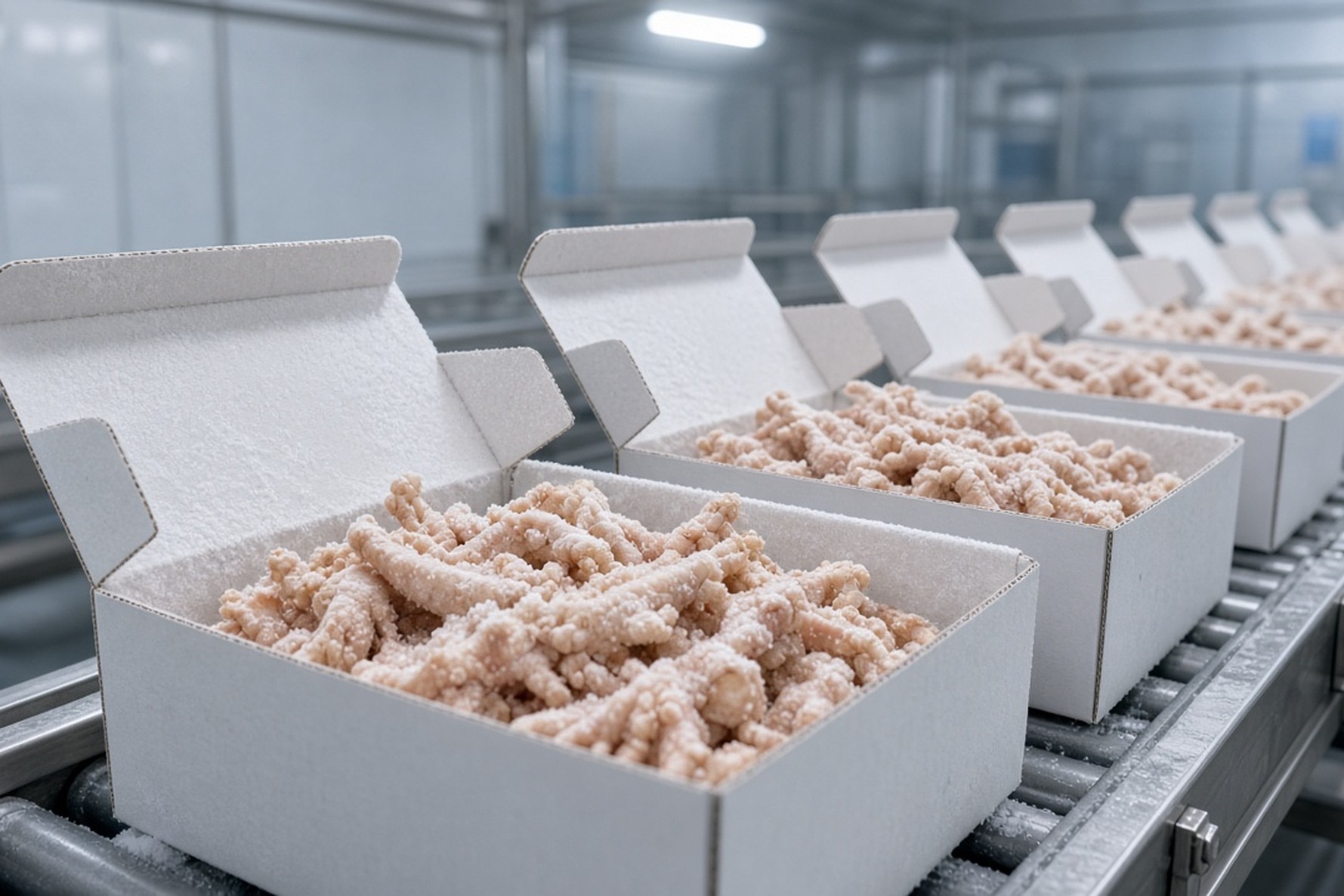
 Iranco Magazine Team
From market access and China Customs factory registration to veterinary certificates, quality specs, cold chain, wholesale contracts and real shipment margin
Export Guide · Poultry · China
Complete Guide to Exporting Chicken Feet to China: Health Certificates, Registration Codes & B2B Profit
From market access and factory registration with China Customs to veterinary health certificates, quality specifications, the cold chain, wholesale contracts, and real shipment margin calculation — a professional guide for poultry exporters and B2B importers.
2025 Trade Data — China Market
Trade statistics for 2025 show that China’s commerce in HS 020714 — frozen edible chicken cuts and offal — was a market worth approximately USD 1.8 billion. In the same year Russia exported 109,000 tonnes of chicken feet to China and became one of the most important suppliers by value.
Exporting chicken feet to China is a clear example of trade whose value depends not only on raw material, but on legal market access. In many markets chicken feet are treated as a low-value slaughter by-product; in China they can enter a human-consumption chain with significant commercial value. That difference in consumption patterns has turned a product with limited value in one country into a specialist item for meat importers, wholesalers, processors, and distribution networks in China.
One point must be clear from the outset: having quality chicken feet, cold storage, a Chinese customer, or even a general exporter registration in China Customs systems does not by itself authorise export of this product. Meat and poultry products are veterinary-sensitive goods, and China manages their entry on the basis of the exporting country’s veterinary system, animal-disease status, quarantine agreements, agreed health-certificate formats, and registration of production units. The formal market-access process for meat includes country assessment, risk review, agreement on quarantine requirements, and only then registration of eligible plants.
For an Iranian exporter, therefore, the first question should not be “What is the price of chicken feet in China?” The correct question is: at the time of contract, can Iranian chicken feet and the intended factory enter China under an approved pathway? Only after a positive answer do topics such as size, appearance, skin integrity, breakage, packaging, freezing temperature, reefer freight, and profit margin acquire commercial importance.
This guide follows that logic: legal entry first, then product quality, then logistics, and finally transaction profitability.
1. How China’s chicken feet market works
China is one of the largest international markets for chicken parts and chicken feet. Unlike markets where chicken feet are mainly seen as feed, gelatin, or industrial processing inputs, a substantial share of demand in China is allocated to food consumption.
This demand structure means importers are not only chasing the lowest price. Product appearance, size uniformity, intact skin, absence of freeze-burn marks, colour, cleanliness, the cut at the upper part of the foot, and processing quality directly affect sell-through.
China’s place in global chicken feet trade
2025 statistics show Russia exported about 109,000 tonnes of chicken feet to China, with trade value reaching USD 327 million. In the same year Brazil supplied about USD 326 million, Thailand USD 219 million, the United States USD 69 million, and Belarus USD 33 million to this market.
These figures reveal two important realities. First, China’s market is very large but divided among a few countries with formal access and approved production units. Second, market access can matter even more than price advantage. A low-cost producer whose country or plant lacks entry authorisation cannot effectively compete with a supplier on China’s approved list.
Main suppliers
In recent years Russia, Brazil, Thailand, the United States, and Belarus have been the main players in this market. In 2025 reduced supply from some origins and poultry-disease restrictions changed the supplier mix. Trade forecasts published for 2026 also identify the return of Brazilian supply as one of the key factors likely to reshape the market again.
| Origin | Commercial position in China | Competitive feature |
|---|---|---|
| Russia | Major supplier | Relative geographic proximity and substantial volume |
| Brazil | Global-scale player | Integrated poultry industry and high production scale |
| Thailand | Established supplier | Strong record in poultry processing and export |
| United States | Recognised supplier | High chicken production volume and historical market access |
| Belarus | Smaller supplier | Formal market presence and regional land routes |
For an Iranian exporter, comparison with these countries should be based on delivered cost in China together with authorisation status, not slaughterhouse gate price alone.
2. The main issue for exports from Iran: market access first, sales second
In meat trade with China, registering an exporting company and registering a factory are two different concepts.
An Iranian company may be registered in China-related systems for certain commercial activities or food groups, but that registration does not mean the company is authorised to export chicken feet. For meat and meat products, beyond general requirements, the country of origin, the product, and the production unit must be approved under the relevant sanitary and quarantine framework.
In its formal process, China Customs first reviews the veterinary system of the applicant country. It then requests information on animal diseases, control of veterinary drug residues, slaughterhouse oversight, public health, production methods, and quality-control systems. If the assessment is acceptable, inspection and negotiation on quarantine protocol and health-certificate format become possible. Only after these stages does factory registration acquire meaning.
Four levels that must be checked separately
| Review level | Key question |
|---|---|
| Country | Has China accepted entry of this product from the country of origin? |
| Product | Are chicken feet or the relevant chicken-meat group within the permitted scope? |
| Factory | Does the abattoir or processing unit hold valid registration for export to China? |
| Consignment | Do the product, certificate, packaging, and conditions of this shipment meet requirements? |
This distinction is one of the most important commercial points for buyer and seller. Before signing a firm contract, receiving advance payment, or booking a container, the current status of the country name, product group, and production-unit registration number in official China Customs lists must be verified.
Is having a GACC code enough?
No. A general exporter registration code, a manufacturer registration code, and authorisation to import a meat product are three different matters. Even if an Iranian company holds an active registration number for general food-export activity, that number alone does not authorise export of chicken feet produced at every plant.
In professional contracts, the Chinese buyer should confirm the name and registration number of the approved production unit before payment, in addition to the seller’s name.
3. Manufacturer registration with China Customs and the new 2026 regulations
From 1 June 2026, China’s new regulations on registration of overseas food manufacturers under Customs Decree No. 280 have taken effect and replaced the previous Decree No. 248 framework. This change matters for food exporters because it updates the registration structure for overseas factories.
Under the new rules, an overseas manufacturer must register with China Customs. For certain higher-risk food groups, including meat and meat products, the role of the competent authority in the country of origin remains central.
Main registration dossier information
A typical registration file usually includes information such as:
- Legal name of the production unit;
- Country and production-site address;
- Legal representative;
- Contact information;
- Registration number issued by the official authority in the country of origin;
- Requested product group;
- Food safety and hygiene system information, where required;
- Information on production type and unit capacity;
- Competent-authority review report for groups subject to official recommendation.
Under current China regulations, registration documents may be submitted in Chinese or English, and registration of an approved unit is usually valid for five years.
Registration number on packaging
An important regulatory requirement is that a registered manufacturer exporting food to China must print the China registration number, or the number approved by the competent authority in the country of origin, on packaging as required by regulation.
For a product such as chicken feet shipped in wholesale cartons, alignment among carton information, veterinary certificate, packing list, and customs documents is especially critical.
Common exporter mistake
The biggest mistake is to begin factory registration independently of country market access. For meat, if the country or product is under import restriction, China Customs may also refuse new registration requests linked to the same product group. The new regulations explicitly allow suspension of registration acceptance in such cases.
4. Veterinary health certificate — the primary shipment document
Exported chicken feet are an edible animal product. Their health certificate is therefore not merely a general food certificate.
In formal meat trade with China, the format and content of the health certificate are part of the agreement between the veterinary authorities of the two countries. During market-access negotiations, the parties agree on quarantine requirements and the health-certificate text acceptable to China.
This matters greatly because a general veterinary certificate form cannot be used for every destination country.
What does the certificate usually cover?
Depending on the protocol for the country of origin, the certificate may include confirmations regarding:
- Identification of the production plant;
- Product origin;
- Animal species;
- Slaughter conditions;
- Veterinary supervision;
- Disease status relevant to the destination country;
- Fitness for human consumption;
- Compliance with production hygiene requirements;
- Consignment specifications;
- Number of packages;
- Weight;
- Container and seal numbers;
- Storage and transport conditions.
The exact text must be the text agreed with China. Exporters must not substitute certificate templates from other countries for the China-specific format.
Role of the Iran Veterinary Organization
For exported animal products, the origin of raw material, abattoir, cold store, and processing unit must operate under relevant veterinary supervision and licences.
But in exports to a market such as China, compliance with Iran’s domestic regulations is only part of the issue. A unit authorised for production or export in Iran is not automatically authorised for product entry into China.
5. What specifications does chicken feet for the China market need?
In B2B purchasing, the label “frozen chicken feet” is not enough to conclude a contract. Two shipments with the same title can differ greatly in commercial value.
The buyer must define product specifications in measurable form.
Difference between foot and paw
In international trade a commercial distinction usually exists between the fuller foot section and the paw. Cutting method, product length, and whether certain parts of the limb remain or are removed must match exactly in the sample and contract specifications.
Product-name translation on a proforma invoice must not replace photos, samples, and written cut specifications.
Key order parameters
| Parameter | What must be defined | Importance |
|---|---|---|
| Cut shape | Exact cut location | Prevents dispute over product length |
| Weight or size | Agreed range | Sales uniformity and grading |
| Colour | Acceptable appearance range | Direct effect on market acceptance |
| Skin integrity | No severe tearing or unacceptable damage | Visual quality |
| Nails | Retained or removed per order | Varies by market and buyer |
| Stains and bruising | Contractual acceptance limit | Grade determination |
| Breakage | Maximum contractual tolerance | Product quality |
| Visible contamination | No foreign matter | Safety and acceptance |
| Freezing method | Method and frozen state | Texture and appearance quality |
| Net weight | Actual weight excluding packaging | Price basis |
| Packaging | Bag weight and master carton | Warehouse and distribution operations |
| Storage temperature | Per product and contract requirement | Cold-chain integrity |
In chicken-feet trade, the “percentage of product outside specification” must be defined from the sample stage onward. Terms such as “premium quality” or “Grade A” without quantitative criteria have limited value in an international contract.
Desirable appearance
A suitable shipment should usually be uniform, clean, and free of visible contamination. Severe discolouration, large stains, heavy bruising, extensive skin tearing, breakage, foreign matter, or signs of improper storage can reduce commercial value.
China’s national food-safety standard GB 2707-2016 is one of the baseline standards for fresh and frozen livestock and poultry products, and in assessment of imported product it should be read together with other current regulations on residues, contaminants, and import requirements.
6. Quality control — from abattoir to container
Quality control for exported chicken feet should not be limited to opening a few cartons at loading.
Quality is shaped from slaughter and foot separation onward. If initial operations are inadequate, freezing cannot correct the defects created.
Control on the production line
Important steps include:
- Proper separation of product from the carcass;
- Removal of visible contamination;
- Washing and preparation according to approved process;
- Skin and appearance inspection;
- Grading;
- Removal of damaged product;
- Proper freezing;
- Rapid packaging;
- Transfer to cold store;
- Batch traceability recording.
Relevant testing
The testing programme should be set according to destination regulations, veterinary protocol, the plant’s food-safety programme, and buyer contract.
Items that may be reviewed include:
- Relevant microbiological agents;
- Veterinary drug residues;
- Relevant chemical contaminants;
- Foreign matter;
- Net weight;
- Sensory and appearance control;
- Freezing and storage conditions.
Test limits should not be copied contractually from another market. China’s regulations on drug residues and food-safety standards should be the basis for defining the control programme.
Pre-loading sampling
One of the best ways to reduce commercial dispute is random inspection of export-ready cartons before loading.
A professional buyer should specify:
- How many cartons to inspect;
- From which points in the batch samples are taken;
- Which defects are counted;
- What weighing method is used;
- What tolerance applies to each defect;
- What conditions trigger batch rejection.
Sample versus shipment discrepancy
A common problem in food trade is that the initial sample is manually selected from the best product while the final shipment combines production from different days.
The professional solution is to record the reference sample, written specifications, and acceptance criteria in the contract at the same time.
7. Chicken feet tariff code and the importance of correct classification
Frozen chicken feet in international trade generally fall in Chapter 02 of the Harmonized System and in group 0207 for edible poultry meat and offal.
For many chicken-feet trade flows, base code HS 020714 is used, covering frozen edible cuts and offal of species Gallus domesticus. In the destination country’s national classification this code may be subdivided further. China’s trade data also record a substantial share of chicken-feet shipments under subheadings related to 020714.
Why should the tariff code be fixed before final pricing?
The correct code affects:
- Import duty and levy rates;
- Required documents;
- Import licences;
- Quarantine control;
- Customs declaration;
- Market-statistics analysis;
- Competitor price comparison.
Using the term “HS Code 020714” in early negotiation is useful, but the Chinese importer must determine the exact subcode used in declaration for the actual product based on real specifications.
An important market-analysis error
Total statistics for HS 020714 should not be treated as equivalent to “chicken feet” alone. This group can include other cuts and offal as well.
For chicken-feet-specific analysis, more detailed customs data or descriptive shipment data should also be reviewed.
8. Export packaging and the cold chain
Chicken feet exported to China are mainly a frozen product. Packaging is therefore not only a transport tool; it is part of the quality-preservation system.
Wholesale packaging
International markets show examples of cartons around 10, 15, 20, and 25 kg, but carton weight should not be chosen based on seller habit alone. The buyer should define the weight required by its distribution network.
Actual international chicken-feet trade data show 20 kg packs and container loads of about 25 to 28 tonnes net on some trade routes. These figures reflect real commerce, not a mandatory standard for every contract.
Appropriate pack structure
Export packaging should:
- Be suitable for food contact;
- Not become brittle at freezing temperature;
- Protect product against secondary contamination;
- Allow printing of traceability information;
- Have adequate resistance to cold-store humidity;
- Not deform severely during palletising and ocean transport.
Inner bags and master cartons should be prepared according to China’s registration and labelling requirements.
Important carton information
Depending on current product and protocol requirements, information such as the following matters:
- Product name;
- Country of origin;
- Factory name or code;
- Registration number;
- Batch number;
- Production date;
- Net weight;
- Storage conditions;
- Information required for traceability.
This information must be consistent with veterinary and customs documents.
9. Ocean transport and reefer container management
For a B2B transaction at commercial volume, frozen chicken feet are usually shipped in reefer containers.
Here, profit or loss depends not only on freight. Choice of a sound container, pre-cooled product, stowage method, and temperature recording can mean the difference between acceptable delivery and serious loss.
Product must be frozen before loading
A reefer container is not designed to pull down the temperature of several tonnes of warm product quickly. Product must be frozen and stabilised under contract-defined conditions before entering the container.
If relatively warm cartons are placed inside the container, besides longer time to reach target temperature, the risk of severe temperature variation across the load increases.
Air circulation
Container airflow must not be blocked by incorrect stowage.
Cartons should be stacked so that:
- Cold-air paths are preserved;
- Load stays within container limit lines;
- Abnormal pressure on cartons is avoided;
- Doors close without strain.
Temperature recording
For a high-value shipment, use of temperature data loggers can be very important in managing commercial dispute.
If at delivery it is claimed the product suffered temperature fluctuation in transit, recorded data help identify whether the problem occurred at origin cold store, inland transport, port, vessel, or destination.
Full container or groupage?
For frozen meat products, full-container shipment usually offers a more manageable structure for temperature control, cross-contamination prevention, documentation, and port operations.
| Option | Advantage | Limitation |
|---|---|---|
| Full reefer container (FCL) | Better load and temperature control | Requires higher order volume |
| Cold-store groupage (LCL) | Suitable for limited volume | Greater operational and control complexity |
| Air freight | Very high speed | Very high transport cost for bulky cargo |
10. What does a Chinese buyer really want from the seller?
Selling chicken feet to China does not begin with sending a message stating “price per tonne”.
A professional importer usually wants to know first whether the seller can actually export legally.
Documents important in initial negotiation
A buyer may request:
- Factory number and details;
- Registration status in China;
- Veterinary licences;
- Technical product specifications;
- Production-line photos;
- Actual product photos;
- Packaging sample;
- Test report;
- Monthly supply capacity;
- Loading port;
- Payment terms;
- Delivery terms;
- Sample contract or proforma invoice.
Who are the main buyers?
China’s B2B market can include several groups:
Specialist meat importers
Companies with licences, cold-store infrastructure, and clearance capability for meat products.
Cold-chain wholesalers
Distribute imported product in regional markets and wholesale channels.
Processing units
Purchase chicken feet for flavoured, cooked, packaged, or ready-to-eat products.
Food-service distribution networks
Supply restaurants and catering centres.
For an Iranian exporter, working with an importer that has real experience clearing meat and poultry is far lower risk than working with a general trade intermediary.
11. How to calculate B2B profit on chicken feet exports
Chicken-feet margin cannot be calculated only from the difference between “purchase price in Iran” and “price in China”.
An export shipment has several cost layers, and ignoring any of them can erase apparent deal profit.
Practical landed-cost formula
Raw material + processing + freezing + packaging + testing + documents and certificates + inland transport + cold storage + port costs + ocean freight + insurance + finance cost + trading commission + risk reserve
Selling price is then set according to agreed delivery terms.
Main profitability factors
| Factor | Effect on profit |
|---|---|
| Raw chicken-feet purchase price | Direct and very high |
| Percentage of export-acceptable product | Determines real yield |
| Size uniformity | Affects selling price |
| Breakage and defects | Reduces value or increases waste |
| Carton and inner-bag cost | Direct effect per tonne |
| Freezing speed and cold-store capacity | Affects quality and cost |
| Container volume | Affects freight cost per kg |
| Ocean freight | Important variable in destination price |
| Transaction finance cost | Important in long-term contracts |
| Rejection or claim rate | Can erase profit across several shipments |
| Authorisation status | Primary condition for any deal |
High price does not always mean high profit
A buyer may offer a higher price for a larger size, but if only a low percentage of the plant’s output falls in that size, sorting cost and reduced yield can make the real margin lower.
Profit should therefore be calculated on each kilogram of exportable sellable product, not each kilogram of chicken feet entering the line.
Cost of off-grade product
Suppose a plant produces several quality groups. If only part of output meets China order specifications, rejected product must be sold in another market.
Lower selling prices for downgraded groups directly affect overall project economics.
For this reason, before signing a contract it is better to review at least several days of actual production to determine the percentage of product matching buyer specifications.
Why China market prices should not be copied blindly
Prices quoted in the market may relate to:
- A different origin;
- A registered plant;
- A different size;
- An old contract;
- Different delivery terms;
- Goods inside China after import costs are paid;
- Or even processed product.
Valid comparison is possible only when specifications and commercial terms of two offers are identical.
12. Contract structure for selling chicken feet to a Chinese buyer
The contract should anticipate likely disputes before production begins.
Describing the product as “export-grade chicken feet” is not sufficient.
Items that should be recorded in the contract
- Exact product name;
- Species;
- Frozen state;
- Cut shape;
- Size or weight range;
- Skin condition;
- Nails per order specification;
- Breakage tolerance;
- Bruising and discolouration tolerance;
- Net weight per pack;
- Number of packs per carton;
- Carton specifications;
- Storage conditions;
- Factory number;
- Inspection conditions;
- Delivery point;
- International trade terms;
- Estimated preparation time;
- Payment method;
- Non-conformance handling method.
An approved sample should be part of the agreement
In sensitive transactions, photos and video are not enough. Where practically possible, a physical sample or approved production reference should be confirmed.
Sample characteristics must match written specifications, because in case of dispute the contractual wording is the clearer benchmark for resolution.
Importer checklist before placing an order
A Chinese importer or trading company planning to order chicken feet from Iran should review the following before payment:
- Current authorisation status of the country of origin for the intended product at order time;
- Exact permissibility of the chicken-feet group or related product;
- Valid factory registration with China Customs;
- Match between factory address and registered information;
- Validity of the plant’s veterinary licences;
- Actual photos of production line and cold store;
- Sample receipt or approval of reference sample;
- Exact definition of chicken-feet cut location;
- Defined size range;
- Breakage tolerance set;
- Bruising and appearance-defect tolerance set;
- Nail status specified;
- Net pack weight defined;
- Master carton structure defined;
- Label and registration number checked before printing;
- Required tests defined;
- Health certificate issuable for China destination verified;
- Entry port and importer clearance capability confirmed;
- Pre-loading inspection method defined;
- Payment terms and document release conditions set;
- Actual production capacity during contract period confirmed;
- Freezing programme and cold-store capacity reviewed;
- Reefer transport conditions specified;
- Non-conformance claim handling recorded;
- All documents aligned with the actual factory name and number.
This checklist matters before price comparison. A cheaper offer from a plant with unclear registration status is not comparable to goods with a clear legal pathway.
What information should be sent to receive an accurate price?
A chicken-feet price request is comparable only when the buyer sends complete technical and commercial specifications.
Minimum recommended information includes:
- Product: chicken feet or chicken paws;
- State: frozen;
- Exact cut shape;
- Size or weight range;
- Nail status;
- Breakage tolerance;
- Maximum acceptable appearance defects;
- Weight per pack;
- Weight per master carton;
- Private-label requirement or not;
- Trial order volume;
- Probable monthly volume;
- Destination country: China;
- Destination port;
- Preferred delivery terms;
- Required tests;
- Label language and information;
- Purchase timeline;
- Proposed payment terms.
For example, “price for 25 tonnes of chicken feet to China” is not a complete price request. Until the seller knows what size, cut type, packaging, and delivery terms the buyer wants, it cannot provide a reliable price. Buyers wishing to evaluate supply from Iran can include these specifications in an Iranco purchase request so sourcing options can be reviewed against defined requirements.
Iran supply path for export orders
In international chicken-feet trade, finding product is only one stage. The seller must also clarify product origin, factory, veterinary status, production capacity, quality specifications, and ability to execute the buyer’s required packaging.
For the China market an additional stage is added to this chain: confirmation that the product can legally enter the destination. Before a deal is finalised, Iran’s access status for the product group, production-unit registration, and documents required for that shipment must be checked.
Iranco (iranco.com) can provide a platform for buyers seeking to assess chicken-feet supply capacity from Iran by submitting purchase requests based on technical specifications. The request should ideally include product shape, size, nail status, pack weight, approximate order volume, destination country and port, and expected standards.
A precise request also enables more logical comparison of several supply options. Two sellers are comparable only when they quote on the same product with identical specifications.
For a project whose destination is China, country and factory authorisation status must be confirmed before entering the firm commercial order stage. Once that is clear, sample, price, packaging, monthly capacity, and transport conditions can be coordinated with the final supplier.
Conclusion
Exporting chicken feet to China is economically attractive because the product has substantial food demand and commercial value in the Chinese market. But market size must not distract the exporter from the most important reality of this trade: for meat products, entry authorisation matters more than finding a customer.
The first stage of a real chicken-feet export project from Iran must be verification of legal product access to China. After that, factory registration, acceptable veterinary certificate, technical product specifications, packaging, and transport route must be reviewed.
At the commercial stage, size, uniformity, cut shape, skin integrity, breakage level, and appearance defects must become contractual metrics. Terms such as “Grade A” are not enough in a professional contract without a specification table and measurable tolerances.
Real profit does not come from a simple Iran–China price gap. Exportable product yield, processing cost, freezing, packaging, testing, cold storage, inland transport, reefer container, finance cost, and non-conformance risk must all enter the calculation.
For a B2B buyer, the best transaction structure is to confirm legal status and factory first, then finalise sample and product specifications, and only then set price and contract volume. That sequence significantly reduces the likelihood of dispute, shipment hold, and loss from a deal that was never executable from the start.
Frequently asked questions
Is China a suitable market for chicken feet?
Yes. China is one of the world’s largest chicken-feet markets, with major suppliers including Russia, Brazil, Thailand, the United States, and Belarus. In 2025 Russia alone exported about 109,000 tonnes of chicken feet to China. However, large demand does not mean free entry from every country; veterinary access from the country of origin is a fundamental condition.
Can an Iranian exporter with a GACC code export chicken feet to China?
A general exporter registration number alone is not enough. For meat and poultry products, the country of origin, product, and production plant must also be acceptable under China’s regulations. Before contract, the buyer should verify that the specific production unit can export the same product group to China.
How long is factory registration with China Customs valid?
Under China’s new regulations on registration of overseas food manufacturers, effective from 1 June 2026, overseas manufacturer registration is valid for five years. Start and end dates are specified at registration, and the plant must verify current registration status before export.
What are the most important quality specifications for exported chicken feet?
Cut shape, size, uniformity, colour, skin integrity, nail status, breakage level, bruising, and visible contamination are among the main indicators. In a professional contract, tolerances should be set for countable defects so quality is not described only with terms such as “Grade A”.
Under which tariff code is chicken feet traded?
Frozen chicken feet in international trade usually fall in group 0207 and, for many shipments, in base subheading 020714 for frozen edible chicken cuts and offal. The exact subcode used in China must be determined by the importer and customs broker based on the actual product type.
What packaging is suitable for exporting chicken feet?
Frozen wholesale packaging should be moisture-resistant at low temperature, food-contact suitable, and traceable. Pack weight should be chosen according to buyer request. Real trade shows examples from 10 to 20 kg and other weights, but no single weight is a universal commercial standard for all markets.
How is export chicken-feet price determined?
Price depends on size, appearance quality, cut shape, order volume, raw-material cost, exportable-product percentage, packaging, cold-store cost, testing, transport, and delivery terms. To compare two offers, all these specifications must be identical; otherwise a lower price per tonne is not necessarily the better offer.
What volume should be ordered for one container of chicken feet?
Actual capacity depends on carton weight, palletising method, container weight limits, and shipping route. Real global trade data show shipments around 25 to 28 tonnes, but permitted weight per shipment must be set according to container, shipping line, and route restrictions.
How can Iranian chicken feet be sourced for export?
Product shape, size, packaging, order volume, and destination must first be defined. Then abattoir or processing-unit capacity, relevant licences, sample, quality specifications, and cold store are reviewed. For China destination, country and factory market-access status must also be confirmed before firm purchase. These specifications can be submitted in an Iranco purchase request so suitable supply options can be reviewed.
How is profit on chicken feet exports to China calculated?
Real profit is not the simple difference between factory price and China selling price. Raw-material purchase price, exportable-product yield, processing, packaging, freezing, cold storage, testing, documents, inland transport, port cost, ocean freight, finance cost, and quality-claim risk must be deducted from shipment revenue. Profit should be calculated on product that is actually sellable.
Featured Products
Related Articles



