 Iranco Magazine Team
Practical guide to export carp selection, QC and cold chain, health documents, packaging, tariff codes and fresh vs frozen shipment logistics to the Kuwait market
Export Guide · Seafood · Kuwait
Farmed Carp Export to Kuwait: Health Standards and Container Shipping
Practical guide to export carp selection, quality control and cold chain, health documents, packaging, tariff codes, and shipping fresh and frozen consignments to the Kuwait market
Four key indicators
Farmed carp export to Kuwait depends less on geographic distance than on initial fish quality, rapid chilling, compliant health documents, packaging and an unbroken cold chain. Kuwait’s fish and aquatic product imports were about USD 262.13 million in 2022, while domestic production was about 3,275 tonnes.
Analytical introduction
Kuwait’s seafood market has a key commercial trait: domestic production alone cannot meet demand, and a large share of supply arrives through imports. FAO data for 2022 puts Kuwait’s fish and aquatic product imports at about USD 262.13 million, while total fisheries and aquaculture output is about 3,275 tonnes. Aquatic food available for consumption is reported at about 13 kg per person. Kuwait is therefore an import-driven market — though that alone does not guarantee demand for every fish species.
Iranian farmed carp must face a clear reality: Kuwait’s seafood basket is not price-only. Marine fish, imported frozen products and species from Asian, Arab and regional origins compete. Exporters cannot rely on Iran’s proximity alone. Weight uniformity, sensory quality, gutting method, belly and gill condition, freezing type, glaze level, packaging integrity and shipment traceability all affect sellability.
For the importer, the issue is not simply buying “carp.” Species, whole vs gutted, chilled vs frozen, piece-weight range, packaging and accompanying documents must be defined precisely.
Kuwait’s food import rules also place fish in the high-risk food group. Document match, transport conditions, cargo temperature and product appearance therefore matter at entry. For Iranian exporters, a real opportunity appears when farm production, harvest, chilling, processing, freezing, packaging and logistics are designed from the start around the Kuwaiti buyer’s purchase specification.
1. Kuwait’s fish market and the place of farmed carp
Kuwait is a small consumer market by population but depends heavily on food trade. In seafood, imports play a major supply role. FAO’s Kuwait market report recorded fish and aquatic product imports above USD 262 million in 2022, with total fisheries and aquaculture production at 3,275 tonnes — about 14% from aquaculture.
For carp exporters this means two things: the market is structurally used to imported product; and total seafood market size must not be confused with carp-specific demand. Kuwaiti consumers choose among local marine fish, imports, frozen fillets and processed products.
Who is the likely buyer of Iranian carp?
- Specialized seafood importers and wholesalers
- Frozen food distribution companies
- Grocery stores and retail chains
- Fish and seafood retail outlets
- Restaurants and kitchens that use whole fish
- Buyers who cut or repack after arrival
Needs differ. Retail may prioritize uniform piece weight and pack appearance; wholesalers focus more on price per kg, yield loss, glaze percentage, pieces per carton and supply stability.
Why carp must be sold with precise specifications
“Export farmed carp” is not enough for a professional deal. The commercial carp family includes several species with different body traits, taste, bone structure and market weights. Offers should at least state species name, processing form and weight band. Iran’s warm-water aquaculture can supply carp family fish, but export advantage appears when a farm can deliver uniform, repeatable product across successive shipments.
2. Choosing species and product form for Kuwait
Do not buy carp by generic name alone. Scientific or at least precise commercial species names must appear in the purchase request and product documents. International commercial classifications cover common carp, grass carp and groups of silver and bighead carp. HS also has dedicated lines for fresh/chilled and frozen carp.
Common product forms
| Product form | Key feature | Best for |
|---|---|---|
| Whole chilled | Natural appearance; needs a very fast cold chain | Fresh sales and short-route orders |
| Whole gutted chilled | Viscera removed; lower spoilage drivers | Wholesale and prep centres |
| Whole frozen | Longer logistics shelf life | Container loads and frozen storage |
| Gutted frozen | More ready for use or cutting | Wholesale, restaurants and processing |
| Portions or fillet | Higher value-add and prep | Retail and food service |
For fillet and cut meat, the tariff code is not necessarily the same as for whole fish. Piece weight should be an agreed band set with the buyer. Whole fish looks more natural, but hygienically gutted product with proper washing and immediate chilling is easier to control on longer commercial chains.
3. Technical specs Kuwaiti buyers expect
A professional RFQ should define the product so two different sellers can quote the same specification. A common error is asking for a price “per tonne of frozen carp” without saying whether declared weight includes glaze.
| Parameter | Option / definition needed | Buyer importance |
|---|---|---|
| Species | Commercial and scientific name if needed | Avoid wrong-species delivery |
| Product state | Fresh chilled or frozen | Logistics and shelf life |
| Process form | Whole, gutted, headed, portion or fillet | Use case and tariff code |
| Weight band | Piece weight range | Sales uniformity |
| Net weight | Actual fish weight | Economic comparison of offers |
| Glaze | Presence/absence and calculation method | Avoid weight disputes |
| Primary pack | Bag, wrap or consumer pack | Product protection |
| Master carton | Net weight and approximate piece count | Warehousing and distribution |
| Freezing method | Per plant capability and order | Texture and quality impact |
| Product temperature | Per chilled or frozen state | Cold-chain control |
| Production date & batch | On pack and documents | Traceability and inventory |
| Health documents | Defined before loading | Clearance at destination |
4. Export carp quality: from farm to packing line
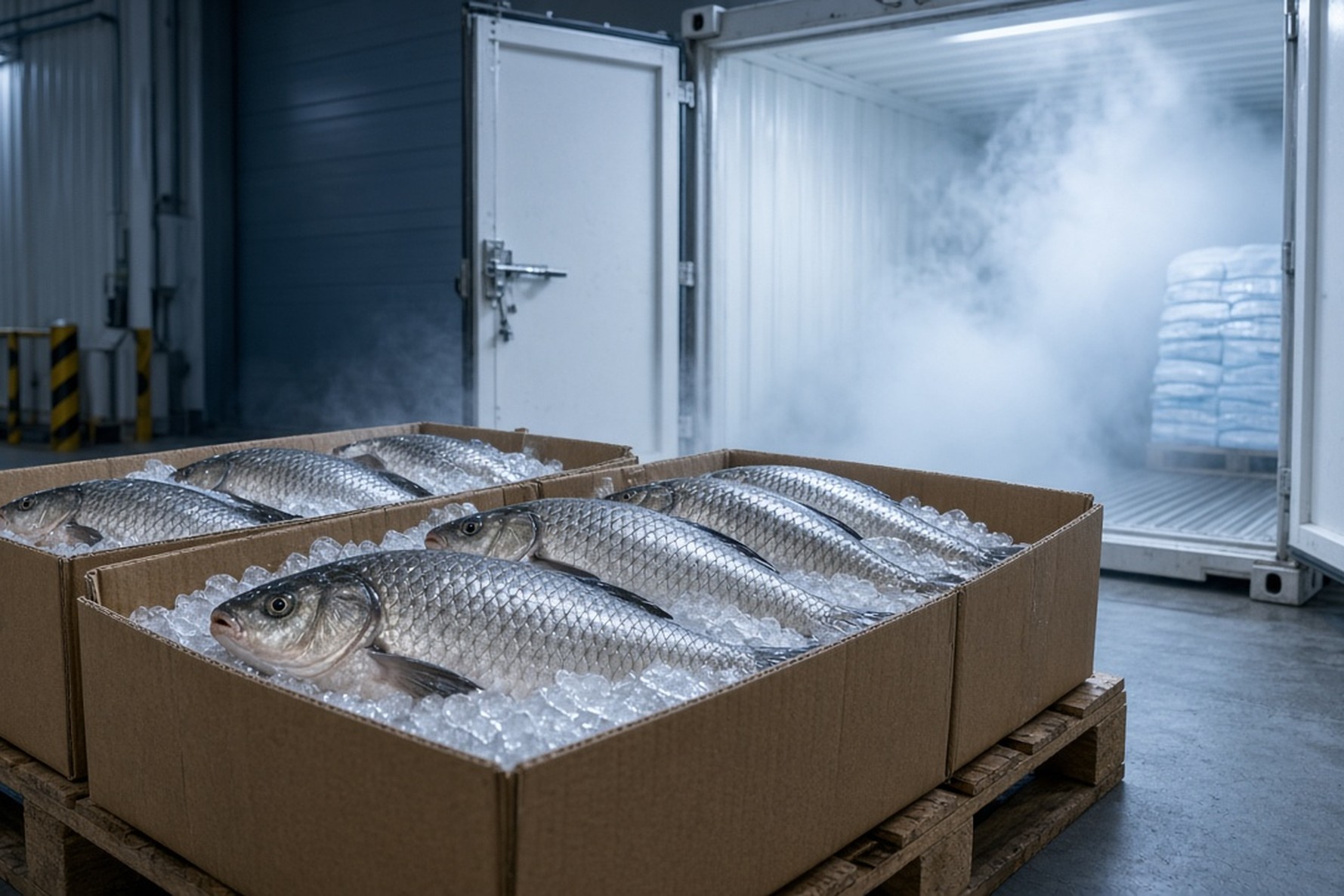
Fish quality cannot be “built” after harvest. Processing and packaging only preserve what already exists. For export orders, harvest should be aligned with the processing line so fish spend minimal time at ambient temperature after leaving the pond.
FAO treats near-zero °C as a suitable holding basis for fresh chilled fish and stresses that rapid temperature reduction slows microbial and enzymatic activity. The thermal centre of the fish must also cool; larger fish need longer to drop core temperature than small fish.
Sensory features of suitable fish
| Check point | Acceptable | Warning sign |
|---|---|---|
| Skin | Natural look, no severe damage | Discolouration, spots or widespread damage |
| Eyes | Consistent with freshness | Cloudy and deeply sunken |
| Gills | Acceptable sensory condition | Darkening and off-odour |
| Texture | Firm, suitable consistency | Softness and disintegration |
| Odour | Natural fish smell | Sour, amine, ammonia or putrid odour |
| Belly | Intact, no abnormal rupture | Rupture, leakage and contamination |
| Frozen surface | No severe freezer burn | Widespread dryness and whitening |
| Pack | Intact and sealed | Tears, leakage or contamination |
Off-flavour and off-odour control before harvest is important in freshwater farmed fish. Professional buyers should include cooked sensory evaluation alongside raw appearance in sample approval.
5. Food safety and QC tests
Kuwait’s food import rules place fish in the high-risk group. Test type should follow product form, process, farm risks and buyer requirements. HACCP programmes matter, but a certificate alone does not replace real temperature control, line hygiene and traceability.
- Microbial control: Water, ice, equipment, work surfaces, containers, staff hands and gutting operations are main contamination sources.
- Water and ice: Ice in direct contact with fish is part of the food-holding system and must come from potable or suitable water.
- Veterinary drug residues: Drug use history and withdrawal periods before harvest must be traceable.
- Heavy metals and contaminants: Tests should follow species risk, farm site, feed and destination rules.
- Net weight and glaze: Carton weight, net product weight and glaze calculation method must be clear.
6. Health rules and fish entry documents for Kuwait
The key to food export to Kuwait is simultaneous match of goods, documents and physical shipment condition. Kuwait’s Public Authority for Food and Nutrition food import rules under Ministerial Resolution No. 6 of 2023 set baseline documents for imported food consignments.
- Customs declaration
- Certificate of origin
- Delivery permit
- Commercial or import licence
- Health certificate
- Packing list or consignment contents
- Additional documents requested by the competent authority
The health certificate must be issued or endorsed by the competent official authority of the origin or exporting country and must match the consignment and other documents. Batch numbers on cartons, packing lists and certificates must be reconcilable. Import inspection reviews packaging condition, odour, moisture, non-compliant temperature, pests or foreign matter, and for frozen goods freezer burn or thaw–refreeze signs. Kuwait rules also allow requesting temperature records.
7. Labelling, packaging and shipment traceability
Export product labels should be finalised with the Kuwaiti importer before loading. Printing cartons and shipping before label approval raises correction risk at destination. Kuwait rules require labels to meet approved food labelling technical regulations and standards.
Information to check before final print
- Correct product name; species or scientific name if required
- Form and state (whole/gutted, frozen/chilled)
- Net weight, country of origin, producer or exporter details
- Production date, expiry or shelf life, batch number
- Storage conditions and importer details if required
- Language and format per destination rules
Glaze can form a protective ice layer on frozen fish but must not inflate sales weight. Frozen export cartons must resist compression, cold-store humidity and forklift handling, with dimensions aligned to container loading plans.
8. Container shipping carp to Kuwait: fresh or frozen?
For container export, chilled vs frozen is a fundamental difference. Fresh fish should be held near melting-ice temperature. A reefer container preserves cargo temperature and must not replace plant pre-chilling. For frozen fish, Codex sets −18°C or colder as the technical holding basis.
| Factor | Chilled | Frozen |
|---|---|---|
| Target product temperature | Near 0°C | −18°C or colder |
| Delay sensitivity | Very high | Lower than fresh |
| Logistics shelf life | Limited | Longer |
| Main risk | Microbial growth and freshness loss | Thaw–refreeze, freezer burn |
| Distribution flexibility | Lower | Higher |
| Sea freight suitability | Depends on route time and clearance | Usually more controllable |
Stowage must not block container airflow. At least one temperature logger has high commercial value. Abnormal ice crystals, pieces sticking together, carton wetting and surface drying on frozen fish can signal the need to review temperature history.
9. Carp tariff codes and commercial documents
Tariff codes must follow the exact product form. In the Harmonized System, HS 030273 covers fresh or chilled whole carp and HS 030325 covers frozen carp (excluding fillets and meat of heading 0304). Fillet or boneless meat needs reclassification by actual characteristics.
Invoice descriptions should reflect product and species name, frozen or chilled, whole or gutted, net weight, carton count, batch number and country of origin. HS code and duty rate are different concepts; the final rate must be checked in Kuwait’s customs system at declaration time.
10. How is export carp pricing to Kuwait set?
There is no single “world price” for export carp. Price must be compared for a defined product — and never compare per-kg prices without net weight clarity.
| Factor | Price effect |
|---|---|
| Species and piece weight | Production cost, sorting and market demand |
| Whole or gutted | Processing cost and yield loss |
| Fresh or frozen and glaze | Chilling, freezing cost and commercial weight |
| Packaging and order volume | Carton, print and loading cost |
| Tests and delivery terms | QC cost and final delivery-point price |
| Transport route and supply season | Container type and farm availability |
11. Competitors of Iranian carp in Kuwait and Iran’s real advantage
In Kuwait, Iranian carp does not compete only with other carp. Tilapia, pangasius and various marine and farmed fish are potential substitutes. Iran’s most usable advantage is regional distance and relatively short routes to Kuwait — especially for chilled product. Proximity becomes a real advantage only when harvest is scheduled, chilling starts immediately, documents are ready before departure, transport is booked and the importer is ready for clearance.
A supplier that can repeat the same specification across later shipments is more valuable to a professional importer than one that offers a different product each time. Iranian product faces the same health and documentary criteria as other origins at the entry point.
12. Importer checklist before placing an order
- Define the exact fish species.
- Specify product form (whole, gutted, headed, portion or fillet).
- Set storage state (chilled or frozen).
- Write piece weight band and tolerance.
- Receive a real sample representative of commercial production.
- Do sensory evaluation; photos alone are not enough.
- Define net weight; for glazed product, define calculation method.
- Approve carton specifications.
- Review the label proof before printing.
- Align health documents in advance.
- Define the testing programme.
- Check batch traceability.
- Set the temperature-logging method.
- Control product temperature at loading.
- Record container and seal numbers.
- Review loading and stowage plans.
- Assess repeat-order capacity.
- Put acceptance criteria in writing.
- Compare final delivered cost.
- Complete destination coordination before dispatch.
What information is needed for an accurate price?
- Fish species and scientific name if needed
- Fresh chilled or frozen; whole, gutted, headed, portion or fillet
- Piece weight range and required net weight
- Glaze terms, net weight per carton and inner packaging type
- Need for print or private label
- Order quantity and approximate container count
- Tests and health-certificate requirements
- Kuwait destination, transport mode, delivery terms and approximate loading time
Supply path for farmed carp from Iran
In international carp buying, the difference between two offers is not only price per kg. One offer may be whole fish in a different weight band and another gutted; declared weight may be net in one case and glazed in another.
Iranco lets international buyers register supply requests with these details so options in Iran are reviewed against a common specification. For export carp sourcing, include approximate volume plus species, weight band, process form, carton weight and Kuwait destination.
Conclusion
Farmed carp export to Kuwait is geographically feasible for Iran, but short distance alone does not determine commercial success. For a professional buyer, the first decision is precise product selection: species, weight band, process form, chilled or frozen state and net weight must be set before price talks.
On the regulatory side, health certificates, certificates of origin, packing lists and other import documents must match the real consignment. For frozen product, holding at −18°C or colder with temperature history is the basis of a defensible cold chain. A strong Kuwait export offer combines competitive price with precise product, transparent weight, repeatable quality, robust packaging, matching documents and a traceable cold chain.
Frequently asked questions
Is Kuwait a suitable market for Iranian carp exports?
Kuwait is broadly an import-driven seafood market; fish and aquatic imports were about USD 262 million in 2022. That figure covers all aquatic products and should not be treated as carp market size.
Is fresh or frozen carp better for Kuwait export?
It depends on sales channel and logistics capability. Chilled product carries more freshness value but is sensitive to delay. Frozen product offers more flexibility for transport, storage and distribution.
What is the right shipping temperature for frozen carp?
Codex sets −18°C or colder as the technical basis for frozen fish holding. Product should reach target temperature before loading; the container maintains it.
At what temperature should fresh chilled fish be held?
Near melting-ice temperature — about 0°C — is the usual technical basis. Chilling should start immediately after harvest.
Which documents matter for food entry into Kuwait?
Customs declaration, certificate of origin, importer licences, health certificate and packing list are core documents. Product, pack count, weight and production batch data must match the real goods.
Do fresh and frozen carp share the same tariff code?
No. Fresh or chilled carp is under HS 030273; whole frozen carp under HS 030325. Fillets and other processed forms may fall under other headings.
How should an export carp sample be evaluated?
Photos alone are not enough. Check species, weight, skin, eyes, gills, texture, odour, belly condition and, for frozen product, surface and packaging. Cooked sensory evaluation is also useful.
Why does frozen fish glaze matter?
Glaze forms a protective ice layer and helps reduce surface drying. Contracts should define how net weight is determined so buyers can compare real edible-product price.
What information is needed for a carp price from Iran?
Species, process form, chilled or frozen state, weight band, carton weight, order quantity, glaze terms, packaging, tests, destination and delivery terms. Buyers can put the same details in an Iranco purchase request.
What is the main risk in container shipping frozen carp?
Temperature swing and partial thaw–refreeze. Full pre-freezing, sound reefer units, airflow-friendly stowage, correct sealing and route temperature logging are the main controls.
Featured Products


Related Articles



