 Iranco Magazine Team
A complete guide to physicochemical specs, canning technology, international quality standards, container logistics and bulk purchasing rules
Black Beans · Wholesale · Canning · Codex
Black Beans; Commercial Specs, Food Applications and Wholesale Buying Guide
A comprehensive guide to evaluating physicochemical specifications, processing and canning technology, international quality standards, container logistics and bulk purchasing rules in global trade.
Black beans, owing to their highest anthocyanin content and outstanding textural stability under thermal processes, play a foundational role in canning industries, ready-meal formulation and the plant-protein supply chain. This specialist report sets out all technical parameters of seed calibration, customs classification codes, quality-control requirements and price-inquiry mechanisms for purchasing managers, international traders and food-industry plants.
Fundamental shifts in global dietary habits and industry’s growing move toward plant-based meat alternatives have elevated dry pulses from a general agricultural commodity to a strategic input with precise technical indices. Among pulse types, black beans—drawing on unique biochemical traits including high polyphenolic pigment density, resistant starch with a very low glycemic index and exceptional physical resistance of the seed coat to disintegration—have generated rising demand in processing industries.
This product is not only a cornerstone of traditional diets across large parts of Latin America, but has also become established as a high-value raw material in industrial canning lines, semi-ready soup production and health-oriented foods in Europe, North America and the Middle East. Successful, secure purchasing at industrial scale requires mastery of variables beyond the initial price: specifying uniform calibration, understanding water-uptake behaviour, controlling physical defect tolerances and managing risks from container transit are key pillars that safeguard plant productivity.
1. Botanical Identity, Anatomical Structure and Species Differentiation
Commercial black bean is known scientifically as Phaseolus vulgaris in the Fabaceae (legume) family and, in international trade, is often called turtle bean for its distinctive geometric form. This product must not be confused with other dark-coloured pulses that have different structural and end-use characteristics.
Seed Morphological Traits
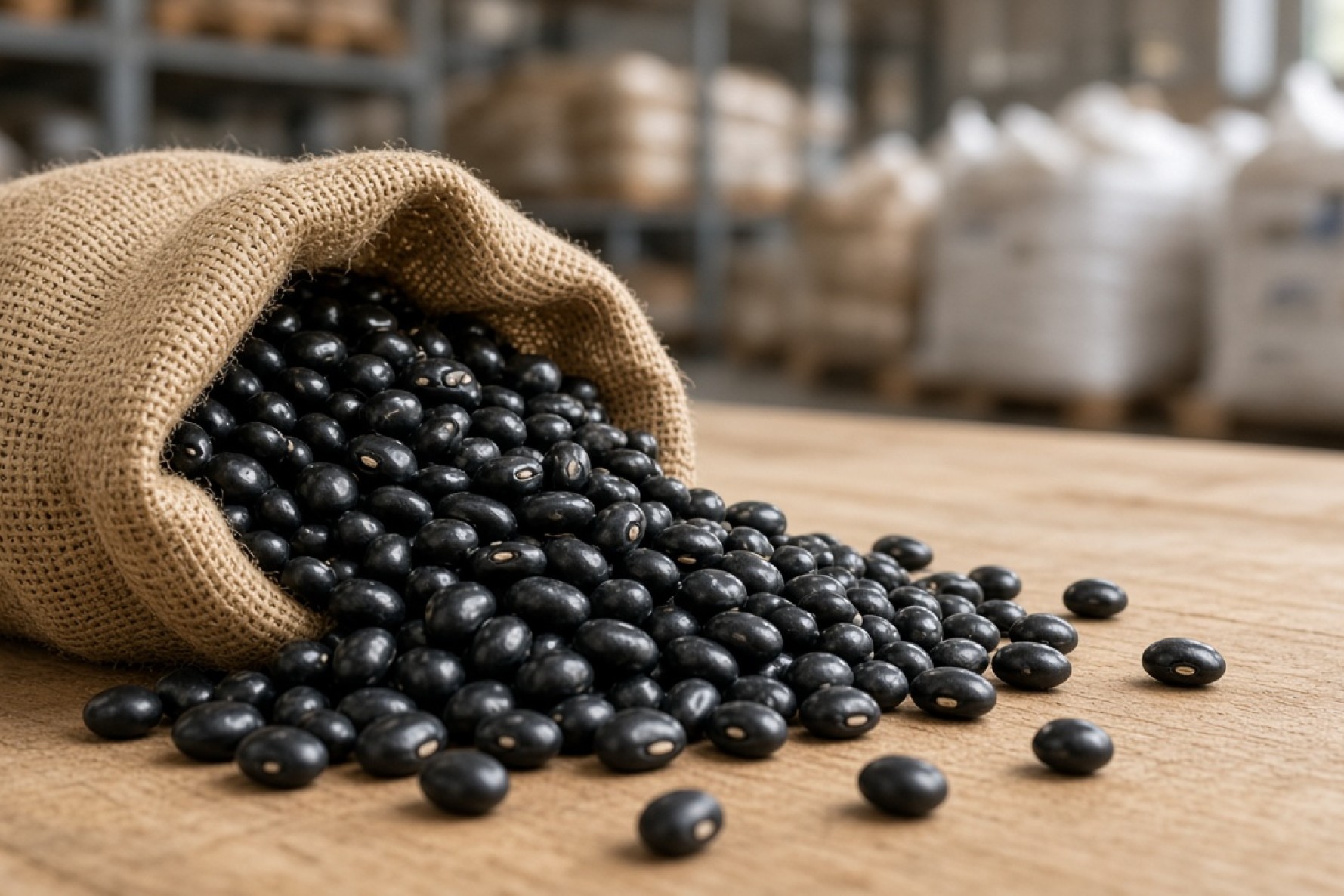
Black bean seeds have a kidney-shaped geometry tending toward a compressed ellipsoid, approximately 7 to 10 mm in length and 5 to 7 mm in width. The outer seed coat, or testa, has a uniform raven-black colour that may appear matte or glossy depending on drying method and storage conditions. A hallmark of this type is an elliptical hilum of brilliant white set in a concave depression of the seed, surrounded by a very thin brown ring. The cotyledons have a highly dense texture of pale creamy bone colour that contrasts sharply with the dark outer coat.
Differentiation from Similar Seeds
- Black gram (urd bean) (Vigna mungo): 3 to 5 mm size, more cylindrical form and a linear hilum groove; fast cooking and rapid loss of texture after hydration — unsuitable for canning.
- Black soybean (Glycine max): spherical appearance, structural oil above 18 percent and entirely different hydration behaviour.
The black bean seed coat has a compact waxy cuticular layer and orderly sclereid parenchyma cells. The strength of the bond between testa and cotyledon prevents skin separation during prolonged immersion and, compared with pinto or white bean cultivars, leaves less skin waste in industrial cooking kettles.
2. Biochemical Specs, Nutritional Traits and Bioactive Compounds
The industrial and commercial value of black beans is directly tied to the macromolecules and micronutrients in the cotyledon and seed epidermis. Beyond serving as a satiating raw material, this product transfers unique functional properties into processed food matrices.
| Chemical parameter | Commercial standard range | Technological role |
|---|---|---|
| Total protein | 21.5–24.8% | Water and fat binding, thermal gelation |
| Total starch | 38.0–42.0% | Hydrocolloid body and gelatinization |
| Resistant starch | 6.5–9.5% | Prebiotic and fibre stabilization |
| Total dietary fibre | 15.0–17.5% | Mechanical consistency and moisture retention |
| Structural fat | 1.0–1.6% | Oxidative stability in storage |
| Total ash | 3.5–4.2% | Stable processing minerals |
| Total phenolic compounds | 280–450 mg GAE | Antioxidant and colour retention |
| Calcium | 120–140 mg | Pectin stability in sterilization |
| Elemental iron | 5.2–6.8 mg | Biological enrichment of canned product |
Anthocyanins and Thermal Behaviour
The black bean seed coat is a dense source of flavonoid glycosides, especially delphinidin 3-glucoside, petunidin 3-glucoside and malvidin 3-glucoside. In neutral and alkaline media, the pigment tends to produce a cloudy dark greyish phase; by adjusting acidity to 5.5 to 6.0, a brilliant black colour stability is secured. Awareness of this kinetics is essential for canned-sauce formulators.
Anti-nutritional Factors
Raw black beans contain phytohemagglutinin (lectin) and trypsin inhibitors. For industrial safety, moist heat above 100°C for at least 10 minutes is mandatory. Phytic acid is also largely washed out by a 12-hour soak and discard of the soaking water, increasing mineral bioavailability.
3. Commercial Standards, Tariff Codes and Defect Tolerance Limits
Export and import consignments are assessed and cleared against international Codex standards such as Codex Standard 171-1989. These frameworks form the basis for cargo acceptance at port entry points and for determining price deductions when quality fluctuates.
- Global HS Code: 0713.33 — kidney beans and other common beans of the species Phaseolus vulgaris.
- Iran national customs code: row 07133310 for pinto and 07133320 for red; black beans are declared under 07133390 as “other”.
| Characteristic | Grade One (premium) | Grade Two (industrial) | Test method |
|---|---|---|---|
| Free moisture | Max 13.0% | Max 14.5% | Moisture oven |
| Genetic purity | Min 99.0% | Min 97.5% | Seed count |
| Inorganic foreign matter | 0.05% | 0.20% | Gravimetric separation |
| Organic foreign matter | 0.15% | 0.40% | Air classification |
| Broken seeds | 1.0% | 3.0% | Slotted sieve |
| Insect pest damage | 0.5% | 1.5% | Longitudinal cut |
| Contaminated / mouldy | 0.5% | 1.5% | Organoleptic |
| Colour deviation | 0.5% | 1.5% | Reference sample |
| Live insects | Zero | Zero | Quarantine sieve |
4. Processing Technologies in Conversion Industries and Canning
Canning industries are the largest wholesale buyers of black beans in international markets. Processing behaviour is driven by three main factors: hydration, initial thermal shock and sterilization in metal cans.
Industrial Hydration
Dry black beans at 12 to 14 percent moisture need water uptake of about 100 to 110 percent of initial dry weight to reach moisture equilibrium. Soak water should not have high hardness; 18 to 22°C and a maximum of 14 hours are recommended. Exceeding this window raises the risk of microbial fermentation and lactic acid souring.
Role of Calcium Ions in Controlling Softening
During autoclaving at 121°C and 1.05 bar, cell walls come under pectin-hydrolysis stress. Adding 100 to 500 ppm calcium chloride or calcium lactate in soak water or brine forms calcium-pectate bridges and preserves wall elasticity; the seed retains cohesive structure even after 60 to 90 minutes of retort.
Blanching and Pre-cooked Flour
Blanching in hot water at 85 to 90°C for 4 to 8 minutes expels trapped air bubbles, inactivates oxidative enzymes and reduces initial microbial load. Whole-seed powder after twin-screw extrusion also yields a gelatinized, gluten-free flour for diet snacks and instant-soup thickeners.
5. Calibration, Physical Specs and Technical Requirements for Wholesale Purchase
When concluding bulk purchase contracts, geometric and physical parameters of the cargo are fundamental to cooking uniformity and cleaning-line efficiency. Failure to specify these values sets up technical disputes after discharge.
| Screen size | Approx. diameter | Hundred-seed weight | Specialized use |
|---|---|---|---|
| Large (4 mm) | 7.5–9.5 mm | 22–25 g | Premium household packing |
| Medium (3.5 mm) | 6.0–7.5 mm | 18–21 g | Canning and ready meals |
| Small (3 mm) | 5.0–6.0 mm | 14–17 g | Milling and enriching flour |
Thousand-seed weight for quality lots is 180 to 220 g and bulk volumetric density is 800 to 850 g per litre. Hard or slow-to-cook seeds from mixed crop years create a disastrous effect on the canning line; some seeds cook while others remain undercooked.
| Technical parameter | Allowed range | Plant objective |
|---|---|---|
| Dominant screen size | Min 85% on 3.5 mm sieve | Hydration uniformity |
| Undersize loss | Less than 3.0% | Lower cleaning waste |
| Water uptake rate at 20°C | 100% capacity in 10 hours | Soak-shift scheduling |
| Geometric symmetry factor | Above 90% | Smooth filler operation |
| Cooking-water turbidity | < 0.25 at 420 nm | Final sauce clarity |
6. Geography of Global Trade and Export Flows
| Country | Export share | Average price | Commercial hallmark |
|---|---|---|---|
| United States | ≈ 19.3% | Highest | Genetic purity, premium calibration |
| Egypt | ≈ 14.7% | Medium to low | Transit access to the Middle East |
| Brazil | ≈ 8.6% | Highly competitive | High volume, quality diversity |
| Canada | ≈ 7.7% | Industrial premium | Organic consistency |
| Argentina | ≈ 7.6% | Regionally competitive | Complements Northern Hemisphere seasons |
| China | ≈ 6.3% | Economy | Diverse bagging, East Asia logistics |
| Nicaragua | ≈ 6.1% | Specialized regional | Traditional Central American flavour |
In Brazil and Argentina harvest concentrates in May to July and creates seasonal discount opportunities; the United States and Canada harvest in September and October. Aligning purchases with surplus seasons reduces import costs by 8 to 12 percent. The UAE and Turkey act as regional Middle East staging hubs.
7. Production Capacity and Market Outlook in Iran
Iran’s pulse consumption basket has traditionally rested on chickpeas, lentils and red, white and pinto beans; yet rising health awareness and canning growth have created continuous demand for black beans. Parts of Zanjan, Lorestan (Azna and Aligudarz), Khuzestan and Fars have suitable climates with an 80- to 100-day growing period that lowers on-farm water use relative to maize or sugar beet.
The main challenge is limited laser cleaning in rural areas and unfamiliarity among some traditional consumers. Even so, mixed vegetable cans and black beans in tomato and chilli sauce have opened export markets in Iraq, Russia, Oman and Azerbaijan.
8. Industrial Packaging, Warehousing and International Transport
| Type | Structure | Net weight | Use |
|---|---|---|---|
| PP sack | Woven with fine venting | 25 and 50 kg | Traditional container loading |
| Multi-layer kraft | 3 paper layers + PE | 25 kg | Humid ports, premium grade |
| FIBC jumbo bag | Heavy weave with spout | 1000–1250 kg | Fast discharge to canning silo |
| Retail MAP | Metallized film | 400–900 g | Chain stores |
Managing Container Sweat
- Install fabric or cardboard anti-sweat liners on container walls and ceiling.
- Desiccant bags (silica gel or calcium chloride) with ≥ 200% absorption capacity; at least 4 to 6 bags of 2 kg each in a 20-foot container.
- Do not load on rainy days; keep seed moisture below 13.5 percent.
Optimal payload for a dry 20-foot container is 22 to 24 metric tonnes. Wooden pallets 100×120 cm with ISPM-15 certification and stretch film with breathable vents are recommended.
9. Pricing Structure and Commercial Risks
| Index | Price impact | Mechanism |
|---|---|---|
| Size uniformity and optical purity | 5–12% premium | Lower packing waste |
| Moisture percentage | Direct linear | Paying for water vs dry matter |
| Non-GMO certificate | 8–15% higher | EU market access |
| Crop season | 10–20% swing | Price drop on South American surplus |
| Container freight | Cyclical | Effect on landed cost at Middle East ports |
Each percentage point of impurity above the allowed limit is typically subject to a price-deduction penalty at a factor of 1.5 to 2 times. Camera-based 3D laser-sorted lots command the highest price tier.
10. Laboratory Test Methods and Quality Control
Blind random sampling is performed to ISO 24333 for cereals and pulses. The Certificate of Analysis (COA) from accredited reference laboratories is the contract compliance benchmark.
| Test | Method | Limit | Significance |
|---|---|---|---|
| Total aflatoxin | HPLC / EN 14123 | < 4 ppb | Port detention |
| Lead / cadmium | Atomic absorption | 0.1 / 0.05 mg/kg | Soil contaminant |
| Pesticide residues | GC-MS/MS · LC-MS/MS | Destination MRL | Plant health |
| Total bacterial count | Culture at 30°C | < 10⁵ CFU/g | Early spoilage |
| Thermophilic anaerobic spores | Thioglycollate medium | < 10² CFU/g | Hot-can spoilage |
| Cooking time | Mattson method | < 65 minutes | Canned texture homogeneity |
11. Importer Checklist Before Placing an Order
- Align tariff code 07133390 in Ministry of Industry registration and customs filings.
- Obtain at least 2 kg of sealed sample and run hydration and cooking tests before signing the proforma.
- State maximum moisture of 13.5 to 14.0 percent as a cancellation or penalty condition.
- Broken-seed tolerance below 1.5 percent with financial penalties per tenth of a percent excess.
- Obtain Non-GMO authenticity certificate and laboratory documentation.
- Require durable PP packing or kraft laminate at a specified grammage.
- Fumigation certificate with phosphine gas at the loading port.
- Container liner and industrial-standard desiccant packs.
- Appoint a third-party inspection company (e.g. SGS) for quality, quantity and loading integrity.
- Specify current crop year and no mixing with carry-over lots.
- Clauses for loading-delay damages or demurrage in credit documents.
- Net weight basis at destination customs scale with max 0.5 percent sea moisture-loss tolerance.
12. Essential Information for a Formal Price Inquiry (RFQ)
- Scientific name and end use: dry black bean (Phaseolus vulgaris) — canning or retail.
- HS code 0713.33 and national code 07133390.
- Calibration: percent above 3.5 mm, breakage, impurity, dual-/triple-channel laser sort.
- Allowed moisture, aflatoxin and pesticide residues.
- Packaging: 25 kg PP, 50 lb, or 1-tonne jumbo bag.
- Tonnage or number of 20-foot FCL containers.
- Incoterms: FOB or CFR.
- Documents: COA, phytosanitary, disinfection and certificate of origin.
13. Iran Supply Path and Iranco’s Role
Expanding capacity of improved farms in Iran and optical cleaning have created a secure base for supplying black beans that meet industrial protocols. Iranco is a strategic platform for processing industries, wholesale buyers and trading companies to register and track tonnage, grade and packing needs—from reference samples through contract quality clauses and export loading inspection.
14. Analytical Commercial Summary
Black bean is an agricultural commodity with high nutritional density and physical specs ideal for continuous thermal processing in canning and ready-meal industries. Successful establishment in the raw-material basket requires mastery of origin quality-control indices, compliance with global Codex standards and smart supply-chain timing. Buyers who build the process on laboratory data, pilot cooking trials, uniform geometric calibration and physical protection in transit will achieve the highest line productivity and sustainable return on capital.
Frequently Asked Questions
How is premium black bean identified?
Uniform surface without white or grey fungal spots, unbroken seed coat, brilliant white hilum, size homogeneity (at least 90% on a 3.5 mm sieve), free of pests and stale odour, stable moisture below 13.5 percent.
Why do seeds stay hard after soaking and long cooking?
Hard-to-cook behaviour from prolonged storage above 25°C and relative humidity over 65 percent; lignin polymers irreversibly stiffen testa pectin.
Is calcium salt necessary in canning?
Yes; 100 to 500 ppm calcium chloride forms calcium–pectate bonds and prevents skin disintegration and sauce cloudiness in a 121°C retort.
How does export supply from Iran work?
Define quality analysis, sizing and tonnage, then register an inquiry via Iranco; after requirements review, reference sample and loading supervision are arranged.
What is the economic minimum order quantity (MOQ)?
For sea transit, one 20-foot FCL container is about 22 to 24 tonnes; for road, typically 20 to 25 tonnes as a single load or trailer.
What are the international and national tariff codes?
International 0713.33; in Iran customs 07133390 under “other”.
How do black beans differ from black gram?
Black bean (Phaseolus vulgaris) is a larger kidney-shaped seed with cream cotyledons and a white hilum; black gram (Vigna mungo) is small and cylindrical and disintegrates quickly after cooking.
What causes cargo sweat in the container?
Seed moisture above 14 percent and sudden ambient temperature change; without liner and desiccant it leads to mould.
Featured Products





Related Articles



