 Iranco Dergisi Ekibi
Hurmadan elma ve sera sebzesine, meyve-sebze işlenmiş ürünlerine — pazar analizi, AEÜ şartları, ambalaj, lojistik ve profesyonel giriş kriterleri
Pazar Raporu · İhracat · Kazakistan · AEÜ
İrandan Kazakistan'a Gıda İhracatı: Tarım ve İşlenmiş Gıda Fırsatları
Hurma, elma ve sera sebzelerinden meyve-sebze işlenmiş ürünlere — pazar analizi, AEÜ kuralları, ambalaj ve lojistik
Dört Temel Gösterge
2024'te Kazakistan yaklaşık 38,71 milyon kg hurma ithal etti; İran bildirilen hacmin %70'inden fazlasını sağladı.
Kazakhstan is not a uniform easy market for Iranian exporters: it produces farm goods and imports heavily from Russia, China, Uzbekistan, Turkey and Europe. Geography alone is insufficient — winning products combine competitive price, consistent quality, suitable packaging, EAEU compliance and predictable logistics.
Kazakhstan imported nearly $59.8 billion of goods in 2024. In food and agriculture Iran has measurable share in dates, apples, cucumbers, eggplants, peppers, some citrus and processed fruit/vegetable lines.
The Iran–EAEU free trade agreement took effect on 15 May 2025. Preferential duty applies only with correct HS classification and proof of preferential origin — verify codes before final pricing.
Iranco provides a B2B purchase-request channel to match Iranian supply against written buyer specifications.
1. Kazakhstan Market Traits for Iranian Food
Bilateral agricultural trade Iran–Kazakhstan reached about $220.1 million in 2024 (+33.2% YoY). A large share includes Kazakh grain exports to Iran and must not be confused with Iranian food exports to Kazakhstan.
Three traits matter: intense regional competition, logistics distance for fresh produce, and EAEU membership aligning safety and labelling rules across the union.
Exporter note
- Separate markets where Iran already trades from purely theoretical niches
- Include border time and cold chain in delivered price for fresh goods
- Do not ship domestic Iranian packs without EAEU-ready labelling
- Apply FTA tariff benefits only after code and origin confirmation
2. Products with Stronger Competitive Capacity
| Product | Imports from Iran 2024 | Status | Assessment |
|---|---|---|---|
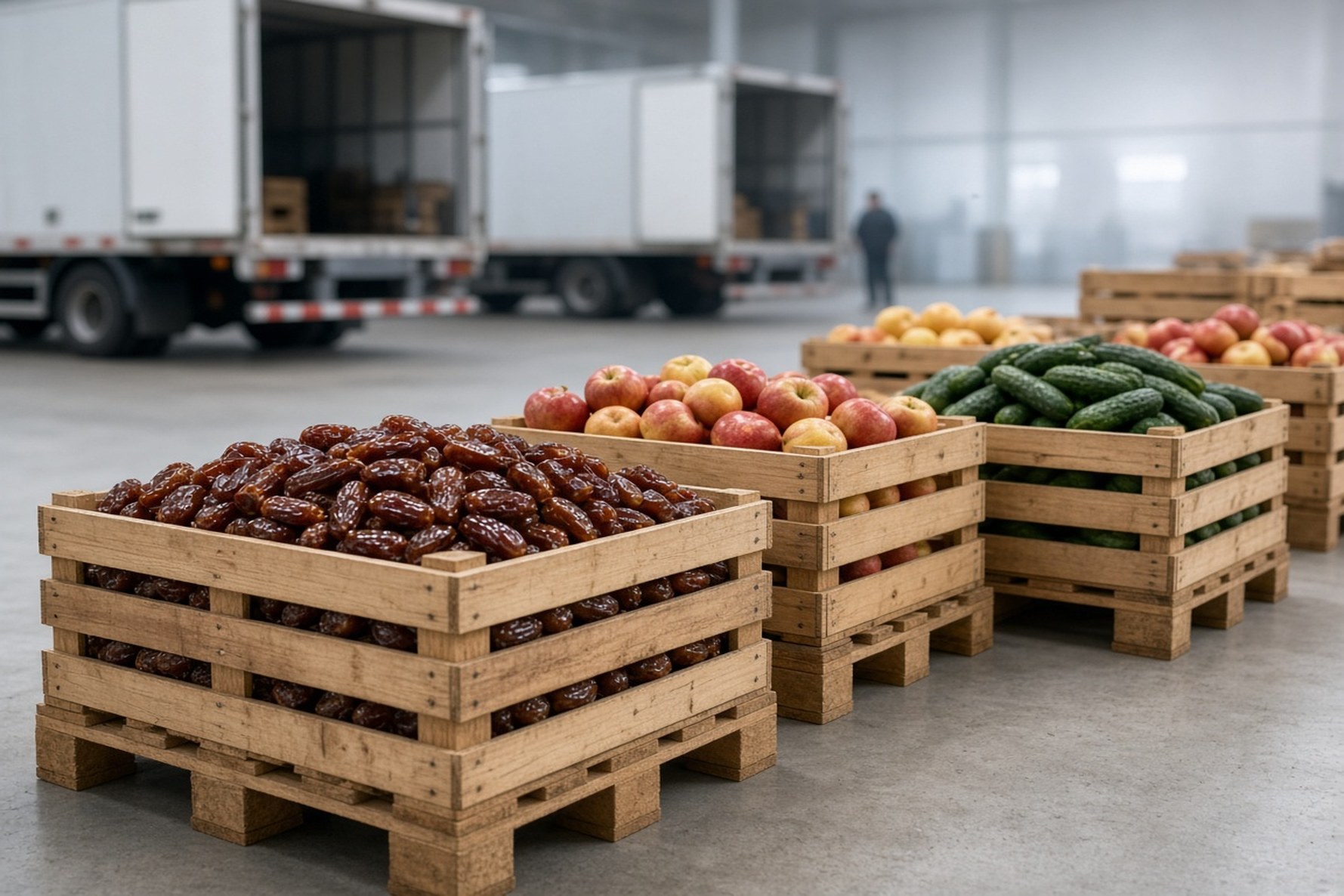
| Dates | 27.58M kg; $10.49M | Very large Iranian share | Established; upgrade retail packs |
| Fresh apples | 23.54M kg; $8.77M | vs Poland & Uzbekistan | Seasonal bulk supply |
| Fresh cucumbers | 5.92M kg; $5.50M | Top-tier supplier | Greenhouse strength |
| Fresh eggplant | 2.76M kg; $3.04M | Dominant 2024 supplier | Quality consistency |
| Fresh peppers | 3.47M kg; $2.82M | Notable presence | Greenhouse |
| Citrus | 6.75M kg; $3.33M | vs China & Pakistan | Selective entry |
| Processed fruit/veg | ~$12.11M | Existing Iranian flow | Industrial & retail growth |
3. Technical Parameters Buyers Must Fix in the Order
| Group | Order parameters | Why it matters |
|---|---|---|
| Dates | Variety, size, moisture, defects, pack weight | Shelf life & price |
| Apples | Variety, diameter/weight, colour, firmness, defects, carton | Sorting disputes |
| Cucumbers | Length, diameter, uniformity, colour, carton weight | Retail acceptance & transit loss |
| Eggplant | Shape, size, skin colour, firmness | Pressure sensitivity |
| Peppers | Colour, size, uniformity, stem condition | Retail display |
| Pistachios | Grade, size, moisture, aflatoxin | Safety & pricing |
| Tomato paste | Brix, salt, colour, pack type | Industrial use |
4. Entry Requirements (EAEU)
TR CU 021/2011 on food safety and TR CU 022/2011 on labelling are core. Most foods need conformity assessment and a declaration of conformity; the applicant is usually a legal entity registered in the union — partner with a professional Kazakh importer early.
The EAC mark follows completed conformity procedures, not export intent alone. Consumer information must be in Kazakh and Russian; Persian- or English-only packs with post-arrival relabelling create operational risk.
Fresh produce may also face plant quarantine and EAEU phytosanitary rules — confirm per SKU before loading.
5. Documents by Product Group
- Fresh fruit/vegetables: commercial docs, origin, quarantine & phytosanitary where applicable
- Nuts/dried fruit: commercial docs, conformity, tests, origin
- Packaged food: conformity declaration, Kazakh & Russian labels
- Specialty foods: check state registration before entry
- Animal-origin: veterinary requirements per product
6. HS Codes and Iran–EAEU FTA
Full free trade applies from 15 May 2025. Preferential rates require listing, preferential origin proof and correct classification. Common six-digit groups include 080410 dates, 080810 apples, 080250 pistachios, 070700 cucumbers, 070930 eggplant, 070960 peppers and 170490 sugar confectionery — declare the full EAEU code based on actual processing and pack.
7. Packaging and Logistics
For fresh goods, quality at the importer’s warehouse matters: strong cartons, dry product surface, uniform sizing, ventilation, stable pallets and temperature control. Iran–Turkmenistan–Kazakhstan land/rail and Caspian multimodal routes suit higher volumes or flexible timing; for highly perishable goods, commercial life beats lowest freight rate.
8. Processed Food: Opportunity vs Competition
Iranian processed fruit/vegetable imports were about $12.11M in 2024 — less time-critical than fresh. Sugar confectionery imports exceeded ~$130M while Iran supplied ~$754k; chocolate imports exceeded ~$371M with Iran ~$302k. Market size does not mean easy entry — brand and distribution dominate sweets and chocolate.
9. Competitors and Transport Corridors
| Group | Key competitors | Iran position |
|---|---|---|
| Dates | North Africa, Saudi Arabia | Very strong |
| Apples | Poland, Uzbekistan, China | Major supplier |
| Cucumbers | China, Uzbekistan, Russia | Very favourable |
| Fresh tomatoes | Turkmenistan, China | Smaller share |
| Pistachios | USA, Turkey | Important niche |
| Sweets/chocolate | Russia, Turkey, China | Small share |
10. Delivered Price Comparison
Professional importers compare product price, sorting, packaging, testing, inland Iran haulage, transit, insurance, border fees, duty, weight loss or spoilage and warehouse/distribution. Cheaper ex-works quotes can cost more per sellable kg in Kazakhstan after losses.
11. Main Delivered-Cost Drivers
| Factor | Effect |
|---|---|
| Sorting & packaging | Sellable quality base |
| Testing & conformity | Direct entry cost |
| Route & cold chain | Spoilage risk |
| Duty & preferential origin | 2025 FTA |
| Kazakh warehouse & distribution | Final delivered price |
Importer Pre-Order Checklist (18 Items)
- Exact product — generic names insufficient
- Measurable commercial grade
- Representative sample same season/quality
- Contractual sampling method for shipment
- Pre-loading tests
- Full HS code with Kazakh importer
- Check Iran–EAEU preferential duty eligibility
- Required certificate of origin type
- Approve Kazakh/Russian label before print
- Who files conformity declaration in Kazakhstan
- Phytosanitary/quarantine for fresh produce
- Net weight per pack and tolerance
- Master carton and pallet spec
- Transport and cold-chain duties
- Explicit Incoterms
- Claims process and deadlines
- Supplier capacity for repeat orders
- Trial commercial shipment if possible
12. Information for a Price Request
- Product name/type, grade, size or weight range
- Moisture or Brix where relevant
- Volume, pack weight, packaging type
- Brand, label language, required tests
- Kazakh delivery city and transport mode
- Incoterms, schedule, trial or periodic order
Sourcing Iranian Food to Buyer Specifications
Two offers differ beyond price per tonne. Iranco lets Kazakh buyers register purchase requests with product, quality, packaging, volume and destination so supply options are screened on real criteria.
Conclusion
Best odds sit where proven demand, Iranian supply advantage and quality on arrival align — dates, apples and greenhouse vegetables are clear examples.
Fresh tomatoes, citrus and melons need selective strategy; do not confuse market size in sweets/chocolate with easy entry.
After the FTA, HS codes, preferential origin, TR CU 021/2011, Kazakh–Russian labels and quarantine belong in deal design from day one. Professional entry starts with the right product for the right segment.
FAQ
Is Kazakhstan a good market for Iranian food?
Not equally for all products; Iran has real presence in dates, apples, cucumber, eggplant, pepper and some processed lines. Decide product-by-product.
Which product has the strongest position?
Dates — about 27.6M kg of 38.7M kg Kazakh date imports in 2024 came from Iran.
Is duty automatically zero?
No. The FTA applies from 15 May 2025 but each SKU needs full code, schedule and origin rules.
Which label languages?
Kazakh and Russian for consumers under TR CU 022/2011.
Phytosanitary for fresh produce?
For quarantine-listed goods under EAEU rules — confirm per product before packing.
What to contract for apples?
Variety, size/weight range, colour, firmness, defect limits, carton, transport and acceptance — not vague “export grade 1”.
Why not compare only ex-works price?
Importers pay delivered cost including haulage, transit, border, loss, warehouse and distribution.
How to source from Iran for Kazakhstan?
Define specs, grade, volume and destination; you can register the request on Iranco.
Öne Çıkan Ürünler








İlgili Yazılar



