 Iranco Dergisi Ekibi
Kalite değerlendirme, laboratuvar standartları, ticari sınıflandırma, ihracat ambalajı ve uluslararası tedarik zinciri yönetimi kapsamlı rehberi
Damask Rose · Dried Petals · Infusion · Food Industry · Export
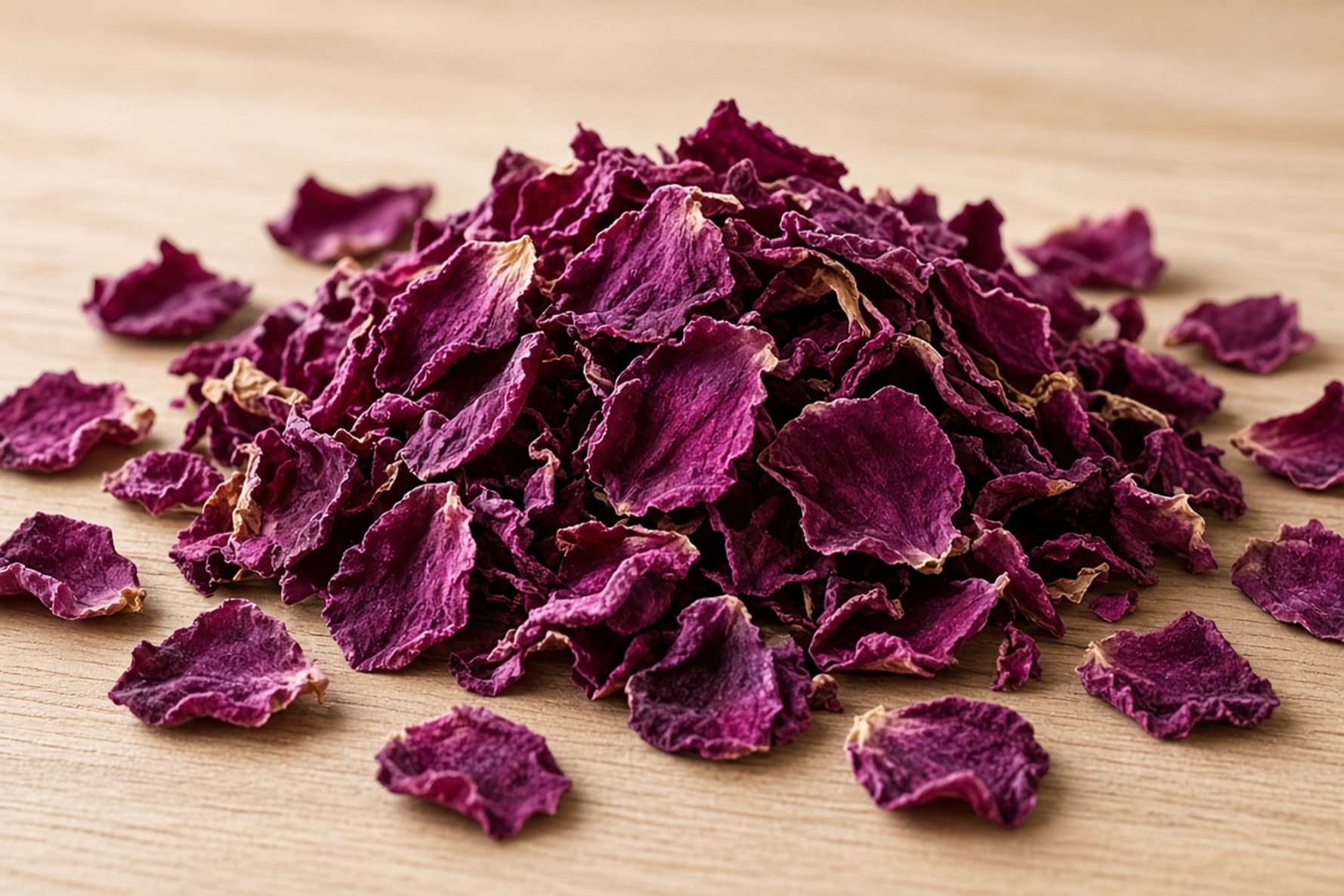
Dried Damask Rose Petals: A Buyer's Guide for Infusions and Food Industries
A specialist guide to quality assessment, laboratory standards, commercial grading, export packaging and international supply-chain management for bulk dried Rosa damascena petals for infusion and industrial use.
Growing global demand for clean-label, organic and wellness-oriented products has moved dried damask rose petals (Rosa damascena) from a traditional aromatic ingredient to a strategic input in beverages, modern confectionery, pharmaceuticals and essential-oil extraction. International buyers once focused mainly on distilled oils and rosewater; today, sorted dried petals are in far higher demand as the visual and flavour core of luxury tea blends and food formulations. Iran, as the historic centre and largest biomass producer of damask rose in the world, benefits from climatic diversity, orchard altitude and a rich profile of volatile aromatics — yet real share in global value chains requires moving beyond traditional bulk supply toward industrial technical compliance. Procurement leaders must monitor anthocyanin colour stability, volatile oil content, heavy-metal thresholds, microbial load and modified-atmosphere packaging with precision.
| Indicator | Value / technical status |
|---|---|
| International tariff code (HS) | 12119091 (dried damask rose flower and petals) |
| Iran’s share of global cultivated area | More than 70% of productive orchards |
| Maximum permitted moisture (ISIRI 168) | 10–12% by weight |
| Optimal warehousing and container transit | 10–15 °C, relative humidity below 50%, away from light |
This report covers the technical, commercial, logistics and hygiene dimensions needed to select, purchase and export this high-value raw material. For complementary guidance on whole buds, see our Dried Damask Rose Buds Wholesale Buying Guide.
1. Iran’s Geopolitical Position and Climatic Advantages in Damask Rose Production
Iran ranks first worldwide in damask rose orchard area; tens of thousands of tonnes of fresh flowers are harvested annually from rain-fed and irrigated farms. Most commercial plantings sit between roughly 1,500 and 2,700 metres above sea level. Intense daytime sun combined with cool mountain nights creates a mild but continuous thermal shock that stimulates secondary metabolism and maximises monoterpene alcohols such as geraniol and citronellol in petal secretory glands.
Major growing hubs and agro-ecological traits
- Kashan, Qamsar, Barzak and Niasar: The oldest distillation and processing cluster in the Middle East, on the foothills of the central desert. Dry air and wide day–night temperature swings produce petals with exceptional aromatic balance, sweet scent and stable essential oil — a benchmark in global infusion industries.
- Fars (Darab, Layzenjan, Meymand): Layzenjan hosts some of the world’s largest rain-fed damask rose plains above 2,000 m without artificial irrigation. Minimal agrochemical use supports ultra-clean organic supply for EU destinations. Meymand is a major traditional and industrial distillation centre with high fresh-petal throughput.
- Kerman (Lalehzar and Bardsir): Lalehzar orchards above 2,500 m are among the highest commercial rose habitats globally. Clean air and late spring cold reduce pest pressure; petals show the deepest purple pigments and the most persistent oil-based aroma.
- North-west (East Azerbaijan and Osku): Later harvest through late May and early June. Petal tissue is thicker and resists breakage and powdering in industrial drying.
Crop calendar and the morning harvest window
Damask rose picking is labour-intensive and time-critical: flowering lasts only 20–30 days per climate. Picking must occur in the cool morning, from dawn (around 05:00) until before full sun (around 09:00). Direct sun on open flowers raises petal temperature and breaks monoterpene bonds, evaporating much of the deep fragrance. Loads picked at midday spoil quickly, lose colour and begin bacterial fermentation. Petals destined for drying should reach sorting halls and dehumidification within two to three hours of harvest.
2. Commercial Types and Physical Forms of Petals on International Markets
Vague terms such as “dried damask rose” cause commercial disputes. Industrial buyers specify physical form to match packing lines or extraction systems:
| Commercial form | Physical size and texture | Main industrial use | Sorting and cleaning sensitivity |
|---|---|---|---|
| Hand-picked whole petals | Intact petals 10–25 mm, no tears | Luxury glass infusions, hotel confectionery garnish | Full separation from receptacle; no sepals |
| Chopped petal flakes | Uniform pieces 3–7 mm | Transparent tea bags, blended infusions, spice formulations | Winnowing to remove fines below 3 mm and coloured dust |
| Damask rose petal powder | Particle size below 250 µm (60–100 mesh) | Pastry bases, natural chocolate colour, yoghurt and ice cream | Cold milling at low temperature to protect anthocyanins |
| Whole dried buds | Firm round buds 10–20 mm diameter | Ceremonial infusions, gift packs, cold beverages | Graded by unopened bud and intact stem base |
Technical and commercial distinction: dried petals versus whole buds
Buds include leathery sepals and the floral ovary. Green sepals add slight astringency and bitterness and slow aroma release in hot water. Pure dried petals lack harsh sepal tannins, taste sweeter and fresher, and transfer colour and fragrance to liquid in under two minutes. Buds have higher bulk density and lower cubic storage cost, but clean hand-picked petals command far higher added value in modern tea-bag infusion lines.
3. Drying Technologies and Their Effect on Actives and Colour
Dehydration is the main quality gate. Fresh petal tissue is 75–80% water. The goal is rapid reduction below 10% moisture without destroying anthocyanin structure or aromatic esters.
Traditional shade drying in hygienic halls
After mechanical or manual separation from the receptacle, petals are spread on food-grade mesh or tiered wooden frames with sterile netting in dark, forced-ventilation halls. Absence of UV limits photolysis of anthocyanins, preserving natural purple-red colour. Visual appeal is excellent, but slow cycles beyond 72 hours without humidity control can raise microbial load.
Continuous industrial dryers with controlled temperature
Modern lines use multi-deck belt dryers or vacuum cabinets with conditioned air. Chamber temperature must not exceed 35–42 °C; above 45 °C causes sugar gelatinisation, Maillard browning at petal edges and severe loss of volatile esters. Moisture typically reaches target in 6–10 hours, limiting mould and biological souring.
Freeze-drying under vacuum
Sublimation removes frozen interstitial water without a liquid phase. Petals retain volume, velvety texture and primary aromatics. High equipment and energy cost limits use to precision pharmaceuticals or ultra-luxury handmade chocolate decoration.
Hygienic processing chain
- Dawn harvest and rapid transfer in ventilated crates to the processing centre.
- Separation of petals from sepals and receptacle by air winnowing or skilled hand work.
- Controlled drying to 8–10% moisture.
- Multi-stage vibratory screening to remove soil fines, stamens and foreign plant debris.
- Packing under nitrogen-modified atmosphere in heat-sealed barrier bags.
4. Technical Specifications, Laboratory Analysis and Certificates of Authenticity (COA)
Quality managers and importers need a valid laboratory analysis report before accepting cargo. The table below defines critical parameters for dried damask rose petals against national and international food standards:
| Parameter | Acceptance limit | Reference method | Buyer relevance |
|---|---|---|---|
| Final moisture | Maximum 10.0–12.0% by weight | ISIRI 1196 (oven 103 °C) | Mould prevention in warehouse |
| Total ash on dry matter | Maximum 8.0% by weight | ISIRI 1197 (550 °C furnace) | Mineral and dust contamination from drying |
| Acid-insoluble ash | Maximum 1.0% by weight | ISIRI 1253 (acid digestion) | Silica, sand and field soil indicator |
| Organic foreign matter | Maximum 1.0% by weight | ISIRI 1032 (sorting and weighing) | Sepals, green leaflets, thorns, non-petal parts |
| Volatile essential oil | Minimum 0.12–0.25 mL per 100 g | Hydrodistillation (Clevenger) | Aroma and taste in hot infusion |
| Total plate count (TPC) | Less than 105 CFU/g | Plate count agar | Processing hall hygiene |
| E. coli | Negative in 1 g | Specific bacteriology | Faecal and water contamination indicator |
| Salmonella | Negative in 25 g | Selective enrichment and culture | Mandatory for EU and Gulf ports |
| Yeasts and moulds | Less than 103 CFU/g | Sabouraud dextrose agar | Mycotoxin risk over shelf life |
| Total aflatoxins | Maximum 10 µg/kg | HPLC | EU food safety Regulation 2023/915 |
| Heavy metals (Pb) | Less than 3.0 mg/kg | GF-AAS / ICP-MS | Roadside and industrial runoff |
| Heavy metals (Cd) | Less than 1.0 mg/kg | ICP-MS | Non-standard phosphate fertilisers |
| Pesticide residues (MRL) | Codex and EU aligned | Multi-residue chromatography | International phytosanitary clearance |
Damask rose aroma arises from dozens of volatiles; their ratios fingerprint species and climate. Monoterpene alcohols exceed 70% of the volatile fraction. Citronellol adds fresh lemon-rose notes, geraniol deep sweet rose, nerol softness. The citronellol-to-geraniol ratio in Iranian petals typically ranges 1.2–1.6, indicating natural balance. Phenylethyl alcohol, highly water-soluble, is preserved with gentle drying and releases immediately in the cup.
Buyers who need export lots matched to precise COAs can review selected farm-standard options through Iranco. For pesticide panel design, see MRL Laboratory Analysis for Agricultural Exports.
5. Industrial Formulation in Infusion, Food and Beverage Chains
Dried petals are not mere decoration: they act as flavour modifiers, natural sensation agents and polyphenol sources in industrial recipes.
| Industry | Preferred form | Formulation goal | Market example |
|---|---|---|---|
| Transparent pyramid tea bags | Sorted flakes 3–5 mm | Visual appeal, fast colour and gentle aroma | White tea blends, detox and sleep infusions |
| Traditional bulk tea | Hand-picked whole petals | Authentic calming fragrance with tea leaf | Kashan-scented orthodox Ceylon, premium black tea |
| Confectionery, chocolate and bakery | Fine flakes and sieved powder | Floral mouthfeel without synthetic essence | Dark chocolate tablets, macarons, modern cake fillings |
| Traditional and industrial dairy | Micronised powder 100 mesh | Balance cold dairy character, mask off-notes | Scented yoghurt and doogh, traditional ice cream |
| Ready-to-drink and carbonated beverages | Hydroalcoholic petal extract | Natural colour and organic flavour without intense sweeteners | Flavoured sparkling water, kombucha, industrial syrups |
In multi-component tea bags, particle size must match flow-control screens to prevent fines settling in the wrapper or separation by bulk density. Sorted 3–5 mm flakes hydrodynamically balance with broken black tea or winnowed chamomile. Extraction at 85–90 °C releases weak organic acids and beneficial tannins that strengthen antioxidant effect in the cup.
Confectionery lines use whole purple-red petals for stability in plant fats; properly dried petals stay brittle in cocoa butter without absorbing ambient moisture. Pure petal powder replaces artificial red dyes while upgrading clean-label nutrition claims.
6. Global Target Markets and Regional Buyer Preferences
Trade in dried damask rose flower and petals under HS 12119091 clusters in regions with distinct technical expectations:
| Country / region | Main buyer groups | Grade and format demanded | Special quality requirements |
|---|---|---|---|
| UAE and Oman | Luxury hotels, spice packers, traditional markets | Large hand-picked buds and vivid whole petals | Opaque 50–250 g packs, Arabic–English bilingual labels |
| Germany and France | Phytopharma, tea blenders, extract houses | Uniform flakes, fully organic petals, sorted powder | Very low residues, no heavy metals, authenticity proof |
| China and Vietnam | TCM, supplements, floral teas | High-tonnage shade-dried whole petals, compressed buds | Quarantine disinfection, no mites or insect larvae |
| India and Pakistan | Gulkand factories, traditional perfumery, sweets | Economy flakes, competitively priced chop | Moisture below 10% for tropical sea transit |
GCC states, especially the UAE and Oman, are major buyers of visually premium Iranian rose products. Home consumption of karak tea and hospitality infusions is closely tied to damask rose aroma. A significant share entering Dubai is re-sorted, crystal- or metallised-packed and re-exported to the UK and USA under international brands. In Germany, health and infusion claims fall under European pharmacopoeia oversight; large buyers often screen 500 g witness samples for more than 500 pesticide analytes. Rain-fed, pesticide-free orchard petals command exceptional price elasticity there.
7. Tariff Codes, Import Rules and Quarantine Standards
Legal trade requires correct Harmonized System classification:
- Heading 121190: Plants and parts used chiefly in perfumery, pharmacy or insecticide, fresh or dried, cut or powdered.
- 12119091: Iran’s eight-digit national code for “dried damask rose flower and petals”, used for buds and petal flakes.
- 33019012: Traditional and industrial rosewater.
- 33012920: Essential oils and related extracts.
Standard clearance documents
- Phytosanitary Certificate: Confirms freedom from nematodes, live storage pests, termites and invasive weed seeds.
- Certificate of Analysis (COA): Official confirmation of microbiology, heavy metals, ash and moisture.
- Certificate of Origin: Chamber-certified for preferential duty or quota alignment.
- Legal destination labelling: Latin botanical name (Rosa damascena), net weight, production and expiry dates, batch, storage method, exporter contact and country of origin. Arabic markets require full Arabic and English text.
8. Export Packaging, Warehousing Engineering and Cold-Chain Integrity
Low bulk density and fragile lamina make packaging decisive: transit vibration can powder cargo and destroy commercial value.
Standard bulk pack structure
- Inner barrier layer: Three-ply matte metallised bags with food-grade PE inner and aluminium foil or matte film middle. Nitrogen flush and modified atmosphere (MAP) at heat seal virtually eliminates anthocyanin oxidation through shelf life.
- Desiccants: Pharmaceutical-grade silica gel sachets between inner bag and carton to block port humidity swings.
- Export master carton: Five-ply die-cut kraft with reinforced walls. Net weight per carton should stay 5–10 kg so upper layers do not crush lower petals.
Sorted dried petal bulk density is roughly 80–120 kg/m³. In sea containers, volume fills before weight limits. A 40 ft High Cube (~76 m³) typically holds about 5–6.5 tonnes in standard cartons. Storage and transit at 10–15 °C and RH below 50% is ideal. On long summer routes to East Asia or via the Suez Canal, reefer containers help prevent wall condensation, purple-to-brown colour shift and volatile oil loss.
9. Landed Cost Structure and Wholesale Price Drivers
- Fresh-to-dry conversion: About 6–8 kg of hand-picked fresh petals yield 1 kg of premium dry product below 10% moisture; dawn labour rates directly move floor price.
- Sorting and winnowing loss: Removing sepals, woody waste, stamens and fines can cut 15–25% of input weight; premium hand-picked lots price higher accordingly.
- Seasonality and cold storage: Peak harvest in late April–June records lowest FOB; autumn and winter cold storage, handling shrink and scarce farm stocks raise price 10–30%.
Reference FOB indications from trade literature often place Iranian sorted petals around USD 10.5–14.5/kg, Turkey (Isparta) USD 11.0–15.5/kg, Bulgaria (Kazanlak) USD 15.5–22.0/kg and South Asia economy grades USD 7.0–9.5/kg — always verify against grade, COA depth and Incoterms.
Buyers seeking volume at farm-reflective pricing can register demand through Iranco for direct producer benchmarking.
10. Commercial Defects, Market Adulteration and Sensory or Lab Detection
| Defect / fraud | Sample signs | Quick and lab detection | Industrial impact |
|---|---|---|---|
| Rosewater-distillation spent petals | Rolled, dull, pale, brittle, weak deep scent | Low Clevenger oil; hay-like taste | Total flavour loss; brand damage |
| Synthetic dyes | Harsh, uniform neon red | Instant red streaks in cold water | Health violation; customs seizure |
| Artificial moistening | Abnormal softness, clumping in cartons | Oven moisture; sour musty odour | Mould colonies; aflatoxin risk |
| High breakage and fines | More than 10% powder at carton bottom | Standard sieve; fines mass percent | Tea-bag machine blockage; cloudy brew |
Field cold-water test: In a glass at 15–20 °C, float a few petals gently. Natural anthocyanins release slowly over minutes as a soft peach or pink halo. If water turns intensely red, purple or fluorescent within seconds, unauthorised chemical colour is likely.
11. Iran’s Competitive Position Versus Turkey, Bulgaria and South Asia
| Country | Competitive strengths | Constraints | FOB price band | Main destinations |
|---|---|---|---|---|
| Iran | Largest area, altitude-rich aroma, competitive price, rain-fed organic orchards | Traditional processing in some hubs; need for optical sorting | Competitive (USD 10.5–14.5/kg) | Gulf, Germany, France, China, Pakistan |
| Turkey (Isparta) | Integrated industrial chain, EU-aligned structure, mechanised packing | Lighter pink petals; oil focus; less dark petal volume | Mid (USD 11.0–15.5/kg) | Western Europe, USA, Japan |
| Bulgaria (Kazanlak) | Historic global brand, EU GI, strict residue monitoring | Limited land, high labour, small dried petal volume | Premium (USD 15.5–22.0/kg) | French perfume and Swiss luxury |
| Pakistan and India (Kannauj) | Low labour, cheap bulk orders | High microbiology, unstable colour, humid drying | Low (USD 7.0–9.5/kg) | Ayurveda, domestic, Middle East |
12. Practical Importer Checklist Before Firm Order
- Define exact grade and physical form (whole petal, 3–5 mm flake, specified mesh powder) — not generic wording.
- Demand a sealed witness sample from current warehouse stock, minimum 500 g.
- Obtain accredited COA covering moisture, ash, microbiology and pesticides.
- Cap organic foreign matter (sepals, receptacle, thorns) at 1.0% by weight.
- Contractually ban live pests, larvae or dried insects in the full lot.
- Require three-ply metallised bags with heat seal and protective gas flush.
- Specify five-ply kraft carton strength and net weight per unit (5 or max 10 kg).
- Review draft labels against destination health and quarantine language rules.
- Agree third-party pre-shipment inspection at origin (e.g. SGS) for weight and quality.
- Align phytosanitary certificate, origin, packing list and bill of lading with import customs.
13. Professional RFQ Guide for Bulk Buyers
Fast, accurate supplier quotes need clear technical RFQ content:
- Product type and grade (hand-picked whole petal, winnowed flake or sieved powder).
- Expected processing (shade-dried, mild industrial dryer).
- Maximum acceptable moisture (e.g. below 9%).
- Total volume and delivery schedule per lot.
- Primary and secondary pack (5 kg metallised carton, vacuum or retail jars).
- Laboratory scope (routine COA or full pesticide screen).
- Incoterms (FOB Bandar Abbas or CIF destination).
- Final country, port or city for quarantine and routing assessment.
On Iranco, procurement managers can submit this checklist as a formal request to compare vetted producers quickly.
14. Export Petal Supply Matched to Buyer Specifications with Iranco
In natural raw materials trade, success is not only the first cheap quote. Batch colour consistency across cartons, COA-to-cargo alignment and export-grade barrier packing are prerequisites for long-term food-industry presence. Small differences in drying or petal breakage can materially change packing-line yield or extraction return.
Iranco lets international buyers, exporters and importers register purchases against standard quality components: petal grade, moisture ceiling, light-blocking pack, microbiology tests and order volume. Sourcing from leading Kashan, Fars and Kerman orchards is tracked from initial screening and witness samples through final packing. Bulk buyers can follow coordinated supply aligned with target destinations.
Conclusion
The dried damask rose petal market is where agricultural authenticity meets advanced processing standards. Iran’s high-altitude rain-fed ecosystems offer deep red pigments and ester-rich aromatic balance. Value creation depends on graded product, moisture below 10%, microbial control and modified-atmosphere packs. Traders who base contracts on laboratory criteria, sensory authenticity and cold-chain transit secure durable margins in global infusion and food formulation markets.
Frequently Asked Questions
Which petal type is best for tea-bag infusions?
Winnowed chopped flakes at 3–5 mm are ideal: they extract colour and aroma quickly in hot water while limiting dust passing through paper or mesh tea-bag pores.
How can premium natural petals be recognised by appearance?
Look for vivid purple-red colour, crisp texture without damp elasticity, sweet pleasant scent without sour mustiness, and absence of soil fines, sepals or brownish darkening.
Why do dried petals turn brown in storage?
Sun or moonlight exposure, ambient RH above 60%, warehouse temperature above 20 °C and oxygen ingress oxidise anthocyanins and trigger polyphenol reactions in petal tissue.
What is the typical export MOQ?
Air freight often starts at 100–500 kg; sea container moves usually begin around 1 tonne up to a full container because of carton volume.
How can buyers source reliably from Iranian producers?
Register visual grade, moisture, volume and destination on Iranco for direct access to a network of standard orchards and processing workshops.
Which lab tests are mandatory for EU entry?
Pesticide MRL panels, lead and cadmium, total aflatoxins, and microbiology including Salmonella in 25 g and E. coli in 1 g are typically required.
Shade-dried versus industrial hot-air drying?
Proper shade drying best fixes natural purple colour; controlled industrial dryers deliver lower microbiology, uniform moisture and less environmental dust risk in shorter cycles.
What should a purchase request to Iran include?
Physical form, cleanliness grade, target moisture, tonnage, pack structure, shipping mode and destination port. Iranco accepts these fields for complete price benchmarking.
Öne Çıkan Ürünler
İlgili Yazılar



