 Команда журнала Iranco
Лабораторные требования, анализ загрязнителей, международные стандарты и техдокументация в мировой торговле продуктами
Экспортный КК · ISO/IEC 17025 · Кодекс
Контроль качества экспортных продуктов: что проверяют зарубежные покупатели?
Лабораторные испытания, пределы загрязнителей, международные стандарты и процедуры инспекции на рынках назначения.
Руководство описывает испытания контроля качества, физико-химические показатели, микотоксины, остатки пестицидов и санитарные требования к экспортным продуктам. Международные покупатели и отделы QA могут согласовать лабораторные данные с законодательством страны назначения и снизить риск задержки или возврата.
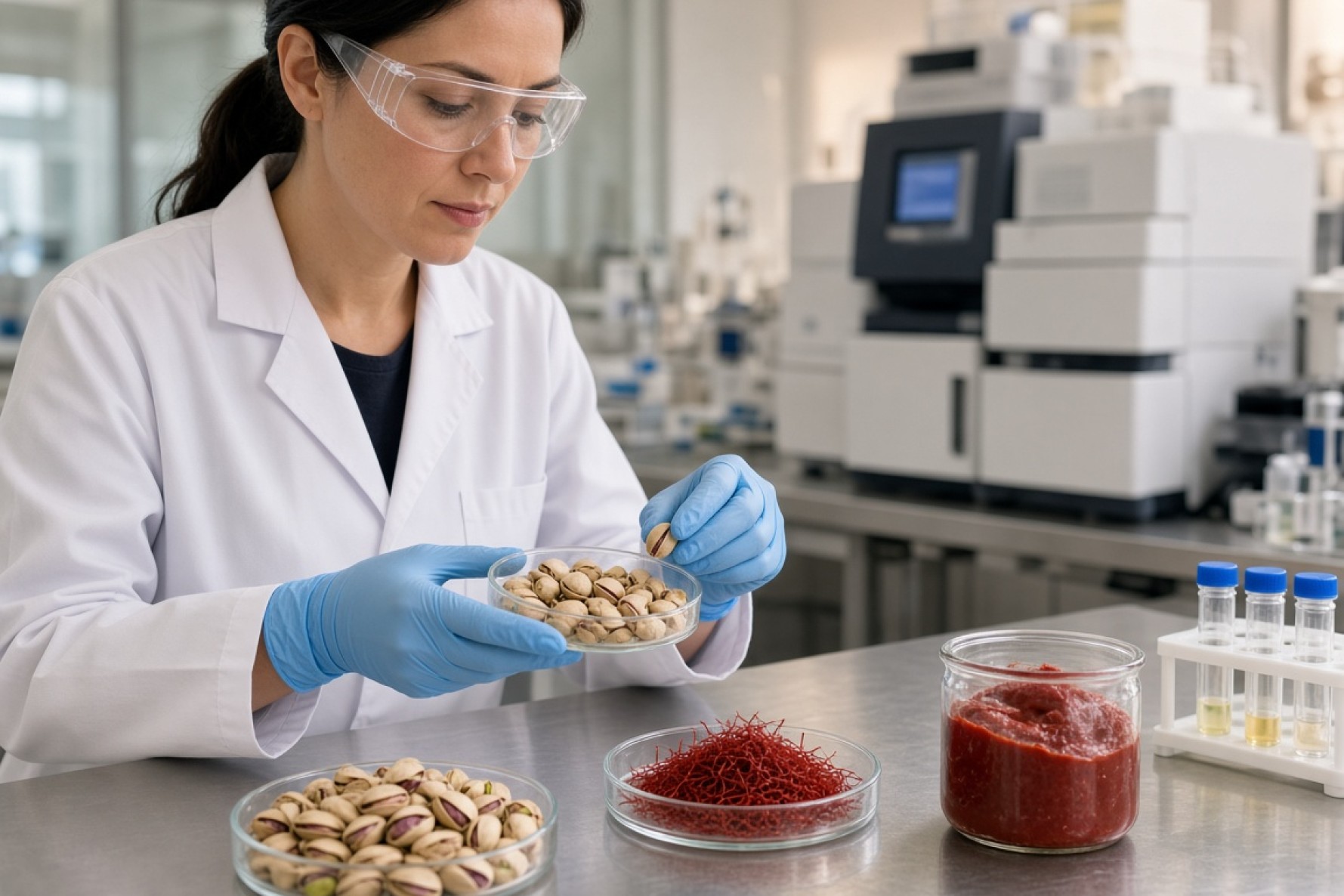
В трансграничной торговле качество подтверждается прослеживаемыми лабораторными данными до разблокировки аккредитивов. Пробелы по микотоксинам, MRL, патогенам или физико-химии ведут к RASFF и репутационным потерям. Иран силён в фисташке, шафране и томатной пасте, но экспортёры должны знать панели тестов назначения и профилактические чек-листы КК.
1. Регуляторная база и эталонные стандарты
| Market | Lead authority | Key rules | Test focus |
|---|---|---|---|
| European Union | EC / EFSA | Reg. 2023/915 & 396/2005 | Mycotoxins, multi-pesticide, heavy metals |
| GCC | GSO | GSO 1016, halal | Micro load, SO₂, preservatives |
| EAEU | EEC Commission | TR CU 021/2011 | Metals, quarantine pests, Howard mold |
| China | GACC | Decrees 248–249, GB series | Facility registration, toxins, purity |
Cross-border food trade rests on Codex Alimentarius, WTO SPS agreements, ISO 22000, HACCP and destination regulations. Codex sets baseline safety limits; the EU and EAEU often apply stricter caps than Codex minimums — stating “Codex compliant” alone is insufficient in contracts.
Certificates of analysis are legally credible at foreign customs only when issued by ISO/IEC 17025 accredited laboratories with calibrated equipment, validated methods and competent staff. Non-accredited COAs are commonly rejected and cargoes held as lacking inspection proof.
2. Микотоксины и грибные токсины
| Toxin | Product | EU limit (µg/kg) | Reference method |
|---|---|---|---|
| Aflatoxin B₁ | Ready-to-eat pistachio | 8 | HPLC-FLD / LC-MS/MS |
| Total aflatoxins | Ready-to-eat pistachio | 10 | EN 14123 / ISO 16050 |
| OTA | Raisins & sultanas | 8 | EN 14132 / LC-MS/MS |
| OTA | Other dried fruit | 2 | LC-MS/MS |
| Patulin | Apple juice / concentrate | 50 | ISO 8128 |
Mycotoxins are heat-stable secondary metabolites; roasting or pasteurisation does not guarantee removal. Destinations allocate heavy sampling to aflatoxins, ochratoxin A and patulin.
For pistachios and tree nuts the EU caps AFB₁ at 8 µg/kg and total aflatoxins at 10 µg/kg for direct consumption; higher tiers apply when physical sorting is required before use. OTA limits are 8 µg/kg for sultana raisins and 2 µg/kg for other dried fruit. Patulin in apple juice is capped at 50 µg/kg.
Rapid ELISA screens are not accepted for official release; buyers require HPLC-FLD with immunoaffinity cleanup or LC-MS/MS with documented LOQ/LOD.
3. Остатки пестицидов (MRL) и таможня
Maximum residue limits define the highest legal pesticide level in mg/kg. EU border control shifted from single-compound tests to multi-residue LC-MS/MS and GC-MS/MS panels detecting hundreds of actives at 0.005 mg/kg or lower.
When no EU MRL exists for a compound–commodity pair, the default 0.01 mg/kg applies and triggers rejection. Organophosphates such as chlorpyrifos are banned or accepted only at instrumental LOQ. Systemic fungicides on nuts and dried fruit are closely watched.
In concentrates (tomato paste, dried apricot sheets, powders) residues concentrate with the drying factor — factories must source from orchards that respected pre-harvest intervals.
4. Тяжёлые металлы, SO₂ и миграция из упаковки
| Analyte | Food type | Codex (mg/kg) | EU (mg/kg) |
|---|---|---|---|
| Lead | Tomato paste | 0.2 | 0.10–0.15 |
| Cadmium | Fruit & nuts | 0.05 | 0.02–0.05 |
| SO₂ | Golden raisins | 1500 | 2000 |
| Tin | Canned foods | 250 | 100–200 |
Lead, cadmium, arsenic and mercury accumulate in tissues and are controlled with ICP-MS or GFAAS. Tomato products reflect soil and irrigation quality; canned goods require tin migration limits.
Sulphur dioxide preserves golden raisins and apricots; Codex allows up to 1500–2000 mg/kg while EU retail rules tighten labelling above 10 mg/kg free SO₂. BPA, phthalates and tin from lacquered cans are part of packaging safety dossiers.
5. Микробиологическая безопасность
Microbiological tests are the first sanitary gate at customs. Salmonella must be absent in 25 g across representative samples; Listeria and pathogenic E. coli are monitored in ready-to-eat and chilled lines.
TPC, yeast and mould counts reflect line hygiene; thermal processing of aseptic paste must be validated with incubation holds. For buyers sourcing from Iran, Iranco helps match RFQs to suppliers tested against agreed biological indices before dispatch.
6. Физико-химия и подлинность по группам
| Export product | Key test | Typical spec | Method |
|---|---|---|---|
| Saffron | Crocin colour | >200 grade 1 | ISO 3632 UV |
| Tomato paste | Brix | 36–38% | Refractometer 20 °C |
| Tomato paste | Howard mould | ≤40% (target <35%) | AOAC 965.41 |
| Pistachio | Moisture | 5–7% | Oven 103 °C |
Nuts: moisture 5–7% for pistachios, water activity below ~0.65–0.70, peroxide value under 3 meq/kg fat. Saffron: ISO 3632 spectrophotometry — crocin >200, picrocrocin >70, safranal 20–50, moisture ≤12%.
Aseptic tomato paste: Brix 36–38% without added salt, Howard mould ≤40% microscopic fields (contracts often ≤35%), Hunter a/b ≥2.1 at 12° Brix, pH 4.1–4.4, Bostwick per hot- or cold-break grade.
7. Органолептика, дефекты и фальсификация
Organoleptic teams screen rancidity, burnt notes, colour uniformity and mould spots before lab release. AQL sampling quantifies foreign matter, insect damage, breakage and black specks in paste.
Adulteration tests include HPTLC/LC-MS for illegal dyes in spices, ash and acid-insoluble ash for saffron purity, and IRMS for added syrups in concentrates.
8. COA, отбор проб и PSI
A valid COA lists traceability (lot, dates, packs, weights), ISO/IEC 17025 accreditation ID, method standards (AOAC/ISO/EN), results vs limits and LOD/LOQ for trace analytes, signed by authorised signatory.
Sampling must follow Codex CXS 229 or EC 401/2006 with composite samples from many container points. Independent PSI at origin seals cartons, witnesses drawing and issues inspection certificates tied to payment milestones.
9. Упаковка, MAP и холодовая цепь
Seal integrity, WVTR/OTR for nuts and saffron, flex resistance of aseptic bags in 220 L drums, BCT/ECT for cartons and MAP with N₂/CO₂ below 2% O₂ are standard export QA topics.
Data loggers on reefer or ventilated containers document temperature/humidity — condensation drives secondary mould and aflatoxin risk on long sea lanes.
10. Сравнение рынков — ЕС, GCC, ЕАЭС, Китай
| Region | Priority tests | Core documents | Top rejection drivers |
|---|---|---|---|
| EU | Aflatoxin, OTA, MRL <0.01 | ISO 17025 COA | Toxins & banned actives |
| GCC | Micro, halal, SO₂ | Health & halal certs | Label & micro fail |
| EAEU | Metals, pests, Howard | EAC, phytosanitary | Live pests, mould index |
| China | GB, aflatoxin | GACC code, health cert | GB mismatch, registration |
EU: mycotoxins and pesticide panels with ISO 17025 COA. GCC: GSO microbiology, halal, bilingual dating, SO₂ in dried fruit. EAEU: quarantine pests, Howard mould, heavy metals, EAC declarations. China: GACC registration, GB compliance, Chinese labelling.
11. Коммерческая ценность партий с тестами
Lots with EU-aligned aflatoxin and MRL certificates command premiums after laser sorting and orchard audits. Higher crocin and clean Brix/Hunter specs directly affect settlement for saffron and paste.
Iran competes with the USA on pistachios, Spain on saffron packaging value-add, and Turkey/China on tomato paste — technical QC on mould and pesticides is the differentiator in European retail chains.
12. Промышленные сорта и чек-лист импортёра
Confectionery needs low-peroxide pistachio pieces; dairy uses high-crocin saffron; sauce plants specify hot-break vs cold-break Bostwick. Importers should fix specs, destination hygiene law, pre-shipment independent lab, PSI, defect tolerances, packaging ISPM 15, Incoterms with loggers, and payment conditional on COA + clearance.
For accurate export RFQs list HS code, grade, Brix/moisture/crocin/HMC targets, contaminant caps per country, pack type, FCL volume, Incoterm and required third-party certificates.
Чек-лист импортёра перед заказом
- Приложить обязательную техспецификацию (Brix, влага, цвет, дефекты).
- Указать санитарное право назначения (EU, GSO, TR CU), а не «экспортное качество».
- Протестировать образец до отгрузки в независимой лаборатории ISO/IEC 17025.
- Официальный отбор проб по Codex/ISO 2859 третьей стороной.
- PSI до погрузки; оплата при COA и таможенном выпуске.
Частые вопросы
What is the critical test for EU pistachio exports?
Four aflatoxins by HPLC-FLD: AFB₁ max 8 µg/kg and total max 10 µg/kg for ready-to-eat kernels, plus moisture control below ~7% to limit in-container mould growth.
What is Howard mould count in tomato paste?
A microscopic field count of mould filaments; Codex-style contracts use max ~40% fields, while many EU/Russia buyers contract 30–35% to prove sound fruit input.
What does ISO 3632 measure for saffron?
Spectrophotometric crocin (colour), picrocrocin (taste) and safranal (aroma) plus moisture and ash limits for grading.
Why are raisins stopped for sulphur dioxide?
SO₂ preserves colour but is a strong allergen; exceeding legal mg/kg or missing label warnings above 10 mg/kg free SO₂ causes border holds.
What accreditation must an export COA have?
ISO/IEC 17025 accreditation with full traceability, methods, LOD/LOQ and authorised signature — otherwise customs and buyers reject the document.
How can buyers source tested Iranian foods?
Submit grade, pack, volume, destination limits and inspection needs via Iranco RFQ so vetted suppliers are matched to your QC checklist.
Аналитическое резюме
Контроль качества экспорта охватывает поля, переработку, аккредитованные тесты, PSI и упаковку до выпуска в стране назначения. Считайте КК конкурентным преимуществом и документируйте каждую партию по ISO/IEC 17025 с панелями под рынок.
Избранное Продуктs








Related Статьи



