 Iranco Magazine Team
A comprehensive guide to technical specifications, carcass yield analysis, packaging technologies, hygiene standards and margin optimization in institutional buying
Buying Guide · Poultry Protein · Retail
Portion Chicken: Wholesale Procurement Guide for Retail Stores
A comprehensive guide to technical specifications, carcass yield analysis, packaging technologies, sanitary standards, and margin optimisation in institutional buying — published in the Iranco magazine.
Wholesale procurement of portion chicken demands command of microbiological quality indicators, cold-chain engineering, and precise anatomical yield ratios to optimise profitability in chain stores and modern retail. This specialist guide explains qualitative assessment frameworks, modern packaging technologies such as modified atmosphere, national standards, and inbound inspection protocols so ordering errors and waste rates across the distribution network are minimised.
Analytical introduction
Shifts in consumption patterns and rapid growth of chain retail have moved the protein market from traditional whole-carcass supply toward portioned and cook-ready products. Efficient management of meat and poultry departments in modern retail faces three core challenges: controlling weight loss from purge, stabilising microbial load through the selling period, and managing gross-margin volatility. Portion chicken, because of structural cuts, loss of skin cover, and increased cut-surface area exposed to the environment, spoils faster chemically and biologically than whole carcasses; the smallest lapse in temperature monitoring or selection of packaging films leads to organoleptic decline, slimy texture, and load rejections.
Iran, with annual broiler meat production capacity exceeding 2.3 to 2.6 million tonnes, operates one of the region’s largest broiler production structures. That volume relies on modern industrial slaughter complexes classified by the national veterinary organisation into base, grade A, and advanced grade A+ lines. Differences in slaughter infrastructure—especially carcass chilling systems (immersion water chillers versus air-blast tunnel chillers)—directly affect absorbed moisture, purge in retail packs, and shelf life on store displays.
Procurement managers need more than a daily price quote: aligning cut mix with the demographic profile of store catchments, splitting MAP versus conventional tray packs, and embedding precise technical parameters in commercial contracts are essential to cut invisible waste and maximise protein-category profitability.
1. Portion-chicken market dynamics and retail consumption patterns
The raw animal-protein market has undergone structural change in distribution in recent years. National veterinary restrictions on portioning carcasses in open traditional shop space—because of cross-contamination risk—have concentrated production in licensed industrial packing plants. At the same time, smaller households and less time for home trimming have steered end consumers toward hygienic retail packs such as breast fillets, boneless breast, wings for grilling, and trimmed legs.
Iran’s slaughter industry has introduced quality grading as lines are modernised. In traditional or second-grade plants, evisceration is manual and carcasses enter long ice-water tanks (water chillers). That method drives extra water into muscle fibres, which later appears as free purge in retail trays. By contrast, A and A+ units use automated evisceration and air-blast mist chillers. That approach sharply lowers surface bacterial load, keeps free meat moisture below 1.5%, and delivers clearer, low-purge packs with longer shelf life to retail centres.
From a commercial standpoint, industrial portioning lets retailers separate margins precisely. Carcass cuts are not homogeneous: breast muscle and fillet are lower price-elasticity items with high gross margin, while frames, wings, and necks move more slowly or feed industrial uses. Buyers must balance order-basket volume against revenue mix in each store catchment to avoid surplus slow movers expiring in chilled cabinets.
2. Carcass anatomy: cuts, weight shares and extraction yield
Chicken meat profitability depends directly on anatomical yield maths. Standard carcass weight for industrial portioning is 1600 to 2200 g. Carcasses under 1400 g carry more bone relative to muscle and deboning causes heavy weight loss. Live birds above 2.8 kg deposit intramuscular fat and alter breast collagen structure, reducing sensory acceptance and raising trim waste.
Chicken breast and pure fillet
Breast is the highest-value portion on extraction lines. On a standard chilled carcass, whole breast with skin and keel accounts for 38 to 42% of carcass weight. Industrial conversion to skinless, boneless breast requires removing skin (~3.5% of carcass) and keel cartilage (~8 to 10% of breast), bringing net boneless breast yield to about 24 to 28% of original carcass weight. The two strips under the keel—the tenderloins—form chicken fillet at 4 to 6% of carcass weight. Because of very fine texture, absence of coarse tendons, and negligible fat, fillet is the highest-priced item in the poultry basket.
Chicken leg and anatomical components
Leg is a dark, moist locomotor muscle comprising 32 to 35% of cook-ready carcass weight. A whole leg joins two distinct parts at the knee joint:
- Drumstick: About 14 to 16% of carcass weight; usually sold skin-on, bone-in for frying or grilling.
- Thigh (upper leg): 16 to 18% of carcass weight. After deboning, it is the base for thigh fillet kebab and many foodservice applications.
Wings, drumettes, neck and back frame
Both wings with drumette total about 9 to 11% of carcass weight. The wing has three segments—drumette, flat, and tip. Tips lack saleable muscle and are removed before packing on modern lines. The remaining frame—vertebral column, ribs, and neck junction—accounts for about 18 to 22% of carcass weight. Low unit value cuts are packed for home soup use or sent to sausage and paté plants for mechanical separation (standard chicken paste) and extract production.
| Meat cut | Supply form and industrial cut standard | Share of whole carcass (%) | Primary retail customer and use |
|---|---|---|---|
| Whole bone-in breast | With keel bone and skin; no neck or wings | 38 to 42 | Value family basket; stewing and boiling |
| Boneless breast | Skinless, fully boneless, no keel cartilage | 24 to 28 | Working households, diet segments, restaurants and QSR |
| Premium chicken fillet | Lean muscle, no thick tendon, no blood spotting | 4 to 6 | High-income buyers, athletes, fried strips |
| Whole chicken leg | Drumstick and thigh, bone-in, skin-on or skinless | 32 to 35 | Traditional home cooking, rice dishes, meal-prep kitchens |
| Drumstick | Standard knee joint cut, uniform bone and skin | 14 to 16 | Family frying, fast-food baskets |
| Boneless thigh meat | Pure thigh meat, boneless, natural fat streaks | 12 to 14 | Thigh kebab, grill restaurants, braised dishes |
| Wings and drumettes for grilling | Cut wings with drumette, tips removed | 8 to 10 | Weekend grilling, QSR and fried chicken |
| Frame, back and neck | Vertebral bones without viscera | 18 to 22 | Economy basket, soup stock, further-processed meat industry |
These data let commercial staff structure mixed purchase packs with plants: processors prefer balanced contracts that move premium cuts such as fillet together with other portions.
3. Technical specs, sensory requirements and chicken quality standards
Portion chicken ready for retail display must meet national technical and sensory standards and veterinary hygiene control instructions. Compliance protects consumer food safety and prevents legal disputes between buyer and distributor.
Organoleptic assessment
Breast muscle colour should be very pale pink leaning white; leg muscle is naturally darker pink because of higher myoglobin. Any shift toward grey, greenish tinge at the bone line, or abnormal yellowing signals bacterial spoilage or acute fat oxidation. Skin must be moist, glossy, uniform, and free of excessive feather stubble. Fresh muscle pressed with a finger should spring back immediately; indentations must not persist. Mushy texture, excessive surface slime, and sour, ammonia, or stale odours are grounds for rejection.
Physical criteria and plant preparation
All cuts must be made with clean, smooth, burr-free blades. Shattered bone at leg or wing cuts from improper hydraulic shear pressure is a serious defect: bone splinters can injure consumers or puncture packaging. Meat must be fully cleared of trachea, lung, crop, abdominal fat pads, large joint blood clots, and green gall-bladder discharge.
| Technical / physical attribute | Standard status and quality limit | Commercial importance in store and to the shopper |
|---|---|---|
| Muscle acidity (pH) | 5.8 to 6.2 in breast muscle | Water-holding stability, firm bite, colour stability |
| Free drip (Drip Loss) | Below 2.5% in fresh packs | Avoids cloudy purge in pack base and weight loss |
| Bone and cartilage fragments | No sharp splinters or shattered bone | Prevents mouth injury and legal complaints |
| Visceral and abdominal fat | Free of loose yellow fat masses | Pay only for lean meat; limits oxidative spoilage |
| Skin residue on skinless cuts | Maximum 1% of meat surface area | Meets diet-oriented and skinless buyers |
| Respiratory and digestive remnants | Zero (lung and trachea fully removed) | Blocks psychrotrophic growth inside the pack |
Stating these values explicitly as acceptance criteria on commercial order forms gives store QC staff a firm basis when unloading at the central warehouse.
4. Hygiene protocols, laboratory testing and microbiological limits
Raw chicken is a high-moisture substrate for pathogens. Bulk portion buying without laboratory documentation creates irreversible brand risk. Quality tests should align with Iranian national standard 9714 and official veterinary protocols.
Pathogens and spoilage indicators
Microbiological panels cover total aerobic count, psychrotrophs, Staphylococcus aureus, and faecal indicators such as E. coli. Total viable count (TVC) must not exceed 106 CFU per gram of portion meat. Any Salmonella in 25 g of tissue is a food-safety red line: mandatory rejection, lot hold and destruction, and legal follow-up against the plant.
Biochemical spoilage markers (TVB-N)
Total volatile basic nitrogen (TVB-N) assesses freshness and helps detect thawed old birds. These bases—ammonia, dimethylamine, trimethylamine—come from bacterial proteolysis and amino-acid breakdown enzymes. Veterinary guidance treats values below 24 mg nitrogen per 100 g meat as satisfactory. The 24 to 27 mg band is a spoilage threshold requiring rapid sale; above 27 mg indicates advanced spoilage and unfit product.
| Microbiological / chemical test | National reference standard | Permitted range per gram of meat | Technical and hygiene impact if out of spec |
|---|---|---|---|
| Total viable count (TVC) | Standard 5272 | Maximum 105 to 106 CFU | Sharp drop in chilled shelf life and off-odour |
| E. coli | Standard 2946 | Maximum 50 to 500 CFU | Faecal contamination of the portioning line |
| Coagulase-positive Staphylococcus aureus | Standard 1117 | Maximum 100 to 1000 CFU | Secondary contamination from packer hand contact |
| Salmonella | Standard 1810 | Negative in 25 g meat | Acute infectious illness and severe regulatory action |
| Total volatile basic nitrogen (TVB-N) | Kjeldahl distillation method | Less than 24 mg per 100 g | Tissue spoilage and protein putrefaction odour |
| Drug and antibiotic residues (MRL) | HPLC chromatography methods | Below veterinary authority MRL limits | Gradual toxicity, antimicrobial resistance, load rejection |
5. Quality defects, commercial fraud and segregating non-conforming loads
Bulk poultry distribution can involve fraud and processing failures. Inbound inspectors must recognise them quickly so financial loss and market-inspection penalties do not fall on the retailer.
Common slaughter and processing defects
- Artificial water uptake and moisture retention: Improper immersion chilling or extended ice-water residence swells muscle sponge-like. That false moisture later leaves cells, reducing net paid weight and coating packs in unpleasant purge.
- Hydraulic water and phosphate injection: In rare cases, non-compliant suppliers use pressure injectors to pump brine with polyphosphates into breast depth, artificially raising piece weight by 10 to 20%; the meat is jelly-like and releases excessive water in cooking.
- Joint bruising and broken bones: Incorrect stunner voltage or rough shackling causes blood clots in leg and wing joints and dark haematomas that destroy market appeal.
Date fraud and repacking
A common violation is thawing old frozen stock, portioning in workshops, and selling it as fresh chilled chicken. Such meat lacks firm texture, shows extreme purge, and looks dull and soft because of freeze–thaw cell damage. Re-sticking “today’s” labels on slow-moving MAP trays is another fraud detectable by heat-seal condition and traceable barcodes.
| Defect or fraud type | Visual and laboratory signs | Corrective action and buyer decision |
|---|---|---|
| Unauthorised absorbed water | More than 3.5% release in standard drip test | Deduct total load weight and charge supplier penalty |
| Frozen sold as fresh | Mushy texture, pale colour, free purge, high TVB-N | Immediate full rejection; report to veterinary authority |
| Irregular cuts and shattered bone | Sharp bone chips in breast and leg meat | Issue technical notice; return affected lots |
| Faecal or bile contamination | Yellow-green stains on skin or fat | Hold unfit stock; destruction at plant cost |
| Net weight vs label mismatch | Product without tray weighs less than label | Declare weight discrepancy; claim short-shipment damages |
6. Retail packaging engineering: conventional methods vs modern MAP
Chicken packaging is a physical barrier against surface moisture loss, lipid oxidation, and spoilage bacteria. Technology choice sets shelf life and logistics radius.
PVC stretch over foam trays (conventional)
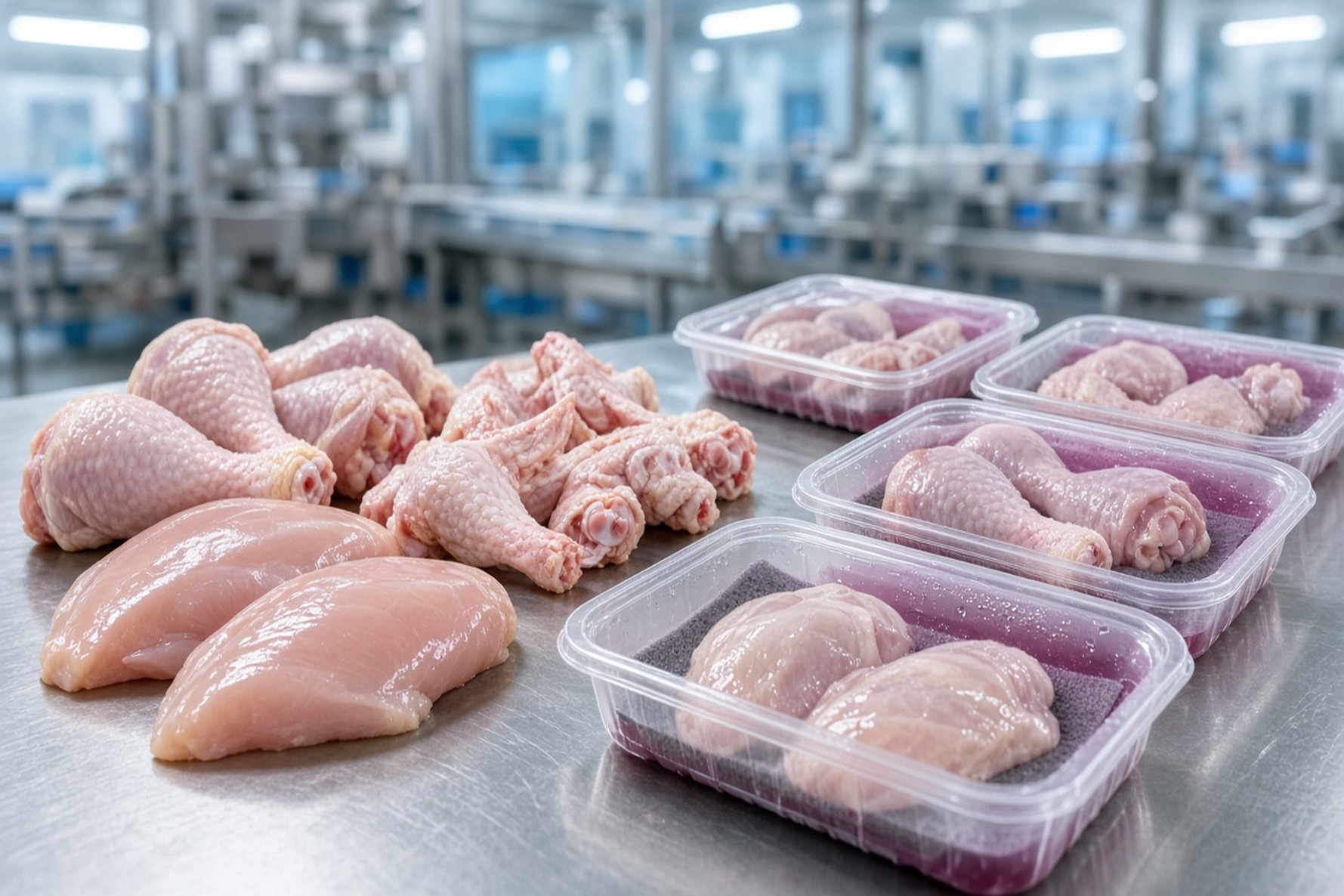
In this traditional format, cut pieces sit on expanded polystyrene trays and are covered with flexible clear PVC film. These films are highly permeable to gases, especially oxygen. Capital and material cost is very low, but free oxygen accelerates aerobic psychrotrophs such as pseudomonads. Under ideal chilling, shelf life rarely exceeds 3 to 4 days and continuous purge creates poor shelf appearance.
Modified-atmosphere packaging (MAP)
MAP is the most effective approach for fresh retail portion chicken. Headspace in a rigid polymer tray is evacuated and replaced with a controlled gas mix, then heat-sealed. The atmosphere has two main components:
- Carbon dioxide (CO2): Used at 20 to 30%; dissolving in surface moisture forms weak carbonic acid, slightly lowering surface pH and strongly inhibiting Gram-negative bacteria and moulds.
- Nitrogen (N2): At 70 to 80% as an inert, odourless, low-solubility filler that prevents film collapse as CO2 is absorbed by the meat.
Low-permeability trays extend fresh chicken shelf life from 3 days to 14 to 21 days at a steady 2 °C, enabling flexible inventory, fewer expiry losses, and supply to distant branches.
Vacuum skin and thermoforming
Marinated portions or deep-frozen products may use vacuum skin packs: heated flexible film adheres fully to the meat and expels air bubbles, stopping freezer burn and fat oxidation. Across technologies, cellulose-polymer absorbent pads in tray bases are required to control released purge.
| Packaging system | Polymer and tray / lid materials | Shelf life at 0–4 °C | End pack cost | Main retail benefit |
|---|---|---|---|---|
| Conventional foam stretch | EPS tray + elastic PVC overwrap | 2 to 4 days | Lowest cost | Low pack cost, suited to daily turnover |
| Modified atmosphere (MAP) | Rigid PP or PE tray + gas-barrier film | 14 to 21 days | Mid to high | Waste control, odour and leak containment, long life |
| Vacuum skin pack | PET tray + flexible multilayer film | 21 to 28 days | Highest cost | Strong visual appeal, sauce and marinade hold, oxidation control |
| Master carton and bulk shrink | Food-grade five-ply carton + PE liner | 2 to 3 days (chilled) / 9 to 12 months (frozen) | Most economical | Minimal pack cost, bulk moves for industrial users |
The Iranco platform connects retail companies with leading producers equipped with MAP lines so buyers receive products at the highest packaging standards.
7. Cold-chain management, logistics and drip-loss control (Drip Loss)
Chicken is highly temperature-sensitive. Variation during transport and unloading drives early spoilage and heavy purge. Stable temperature from processing hall to display case is the core of meat quality stability.
Chilling rules in production and logistics
- Portioning hall: Meat prep room temperature must not exceed 10 to 12 °C so bacteria do not multiply during cutting.
- Rapid pre-chill: After packing, portions must reach 0 to 2 °C core temperature quickly via blast chill tunnels.
- Refrigerated fleet: Fresh-chicken trucks and trailers need strong refrigeration and continuous temperature logging (online thermographs), holding load at 0 to 3 °C. Frozen product requires uninterrupted −18 °C at meat core.
Controlling drip loss and pallet stacking
Drip Loss is the process where myofibrillar proteins lose water-holding capacity under temperature swing or pH shift, releasing sarcoplasmic fluid, salts, and myoglobin. Even a two-degree cold-chain excursion can double purge rate. Loads should sit in standard vented plastic crates so container air circulates between stacks. Tight floor stacking without pallets creates hot spots and souring. Reviewing vehicle data-logger records before approving unload is a critical control at distribution warehouses.
8. HS tariff codes, export rules and regional market entry
Chicken meat serves domestic retail and cross-border trade. Chain companies in foreign markets need full awareness of tariff classification and quarantine law.
Harmonized System (HS Code) structure
Poultry products in customs export/import regulations fall under Chapter 2, heading 0207:
- HS code 020712: Whole chicken, frozen, not cut.
- HS code 020713: Poultry cuts and edible offal, fresh or chilled.
- HS code 020714: Poultry cuts and edible offal, frozen.
Sanitary and customs requirements in target markets
Neighbouring markets—including Gulf states, Iraq, Armenia, and the Russian Federation—apply defined hygiene rules for portion chicken entry:
- International export establishment code (IR): Plant and slaughterhouse must meet audited hygiene standards and hold a registered export code.
- Islamic slaughter (halal) certificates: Official religious approval under recognised agricultural and regional accreditation bodies.
- Multilingual labelling: Net weight, slaughter date, expiry, and chill conditions in Persian, English, and destination language (Arabic or Russian).
- MRL compliance: Full alignment with regional limits for drug residues and heavy metals under frameworks such as Gulf Standardization Organization (GSO) or Eurasian Union standards.
9. Financial analysis and landed cost: whole carcass vs industrial portion packs
Choosing in-store portioning versus buying industrial packed cuts requires weighing visible and hidden costs. Financial review shows back-of-store breaking carries overheads that erode initial margin.
Hidden cost of manual breaking
In-store chicken breaking needs space, stainless saws, hygienic tables, knives, benches, and skilled butchers. The largest waste source is human error in muscle separation: incomplete deboning leaves saleable meat on frames sold cheaply as frames. Non-saleable trim—visceral fat, vessels, and free tissue moisture—wastes about 5 to 8% of the carcass. Open-store breaking also accelerates contamination and cuts shelf life below 48 hours, raising return rates.
Economic value of industrial portion buying
Industrial portion orders make per-kilogram landed cost fully transparent. Product arrives with standard price barcodes, net weight, and durable packs that integrate cleanly with store inventory systems. Long MAP shelf life drives display waste toward zero and lets forecast gross margin materialise.
| Commercial evaluation parameter | Manual portioning in store | Industrial packed portion purchase |
|---|---|---|
| Direct labour and tool cost | High (butcher, saw, hygiene gear, uniforms) | Zero (ready product goes straight to shelf) |
| Invisible yield loss and carcass waste | 5 to 8% (fat, skin, poor deboning) | Zero (store pays only for edible meat weight) |
| Shelf life in store chiller | Maximum 2 days (high spoilage, returns, odour risk) | Up to 21 days with standard MAP |
| Regulatory and legal risk | High (veterinary inspection, illegal portioning offences) | Fully aligned with health licences and official rules |
| Inventory and barcode accuracy | Low with unexplained weight gaps | Highly accurate POS integration with fixed barcodes |
Together, these factors show centralised industrial buying controls operational volatility and supports stable margin.
10. Retail buyer checklist before ordering and at delivery
A systematic hygiene and commercial verification routine is essential for bulk buying. This practical checklist blocks defective loads from entering the warehouse network:
Mandatory pre-contract supplier checks
- Verify operating health licence: sight and query the official portioning plant permit on the national veterinary system.
- Source slaughterhouse grade: prioritise grade A and A+ plants with air chillers to optimise tissue moisture.
- Align cut specifications: written agreement on fat, cartilage, excess skin removal, and standard weight per cut.
- Fix packaging technology: confirm MAP tray share versus conventional stretch film in the product mix.
- Assess daily supply continuity: confirm line capacity for on-time delivery at peak demand such as weekends.
Operational controls during store unload
- Match veterinary transport certificate to physical load and issue date.
- Download vehicle data-logger charts to confirm uninterrupted chill in transit.
- Measure core muscle temperature on random samples with a calibrated probe (required range: 0 to 4 °C).
- Check abnormal purge: tray surface and pad performance; no pooled coloured sticky liquid under pieces.
- Inspect pack integrity: correct MAP gas fill, no holes, film tears, or abnormal swelling.
- Verify marking: legible production date, expiry, health licence number, and trace barcode.
- Random weigh packs to validate net weight against label.
11. What information is needed for an accurate price quote?
Buyers need a transparent, comparable proforma from plants or supply desks. Ambiguity on any parameter distorts true price discovery:
- Exact cut and processing description: Pure fillet, skinless boneless breast, skin-on drumstick, boneless thigh, or wing and drumette for grilling.
- Unit pack weight and format: Retail trays at 800, 900, or 1800 g, or bulk liner bags and 10 kg master cartons.
- Packaging technology: Traditional foam stretch trays, MAP with protective gas, or vacuum thermoforming.
- Slaughter chill method: Mandatory air-chill lines (no added water) versus acceptance of standard water chill.
- Order volume and frequency: Daily or weekly tonnage in kg or tonnes and monthly demand forecast.
- Delivery point and mode: Central warehouse delivery (buyer site) or ex-slaughterhouse loading.
- Private-label needs: Store brand custom production versus plant brand distribution.
Bulk buyers can register technical specs and logistics parameters in Iranco’s quote structure to compare offers from qualified suppliers.
12. Direct portion-chicken supply from industrial slaughter plants via Iranco
Fresh protein value chains need the shortest path between producer and retail network because of rapid spoilage and strict temperature windows. Multiple intermediaries raise logistics cost and landed price irrationally and stall product in substandard warehouses, shortening effective shelf life on display.
Iranco is a specialist food-industry procurement platform connecting commercial managers at chain stores, hypermarkets, and hotels with graded slaughter complexes and industrial packing units. Buyers can place commercial orders by tonnage, MAP specifications, cut mix, and loading destination. The transparent workflow supports quality monitoring, hygiene sampling, annual supply contracts, and removal of intermediary mark-ups.
Summary
Wholesale portion chicken is central to protein-category identity and competitive advantage in modern retail. Precise product choice requires attention to extraction structure, slaughter chill system (air vs water), and investment in modern packaging such as MAP so purge and microbiological waste fall to the minimum practical level.
Smart commercial managers link supply chains to quality metrics, national veterinary standards, and cold-chain monitoring tools—not headline price alone. Direct procurement infrastructure and targeted contracts with large producers secure product flow, food-safety compliance, and sustainable retail-network profitability.
Frequently asked questions
1. What is the main difference between air-chilled and water-chilled portion chicken?
Water chillers immerse carcasses in ice water, absorbing an extra 3 to 5.5% water into muscle fibres that later purges in trays. Air chillers use cold air blast; moisture uptake stays below 1.5%, microbial load is lower, and shelf life is longer.
2. What retail advantage does modified-atmosphere packaging (MAP) provide?
By removing oxygen and replacing it with carbon dioxide (bacterial inhibitor) and nitrogen (filler gas), MAP extends fresh chicken life from 3 days to 14 to 21 days, cutting waste and greatly increasing selling flexibility.
3. Why is industrial portioning preferred over breaking carcasses in store?
In-store breaking causes 5 to 8% weight loss from deboning waste, labour and equipment cost, sharply reduced shelf life, and high hygiene violation risk. Industrial buying delivers hygienic, uniform, barcoded product with clear net margin.
4. What must be stated to get a wholesale portion-chicken price quote?
Buyers should specify exact cut, skin and bone status, slaughter chill type (air or water), packaging (stretch or MAP), pack weight, required tonnage, and unload warehouse address. Iranco registers quotes against these transparent parameters.
5. What is TVB-N and how is it used in meat quality assessment?
Total volatile basic nitrogen (TVB-N) measures protein breakdown by bacteria. Values below 24 mg per 100 g are satisfactory; above 27 mg indicates chemical spoilage and unfit product.
6. What purge level is acceptable in chicken packs?
Hygiene guidance says exudate should not exceed 2.5 to 3.5% of total piece weight. Higher purge signals substandard water chill, cold-chain shock, or thaw of old frozen stock.
7. What temperature is required when accepting fresh chicken at the warehouse dock?
Vehicle chamber and muscle core temperature at unload must sit between 0 and 4 °C. Readings above 6 °C, because rapid microbial spoilage begins, are legal grounds for outright rejection.
8. How can portion chicken be sourced directly from accredited slaughter plants?
Buyers can define tonnage, cut types, and packaging specs. The Iranco network enables direct connection to top-grade slaughter lines and delivery to current standards.
Featured Products




Related Articles



