 Iranco Magazine Team
Technical analysis of juice yield, Brix-to-acid balance, concentrate processing standards and wholesale/export purchasing protocols
Sourcing guide · Valencia · Industrial juice · Concentrate
Valencia Orange for Juice Processing: Juice Yield, Brix and Industrial Procurement Guide
Technical analysis of extraction yield, Brix–acid balance, concentrate processing standards and bulk export procurement protocols.
Valencia orange — with industrial juice yields of 45–55%, naturally high Brix and inherent resistance to delayed bitterness — is the global benchmark for juice and concentrate processing. This specialist guide explains biochemical drivers, laboratory acceptance rules, national and international standards, cold-chain logistics and bulk contract mechanics for food manufacturers and traders.
Industrial juice economics rest on soluble solids, not apparent fruit weight. An NFC or FCOJ line buyer who selects loads only on “large and orange” may record high input tonnage but low extract volume and final concentrate strength. Valencia in southern Iran’s tropical belt — Jiroft, Kahnuj, Fars plains and Hormozgan orchards — fills a strategic supply window in the late season when northern navel availability drops.
High heat, long sunshine and favourable day–night swings in the south support sugar accumulation with balanced acidity. For raw-materials managers, aligning contracts with acceptance indices (Yield, Brix, Limonin, Brix/Acid) and cold chain through to the extractor inlet separates operating margin from hidden waste. Related topics such as fruit-juice export and beverage packaging appear in Iran fruit-beverage export guides and complement this analysis for merchants.
1. Valencia production geography and industrial supply hubs in Iran
Valencia in Iran is grown mainly in the tropical south and south-east — a climate with sharply different harvest calendar and postharvest behaviour from the humid subtropical north.
- South Kerman: Jiroft and Kahnuj — the core of export and industrial Valencia; Helilrud plain and Kahnuj basin orchards with high Brix and elastic peel.
- South Fars: Darab, Jahrom, Qir and Karzin, Fasa — significant capacity for industrial and regional fresh trade; access to Persian Gulf ports.
- Hormozgan and Khuzestan: Winter supply complement; pay attention to irrigation management and calibre uniformity in large contracts.
Sorting terminals near the orchard, industrial washing, discharge into bulk bins and pre-cooling before haul to the plant are the foundation of extract quality. Industrial buyers can register load specifications (target juice yield, minimum Brix, weekly volume and delivery point) on Iranco so orchard-origin supply and sort lines are reviewed against the same RFQ.
2. Structural differences: Valencia vs navel, Thomson and local cultivars
Navel and Thomson are optimised for fresh consumption and retail appearance; Valencia is economically designed for juice extraction and flavour stability after pasteurisation. Delayed Bitterness arises when limonin glucoside solubilises from albedo and seed tissue during extraction — navel is more sensitive; Valencia typically shows lower limonin, controllable with finisher discipline and peel-oil control.
| Cultivar | Juice yield | Limonin | Pasteurised stability | Brix | Peel / seed | Economic outlet |
|---|---|---|---|---|---|---|
| Valencia | 45–55% | Low (<5 ppm target) | Excellent for NFC/FCOJ | 11–13.5 | Thinner peel; seedy | Concentrate, NFC, essence |
| Thomson navel | 35–42% | Moderate | Moderate | 9–12.5 | Thick; seedless | Fresh export, limited juice |
| Blood orange | 40–48% | Variable | Anthocyanin monitoring needed | 10–13 | Medium | Niche market, premium beverages |
| Local / seedling | 30–45% | Unspecified | Uncertain | 8–11 | Variable | Domestic use, low-cost bulk |
Where d-Limonene is recovered separately, Valencia peel adds co-product value; on simpler lines, peel-oil control at the extractor and finisher prevents bitterness and cloud instability.
3. Physicochemical indices and harvest calendar
Three contract pillars: Juice Yield (extract weight ÷ fruit input weight), Brix (soluble sugar solids %) and Brix/Acid Ratio (sweetness–acidity balance acceptable for labelling and flavour profile).
Industrial maturity index
Maturity Index = Brix ÷ Titratable Acidity (% citric acid)
For industrial orange juice, ratios of roughly 10:1 to 14:1 are common at peak season in southern Iran; outside that band, dilution or blend adjustment may be required.
| Phase | Timing | Brix | Acidity | Juice yield | Use |
|---|---|---|---|---|---|
| Early | Bahman — mid-Esfand | 10–11.5 | Higher | 42–48% | Local fresh, adjusted NFC |
| Industrial peak | Mid-Esfand — Ordibehesht | 11.5–13.5 | Balanced | 48–55% | FCOJ, concentrate, large contracts |
| Late | Late Ordibehesht — Khordad | 12–14 | Falling acid | 45–52% | High solids; granulation risk |
4. Technical acceptance specifications for industrial buyers
Supply contracts should separate rejection limits from target (ideal) ranges for each parameter. Statistical sampling of each incoming lot (minimum per agreed sampling plan) before discharge to the line prevents dispute after processing.
| Parameter | Rejection limit | Target | Notes |
|---|---|---|---|
| Juice yield | Minimum 42% | 48–55% | Standard press test in laboratory |
| Brix | Minimum 10.5 | 11.5–13 | Refractometer at 20°C |
| Acidity | 0.8–1.4% citric | 0.9–1.1% | Titration |
| Brix:acid ratio | Minimum 9:1 | 11:1 to 13:1 | Maturity index |
| Limonin | Maximum 8 ppm | <5 ppm | HPLC |
| d-Limonene in juice | Per line specification | Scott / GC control | Peel oil |
| Calibre | 65–95 mm | 75–88 mm | Uniformity for extraction |
| Defects and decay | Per INSO 4083 | <5% non-progressive defect | No active mould |
| Foreign matter | Zero | Zero | Leaves, stones, metal |
5. Defect assessment and laboratory protocols
Incoming plant quality aligns with national standard INSO 4083 (fresh citrus) and the buyer’s internal test panel. Reference equipment: digital refractometer, acidity titration, Scott oil test, HPLC for limonin, and microbiological screening including Alicyclobacillus in finished product (not necessarily in raw fruit, but a line-hygiene warning).
- Granulation: Woody texture and reduced juice in late season — extract yield falls without obvious peel change; mandatory longitudinal cut sampling.
- Freeze injury: Bleached patches and water-soaked tissue — rapid decay risk in store before extraction.
- Regreening: Chlorophyll return in warm storage; Brix alone may mislead — acidity and internal cut are the decision criteria.
An analysis certificate for each lot (Brix, acidity, defect %, temperature at loading) should attach to the transport document so plant intake inspection has a legal reference.
| Test | Method | Frequency |
|---|---|---|
| Brix | Refractometer | Each lot / random sample |
| Acidity | Titration | Each lot |
| Limonin | HPLC | Weekly or each new contract |
| Peel oil | Scott / GC | Sample from trial juice |
| Yield | Laboratory extractor | Daily at season peak |
6. Process engineering from dump to NFC and FCOJ
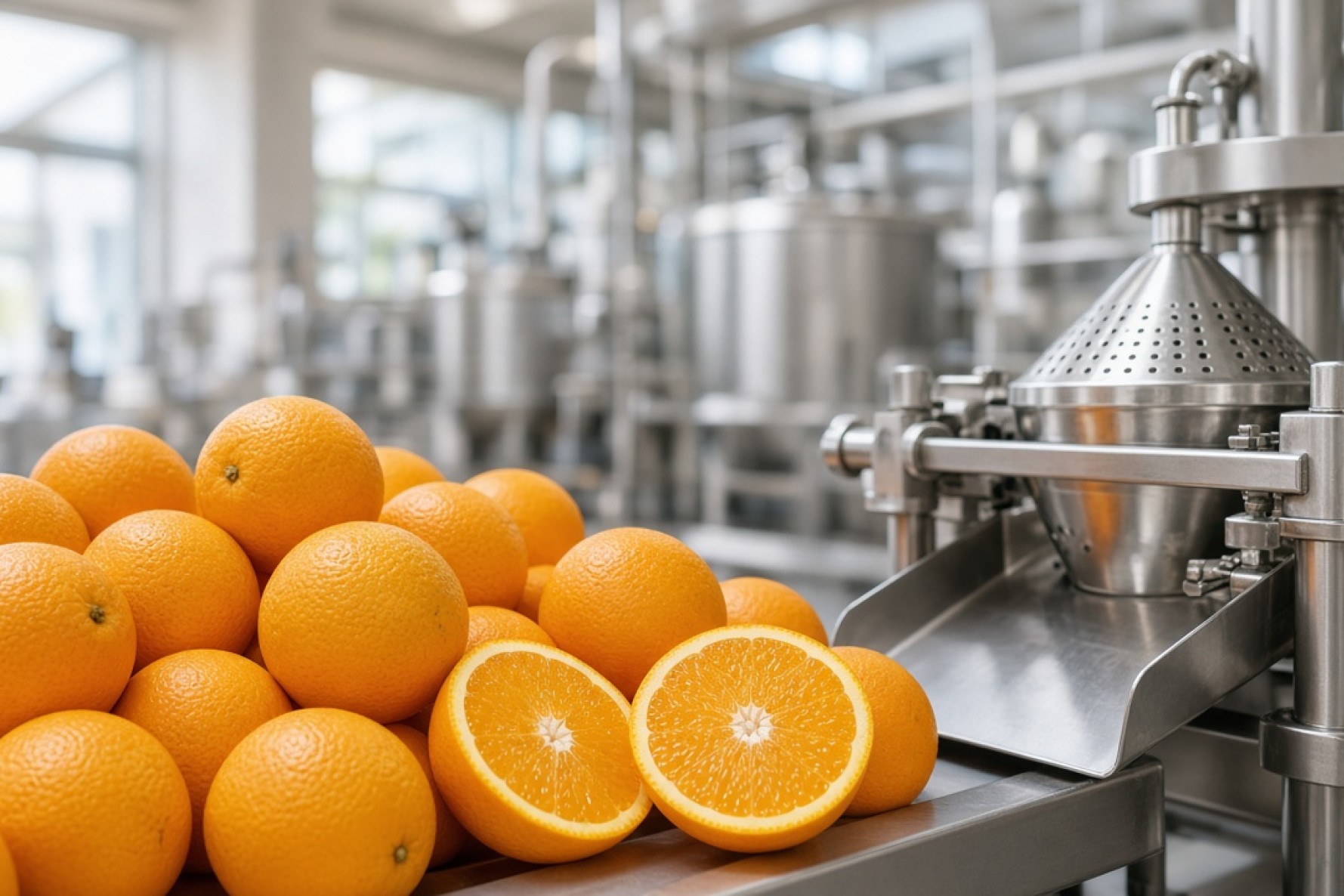
Material flow in modern Valencia plants typically follows the block below; skipping primary wash or inlet temperature control affects every downstream step.
[Dump / Flume Wash] → [Sizing & Grading] → [In-line Extractor + Peel Oil Recovery]
        → [Finisher / Strainer] → [Centrifuge / Clarification optional]
        → Branch A: [NFC: Flash Pasteurization → Aseptic Fill / Chilled Tank]
        → Branch B: [Evaporator TASTE / Vacuum] → [FCOJ 65° Brix → Freeze -18°C]
- Dump and wash: Recirculated filtered flume water; soil and leaf removal; controlled wash temperature to limit respiration.
- Sizing: Undersize diverted to side sales or chop; uniformity to fill extractor cups.
- In-line extractor: Controlled pressure on juice sacs; peel oil collected on a separate path.
- Finisher and centrifuge: Remove coarse pulp and sediment; visual clarity for NFC and evaporator feed for concentrate.
- TASTE evaporation and pasteurisation: Aroma retention at lower temperature than legacy evaporation; frozen FCOJ at -18°C for export.
7. National standards, Codex and safety requirements
- INSO 4083: Grading, permitted defects, packaging and storage of fresh citrus entering the factory.
- Codex Stan 247: International framework for juice and nectar — labelling, minimum fruit content, additives.
- AIJN: European industry reference for concentrate analysis and commercial terminology (contractual reference in export deals).
- MRL and quarantine: Pesticide limits in raw fruit and phytosanitary certificates for fresh export; microbiological and heavy-metal panels for processed product in destination markets.
Buyers should fix the orchard-approved pesticide list (post-bloom fungicides) in the grower contract so simultaneous juice or fresh exports to EAEU and GCC markets do not fail residue checks.
8. Export markets and competitive position
Direct export of Valencia fruit and products (concentrate, NFC, frozen pulp) to the Russian Federation and Eurasian Economic Union, Iraq and GCC states flows via southern land corridors and Persian Gulf ports. Price competition with Egypt (Valencia volume), Turkey (transit), Spain (brand) and Brazil (global FCOJ dominance) defines margin.
| Country | Volume / season | Brix / yield | Logistics | Advantage | Challenge |
|---|---|---|---|---|---|
| Iran | Winter–spring | High Brix, good yield | Proximity to CIS and Iraq | Energy and labour cost | Seasonal fleet volatility |
| Egypt | Stable | Uniform industrial | Sea container | Volume and FCOJ experience | Global price competition |
| Turkey | Seasonal overlap | Medium to good | Fast transit | Sort infrastructure | Input cost |
| Spain | EU | Excellent | European cold network | Brand and trust | High price |
| Brazil | Year-round | FCOJ standard | Bulk export | Global scale | Distance from Middle East |
9. HS codes and customs classification
| HS code | Description | Application |
|---|---|---|
| 080510 | Fresh oranges (sweet) | Raw fruit for plant or fresh export |
| 200911 | Orange juice, unfermented, no added sugar | NFC, direct juice |
| 200912 | Frozen orange juice | Frozen concentrate FCOJ |
| 200919 | Other citrus juice | Blends, special contract formulations |
On export proforma invoices, separating raw fruit (080510) from concentrate (200912) directly affects duty, health permits and transport conditions.
10. Packaging, cold chain and delivery to the plant gate
- Bulk bins: Primary factory delivery format — 300–500 kg capacity, vented and gravity discharge.
- Telescopic cartons: Fresh export or inter-terminal transfer — five-ply, vent holes.
- Sterile drums and isotanks: For export NFC or pasteurised pulp, not raw fruit.
- Raw fruit reefer: 4–7°C, 85–90% RH, ventilation 15–25 m³/h to remove ethylene and CO₂.
- FCOJ: Frozen storage at -18°C; broken cold chain in concentrate export transit is irreversible.
Loading warm fruit (above 12°C) into a refrigerated container is a common error; pre-cooling at least 24 hours before haul is mandatory to preserve Brix and limit decay.
Temperature data loggers from orchard to plant are recommended for quality dispute settlement and cargo insurance. For FCOJ export, 65° Brix after evaporation and freeze point must match each lot COA in the foreign buyer contract.
11. Pricing on soluble solids (Solids Sourcing Cost)
Professional buyers convert price per tonne of fruit into equivalent kilograms of dissolved sugar:
Solids (kg) ≈ Fruit mass (kg) × Juice yield × (Brix / 100)
Example: 1,000 kg fruit × 52% yield × 12 Brix ≈ 62.4 kg soluble solids.
Comparison: the same tonnage at 40% yield and 10 Brix ≈ 40 kg — a 56% difference in dry input with no change in nominal per-tonne price.
Market drivers: season phase (peak Esfand–Farvardin), distance to plant, pack type (bin vs carton), prepayment and guaranteed weekly volume. Contracts with penalties below minimum yield and bonuses for Brix above target align supplier behaviour.
12. Twelve-point checklist for importers and industrial buyers
- Contract cultivar name: Valencia — not a generic “industrial orange” clause.
- Minimum juice yield: Numeric (e.g. 45%) with reference test method.
- Brix and Brix:acid: Minimum and target per lot.
- Limonin ceiling: ppm in trial juice sample.
- INSO 4083 defects: Permitted percentage and ban on active mould.
- Calibre: mm or gram range for line uniformity.
- Delivery temperature: Maximum 7°C at plant unload.
- Pesticide MRL: Approved list and laboratory certificate.
- Harvest-to-extract time: Maximum agreed hours.
- Net weight and shrinkage: Certified scales at origin and destination.
- Independent inspection: For large export orders when required.
- Termination terms: If intake quality panel fails.
13. Information required for RFQ and price inquiry
- Product: industrial raw Valencia (or NFC/FCOJ if processed)
- Volume: daily / weekly tonnes or number of bins
- Minimum Brix, target juice yield and limonin ceiling
- Calibre and permitted defect percentage
- Delivery point: plant gate (city) or FOB port
- Pack type: metal/plastic bin, carton or bulk
- Delivery window (season months)
- Incoterms and settlement currency
- Laboratory certificates required (Brix, acidity, MRL, HPLC limonin)
- Final export or domestic use — customs destination
14. Industrial Valencia supply through Iranco
Iranco organises direct exchanges in Iran’s food chain, connecting plant buyers and traders with producers in south Kerman, Fars and Hormozgan and equipped sorting terminals — without inefficient intermediaries that dilute quality indices.
After you submit an RFQ with technical parameters, specialists evaluate supply options, coordinate sampling and align loading schedules with the contract. For simultaneous fruit export and packaging advice, synergy with Iran orange export market guides is available.
15. Summary
Valencia orange underpins global juice economics and is the best cultivar choice for concentrate and NFC in southern Iran — provided yield, Brix, limonin and cold chain are measured instead of visual judgment. The late southern calendar fills the northern supply gap and opens a strategic procurement window for plants.
INSO 4083, Codex and the plant laboratory panel control delayed bitterness and contract dispute risk. Pricing on soluble solids restores true economic transparency. Registering technical specifications on Iranco is the starting point for sustainable supply.
16. Frequently asked questions
Why is Valencia chosen for orange concentrate production?
Because of high juice yield (45–55%), natural Brix suited to evaporation, low limonin and flavour stability after pasteurisation — compared with navel, which is optimised for fresh consumption.
What is standard Valencia juice yield in the plant?
At optimal harvest in southern Iran, typically 48–55% of fruit weight becomes juice; industrial contracts often set 42–45% minimum as the acceptance line.
How does regreening affect industrial purchasing?
Green peel return does not necessarily mean immaturity, but indicates warm storage conditions; Brix must be confirmed with acidity and internal cut so late-season low-juice loads are not accepted by mistake.
What is the ideal Brix:acid ratio for orange juice?
For industrial Valencia in Iran, roughly 10:1 to 14:1 is common; below 9:1 tastes sour and above 15:1 may require formulation adjustment.
How does INSO 4083 help the plant buyer?
It defines visual defect grading, decay limits and fresh-fruit packaging conditions and is the legal basis for rejecting or accepting an incoming lot before extraction.
What reefer temperature is used for Valencia haul to the plant?
4–7°C with 85–90% RH and adequate ventilation; below 3°C risks freeze injury and above 10°C accelerates decay and yield loss.
How do we buy industrial Valencia through Iranco?
Submit a purchase request or RFQ with volume, Brix, target yield and delivery point on Iranco; after matching with southern suppliers, sampling and contract proceed.
What information is needed for an accurate price quote?
Tonnage, season window, minimum Brix and yield, calibre, pack type (bin/carton), delivery point, Incoterms and required laboratory certificates — the same field list as section 13 of this guide.
Featured Products






Related Articles



