 Iranco Magazine Team
Physicochemical markers, lab purity assessment, domestic market mechanics and premium grain export strategy
Export Guide · Mazandaran Tarom Rice
What Is Tarom Sangi Rice? Quality Review, Sales Market & Export Opportunities for This Iranian Variety
Physicochemical indices, laboratory purity assessment, domestic market mechanics, and a market-entry strategy for premium cereal destinations.
This analytical report examines Mazandaran Tarom Sangi rice in professional depth — grain morphology, cooking parameters, food-safety controls, and methods for detecting adulteration. Traders, procurement managers, and exporters can use this guide to anchor commercial decisions in precise technical criteria and destination-market standards.
Analytical introduction
International trade in premium cereals rests on scientific criteria, precise grain-structure assessment, quality consistency at multi-tonne scale, and supply-chain risk management. In Iran’s rice market, Tarom Sangi — also traded as “bony Tarom” or local Tarom — is the flagship of Caspian-plain production. Its distinction lies in the bond between native genetic structure and Mazandaran’s sedimentary soils. Unlike high-yield varieties optimized for tonnage, this rice earns commercial value through dry-matter density, high concentrations of aromatic volatiles, and texture that holds for hours after cooking. Those advantages place Tarom Sangi at the top of preferences for ceremonial halls, fine dining, and luxury household consumers.
Despite strong revenue potential, export and bulk supply face real frictions: uneven quality from traditional mills, blending with cheaper improved varieties, seasonal price swings in local wholesale yards, and conventional packaging that fails on long transit routes. Successful entry into destinations such as the GCC, Middle Eastern diaspora markets in Europe, and the Russian Federation requires moving beyond traditional practice and meeting modern industrial requirements. Traders, processors, and bulk buyers should master laboratory traits, contaminant limits, genetic authenticity methods, and logistics design before signing contracts. This article maps those dimensions with a data-driven lens for food-industry and cross-border traders.
1. Lineage, agronomic origin, and climatic niche of Tarom Sangi
Historically, the Tarom landrace traces to the highlands and foothills of Tarom County in Zanjan Province. Over recent decades, the best local selections were transferred to Mazandaran’s fertile plain, where the regional climate pushed physical traits and aroma to their peak. Today the sole stable, exclusive production hub for Tarom Sangi is the sedimentary belt of central Mazandaran — Fereydunkenar, Babol, Babolsar, Mahmudabad, and Juybar.
Mazandaran soils and hydrological nutrition
The Fereydunkenar plain and adjacent natural wetlands have deep clay-loam textures with high capacity to fix micronutrients, phosphorus, and potassium. Wintering migratory birds leave nitrogen-rich organic deposits in ponds and paddies, enriching soil biology and sharply reducing the need for synthetic fertilizer during vegetative growth. Irrigation comes from the Haraz and Babolrud rivers, fed by Central Alborz snowmelt. Cool, stable water flow, mild day–night temperature gradients in Mordad (August), and relative humidity above 80% create rare conditions for dense starch crystallites in the endosperm.
The “sangi” (stony) grain and its texture
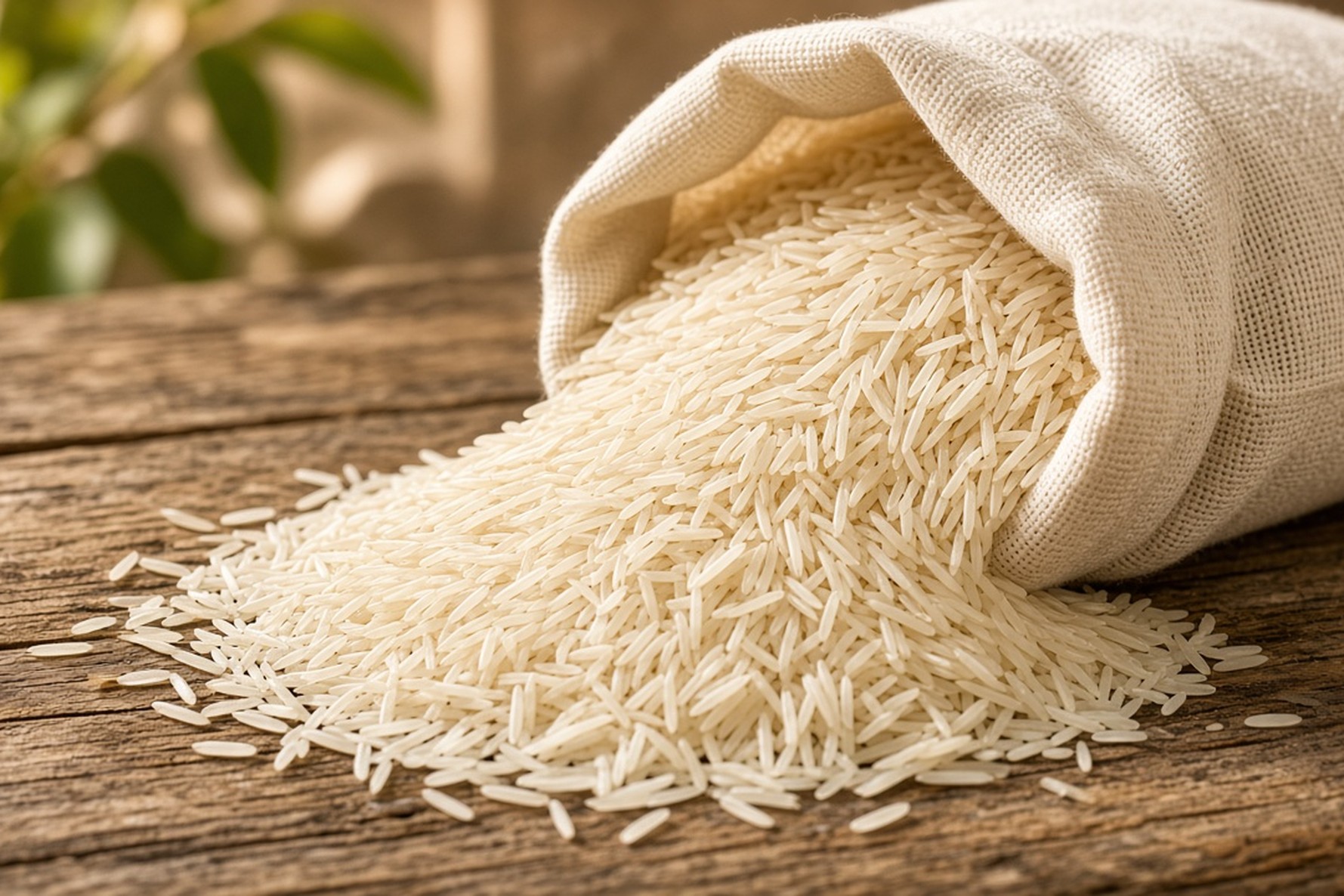
The labels “sangi” (stony) or “bony” refer to dense molecular starch bonding and high mechanical resistance under milling stress. Unlike some local types with porous micro-voids, Tarom Sangi has a solid, hard body. That rigidity limits breakage on husking rollers and whitener abrasive stones. Milled white grain is not glassy-transparent; it shows a semi-opaque ivory-to-bone sheen that seasoned buyers treat as the first visual authenticity cue.
2. Physicochemical profile, organoleptic indices, and cooking behaviour
International rice quality is not judged by appearance alone; it requires quantitative physicochemical values from accredited food laboratories. Tarom Sangi shows a favourable rheological balance that preserves grain integrity in industrial cookers and holds polo texture on catering lines.
Amylose-to-amylopectin ratio and softness
Rice starch comprises amylose (linear chains) and amylopectin (branched chains). Tarom Sangi amylose sits at 20–22%, placing it in the intermediate-amylose class. That level prevents stickiness and clumping typical of low-amylose East Asian types, while avoiding the dryness, coarseness, and brittleness of high-amylose rices (above 25%) after cooling. The biochemical balance keeps cooked grains soft, elastic, and tender even hours after service.
Gelatinization temperature and gel consistency
Starch gelatinization for Tarom Sangi falls in the intermediate band of 70–74 °C. That governs hot-water uptake and controlled endosperm swelling, reducing early grain rupture in hard-boil catering kettles. Laboratory gel consistency with alkali tests records 60–80 mm (soft gel). After heating and cooling, the starch does not firm excessively — delivering a light mouthfeel and easy digestion.
Volumetric behaviour, elongation ratio, and lasting aroma
Raw Tarom Sangi length measures 7.0–7.5 mm — long-grain under international trade criteria. During salt-water soaking and steaming (dam-keshidan), grains elongate markedly to 12–13 mm. Elongation ratio is about 1.7–1.8×, with limited width gain, producing a slender cooked presentation. The signature aroma compound is 2-acetyl-1-pyrroline, fixed at high concentration in the grain matrix and released on heat.
| Technical parameter / test index | Tarom Sangi range | Functional & commercial value for buyers |
|---|---|---|
| Raw grain length | 7.0–7.5 mm | Long-grain commercial class; premium pricing justification |
| Cooked grain length | 12.0–13.0 mm | Ceremonial elongation and plate volume |
| Length-to-width ratio | 3.3–3.5 | Slender needle profile without lateral thickening |
| Starch amylose | 20.0–22.5% | Separate grains after cooking; no mush; lasting softness |
| Gelatinization temperature | 70–74 °C | Even cooking; resistance to bursting in hard boil |
| Gel consistency | 60–80 mm (soft) | Tender polo; flavour retention without dry grain |
| Post-cleaning moisture | 13.0–14.0% | Less fissuring; safer warehouse shelf life |
| Grain colour spectrum | Opaque ivory tending to cream | Visual authenticity vs glassy hybrid or imported types |
3. Analytical comparison of Tarom Sangi with other northern Iranian rices
Bulk orders and trade contracts need a clear comparative map of Tarom Sangi against other Caspian varieties. Northern paddies in Gilan and Mazandaran split into traditional quality landraces and improved high-yield types.
Versus Tarom Hashemi and Dom-siah Sadri
Tarom Hashemi grain is slightly thicker, with farm yield roughly 10–15% higher per hectare than Tarom Sangi, but raw grain density measures lower. Dom-siah Sadri, rooted in historic Gilan paddies, sits in the ultra-elongated class, yet tall weak culms cause heavy lodging losses in wind and rain and greater sensitivity at threshing. Tarom Sangi offers a stable balance of milling recovery, lasting aroma, and physical grain strength — with less industrial breakage.
Versus high-yield types such as Fajr and Shiroudi
High-yield varieties were bred through genetic improvement to raise food security and cut import dependence. Fajr, linked to aromatic foreign lines, has an oily, glossy, glassy grain and decent elongation, but higher amylose and aroma that fades quickly after cooking. Shiroudi, widely planted in Mazandaran, lacks natural aroma and turns chalky and firmer once cooled. A 50–100% price premium for Tarom Sangi over high-yield types reflects a fundamental gap in texture value and end-consumer perception.
| Technical & market index | Tarom Sangi | Tarom Hashemi | Dom-siah Sadri | Fajr | Shiroudi |
|---|---|---|---|---|---|
| Primary growing region | Mazandaran (Fereydunkenar & Babol) | Mazandaran & Gilan | Gilan (Rasht & Astaneh) | Mazandaran & Golestan | Mazandaran (Sari & Neka) |
| Grain structure density | Bony, highly compact | Semi-hard, elongated | Brittle, long, fragile | Dense, glassy | Semi-chalky, matt |
| Aromatic compound intensity | Strong, lasting, warm | Strong and popular | Very strong, pronounced | Moderate, volatile | Negligible or neutral |
| Cooked texture shelf life | Excellent (up to 24 h) | Excellent (up to 12 h) | Excellent (up to 10 h) | Moderate (dries quickly) | Weak (brittle bite) |
| Yield (tonnes paddy/ha) | 3–3.5 | 3.5–4 | 2.5–3 | 5–5.5 | 6–6.5 |
| Wholesale price tier | Ultra-premium (luxury) | High and liquid | Very expensive | Mid-range, economical | Base, mass market |
4. National and international quality standards and physical defects
In formal and customs trade, rice quality is judged against allowed limits for visual defects and grain defects. For Tarom Sangi lots, Iranian National Standard ISIRI 127 (“Rice — Specifications and Test Methods”) and Codex Alimentarius rules form the technical inspection baseline.
Broken, head, and broken-fraction grains
Broken grain means pieces shorter than three-quarters of a whole kernel. Trade practice splits this into head rice (half to three-quarters length) and broken fractions (under half length). Advanced mills with grading screens and Trieur cylinders can hold export-grade Tarom Sangi broken content below 2.0%. Above 5% broken, a lot loses premium status and falls to ordinary consumption grades.
Chalky, green, yellow, and spotted grains
Chalky (“white belly”) grains show opaque, irregular starch zones formed under heat stress late in milk stage; they split quickly in boiling water and cloud the colander. Green grains signal premature harvest; yellow or black-tip grains indicate fermentation from delayed drying of wet paddy and storage fungi. Laser colour sorting (Sortex) before packing is essential for export contracts.
| Defect / damaged grain index | Premium export grade limit | Commercial grade-one limit | Standard laboratory method |
|---|---|---|---|
| Maximum free moisture | 13.5% | 14.0% | IR moisture balance or oven at 105 °C |
| Total broken (head + fines) | Max 2.0% | Max 5.0% | Gravimetric separation on slotted rice sieves |
| Chalky / opaque (>½ grain) | Max 1.0% | Max 3.0% | Visual grading of 100 g on a transluminator |
| Yellow, brown, burned grains | Max 0.1% | Max 0.5% | Hand count and machine-vision systems |
| Immature, thin, green grains | Max 0.5% | Max 1.5% | Wire screens plus visual analysis |
| Red bran streaks | Max 0.2% | Max 1.0% | Assessment of longitudinal bran lines on white grain |
| Organic foreign matter (straw, weed seed) | Absolute zero | Max 0.1% | Magnified visual check and pneumatic cleaning |
| Mineral foreign matter (sand, dust) | Absolute zero | Max 0.05% | Gravity destoner separation |
| Live insect / weevil infestation | Absolute zero | Absolute zero | Biological inspection of sample layers per quarantine standards |
5. Grain safety monitoring: heavy metals, toxins, and contaminants
Grain safety is a top priority at commercial ports worldwide. Contaminated paddy soil or irrigation water enters the food chain. Because Mazandaran paddies draw from highland watersheds, heavy-metal levels in authentic Tarom Sangi typically stay below international red-line thresholds.
Maximum heavy-metal tolerances under National Standard 12968 and Codex
- Inorganic arsenic: maximum 0.15 mg/kg (150 µg/kg) in white rice tissue.
- Lead: maximum 0.15 mg/kg for polished rice.
- Cadmium: maximum 0.06 mg/kg under Iranian and EU market rules.
Pesticide residues are checked by mass chromatography. Maximum total aflatoxin is 4 µg/kg (ppb). Fungal toxin control depends on moving wet paddy into industrial dryers within twenty-four hours of harvest.
| Chemical / biological contaminant | National max (mg/kg) | Codex max (mg/kg) | Instrumental method |
|---|---|---|---|
| Inorganic arsenic | 0.15 | 0.15 | ICP-MS |
| Lead | 0.15 | 0.20 | Graphite-furnace AAS |
| Cadmium | 0.06 | 0.10 | Electrothermal AAS |
| Total aflatoxin | 0.004 (4 ppb) | 0.005 (5 ppb) | HPLC with fluorescence |
| Ochratoxin A | 0.003 (3 ppb) | 0.005 (5 ppb) | LC-MS/MS |
| Insecticide residues | Per applicable MRL | Codex provisions | GC-MS/MS |
6. Modern laboratory and field methods for purity and fraud detection
The price gap between pure Tarom Sangi and high-yield or imported long-grain types raises blending incentives in informal channels. Professional buyers combine laboratory and field tests to confirm lot authenticity.
Authenticity assessment follows four sequential technical steps: DNA fingerprinting with microsatellite markers; alkali solubility in 1.7% potassium hydroxide after 23 hours at 30 °C; headspace gas chromatography for endogenous 2-acetyl-1-pyrroline versus chemical fragrance oils; and a controlled cooking trial to verify uniform softening and elongation.
Field tests and visual warehouse inspection
- Authentic lots show uniform bone-ivory, semi-opaque colour; glassy transparent grains signal Fajr or Shiroudi intrusion.
- Crushing a few grains or inspecting fracture faces under industrial magnification reveals Tarom Sangi’s dense crystalline body.
- Natural aroma releases when warm breath is blown over grains; artificially scented rice smells sharp and unstable.
7. Crop cycle, output volume, and modern milling in Mazandaran
From Farvardin (March–April), bed preparation and nursery seeding start under plastic. Ordibehesht (April–May) is transplanting; Khordad–Tir (May–July) cover tillering and weeding. Mordad (July–August) brings combine harvest and wet-paddy delivery to mills. Shahrivar–Aban (August–November) favour ratoon (second-cut) on suitable fields. Winter peaks standard storage, final screening, optical sorting, and commercial packing.
Main crop versus ratoon (second cut / donuj)
- Main crop (summer harvest): cut in Mordad; denser, fuller grains with highest stability in industrial husking.
- Ratoon / second cut (autumn harvest): after Mordad harvest, stubble regrows without new transplanting; richer aroma and very tender texture, but lower yield and prices 20–30% higher.
Milling process and optical sorting
Harvested paddy holds 20–25% moisture and must enter industrial dryers with indirect burners immediately so that over 48–72 hours, at a maximum of 40 °C, moisture reaches a safe 13.5%. After husking and polishing, grain passes vibrating screens and rotating cylinders; then optical spectrometric sorters remove spotted, yellow, and green kernels and lift lot purity above 99.8%.
8. Price discovery and commercial economics of Tarom Sangi
Wholesale quotes for Tarom Sangi in Mazandaran track quality components, crop timing, and sorting cost.
Grain resting and the “aged rice” concept
Freshly milled “new” rice still has raw starch structure and higher mush risk. Proper warehouse rest for at least two to four months stabilizes structural water and strengthens cell walls. Rested, aged Tarom Sangi always trades above freshly harvested lots.
Effect of screening grade and cleaning on lot value
- Single-screen rice: 5–8% broken; suited to institutions and ordinary catering.
- Double-screen cleaned: 2.5–3.5% head rice; standard home and restaurant grade.
- Triple-screen Sortex: 0–1% breakage; baseline for export lots and top quotes.
Price floors usually form in late Mordad and early Shahrivar, then trend upward from mid-autumn. Buyers seeking pure Mazandaran Tarom Sangi with minimal intermediaries can register technical specs and tonnage on Iranco.
9. Target export markets, consumer behaviour, and competitive edge
International Tarom Sangi trade focuses on luxury destinations, quality-sensitive consumers, and top restaurants. Competitive position rests on distinctive aroma and texture.
GCC markets
The UAE, Oman, Qatar, and Kuwait are major long-grain importers. Mass volume is dominated by Indian and Pakistani basmati, yet demand for traditional aromatic polo from local Arab households, royal catering, and five-star hotels remains steady.
Diaspora markets in Europe and North America
Multi-million Iranian and broader Middle Eastern communities in Germany, Sweden, the UK, and Canada sustain loyal demand. The main challenge is compliance with strict EU food-safety rules.
Russian Federation and CIS markets
Links from Iran’s northern ports (Anzali, Amirabad, Noshahr) to Astrakhan and Makhachkala create a strong logistics advantage. Organic positioning and non-GMO messaging are effective competitive tools.
| Destination market | Demand & value-add | Preferred pack weight & type | Entry sensitivities & rules | Incumbent competitors |
|---|---|---|---|---|
| United Arab Emirates | High — affluent buyers & hotels | 5 & 10 kg multi-layer odour-barrier bags | ESMA & Halal certificate | Indian Basmati 1121 |
| Iraq (central & Kurdistan) | Volume-led, growing | 10 & 20 kg moisture-proof canvas-style bags | Border inspection certificate & Arabic label | Khuzestan Anbarboo & Pakistani basmati |
| Germany & Schengen | Steady — diaspora demand | 1 & 5 kg full vacuum packs | EU pesticide residue limits | Thai jasmine & premium basmati |
| Russian Federation | Rising fast | 5 & 10 kg durable polymer bags | Rosselkhoznadzor | Krasnodar round-grain & Indian rice |
| Canada | Steady with high purchasing power | 10 kg zip-lock bags | CFIA food inspection | Export basmati from Pakistan & India |
10. Tariff regimes, trade documents, and international logistics
Harmonized System (HS) tariff codes
- 1006.30.00: Semi-milled or wholly milled rice — primary clearance code for white Tarom Sangi.
- 1006.20.00: Husked (brown) Tarom Sangi rice.
- 1006.40.00: Broken rice, fines, and secondary head fractions.
Essential commercial documents for the consignment
- Export phytosanitary certificate from the Plant Protection Organization
- Quality and health analysis certificate from laboratories approved by the Food and Drug Administration
- Certificate of origin endorsed by the Chamber of Commerce
- Packing list and commercial invoice
- Third-party inspection certificate at the origin customs office
Export packaging technologies and transport-chain control
- Vacuum packaging: five-layer polymer films (polyamide/polyethylene).
- Modified atmosphere: 70% carbon dioxide and 30% nitrogen.
- Multi-layer zip bags with canvas-style wrap: traditional look with impermeable inner liner.
In container transit, liner bags and at least 10–15 silica-gel desiccant hanging packs at the container roof are required to counter container rain. Pallets should stand at least 20 cm clear of the walls.
11. Importer checklist before placing an order
- State the exact product name “Mazandaran white Tarom Sangi rice” on the proforma; avoid generic titles
- Set a numeric broken-grain ceiling (e.g. max 1.5% or 3.0%)
- Require minimum 97% lot purity with the right to DNA fingerprinting
- Specify crop year, harvest season (main crop or ratoon), and milling age not exceeding twelve months
- Mandate optical sorting, multi-stage cleaning, and magnetic destoning
- Cap moisture at 13.5% maximum
- Obtain two sealed 3 kg reference sample packs
- Require heavy-metal and aflatoxin certificates from an ISO 17025 laboratory
- Define packaging material, thickness, dimensions, and weight tolerance
- Validate capacity for stable supply across successive parcels
- Issue container disinfection and safe palletizing instructions
- Clarify Incoterms and document-release timing
12. What information should you send for an accurate price?
- Product type and origin (Fereydunkenar or Babol)
- Harvest round: summer main crop or autumn ratoon
- Quality grade and broken percentage
- Industrial processing: cleaning, laser sorting, single or double polish
- Pack type and weight (1, 5, 10, or 20 kg)
- Total tonnage and parcel delivery schedule
- Final destination country/port and transport mode
- Trade terms and Incoterms
- Requested tests: DNA, pesticides, heavy metals, and aflatoxin
13. A reliable Tarom Sangi supply path from Iranian paddies via Iranco
In premium cereal trade, the difference between two offers is not price alone. Physical grain uniformity, genetic purity, absence of hidden defects, stable cooking behaviour, and on-time delivery determine whether a contract is profitable. Because of its premium structure and strong demand, Tarom Sangi sits at the centre of authenticity concerns.
Iranco is a specialist platform linking commercial buyers with Iran’s food production and processing sector. It enables Tarom Sangi purchase requests built around the buyer’s technical criteria. Traders, importers, and hypermarket procurement teams can submit crop region, breakage grade, toxicology tests, and packaging structure as a commercial request so authentic Mazandaran mill options can be reviewed in a structured way.
14. Analytical summary
Tarom Sangi holds a premium place in Iran’s quality cereal basket, balancing rheological indices, ~1.8× elongation, natural aroma from 2-acetyl-1-pyrroline, and lasting cooked texture. Its distinction is starch density and bony structure that raise milling breakage resistance and stabilize cooked output. Successful entry into high-value regional and European destinations requires DNA molecular tests, pesticide control to international standards, and packaging systems that restrain moisture and oxygen. For importers and procurement managers, precise contract specs, continuous sample verification, and transparent supply chains are the main levers for commercial value from this Iranian product.
15. Frequently asked questions
Why does Tarom Sangi price higher than other Tarom types?
The premium reflects lower yield (about 3–3.5 tonnes/ha), sensitivity to wind and pests, and high grain density that delivers distinctive aroma and cooking. Ceremonial demand and weight loss from precise sorting also lift quotes.
What is the core difference between Tarom Sangi and Tarom Hashemi?
Tarom Sangi has denser, bonier grains with a milky-ivory background and higher breakage resistance. Tarom Hashemi is slightly more elongated and thicker.
How long does Tarom Sangi’s natural aroma last?
In standard multi-layer, vacuum, or modified-atmosphere packs below 20 °C without humidity, natural scent lasts up to 24 months. Traditional jute packs can lose that aroma within about 6 months.
How can buyers source pure Tarom Sangi directly from Mazandaran paddies?
Buyers first define technical indices — breakage grade, genetic purity, pack type, and lab tests — then can submit them via Iranco so supply options from modern Mazandaran mills can be reviewed.
How does main-crop Tarom Sangi differ from ratoon quality?
Mordad main crop has denser grains, lower breakage, and better fitness for long packaging life. Autumn ratoon has richer aroma and very tender texture, but limited supply and higher price.
What is the most reliable packaging for ocean export lots?
Vacuum packs in five-layer polymer film or modified atmosphere with inert gas, plus moisture absorbers in the container, prevent container rain and fungal spoilage.
What information is needed for an accurate price and formal proforma?
Order volume, allowed broken percentage, pack type and material, destination country, and Incoterms delivery terms are essential. Iranco also quotes on the same information set.
Does Tarom Sangi dry out after cooking and cooling for several hours?
No. With amylose balance (20–22%) and soft gel consistency, starch retains moisture structure; even after several hours, grains stay separate and tender.
Featured Products




Related Articles



