 Iranco Magazine Team
Specialist review of ecology, cooking and aroma traits, laboratory authenticity tests, packaging standards, supply-chain analysis and export opportunities for Tarom Deylamani rice
Export Guide · Tarom Deylamani Rice
Tarom Deylamani Rice: Specifications, Authenticity Testing and Wholesale Capacity in Iran and Export Markets
Specialist review of ecology, cooking and aroma traits, laboratory authenticity tests, packaging standards, supply-chain analysis and export opportunities for Tarom Deylamani rice.
Introduction
Tarom Deylamani rice is one of the most valuable and oldest native Tarom landraces on the western Alborz foothills — a balance of strong aroma and reliable cooked elongation. This guide analyses biochemical specs, structural differences versus high-yield types, fraud detection in bulk trades, ISIRI Standard 127 requirements and commercial capacity for wholesale buyers and exporters.
Limited paddy land along the southern Caspian coast and rising demand for aromatic grains give the Tarom family a unique position. High-yield varieties eased food-security volume pressure, yet premium and banquet demand still centres on natural aroma and soft texture after cooling. Pure Deylamani from west Mazandaran and east Gilan foothills and plains underpinned national breeding programmes.
High wholesale premiums attract blending of large tonnages with cheaper types. Successful entry for traders, catering and exporters requires lab data, starch knowledge, moisture and impurity standards and an integrated supply chain. Sustainable Middle East and Europe export margins need barrier packaging, credible certificates and fewer non-specialist intermediaries at sorting points.
1. Ecological origin, agronomic history and place in northern paddies
Deylamani belongs to foothill ecotypes of the native Tarom landrace, adapted over centuries to western Alborz slopes. Upstream Deylaman and lower paddies of Ramsar, Tonekabon, Chalus and Nowshahr in west Mazandaran are the traditional geographic heartlands. Organic-rich alluvial soils, cool snowmelt irrigation and mild day–night swings lengthen grain filling and allow accumulation of free fatty acids and aromatics in aleurone and endosperm.
In the 1980s (1360s SH) Iran’s Rice Research Institute selected this landrace as the female parent in crosses. The result was “Shiroudi”: Deylamani (cooking, elongation, aroma) × high-yield “Khazar” (lodging resistance, short stature, tonnage). Pure Deylamani nonetheless retains distinct organoleptic traits versus later hybrids.
Pure-stand yield averages about 3–3.5 t paddy/ha versus 7–8 t for improved types. Tall stems and slender internodes make plants prone to lodging in summer wind and rain. That yield gap and labour-intensive harvest have shrunk acreage versus Tarom Hashemi and shifted Deylamani into a niche, ultra-premium wholesale segment.
2. Physical specs, grain morphology and geometry
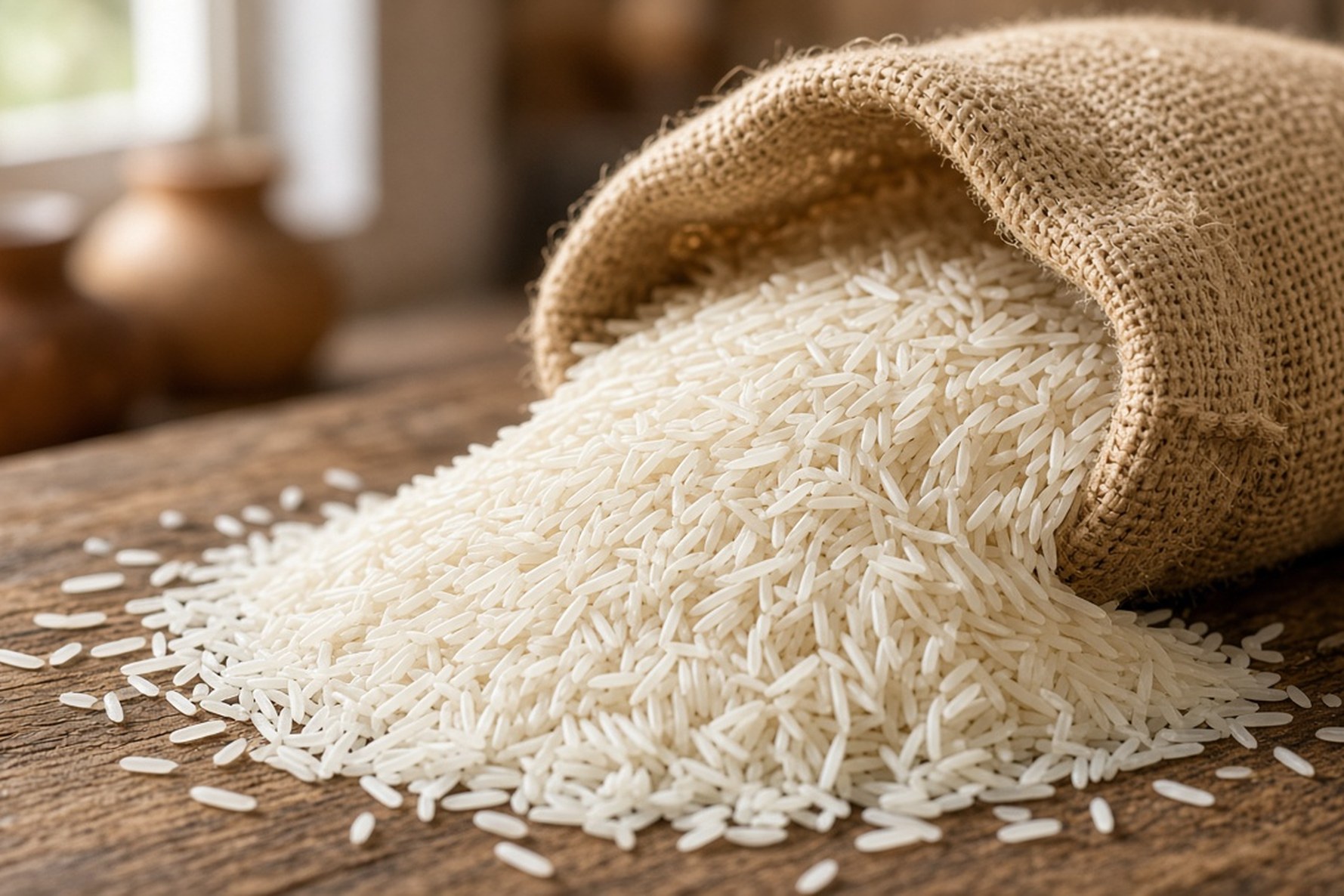
Grains are bony, very slender long-grains. After husking, whitening and polish the colour is matte ivory to light milky cream — never the glassy sheen of many imported long-grains. The tip has a delicate narrow curve that local millers call pen- or needle-shaped.
| Geometric / physical index | Standard range | Technical meaning |
|---|---|---|
| Raw grain length | 7.6–8.1 mm | Full physiological fill; no wrinkling |
| Raw grain width | 1.8–1.9 mm | Balanced dimensions; avoids thick grain |
| Length/width ratio | 4.0–4.2 | Very slender class (Codex cereals) |
| Raw thickness | 1.5–1.6 mm | Dense endosperm; lower milling breakage |
| Thousand-grain weight | 21–23 g | Kernel fill on the panicle |
| Appearance colour | Matte ivory / bony white | No storage heat yellowing |
| Surface chalkiness | < 5% | Homogeneous texture; steaming resilience |
Industrial micrometre sampling shows high dimensional uniformity. Kernels lack large air voids; dense starch centres resist breakage in abrasion/polish and support even hot-water uptake in cooking.
3. Biochemistry, gelatinisation kinetics and cooking behaviour
Pilaf and chelo quality track starch chemistry, viscosity behaviour and release of volatile fatty acids. Market value of Deylamani is grounded in the laboratory ranges below.
| Biochemical / cooking variable | Acceptance range | Cooking outcome |
|---|---|---|
| Amylose | 21.0–22.5% | Full grain separation; low stickiness |
| Gelatinisation temperature | 69–74 °C | Balanced cook time; less belly bursting |
| Gel consistency | 65–75 mm (soft) | Softness retained hours after cooling |
| Cooked grain length | 12.5–13.5 mm | Elongation ratio 1.65–1.75× |
| Elongation ratio | ≥ 1.65 | Length gain without abnormal thickening |
| 2-acetyl-1-pyrroline | > 500 ng/g | Natural lasting aroma while steaming |
Amylose above 25% yields dry, early-hardening grains; below 18% they become wet and sticky. The 21–22.5% window keeps fibre walls intact in boiling expansion while leaving a tender bite. Standard process: about two hours soak in 10% salt water, then boil so starch cells swell without membrane rupture — raw ~7.8 mm readily exceeds 13 mm cooked. Specialty catering buyers can register supply requests on Iranco against lab sheets and physical samples.
4. Technical and field methods for authenticity and fraud monitoring
Price gaps between elite aromatic lots and high-yield types incentivise blending in traditional wholesale yards. Differentiation methods are essential for QA and chain procurement.
Versus Shiroudi
The main bulk-buying challenge is separating Deylamani from Shiroudi (Deylamani × Khazar), which is geometrically close to the maternal parent. Three keys: Shiroudi is dull chalky white while Deylamani is crystalline ivory; Shiroudi has weak or no aroma even when fresh, while Deylamani releases a sweet diffuse scent on hand-rub or warm breath; Shiroudi is slightly thicker with a less sharp tip slope.
Versus Fajr
Fajr is a high-yield needle type with a sword-like shape, glassier and more translucent than Deylamani, ending in a clear oblique tip. Its aroma is cool and grassy — sharply different from Deylamani’s warm pleasant perfume.
Yard field tests
- Breath / hand-rub: Warm 100 g in a jar or palms; authentic scent is mild and lasting. Synthetic essence is sharp, soapy and uneven and washes off in cold water.
- Bite resistance: Authentic kernels crack hard with a clear sound; immature/blended lots powder without resistance.
- Fridge staling test: Cooked rice 24 h at 4 °C then warm to room temperature — Deylamani recovers a creamy soft bite; blended high-yield rice stays dry and brittle.
- Micrometre distribution: A pure 50-grain set shows a normal curve at 7.6–8.1 mm; hand blends show two distribution peaks.
5. Laboratory tests, contaminant limits and ISIRI Standard 127
Secure commercial-scale trades rely on Iran National Standard 127 (“Rice — specifications and test methods”, 7th revision, 1399 SH / 2020–21).
| Parameter | Grade 1 limit | Grade 2 limit | Reference method |
|---|---|---|---|
| Moisture | 14.5% | 14.5% | Oven 130 °C |
| Broken grains | max 2.0% | max 5.0% | Slotted sieve |
| Chalky / immature | max 2.0% | max 4.0% | Polarised light |
| Heat damage | max 0.5% | max 1.5% | Endosperm colour change |
| Insect-damaged | < 0.1% | < 0.5% | Lab magnification |
| Mineral foreign matter | max 0.02% | max 0.05% | Sedimentation gravity |
| Plant impurities | max 0.1% | max 0.3% | Standard cleaning |
Contaminant ceilings
- Lead max 0.15 mg/kg · Cadmium max 0.06 mg/kg · Total inorganic arsenic max 0.2 mg/kg
- Total aflatoxins max 30 µg/kg · Aflatoxin B1 max 5 µg/kg
- Pesticide MRL: no excess of organophosphates (e.g. diazinon) or systemic fungicides (e.g. tricyclazole) beyond Codex ranges
An accredited COA aligned with Iran FDA, together with a certificate of origin, forms the core transit documentation set.
6. Wholesale market mechanics, pricing cycles and processing hubs
Authentic Iranian rice wholesale tracks seasonal harvest, milling yield and import policy. Deylamani transplanting starts in Ordibehesht (April–May); peak harvest is late Mordad–Shahrivar (August–September). Main processing, optical sorting and wholesale hubs are Tonekabon, Chalus, Babol, Fereydunkenar and Amol.
Seasonal price phases
- Phase 1 (autumn — peak supply): Mehr–Aban — best window for integrated supply contracts at the year’s lowest floor.
- Phase 2 (winter — catering demand): Azar–late Bahman — Nowruz and hotel/restaurant buying lifts demand.
- Phase 3 (spring / early summer — warehouse deficit): Northern stocks empty and cash prices peak seasonally.
Lot price drivers
- Post-optical breakage: 0–2% (double optical sort) can trade ~25% above 5% broken lots.
- ~13% equilibrated moisture earns a premium for stable warehouse weight.
- Genetic purity and aroma uniformity under machine vision.
- Gentle drying below 40 °C can raise whole-grain yield by up to ~15%.
7. Packaging technology, warehouse engineering and aroma shelf life
Unsaturated fatty acids and volatile essences expose Deylamani to oxidation, moisture uptake and rice weevil (Sitophilus oryzae) attack. Traditional jute bags cut aroma life below four months.
- Woven PP with waterproof laminate: 10, 25 and 50 kg for high tonnage land routes.
- Cotton/linen with nylon liner: 5 and 10 kg for hypermarkets with heritage look.
- Multi-layer PA/PE vacuum: 1, 2 and 5 kg export; aroma up to two years without phosphine.
- MAP: Nitrogen or CO₂ injection to keep headspace O₂ below 1%.
| Pack structure | Mechanical strength | Permeability | Aroma life | Primary use |
|---|---|---|---|---|
| Plain jute | Medium | Very high | < 90 days | Traditional trade; fast consumption |
| Laminated PP | High | Low moisture / medium gas | 6–8 months | National wholesale; regional export |
| Zip laminated fabric | High | Medium gas / low moisture | 10–12 months | Premium retail |
| Multi-layer vacuum | Very high in carton | Barrier | 18–24 months | Air/sea export to Europe & Canada |
Warehouses must be roofed, dry, dark and filter-ventilated. Target 15–18 °C and RH below 55%. Bags on plastic pallets ≥15 cm off the floor and ~0.5 m from walls so convective airflow prevents sweating.
8. Export target markets, HS codes and quarantine requirements
Iran is a net rice importer overall, yet premium aromatic outflows earn strong FX margins. Rice sits under HS chapter 1006:
- 10061000 — paddy
- 10062000 — cargo / brown
- 100630 — semi-milled or wholly milled, even polished
- 10063020 — wholly milled polished (main code for grade-1 sorted Tarom)
- 10064000 — broken rice
| Destination | Demand profile | Pack & language | Quarantine / standards |
|---|---|---|---|
| Iraq (Kurdistan) | Aromatic long-grain | 10 & 25 kg Arabic | Health cert; pesticide compliance |
| UAE | Hotels, restaurants, re-export | 5 & 10 kg laminate | Dubai municipality health approval |
| Germany & Netherlands | Diaspora & organic grocery | Vacuum 1 & 2 kg | Strict MRL & heavy metals |
| Canada | Ethnic retail | Master cartons 5 kg | EN/FR bilingual labelling |
| Kuwait & Qatar | Banquet catering | Handled zip bags | Halal & microbial tests |
Mandatory export documents
- Goods declaration in Customs single window (EPL) under the correct tariff line
- Phytosanitary certificate from provincial Plant Protection
- Food health certificate from University of Medical Sciences FDA (non-GMO & contaminants)
- Certificate of origin from Iran Chamber of Commerce
- Transit B/L and counterparty-confirmed commercial invoice
9. Comparative table versus other market rices
| Type | Raw (mm) | Cooked (mm) | Aroma persistence | Cold texture | Cost tier |
|---|---|---|---|---|---|
| Tarom Deylamani | 7.6–8.1 | 12.5–13.5 | Very strong natural | Excellent | Ultra-premium |
| Tarom Hashemi | 7.5–7.8 | 12.0–12.8 | Strong | Very good | Premium volume |
| Sadri Domsiah | 7.8–8.3 | 13.0–14.5 | Strong smoky | Good–medium | Costly limited supply |
| Shiroudi | 7.1–7.3 | 11.5–12.5 | Weak–neutral | Medium | Institutional economy |
| Fajr needle | 7.5–8.0 | 10.5–11.5 | Mild oily | Medium–firm | Mid volume restaurant |
| Imported basmati | 8.2–8.5 | 14.5–16.5 | Neutral / industrial essence | Weak | Lowest cost tier |
Deylamani’s balanced elongation, tenderness and lasting aroma make it unmatched for ceremonial service. Imported basmati elongates more but dries after plating, reducing hospitality value in traditional restaurants.
10. Food-processing uses and banquet catering
- Luxury catering & five-star hotels: authentic chelo, banquet kebabs and formal events needing full grain separation and heater stability.
- Specialty gluten-free flour: optical-sort broken kernels for dietary bakery.
- Infant and rice desserts: easy digestion and soft organic pudding texture.
- Ethnic restaurants & ecotourism: northern moulded kateh with strong ambient aroma.
Ten-step wholesale buyer checklist
- Set grade and max breakage (≤1.5% super-premium; <3% commercial).
- Sealed 500 g homogeneous pre-shipment sample.
- Genetic purity check vs Shiroudi and Fajr.
- Contract moisture 12.5–13.5%.
- Specify “double cleaning + laser optical sorting” on the proforma.
- Real kitchen cook test; aroma and softness after 12 hours.
- Bag material and 1.5 m drop seam strength.
- Validate MRL, heavy metals and pesticide COA.
- Verify supplier line capacity for steady tonnage quality.
- Clarify Incoterms and cargo insurance.
Data needed for an accurate proforma
Sourcing Tarom Deylamani via Iranco
High-tonnage northern premium rice faces fragmented traditional mills, plot-to-plot quality variance and blend risk with cheaper high-yield types. In large contracts, grain-length stability, breakage grade, optimal moisture and aroma life define the deal — not only the headline price. Iranco connects companies, exporters and wholesale buyers directly to suppliers with modern optical lines so orders can be placed on technical specs, breakage class, pack format and delivery point, then quality review, homogeneous samples and quotations proceed on agreed criteria.
Conclusion
Tarom Deylamani is a valued aromatic northern landrace whose 21–22.5% amylose and soft gel consistency balance grain separation with tender texture. Cooked length beyond 13 mm and natural 2AP aroma make it a ceremonial and regional premium choice. Sustainable margins require ISIRI 127 controls, moisture under 14%, vacuum or laminate packaging and accredited lab tracking. Engineered supply chains and transparent platforms minimise trade risk on this ultra-premium grain.
Frequently asked questions
1. Key physical difference versus Shiroudi?
Deylamani is matte ivory, crystalline and strongly aromatic; Shiroudi is dull chalky white, nearly scentless on hand-rub and slightly thicker.
2. What is the cooked elongation ratio?
Raw 7.6–8.1 mm reaches 12.5–13.5 mm after proper salt soak and steaming — about 1.65–1.75×.
3. Why does cooled pilaf stay soft?
Balanced ~21.5% amylose and soft gel slow starch retrogradation, so texture does not harden and crumble within a few hours.
4. Best pack for containerised export?
Multi-layer polyamide vacuum bags in 5-ply cartons on strapped pallets to control oxygen and humidity swings.
5. Health documents for European export?
Phytosanitary certificate, FDA health analysis with MRL and heavy metals (Pb, Cd, As), plus non-GMO attestation.
6. Why strong demand in Iraqi Kurdistan?
Traditional preference for strong aroma, soft texture and separated grains — Iranian Tarom is preferred over Indian basmati.
7. How to buy direct from northern mills?
Draft breakage grade, cleaning, tonnage and pack specs, then register via Iranco for access to vetted Mazandaran suppliers.
8. What data for an accurate wholesale quote?
Allowed breakage, bag weight/material, tonnes, Incoterms delivery point and requested tests — the same detail Iranco quotation requests use.
Featured Products




Related Articles



