 Iranco Magazine Team
Quality assessment, commercial grading, physicochemical parameters, international hygiene rules, container logistics and supply risk management
Export Guide · Estamaran Dates · Wholesale · Quality Standards
Export Sayer (Estamaran) Dates: Wholesale Buying Standards & Buyer Requirements
A comprehensive guide to quality assessment, commercial grading, physicochemical parameters, international hygiene rules, container logistics, and risk management in bulk Sayer date supply from Iran.
This strategic report provides a comprehensive analysis of Iranian Sayer (Estamaran) dates as one of the country’s most important dried-fruit export items. A review of physicochemical characteristics, international grading methods, modern applications in food processing, hygiene standards, bulk packaging, and commercial opportunities in key markets gives importers and bulk buyers the depth of insight needed to place orders with full confidence.
| Key indicator | Value or technical characteristic | Functional importance in the value chain |
|---|---|---|
| Total fruit sugar content | 70 to 75% of dry matter | Rich source of natural reducing sugars for sugar replacement |
| Standard moisture | Under 16 to 18% | Semi-dry structure with biological stability and long shelf life |
| Share of national date exports | About 40 to 45% | Iran’s best-selling and most strategic export date variety |
| Shelf life in a dry warehouse | 18 to 24 months | Eliminates freezing costs and supports long-haul ocean transit |
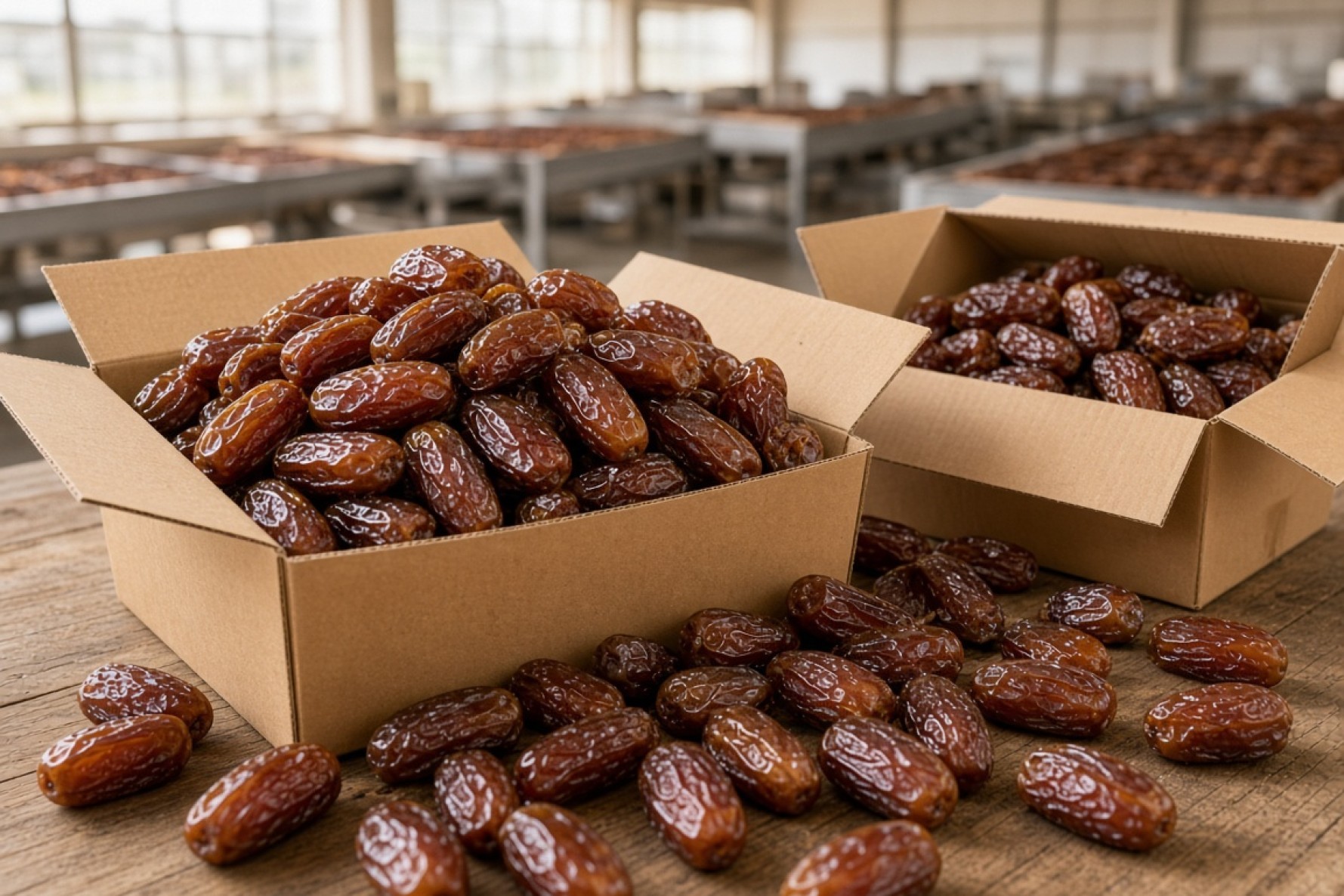
Modern shifts in the global food industry have sharply increased demand for non-artificial sweeteners, health-oriented products, and clean-label formulations. Leading plants in snack bars, confectionery, chocolate, breakfast cereals, bakery, and dairy are working to replace refined white sugar and high-fructose corn syrup with organic fruit derivatives. Among plant-based sources worldwide, Iranian Sayer dates — also known as Estamaran — hold a prominent position. With abundant natural sugar, a thin, adherent skin, optimal moisture, and exceptional ease of pit removal, the fruit is an outstanding raw material for continuous industrial processing lines.
Unlike soft varieties such as Mazafati or Kalute, which are highly sensitive to temperature swings and require an unbroken cold chain, Sayer belongs to the semi-dry fruit category. This inherent structure removes the risk of souring from osmophilic yeast activity and makes long container voyages economically and qualitatively justified. Successful bulk purchasing and industrial use, however, depend on precise quality-control parameters, familiarity with count-per-pound grading, awareness of five-ply export carton standards, and the entry requirements of target markets. Grounded in technical data, this article is a direct guide to selecting, inspecting, and purchasing this commercial commodity successfully.
1. Commercial position and production geography of Sayer dates in Iran
Iran is one of the world’s largest centres of date production, with more than 1.3 million tonnes harvested annually from the country’s palm groves. A large share of this capacity consists of semi-dry varieties grown in the south-west. Within that framework, Sayer is the dominant and characteristic date of Khuzestan Province’s plains. Agricultural data show that more than 70% of Khuzestan’s productive palm area — and over 90% of the province’s total date output — is devoted to Sayer.
Productive hubs and climatic ecosystem
The counties of Shadegan, Karun, Ahvaz, Abadan, Khorramshahr, Darkhoveyn, and Bavi are the concentrated centres of Sayer palm cultivation in Iran. The Karun, Marun, and Jarahi rivers, together with Khuzestan’s distinctive climate — long summers above 45°C and hot winds known as “sharji” — create exceptional conditions for completing fruit development. Sayer dates progress through their natural biological cycle on the palm from khalal and kharak through rutab to full maturity (tamar). During this period the fruit naturally sheds excess water and develops a firm texture with stable moisture.
Harvest begins in the first ten days of Shahrivar (late August / early September) and continues through mid-Mehr (early October). Picked fruit is moved to local collection workshops and mechanised sorting centres. Between 120,000 and 160,000 tonnes of Sayer dates are produced in the region each year, with the majority destined for foreign markets.
Structural advantages in export trade
The strategic value of Sayer dates in global markets stems from their functional characteristics:
- Storage in ventilated warehouses without continuous reliance on costly sub-zero cold storage.
- High yield in manual and mechanical pitting because flesh is not tightly bound to the pit.
- High soluble sugar content that maximises syrup extraction efficiency and homogeneous paste production.
Sayer accounts for roughly 40 to 45% of Iran’s total date export volume by weight and ranks first in annual foreign-exchange earnings among export varieties. That sustained position has made Estamaran the first choice of international buyers of industrial dates.
2. Physicochemical and biochemical profile of Sayer dates
Sayer fruit has an oval shape tending toward rectangular. Length is typically 2.5 to 4.5 cm and diameter 1.5 to 2.5 cm. At full maturity, colour ranges from light amber to dark brown and sometimes deep maroon. The outer skin is thin, adheres appropriately to the flesh, and — unlike dry varieties — does not shatter or powder under mechanical storage pressure.
Sugar balance and nutritional value in fruit tissue
More than 70 to 75% of Sayer dry tissue consists of natural sugars. A key point in the chemical analysis of this variety is the predominance of reducing sugars — fructose and glucose — over sucrose. Sucrose in whole fruit is minimal, which prevents hard crystallisation in derived products. The fructose in the tissue dissolves readily and, combined with water, gives the finished product a uniform, caramel-like texture.
| Chemical and nutritional parameter | Standard range per 100 g | Performance on food industry lines |
|---|---|---|
| Tissue moisture | 15 to 18% | Defines texture class, water activity, and shelf life |
| Total sugars | 68 to 75 g | Natural sweetness and high Brix |
| Reducing sugars (fructose and glucose) | 60 to 68 g | Prevents crystallisation; develops caramel aroma |
| Sucrose (non-reducing sugar) | Under 3 to 5 g | Easy absorption; excellent compatibility with paste systems |
| Total dietary fibre | 7 to 9.5 g | Texture builder and viscosity improver |
| Crude protein | 2 to 2.5 g | Participates in Maillard reactions during baking |
| Total fat | Under 0.3 g | Excellent stability against oxidative spoilage |
| Potassium | 650 to 720 mg | Supports nutritional value claims in food supplements |
| Bioavailable iron | 2 to 2.7 mg | Supports health claims on packaging |
| Total ash | 1.5 to 2.2% | Indicator of mineral purity and absence of sand contamination |
3. Commercial grading system and count-per-pound measurement
In global dried-fruit markets, Sayer dates are traded under a recognised international standard based on “count per pound.” One pound equals 453.59 g; the fewer fruits in that weight, the larger, fleshier, and higher-quality the fruit is considered. Under this standard, Sayer is classified into five main commercial grades:
Super Select
Super Select is the largest and most premium Sayer grade. Count is at most 65 to 70 fruits per pound (equivalent to 140 to 155 per kilogram). Fruits are fully hand-selected, free of deep skin tears, without crystallisation, and uniform in size and dark-brown colour. This grade is purchased mainly for nut-mix consumption, hospitality, luxury gift packs, and direct retail in reputable supermarket chains.
Select
This grade covers 70 to 80, or at most 85, fruits per pound (equivalent to 160 to 185 per kilogram). The main difference from Super Select is slightly smaller fruit size, while flavour and appearance remain at a premium level. Consumer markets in Canada, Australia, and Western Europe are steady buyers of this grade for 500 g and 1 kg retail packs.
Grade B
Defined by a count of 85 to 95 fruits per pound (equivalent to 185 to 210 per kilogram). Fruit size is medium, and minor variation in darkness or lightness of colour is accepted. The product is widely used in economy packs and mixed dried-fruit assortments.
GAQ — Good Average Quality
This grade covers 95 to 110 or 115 fruits per pound (equivalent to 210 to 245 per kilogram). GAQ dates have sound tissue, optimal moisture, and no spoilage, but fruit size is classified as small. Traders and processing plants buy this grade for stuffing, chocolate coating, date chips, and high-volume confectionery use.
FAQ — Fair Average Quality
FAQ includes smaller fruit above 110 or 115 per pound (more than 250 per kilogram). Precise pound count is not applied in this grade. Fruits may show more severe wrinkling or partial skin separation, but flavour and sweetness remain full. This product is the primary feedstock for paste, industrial syrup, liquid sugar, and alcohol production plants.
| Commercial grade | Count per pound (with pit) | Count per kilogram (with pit) | Maximum allowed visual defects | Primary target use |
|---|---|---|---|---|
| Super Select | 65 to 70 | 140 to 155 | Max. 5% | Direct consumption; luxury retail packaging |
| Select | 70 to 80 | 160 to 185 | Max. 8% | Retail packs; hospitality tubes |
| Grade B | 85 to 95 | 185 to 210 | Max. 10% | General direct consumption and mixed dried fruit |
| GAQ | 95 to 110 | 210 to 245 | Max. 12% | Economy packs; stuffed-date processing |
| FAQ | Over 110 | Over 245 | Max. 15% | Paste, syrup, liquid sugar, and snack industries |
| Industrial (unlimited) | No count | Unlimited | Above 15% | Fermentation, vinegar, ethanol, and animal feed |
Supply forms: unpitted and pitted
Sayer dates are sold both unpitted and pitted. Pitted dates account for the majority of sales in European and American markets. Pit removal is done in two ways: manually with stainless-steel punches so the pit exits from the fruit end with minimal flesh damage and overall shape preserved; and continuous mechanical lines for very high industrial volumes. Pitted dates reduce waste freight costs and simplify injection into overseas production lines.
Buyers who wish to evaluate grades by count per pound or review pitted samples can submit a technical request through the Iranco portal so commercial coordination with specialised Khuzestan suppliers can proceed.
4. Sayer dates on advanced food industry processing lines
Physical characteristics of Sayer — moisture below 18%, mild acidity, cohesive fibrous structure, and high Brix — enable direct conversion into a wide range of value-added products. Using this raw material improves texture, retains internal moisture in finished goods, and eliminates chemical sweeteners.
Production of pure date paste
Under Iranian National Standard ISIRI 5720, date paste is a pure, homogeneous product obtained by mild steaming, complete removal of calyx and pit, chopping, and passing pulp through mesh filters. Because of its structural fibre and ideal fructose-to-glucose ratio, Sayer refines into a fully soft, elastic paste.
In protein bars, energy bars, and dense sports snacks, the product plays a dual role:
- Natural binder to stabilise protein powders, oats, and seeds without glucose syrup.
- High-fibre natural sweetener with a controlled glycaemic index that supports a No Added Sugar claim.
In biscuit and cake plants, Sayer date paste acts as a heat-resistant filling; its sugar structure does not break down under oven temperatures above 180°C, does not form bubbles, and keeps inner confectionery layers moist after packaging.
Diced / chopped dates
For diced dates, pitted Sayer fruit is cut on multi-blade mechanical cutters into uniform 5 to 10 mm cubes. The main challenge is adhesion of freshly cut surfaces. Processors apply a fine, imperceptible dusting of gluten-free rice flour or dextrose powder to achieve free-flowing pieces. The product is a fixed component of breakfast cereals, muesli, granola, chocolate truffles, and fancy bread fillings.
Date syrup and liquid sugar extraction
Industrial date syrup production follows ISIRI 5075 by dissolving the fruit’s soluble solids in hot water, filtering out pulp, and concentrating the extract in vacuum evaporators at low temperature. Economy FAQ grades and industrial Sayer are the best feedstock. Output syrup Brix exceeds 70%, with reducing sugars accounting for at least 58%.
At a more advanced stage, passing the extract through ion-exchange columns and activated-carbon beds removes colourants, pectin, and tannins to yield clear liquid sugar. Colourless and free of date aroma, at 72 to 75% Brix, it is a direct sugar substitute on ice-cream, soft-drink, sauce, and canned-product lines.
| Processed product | Preferred input grade | Key technical characteristic | Food industry end market |
|---|---|---|---|
| Date paste | Grade B, GAQ, and pitted | Moisture 18–22%; fully homogeneous; free of coarse fibre | Health-bar, biscuit, cake, and truffle makers |
| Diced dates | Select and GAQ pitted | Uniform cubes with rice-flour coating under 3% | Breakfast cereals, granola, and mixed dried fruit |
| Date syrup | FAQ grade and sorting waste | Brix above 70%; crystallisation-resistant; natural dark colour | Dairy, flavourings, halvah, and tahini-syrup production |
| Clear fruit liquid sugar | Third-grade industrial dates | Brix 72–75%; colourless; no dominant date flavour | Beverage, juice, compote, and jam plants |
| Fermented date vinegar | Grade 3 dates and flesh waste | Acetic acidity above 5%; mild fruit aroma | Sauce, pickle, seasoning, and household use |
5. Standards requirements, quality control, and laboratory test protocols
Exporting Sayer dates requires full compliance with Iranian National Standard ISIRI 285 (“Dates — Specifications and Test Methods”) and the Codex international standard Codex Stan 143. Before loading, buyers require a valid laboratory certificate of analysis (COA) against these indicators.
Maximum limits for physical and visual defects
Under the standards, Sayer fruits must be clean, whole, ripe, and free of excessive crushing, fungal decay residues, fermentation, and souring. Physical defects are calculated by weight percentage or by count percentage:
- Mechanical damage and severe skin tears: max. 5% in premium grade, max. 8% in Grade 1.
- Discoloured or immature fruit: max. 5% in premium, 10% in Grade 1.
- Damaged or unremoved calyx (in calyx-free sorted grades): max. 5 to 10%, subject to party agreement.
- Live pest contamination: absolute zero. Even one live insect at loading leads to rejection of the entire shipment at customs quarantine.
- Dead pest residues: max. zero to 2 per kilogram for premium and Grade 1 classes.
Chemical control parameters
Moisture is measured by vacuum-oven evaporation at 70°C to constant weight. Maximum standard moisture for Sayer is 18%. Higher moisture enables sugar hydrolysis and alcoholic fermentation and souring during transit.
Total ash must not exceed 2.5%, and acid-insoluble ash — indicating sand, dust, and suspended mineral contamination — must not exceed 0.1% by weight.
Microbiology and biosafety criteria
Because of low water activity, Sayer is inherently unfavourable for pathogenic bacterial growth; microbial load testing in accredited laboratories is nevertheless mandatory:
- Total aerobic mesophilic count: max. 10,000 colony-forming units per gram (cfu/g)
- Mould and yeast count: under 500 units per gram (European consignments often require under 100)
- Total coliforms: under 10 units per gram
- Escherichia coli: negative in 1 g
- Salmonella: negative in 25 g of test sample
Fumigation disinfection and residue limits
Harvested dates must be fumigated in standard processing chambers so that all storage pests, eggs, and insect larvae are fully eliminated. Formulated aluminium phosphide tablets that release phosphine gas have fully replaced methyl bromide. Fumigation duration and post-aeration time must be controlled precisely so that residual phosphine in date tissue remains below 0.01 mg/kg and within maximum residue limits (MRL).
| Quality test | Reference standard | Maximum or minimum allowed | Importance in international trade |
|---|---|---|---|
| Tissue moisture % | ISIRI 285 / vacuum oven | Max. 18% | Prevents fungal fermentation and mould growth |
| Acid-insoluble ash | Acid gravimetric method | Max. 0.1% | Measures cleanliness and absence of orchard dust |
| Mould and yeast | ISIRI 997 / Petri dish culture | Max. 500 units/g | Prevents quality loss and product spoilage |
| Salmonella | Selective biochemical culture | Negative in 25 g | Hygiene clearance requirements at entry ports |
| Phosphine gas residue | Gas chromatography | Under 0.01 mg/kg | Consumer safety and customs compliance |
6. International customs classification and HS Codes
Global clearance and transit of dates are registered under Chapter 8 of the World Customs Organization Harmonized System. The general base code for dates is 080410, covering fresh or dried products.
In the Islamic Republic of Iran’s customs, eight-digit sub-headings have been assigned for recognised varieties to enable precise export monitoring and statistics:
| Customs tariff code (HS Code) | Official goods description in the tariff | Use in trade and clearance |
|---|---|---|
| 08041010 | Estamaran (Sayer) dates | Primary declaration code for unpitted and pitted Sayer consignments |
| 08041090 | Other dates not elsewhere specified | For secondary varieties without an independent tariff line |
| 200899 | Pulp and fruit preparations | Used by some countries to clear bulk pure date paste |
| 170290 | Liquid sugar, invert sugar, and syrups | Assigned to date syrup and refined industrial liquid sugar |
When preparing export declarations, exporters must enter the correct code 08041010; incorrect declaration under general codes can create problems for tax-refund calculations, export statistics, and certificates of origin.
7. Bulk packaging engineering, export cartons, and palletising
Bulk packaging for Sayer dates is not only a carrier; it is the product’s defence against stacking hydrostatic pressure, moisture exchange with the transit environment, and re-infestation by insects. All food-contact packaging items must meet food-grade hygiene standards.
Structure of bulk master cartons
The most common and standard bulk export format is telescopic cartons (separate lid and base) or one-piece five-ply cartons with net weights of 5 kg and 10 kg. Carton physical structure should meet these parameters:
- Box compression strength (BCT) and edge crush (ECT): Board must use heavy virgin kraft liners so stacking strength of at least 5 to 6 cartons high is retained in the container at relative humidity up to 80%.
- Food-grade polyethylene inner liner: A light polyethylene bag of 40 to 60 microns inside the carton is essential. Dates are loaded into the bag and edges are folded or heat-sealed to block dust ingress and tissue moisture swing.
- Modified atmosphere packaging (MAP) and vacuum blocks: For pitted-date orders to Europe, product is packed in impermeable multi-layer polymer bags under vacuum as compressed 10 or 12.5 kg blocks. Full air removal prevents surface colour oxidation.
Palletising and load-restraint standards
5 kg and 10 kg cartons should be stacked in an interlocking geometric pattern on pallets:
- Pallet type: Heat-treated wooden pallets conforming to ISPM 15, or reinforced plastic pallets, dimensions 100 × 120 cm or 80 × 120 cm.
- Side restraint: Rigid cardboard corner posts on all four corners are mandatory to stop outer cartons crushing under strapping pressure.
- Moisture and physical stabilisation: At least three layers of stretch film over all faces of the stacked pallet stabilise the load under ship movement.
| Bulk packaging format | Unit net weight | Material and protective structure | Typical dimensions (cm) | Primary demand markets |
|---|---|---|---|---|
| 10 kg telescopic carton | 10 kg | 5-ply heavy kraft with food-grade liner | 38 × 28 × 18 | Russia, Turkey, India, and Kazakhstan |
| 5 kg lidded carton | 5 kg | 5-ply moisture-resistant with inner coating | 34 × 23 × 13 | European Union, United Kingdom, and Canada |
| Industrial bulk vacuum block | 10 to 12.5 kg | Impermeable vacuum bag inside a box | 30 × 25 × 20 | Protein-bar and confectionery plants |
| Retail consumer bags | 500 to 1,000 g | Multi-layer metallised film pouches | Variable | Direct supermarket shelf distribution |
8. International transport, container conditions, and transit shelf life
Owing to its semi-dry nature, Sayer is among Iran’s most stable horticultural products for cross-border movement. Correct temperature management on transit routes prevents defects such as colour change, excessive sticking, and cargo sweating.
Storage conditions and warehouse life
When held in dry, cool, permanently ventilated warehouses at 10 to 15°C and relative humidity below 50%, Sayer remains unchanged in flavour, texture, and moisture for 18 to 24 months. That shelf life lets buyers purchase at peak harvest and cover their plants’ annual needs.
Ocean container selection protocols
Shipments are usually moved in full 20-ft and 40-ft containers (FCL):
- Dry box container: In cool months (Aban through Esfand / October–March), for nearby destinations such as Persian Gulf ports, Russia, Turkey, and India, standard dry containers are low-risk.
- Reefer container: In warm seasons and for long ocean routes to South-East Asia or Western Europe, reefers set at +8 to +12°C are required. Container air vents must be closed so tropical ocean humidity is not drawn inside.
Payload in a standard 20-ft container is about 16 to 18 tonnes net (equivalent to 1,600 to 1,800 ten-kilogram cartons). In 40-ft high-cube containers, owing to destination road gross-weight limits, loading is typically 21 to 23 tonnes.
9. Target export market anatomy and international competition analysis
Demand for Iranian Sayer dates in world markets splits into two distinct domains: markets seeking economy and retail consumption, and markets buying raw materials for processing industries.
Russia and the Eurasian Economic Union
Eurasian countries led by Russia have long been continuous buyers of unpitted Sayer in Select and Grade B. Preferred packaging is 10 kg bulk cartons. In Russia, dates are either re-sorted in workshops or sold in bulk in hypermarkets as an affordable natural sweet. Entry requires Eurasian customs hygiene conformity and a phytosanitary certificate free of live and dead pests.
European Union and the United Kingdom
In Germany, the Netherlands, the United Kingdom, and France, demand centres on pitted dates and date paste. Health snack-bar, plant-based biscuit, and muesli industries in these countries depend heavily on Sayer. European standards apply strict inspections for pesticide residues, mycotoxins, and heavy metals. Buyers in this segment often re-run laboratory tests confirming the certificate of analysis at entry ports such as Rotterdam and Hamburg before final settlement.
India, Turkey, and North American markets
India is a major importer of unpitted GAQ and FAQ Sayer for direct ceremonial use and local halvah and confectionery. Turkey imports for processing, pitting, smaller re-packs, and re-export. Canada mainly demands Super Select and retail pitted packs.
| Destination market | Dominant import grade | Preferred packaging | Consumption and distribution channels | Key customs clearance requirements |
|---|---|---|---|---|
| Russian Federation | Select and Grade B (unpitted) | 10 kg bulk carton | Dried-fruit wholesale and re-pack | Eurasian quarantine limits |
| European Union and United Kingdom | Pitted and paste | 5 kg carton and vacuum block | Snack-bar, bakery, and health-bar industries | Strict residue ceilings and HACCP certification |
| Republic of Turkey | Super Select and Select | 5 and 10 kg cartons | Reprocessing and re-export industries | Ministry of Agriculture plant health certificate |
| India | GAQ and FAQ industrial bulk | Standard 10 kg carton | Traditional fruit wholesale and confectionery | Compliance with India’s food safety authority |
| Canada | Super Select and pitted | Hygienic 5 and 10 kg cartons | Chain and organic retail stores | Canadian Food Inspection Agency approval |
Comparative analysis of Iran’s competitive position versus rivals
The traditional industrial rival to Sayer is Pakistani Aseel; in semi-dry retail dried fruit, Tunisian and Algerian Deglet Nour compete.
| Commercial variety | Primary origin | Tissue structure | Price position | Advantages and limits versus Sayer |
|---|---|---|---|---|
| Sayer (Estamaran) | Iran (Khuzestan) | Semi-dry; sugars above 75%; soft elastic texture | Highly economical and competitive | Ideal moisture and smooth manual pit removal |
| Aseel | Pakistan (Sindh) | Firmer texture; medium sugar; dull brown colour | Low-priced | UK market share; excessive tissue dryness |
| Deglet Nour | Tunisia and Algeria | Semi-dry; translucent; amber tending to yellow | Expensive and luxury | Attractive cluster packaging appearance; high price |
Iranian Sayer has a technical edge over Pakistani Aseel through sweeter flavour, non-brittle tissue, and easier pit separation, while remaining far cheaper than North African Deglet Nour.
10. Pricing drivers and commercial contract framework
Export pricing of Sayer dates is a function of tangible quality indicators, seasonal conditions, and settlement model:
- Size grade by count per pound: Super Select, owing to larger size and more demanding sorting, is priced up to 40% higher than small grades such as GAQ and FAQ.
- Pitting and waste weight loss: Pitted dates command a higher price than unpitted because of 10–12% pit weight loss and processing-line labour.
- Allowed defect tolerance: Tightening visual or calyx defect commitment from 10% to 2% requires extra visual control on the sorting line and raises overhead per kilogram.
- Carton and pallet specifications: Export kraft cartons, printed laminates, and heat-treated standard pallets directly affect landed cost.
- Season and currency swings: In Shahrivar and Mehr (August–October) at peak harvest, farm-gate rial prices are at their annual floor; from Azar (November) onward, storage costs and product loss push prices up.
Contracts are generally concluded under Incoterms as free on board (FOB) at Khorramshahr or Shahid Rajaee Port (Bandar Abbas), or as carriage/cost to destination port (CFR or CIF).
11. Importer checklist before placing a bulk date order
Importers and industrial purchasing managers must control and finalise the following items in the contract text to reduce financial risk, quality non-conformity, and clearance disputes:
- Precise pound grade: State the exact count-per-pound range (e.g. 70–80) and avoid vague terms such as “excellent quality.”
- Pit and calyx status: Specify unpitted or pitted and the process for removing the terminal calyx.
- Tissue moisture ceiling: Explicitly state maximum allowed moisture in the 16–18% range in technical documents.
- Pit residual rate in pitted lots: Define allowed error precisely (max. under 0.2% by weight, or 1–2 pits per 10 kg carton) to protect plant crushing equipment.
- Visual defect tolerance table: Set allowed percentages for crushing, sun scald, tissue cracks, and immature fruit per ISIRI 285 or Codex.
- Fumigation commitments: Require phosphine fumigation and a sealed certificate confirming no live pests and residue within limits.
- Master carton strength: Specify 5-ply board with kraft liner and crush resistance suited to marine humidity.
- Inner liner type: Mandate a food-approved polyethylene bag inside every bulk carton.
- Label information: Full production, expiry, batch number, net weight, and “Product of Iran” in the destination language on the carton.
- Standard palletising: Define pallet specs, corner posts, and full stretch-wrapping of the load.
- Container suited to the route: Reefer for tropical routes and warm months, or standard dry container in winter.
- Origin inspection and sampling: Agree pre-loading quality assessment by independent international inspection companies and container sealing.
12. What information should be sent to receive an accurate quote?
To register a purchase request and receive a clear, stable quotation from exporters, buyers should send a list including the following technical data:
- Product type: Iranian Sayer (Estamaran) dates
- Supply form: Unpitted, pitted, or diced
- Requested grade: Super Select, Select, Grade B, GAQ, or industrial FAQ
- Allowed moisture range: Max. 16% or 18%
- Packaging type and weight: 5 kg or 10 kg telescopic cartons with nylon liner
- Total volume: Exact tonnage or number of 20-ft or 40-ft FCL containers
- Marking type: Supplier generic label or buyer private-brand print on boxes
- Palletising demand: Preference for palletised loading or hand-stowing cartons directly in the container
- Incoterms delivery rule: Delivery at Iranian ports (FOB Khorramshahr or Bandar Abbas) or destination ports (CFR / CIF) with final port named
- Special hygiene analyses: Any stricter residue standards or Halal and international certificates required by destination customs
- Requested delivery time: Final berthing or loading date for the shipment
In international sourcing, sending this information together through Iranco’s trade portal helps buyers compare and select clear technical and commercial offers from authorised sorting units without ambiguity.
Sourcing Sayer dates from Iranian producers with Iranco
In agricultural export trade, obtaining a uniform product that meets count-per-pound grading and stable moisture standards is the central challenge for processing plants and bulk buyers. Large differences in workshop capacity, sorting skill, and year-round supply capability can threaten industrial raw-material security.
Iranco (iranco.com) provides a specialised, trust-building platform that connects international buyers to palm growers and Sayer processing and packaging networks in Khuzestan Province. Buyers can register orders with technical details including pound grade, carton weight, pitted status, hygiene standards, and destination port. After qualitative supplier due diligence, coordinating witness samples, supervising microbiology tests, and aligning packaging documents, Iranco’s specialists create a stable framework for reliable export-order management. To review available capacity and receive options matched to your production-line specs, register your purchase information with Iranco.
Analytical summary
Iranian Sayer dates — with natural reducing sugars above 75%, optimal moisture under 18%, ambient warehouse life up to two years, and rapid pit separation — are among the most cost-effective and strategic raw materials for the global food industry. The variety has shown exceptional capacity to replace refined sweeteners in health-bar, bakery, confectionery, and beverage formulations.
Sustained commercial success in importing and processing Khuzestan Sayer rests on precise count-per-pound grading definitions, sound selection of five-ply cartons, residue testing, and oversight of pitting. Attention to product-engineering indicators ensures purchased consignments retain physical uniformity and biosafety throughout the transit chain and deliver maximum economic productivity for industrial units.
Frequently asked questions (FAQ)
What is the main textural difference between Sayer and Mazafati dates?
Sayer belongs to the semi-dry group with moisture under 18% and tolerates ambient temperature for months without cold-storage equipment. Mazafati is a soft type with moisture above 20–25%, dependent on a continuous cold chain, and its tissue crushes and mashes under mechanical processing.
Why is Sayer the best choice for industrial date paste?
It has dense flesh, an adherent skin, and no coarse fibres, becoming fully soft under mild heating. High levels of reducing sugars fructose and glucose also prevent paste hardening and crystallisation during storage.
On what basis is Sayer graded?
Grading is based on fruit count per English pound (453.59 g). Super Select is max. 65–70, Select 70–80, Grade B 85–95, GAQ 95–110, and FAQ over 110 fruits per pound.
What is the allowed pit residual tolerance in pitted dates?
Under European plant quality standards, residual pits or broken pit pieces should not exceed 2–4 per 1,000 fruits (under 0.2% by weight) to protect mixer and extruder blades.
How long can Sayer dates be stored in a warehouse?
In dry, dark, cool warehouses at 10–15°C and relative humidity below 50%, Sayer fully retains physical and hygienic quality for 18 to 24 months.
What process prevents diced dates from sticking?
After pitted fruit is cut on steel blades, piece surfaces are immediately dusted with less than 3% gluten-free rice flour or dextrose powder to achieve a free-flowing granular state.
What are the main features of a standard bulk export carton?
5 kg and 10 kg cartons should be five-ply kraft with high crush resistance under marine humidity, and contain a food-grade polyethylene bag to block contamination ingress and moisture loss.
How can Sayer dates be purchased directly from Iranian suppliers?
Buyers can register technical specs — pound grade, unpitted or pitted form, carton type, tonnage, and destination port — as a formal request on the Iranco platform so commercial coordination with reputable producers and sample review can proceed.
Featured Products






Related Articles



