 Iranco Magazine Team
Qatar food market review — high-demand import groups, Iranian product positioning, Hamad Port and Abu Samra border, health regulations, customs tariffs, product registration, cold chain and real cost of delivering goods to Doha
Market Report · Qatar · Food Imports · Hamad Port · Abu Samra
Qatar Food Imports: Products, Routes, Costs & Regulations
Analysis of Qatar's food market — high-demand import groups, Iranian product positioning, Hamad Port and Abu Samra border, health regulations, customs tariffs, product registration, cold chain and the real cost of delivering goods to the Doha market.
These four groups alone show that Qatar's food market is not driven only by luxury dining or hotel products. A large share of demand relates to staples, protein, dairy, fruit and cereals.
Analytical Introduction
Qatar's food market is shaped by several factors at once: a concentrated urban population, high per-capita income, a large expatriate workforce, expansion of hotels and restaurants, a modern retail network and natural limits on domestic agricultural production. Even with Qatar's investment in food security and local production, imports remain one of the main pillars of market supply.
For exporters, Qatar's importance is not limited to the size of its economy. By population Qatar is a relatively small market, but in terms of consumption value, dietary diversity and sensitivity to quality and supply stability it is a market worth attention. A Qatari importer usually evaluates more than factory price alone: landed cost, remaining shelf life, label compliance, clearance feasibility, packaging quality, consistency of follow-on shipments and ability to distribute through retail or food-service networks.
2024 trade data confirms this. Qatar's meat and edible offal imports exceeded USD 677 million. Dairy and related groups, fruit and nuts, cereals, cereal-based and flour products, edible oils, vegetables and processed foods each represent a meaningful import market. For example, imports of cereal preparations, flour, starch and milk reached about USD 309.73 million in 2024, while vegetables and edible roots were about USD 262.57 million.
Iran has practical presence in some groups thanks to geographic proximity, agricultural diversity, a broad food industry and sea access to Qatar. In 2024 Qatar imported about USD 14.59 million of vegetables, USD 12.88 million of dairy, eggs and related products, and about USD 9.9 million of fruit and nuts from Iran. Iran's opportunity in Qatar is therefore real — but to expand it, commercial quality, regulatory compliance and logistics must be managed together.
1. What Food Products Do Qatari Importers Seek Most?
The short answer: meat, dairy, cereals — especially rice — fruit and nuts, fresh vegetables, bakery and processed cereal products, edible oils, confectionery and ready foods are among Qatar's important import groups. Commercial attractiveness, however, is not the same across groups.
Meat and protein products
Meat and edible offal, with import value of about USD 677.27 million in 2024, ranked among Qatar's largest food import groups. The market covers red meat, poultry and other protein items, with buyers ranging from major importers and distributors to hotels, restaurants, catering companies and chain stores.
In this group price is not the only criterion. Halal status, country and slaughterhouse of origin, health certificates, cut type, piece weight, frozen or chilled condition, transport temperature and remaining shelf life directly affect purchaseability.
Dairy, eggs and honey
Import value for this group was about USD 385.49 million in 2024. Qatar has built significant domestic dairy production, but imports of cheese, butter, condensed milk, dairy raw materials and specialist products still supply part of the market.
For Iranian exporters, eggs are a notable example. In 2024 Qatar imported more than USD 9 million of shell eggs from Iran. Concentrated or sweetened milk and cream and butter were also among recorded imports from Iran.
Fruit and nuts
Imports of fruit, nuts and citrus and melon peel were worth about USD 364.28 million in 2024. This group is especially important for Iran, where pistachios and other nuts, grapes and raisins, apples, melons, stone fruit, dates and figs sit within export production capacity.
In fresh fruit exports to Qatar, uniform appearance, size, flesh firmness, ripeness grade, cold chain and delivery speed matter more than price alone.
Cereals and rice
Qatar imported about USD 335.09 million of cereals in 2024. India is a leading supplier; Qatar's cereal imports from India alone were about USD 175.61 million in 2024, of which more than USD 174 million was rice.
Rice is therefore a structural market item, and a new exporter in this segment must compete with very large, established supply chains.
Fresh vegetables
Qatar's vegetable and edible root imports reached about USD 262.57 million in 2024. About USD 14.59 million came from Iran. In Iran's basket, tomatoes accounted for about USD 4.8 million, cabbage and cauliflower about USD 2.35 million, other fresh vegetables about USD 2.14 million, and lettuce and chicory about USD 1.88 million.
Processed foods and bakery products
Qatar's imports of cereal preparations, flour, starch and milk were about USD 309.73 million in 2024. This group includes bakery products, biscuits, pasta, breakfast cereals and cereal-based processed foods.
For Iranian producers, the advantage of this group over fresh product is better transport planning and lower sensitivity to a few hours' delay — but brand competition, packaging and product registration are far more demanding.
| Food group | Qatar import value 2024 | Demand type | Key buying factor |
|---|---|---|---|
| Meat & edible offal | USD 677.27M | Household, restaurant, hotel, catering | Halal, cold chain, origin approval |
| Dairy, eggs, honey | USD 385.49M | Retail & food service | Shelf life & temperature control |
| Fruit & nuts | USD 364.28M | Daily & premium consumption | Uniformity, freshness & sort |
| Cereals | USD 335.09M | Staple goods | Delivered price & steady supply |
| Cereal & flour preparations | USD 309.73M | Retail & catering | Product registration & packaging |
| Vegetables & edible roots | USD 262.57M | Daily consumption | Transport speed & cold chain |
| Edible oils & fats | USD 138.04M | Household & food industry | Technical specs & price |
| Sugar & confectionery | USD 108.34M | Retail & food service | Brand, taste & packaging |
2. How Does the Qatar Market Work — and Who Is the Real Buyer?
Qatar should not be viewed only as a supermarket market. A product may start with one importer but ultimately reach several very different channels.
Importers and distributors
A large share of foreign brands enters through licensed Qatari import and distribution companies. These firms usually handle clearance, warehousing, distribution, retailer negotiation and inventory management as well.
For an Iranian factory selling consumer packaged goods, choosing an importer with a real sales network matters more than a few percentage points of price difference.
Chain stores and hypermarkets
This channel requires professional packaging, barcodes, stable product appearance, appropriate shelf life and the ability to repeat supply. Shelf placement is only the first step; the supplier must deliver the same quality and specifications on follow-on orders.
Hotels, restaurants and catering
In this channel consumer brand is not always the top priority. Pack weight, yield, uniformity, suitability for industrial kitchens and unit consumption cost matter more.
For example, a 5 or 10 kg pack of a raw material may suit a central kitchen far better than small retail packs.
Food industries
Part of imports consists of raw materials not destined for final consumption. Nuts, spices, dairy inputs, concentrates, oils and some cereals can enter factories or workshops.
Here COA, technical specifications, batch-to-batch consistency, moisture, microbial load or other product-specific parameters gain greater importance.
3. Through Which Routes Does Most Food Enter Qatar?
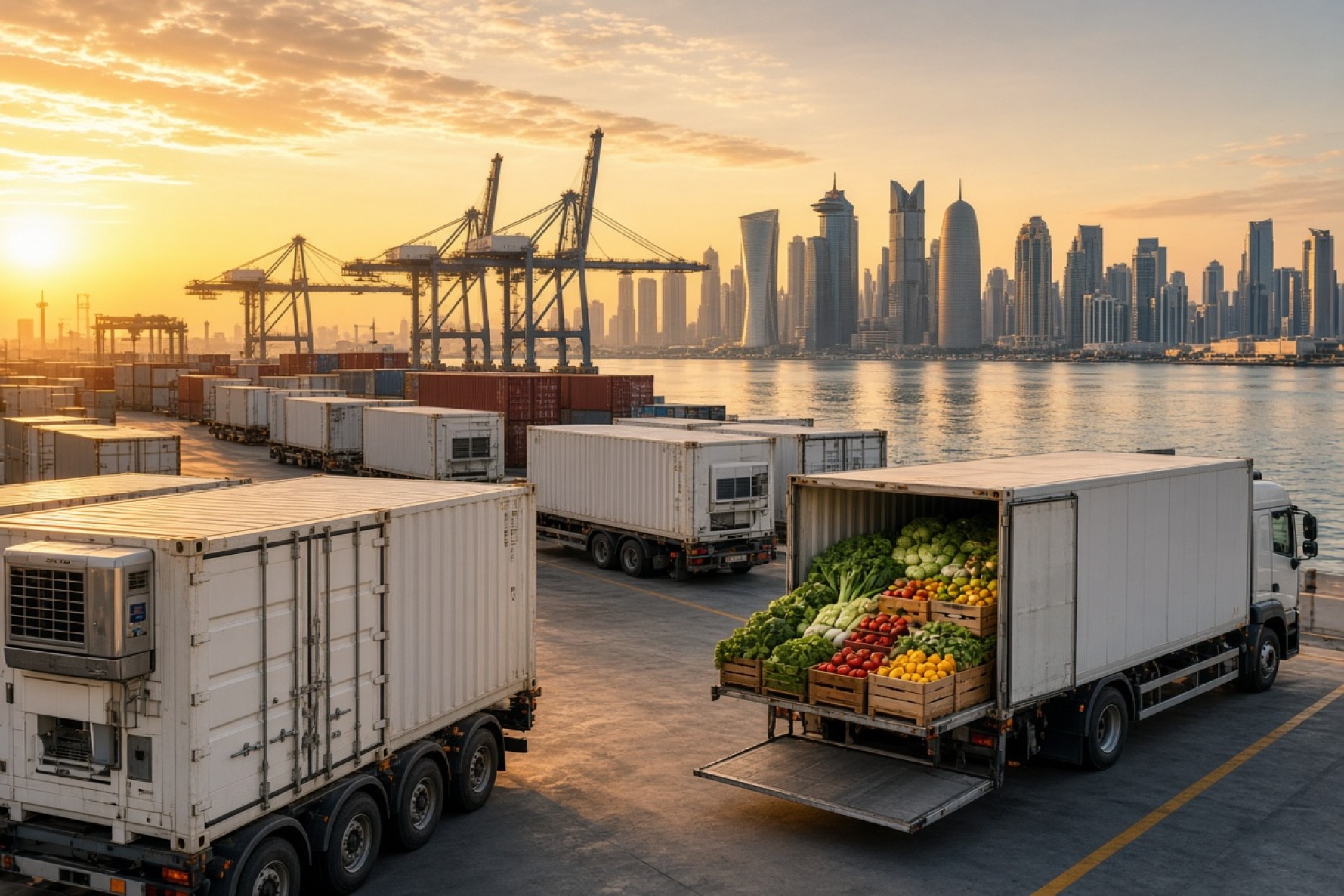
For commercial food imports there are three main practical routes: sea via Hamad Port, land via Abu Samra border, and air via Hamad International Airport. Al Ruwais Port is also active in Qatar's customs and maritime structure, but entry point choice should follow origin, product type and distribution plan.
Qatar transport documents show Hamad Port and Hamad International Airport have become the two major gateways for imported goods moving to Doha logistics hubs. Abu Samra is Qatar's only direct land crossing with Saudi Arabia and plays a strategic role in food supply-chain security.
Hamad Port — main container route
For dry, packaged products, raw materials and many refrigerated cargoes, sea transport is the most economically attractive option at scale.
Dry containers suit nuts, canned goods, biscuits, confectionery, spices, dry raw materials and some beverages. Reefer containers serve frozen products, sensitive dairy, fruit and vegetables and other temperature-controlled goods.
For Iranian exporters, direct sea or Gulf regional programmes offer potential geographic advantage — but this becomes commercial only when sailing schedule, port waiting time, container booking and entry formalities are managed correctly.
Abu Samra land border
Abu Samra is Qatar's land border with Saudi Arabia and operates around the clock. It is especially important for goods entering Qatar from Saudi Arabia or via the GCC land network.
Fresh vegetables and fruit, dairy, fast-moving consumer goods and products shipped from Gulf regional distribution centres to Qatar can use this route.
For direct exports from Iran, use of Abu Samra usually means a multi-stage sea or land route through a third country — so it is not always more economical than direct sea to Qatar.
Air freight
Air freight makes sense when product value is high, weight is limited and time sensitivity is severe. Some premium fresh products, commercial samples, urgent orders and very short-life foods may enter by air.
Air freight cost per kilogram is far higher than sea. It therefore usually lacks economic advantage for bulky, low-value goods.
| Route | Suitable for | Main advantage | Main limitation |
|---|---|---|---|
| Hamad Port | Dry, reefer & frozen containers | High capacity & lower unit cost | Depends on sailing schedule & port ops |
| Abu Samra | Regional land & fresh product | Direct land link to Saudi Arabia | Usually not a direct route from Iran |
| Hamad Airport | High-value, highly perishable goods | High speed | High freight cost |
| Al Ruwais Port | Some regional maritime operations | Complementary port option | More limited than Hamad Port |
4. Where Does Iran Hold a Better Position in Qatar's Food Market?
In 2024 Qatar's total imports from Iran were about USD 145.96 million. Live animals at about USD 67.72 million were the largest group, followed by vegetables, dairy and eggs, fruit and nuts, and spices among important categories.
For Iran's food industry, several practical areas carry greater importance.
Fresh vegetables
Iran recorded exports to Qatar in 2024 of tomatoes, cabbage, cauliflower, lettuce, potatoes, onions and cucumbers. Geographic proximity can shorten time in transit, but product must be controllable for ripeness grade, firmness, sort, packaging and pesticide residue.
Nuts and dried fruit
About USD 4.46 million of classified nuts entered Qatar from Iran in 2024. Iranian nuts and dried fruit have commercial capacity for premium retail, confectionery, hotels and restaurants, and repackaging.
Melons, grapes and other fruit
About USD 2.7 million of melons and papaya, USD 1.28 million of grapes and about USD 705,000 of apples, pears and quince entered Qatar from Iran. These figures show Iran has a fruit market in Qatar, but Iran's share of Qatar's several-hundred-million-dollar fruit market remains limited.
Eggs and some dairy products
Eggs were the most important item in Qatar's dairy and egg imports from Iran in 2024. Concentrated milk and cream and butter also had recorded imports.
Processed products
Qatar's imports from Iran in prepared vegetables, fruit and nuts were about USD 2.39 million. Tomato products, processed vegetables and fruit juice formed part of this trade.
| Iranian group | Market track record | Potential advantage | Sensitive issue |
|---|---|---|---|
| Fresh vegetables | Stronger than many processed groups | Proximity & seasonal diversity | Pesticide residues & cold chain |
| Fresh fruit | Practical presence | Short distance & product range | Sort & remaining shelf life |
| Nuts & dried fruit | Expandable market | High value per weight | Uniformity, aflatoxin in related products |
| Eggs | Significant recorded trade | Regional supply capacity | Veterinary certificates & transport conditions |
| Dairy | Limited but real presence | Diversity of Iran's industry | Cold chain & shelf life |
| Canned & processed veg. | Existing but smaller market | Easier transport than fresh | Registration, label & brand competition |
| Spices | Recorded trade | High value, low weight | Purity, contamination & packaging |
For a Qatari buyer seeking supply from Iran, submitting a request based on exact product, pack weight, order volume, storage conditions and delivery destination is far more effective than a generic request for "Iran food prices". Iranco can receive such requests to review available supply options in Iran.
5. Where Do Qatar's Food Import Rules Begin?
Commercial entry of food into Qatar is not a customs-only process. Product must pass both customs and food safety control.
Qatar's Ministry of Public Health (MOPH) controls imported food. The Wathq system registers importers, exporters and food products and links to the Al Nadeeb single-window customs clearance platform. Official Wathq guidance states that a company is registered first and its products must then be registered in the system.
Importer registration
A foreign seller cannot simply ship goods in any name and expect commercial clearance. The Qatari party must have the legal structure and import authority required and be registered in the relevant systems.
Product registration
Company registration does not automatically register all its goods. Product and packaging information must also be registered and reviewed.
From the exporter's perspective this is critical: before mass production of export packaging, the final label file must be reviewed with the Qatari importer. Changes to product name, ingredients, weight, country of origin or other information may conflict with registered data.
Customs declaration
Import declaration is filed electronically by the importer, representative or customs broker. Related documents must be presented to customs, and goods may be subject to inspection and review based on risk assessment.
Border control
Product registration does not guarantee every shipment enters without control. MOPH may review documents, product identity, packaging, transport conditions and, where necessary, laboratory samples.
Qatar's official imported food inspection service states that inspection takes place after customs declaration in Al Nadeeb, and that company and product must be registered in Wathq.
6. Which Documents Matter for Food Imports into Qatar?
Exact documents depend on product nature, but several papers play a foundational role in most commercial shipments.
GCC imported food control guidance requires food consignments to carry appropriate health certificates from the competent authority in the country of origin or an accepted authority. For meat, meat products or foods with animal components, halal documents also gain importance depending on product and origin.
Practical documents usually include:
- Commercial invoice
- Packing list
- Sea, air or land transport document
- Customs declaration
- Certificate of origin where applicable
- Food health certificate
- Halal or halal slaughter certificate for covered products
- Veterinary certificates for covered animal products
- Phytosanitary or quarantine certificates for covered plant products
- Batch or lot information
- Production and expiry dates
- Storage temperature specifications
- Additional documents requested for specific products
One costly exporter mistake is preparing invoice, health certificate, packing list and label specifications separately. If product name, package count, weight or origin differ among these documents, the review process can become complicated.
7. Labelling and Standards — Where Many Shipments Gain Risk
Qatar applies Gulf regulations and standards in food control. Important documents for prepackaged food include GSO 9 for food labelling, GSO 150-1 for shelf life and GSO 2233 for nutrition information. Product type may also have a dedicated standard.
Qatar's official food registration guide emphasises consistency of Arabic and English information. Country of origin, storage temperature, production and expiry dates are considered in product registration.
Information to verify before printing packs
| Subject | Required control |
|---|---|
| Product name | Accurate and aligned with actual product nature |
| Ingredient list | Aligned with production formula |
| Language | Arabic requirements met; translation consistent |
| Net weight | Matches actual pack |
| Country of origin | Matches actual production |
| Manufacturer | Correct name and details |
| Dates | Per applicable standard for that product |
| Storage conditions | Clear and accurate |
| Nutrition information | Per applicable requirements |
| Allergens | Declared per regulations |
| Barcode | Aligned with registered product |
| Nutrition claims | Only if compliant with regulations |
Hundreds of thousands of packs should not be printed first and the file then sent to the Qatari importer. Label file approval must come before final order of film, can or carton.
8. What Are Food Import Tariffs in Qatar?
There is no single rate for all food. Goods are classified by HS Code and the rate for that line must be checked.
Qatar customs law states imported goods are subject to rates set in the common tariff unless exempt under law, GCC economic agreement or other relevant arrangements. In Qatar's tariff many processed food lines carry a 5% rate, while certain specific goods appear on exemption lists.
For example, some types of bread, biscuits and bakery products appear in Qatar's tariff schedule at 5% with MOPH control requirements.
Saying "Qatar food tariff is 5%" is therefore not sufficient for a professional contract. The exact HS Code must be determined first.
Customs value is only part of cost
Import cost consists of several components:
- Product purchase price: Amount paid to the producer.
- International freight: Depends on origin, route, dry or reefer container, fuel rates, season and shipping space.
- Insurance: If appropriate transport cover is chosen.
- Customs duty: Per HS Code and exemption or tariff status.
- Port and terminal charges: Depends on port, shipping line and operations performed.
- Brokerage and clearance: Per importer's agreement with broker.
- Storage and dwell: Rises if clearance is prolonged.
- Demurrage and detention: Can quickly become significant if container return or exit is delayed.
- Temperature control: For reefer containers — power, monitoring and specialist operations.
- Testing or additional control: May be required for some shipments.
Qatar MOPH's official imported food inspection service is announced as a government service without charge — but that does not mean the entire import process or port, transport, warehouse and clearance costs are free.
9. Sea, Land or Air — Which Suits Which Food?
Transport choice should follow commercial product life at shelf arrival, not only the lowest freight rate.
Dry foods
Nuts, pulses, spices, canned goods, biscuits, confectionery and many dry raw materials usually offer the greatest flexibility. If product is sensitive to high temperature, shipping season and container temperature should also be reviewed.
Even dry product can suffer from excessive heat, humidity, container sweating or long dwell in the port yard.
Fresh fruit and vegetables
Pre-cooling, product-appropriate temperature, relative humidity, air circulation, carton type and stacking method are essential in this group.
Using one fixed temperature for all fruit and vegetables is wrong. Chill-sensitive products should not travel under conditions suited to products stored near freezing point.
Frozen product
The core principle is uninterrupted cold chain. The smallest cold-chain break can alter texture, increase refreezing or reduce product life.
Route temperature logging with data loggers for sensitive shipments can make buyer–seller disputes much easier to resolve.
Dairy and chilled product
Beyond temperature, clearance time matters greatly. A product with short total life that waits several days in transit and port may be legally clearable but commercially unattractive for retail.
| Product condition | Preferred route in many deals | Main priority |
|---|---|---|
| Dry & shelf-stable | Sea | Unit cost & moisture protection |
| Fresh, medium shelf life | Reefer sea or regional land | Time & cold chain |
| Highly perishable & high value | Air | Speed |
| Frozen | Reefer sea | No cold-chain break |
| Commercial sample | Air | Buyer review speed |
| Bulky raw materials | Sea | Scale economics |
10. How Does a Qatari Importer Compare Different Price Offers?
Professional price comparison must be based on final sellable cost in Qatar.
A supplier may sell one kilogram cheaper, but carton weight, units per carton, freight cost, waste percentage or remaining shelf life can make the offer more expensive in practice.
In fresh fruit, a lower price may come with irregular sort. If the importer must separate a significant share after arrival, the real price per sellable kilogram rises.
In packaged goods, weak master cartons, few units per pallet, non-optimal dimensions and heavy packaging material can raise transport cost.
Real cost = product price + freight + insurance + entry duties and charges + warehouse and distribution + waste + capital cost + risk of non-sale.
A request for "price of one container of food" without technical specifications, pack weight and delivery terms therefore has limited commercial value.
Incoterms and delivery point
Seller and buyer must define where responsibility and cost transfer. Comparing prices quoted ex-factory with prices quoted at destination port without cost adjustment can lead to wrong decisions.
Iranian exporters should also present fully transparent financial offers stating whether domestic haul, port, sea freight, insurance and unloading sit with seller or buyer.
11. Iran's Advantages and Limits in Competing with Qatar's Suppliers
Iran is not necessarily Qatar's top supplier for every food group. Country advantage must be assessed product by product.
India has a very strong rice supply chain. European and New Zealand suppliers are present in various dairy segments. Many countries with specialised export structures compete in meat.
Iran's advantage in many products appears mainly in:
- Shorter sea distance than many distant suppliers
- Ability to supply fresh fruit and vegetables
- Diversity of nuts and dried fruit
- High capacity of food industries
- Ability to produce dedicated export packaging
- Taste proximity in many products
- Ability to ship smaller consignments on some regional lines
Limits such as unstable shipping schedules, weak packaging from some producers, irregular export documentation, quality variation between shipments and weak branding can neutralise geographic advantage.
For Qatar's market, quality consistency is often more important than exceptional quality in a single sample. An importer who receives a top-grade sample but a commercial shipment of different quality will rarely repeat the order.
Importer Checklist Before Placing a Food Order
Before advance payment or order confirmation, at least the following should be clear:
- Exact product name and category are defined.
- HS Code matches actual product nature.
- Producer and production location are specified.
- Product can be registered for entry into Qatar.
- Label file is reviewed before final printing.
- Real sample at commercial production quality level is received.
- Net weight and units per carton are specified.
- Carton dimensions and cartons per pallet are known.
- Total order quantity and container count are set.
- Storage and transport temperature for sensitive product is defined.
- Total shelf life and minimum remaining life on arrival are agreed.
- Shipment rejection or acceptance criteria are written in contract.
- Required pre-loading tests are determined.
- Health, veterinary, phytosanitary or halal documents match the product.
- Delivery point and Incoterms are clear.
- Container booking and insurance responsibility is assigned.
- Order preparation time is realistically confirmed.
- Terms for shortfall, damage or non-conformance are specified.
- Reorder plan and supplier monthly capacity are reviewed.
- It is clear whether product is for retail, catering or industrial use.
What Information Should Be Sent for an Accurate Quote?
A food purchase request for Qatar's market should ideally include:
- Exact product name
- Product type or specifications
- Quality grade
- Unit size or weight
- Relevant technical specifications
- Order quantity
- Net weight per pack
- Packaging type
- Units per carton
- Private label requirement
- Arabic label requirement
- Storage conditions
- Expected shelf life
- Required tests
- Port or delivery location
- Transport method
- Desired delivery terms
- Expected order timeline
At Iranco, purchase requests can be reviewed more precisely when buyers send this information instead of a generic enquiry. This structure enables comparison of Iranian supply options against Qatar's real market needs.
Sourcing Iranian Food for Qatar's Market
In food purchasing from Iran, the difference between two offers is usually not price alone. One supplier may have the right product but packaging unsuited to refrigerated transport. Another may offer a more standard product but a minimum order incompatible with importer capacity. In fresh groups, production location and distance to port can directly affect final quality.
Supply should start with defined purchase specifications: product, grade, pack weight, order volume, destination, delivery terms, label requirements, testing and shelf life.
Several supply options should then be compared on real production capacity, sample quality, documents, packaging, preparation time and export track record. Price only becomes meaningful after this stage.
Iranco can serve buyers and importers reviewing Iranian food products for Qatar's market as a platform to register purchase requests and review supply options matched to order specifications. For nuts, fruit and vegetables, processed foods or raw materials, including technical details in the purchase request increases the chance of receiving a comparable offer.
If the goal is supply for Qatar, specify product name, approximate volume, packaging type and delivery location from the start so supply review proceeds on that basis.
Summary
Qatar's food market is geographically small but import-complex. Meat, dairy, fruit and nuts, cereals, vegetables, cereal preparations and a wide range of processed foods continue to enter the country in significant volume. For Iranian exporters, fresh vegetables, fruit, nuts, eggs, some dairy, spices and processed products are areas where Iran's real presence in Qatar trade is recorded.
Iran's main advantage in this market comes from geographic distance, agricultural diversity and food industry capacity — but proximity alone does not create sales. Product must align with Qatar market requirements on registration, health documents, labelling, shelf life, packaging and transport conditions.
Hamad Port is the main operational gateway for many container shipments. Abu Samra is a key regional land trade route, and air freight holds its place for sensitive, high-value goods. Choice among these routes should follow final cost, product life and required speed.
In commercial decisions the key question is not "which product is cheapest?" The right question is which product with repeatable quality, complete documents, suitable packaging and competitive final cost can enter Qatar's sales network without unnecessary risk. An exporter who manages these four factors together has a far better chance of turning a trial order into an ongoing relationship with a Qatari importer.
Frequently Asked Questions
Which foods attract the most attention from Qatar importers?
Meat and protein products, dairy, eggs, fruit and nuts, cereals, vegetables, bakery and processed cereal products are among Qatar's main import groups. In 2024 meat and edible offal at about USD 677 million was one of the largest food groups. Product selection for export should consider market size, competition and the exporter's real supply capacity.
What is the main entry route for food into Qatar?
For container shipments, Hamad Port is one of Qatar's most important entry gateways. Abu Samra is the land route for trade with Saudi Arabia and the GCC regional network, and Hamad International Airport serves sensitive, highly perishable goods. Route choice should align with shelf life, weight, product value and cold-chain needs.
What is Qatar's food import tariff rate?
There is no single rate for all food. Goods are classified by HS Code. Many commercial food lines show a 5% rate, but some items are exempt under the GCC common tariff or have different status. The exact rate must be checked for that product's HS Code before contract.
Must a food product be registered before export to Qatar?
In commercial imports, the importer company and food products must be registered in Qatar MOPH's Wathq system. Product information is registered based on packaging and specifications and links to imported food control. Unapproved changes to label, weight, ingredients or product information can conflict with the registered file.
Which documents matter for meat and animal products?
Health certificate from the competent authority is essential, and for covered products halal or halal slaughter certificate is critical. Qatar MOPH requires halal-related documents in import control for meat, meat products and foods with animal components. Shipment details, producer, origin and batch must match accompanying documents.
Which Iranian products already have a market in Qatar?
2024 data shows fresh vegetables, eggs and some dairy, fruit and nuts, spices, cereal preparations and some processed foods entered Qatar from Iran. Vegetables at about USD 14.59 million, dairy and eggs at about USD 12.88 million, and fruit and nuts at about USD 9.9 million were notable groups.
How is the export price of food to Qatar determined?
Real price is not factory price alone. Pack weight and type, order volume, season, quality, transport route, dry or reefer container, delivery port, tariff, clearance cost, waste and remaining shelf life all affect final cost. Offers should therefore be compared on identical delivery terms and technical specifications.
Is sea transport from Iran to Qatar suitable for fruit and vegetables?
In many cases yes, but the decision depends on product. Geographic distance between Iran and Qatar can be an advantage, but pre-cooling, packaging, appropriate temperature, sailing schedule and clearance speed determine what quality enters the market. Very sensitive product or premium orders may need faster transport.
How can food be sourced from Iran for Qatar's market?
Product, grade, quantity, pack weight, packaging type, destination and test or label requirements must first be defined. Sample, supply capacity and commercial terms of several producers are then compared. Buyers can register these specifications as a purchase request at Iranco so available Iranian supply options are reviewed against their needs.
What is the most common mistake in food export to Qatar?
Shipping product before full coordination with the importer on registration, labelling and documents is one of the main risks. Another is focusing only on price. A cheaper product with insufficient shelf life, weak packaging or document mismatch can create higher final cost than a more expensive but clearance-ready offer.
Qatar food import advisory and Iranian supplier connection
Submit your product specifications, order volume and delivery requirements to Iranco for review of Iranian supply options suited to Qatar's market.
Contact Irancoinfo@iranco.com · WhatsApp: +98 913 104 4182 · Telegram: @irancofood
Featured Products




Related Articles



