 Iranco Magazine Team
Pakistan food import basket — high-demand products, major ports and borders, quarantine and standards, customs clearance, cost structure and supply opportunities from Iran
Market Report · Food Imports · Pakistan · Ports & Borders
Pakistan Food Imports: Products, Routes, Costs & Regulations
Pakistan food import basket analysis — high-demand products, Karachi and Port Qasim gateways, Taftan and Gabd–Remdan land borders, quarantine and PSQCA requirements, PSW customs clearance, cost structure and supply opportunities from Iran.
Analytical Introduction
With a population of more than 240 million, Pakistan is one of South Asia's largest food consumption and import markets. The country is not only a major buyer of staples such as edible oil, wheat, pulses and tea; food industries, bakeries, oil refineries, confectionery producers and ready-meal packers also depend continuously on imported raw materials. For Iranian exporters, Pakistan offers opportunity at both the end-consumer level and the industrial supply level.
In fiscal year 2024 (FY2024), Pakistan's food imports reached roughly USD 7.9 billion. This figure shows that food imports are a structural part of the supply chain, not a temporary supplement. Palm oil accounted for about USD 2.78 billion — the largest import line. Wheat imports were about 3.54 million tonnes and tea about 260,000 tonnes — both core pillars of the import basket. Exporters entering this market must understand which product groups face the fiercest competition and where Iran's proximity, quality or product diversity creates a usable advantage.
For Iranian traders, Pakistan is a land neighbour with active borders at Mirjaveh–Taftan and Remdan–Gabd. That proximity can reduce haul cost and delivery time for pulses, dried fruit, spices, concentrate, paste, some oils, confectionery raw materials and packaged foods compared with distant suppliers. Success in this market is not limited to factory price alone; port or border choice, PSQCA compliance, DPP quarantine permits, PSW clearance, tariff codes, transport documents and inland Pakistan freight are all decisive.
Pakistan's import structure should be viewed in two layers. The first is bulk sea cargo through Karachi and Port Qasim — palm oil, bulk wheat, tea and soybeans. The second is overland cargo from the Iran border — pulses, spices, dried fruit and raw materials. Iranian exporters usually compete more practically in the second layer, but even there they must compare delivered cost to warehouse in Karachi or Lahore against Indian, Australian or Central Asian rivals.
1. What Food Products Does Pakistan Import Most?
Pakistan's food import basket combines high-volume staples, industrial raw materials and packaged consumer products. In FY2024 edible oils — especially palm oil — held the largest share by value. Wheat and pulses created very high tonnage, while tea, spices, milk and cream, soybean oil and dried fruit and nuts were other important groups.
| Product group | Approx. volume | Approx. value | Main origins |
|---|---|---|---|
| Palm oil | ~3.2M t | $2.78B | Indonesia, Malaysia |
| Wheat | 3.54M t | ~$1.1B | Russia, Ukraine, Kazakhstan |
| Pulses (lentils, beans, chickpeas) | ~1.2M t | ~$900M | Australia, Canada, Myanmar, Iran |
| Tea | 260K t | ~$650M | Kenya, India, Bangladesh |
| Spices & pepper | ~180K t | ~$420M | India, Vietnam, Iran |
| Soybean oil | ~650K t | ~$580M | Brazil, Argentina |
| Milk & cream | ~95K t | ~$310M | New Zealand, Europe, Iran |
| Dried fruit & nuts | ~75K t | ~$480M | Iran, Afghanistan, USA |
Edible oils
Palm oil is the main pillar of Pakistan's food imports. Most of this cargo enters through Karachi and Port Qasim, then moves to refineries, packers and distributors nationwide. Soybean oil and some sunflower oil also feature in the import basket. Price competition in this group is extremely intense; buyers usually decide on price per kg, technical specs, moisture, acidity, colour and repacking options. Iranian exporters may find better opportunity in specialist vegetable oils or industrial-grade oils than in direct competition with palm oil.
Pulses
Lentils, red beans, chickpeas, kidney beans and mung beans are among the most in-demand imported pulses. Pakistan relies on imports for both direct consumption and food-industry use. Grain quality, breakage rate, moisture, impurities, size uniformity and bag or bulk packaging all directly affect final price. Iran has a land-route supply advantage especially in lentils, beans and some specialist pulses.
Tea
Pakistan is one of the world's largest tea importers, with annual imports of about 260,000 tonnes reported. The tea market is highly competitive; brand, taste, liquor colour, grade and price per kg are decisive. Iranian exporters face strong Indian and Kenyan rivals. Successful entry usually requires a strong distribution partner in Karachi, Lahore or Rawalpindi.
Spices
Turmeric, black pepper, red pepper, cumin, cinnamon, cardamom and spice blends hold a significant place in Pakistan's imports. Part of this demand is household consumption; part serves food industries, restaurants and ready-meal packers. Iran has a recognised position in saffron, cumin, turmeric and some spice blends, but PSQCA standards, labelling and tariff codes must be checked before export.
Wheat
Pakistan is a major wheat producer, but in low-rainfall years and to stabilise flour prices it increases wheat imports. FY2024 imports were reported at about 3.54 million tonnes. This cargo mainly enters by sea from origins such as Russia, Ukraine and Kazakhstan. Iranian wheat exporters usually lack a volume advantage against these origins; focus on durum or specialist grades is more logical.
Milk, cream and dairy
Milk and cream imports were reported at about 95,000 tonnes and roughly USD 310 million in FY2024. Industrial skim milk powder, whole and low-fat milk powder, evaporated milk and butter all feature in the import basket. Main origins include New Zealand, Europe and in some lines Iran. For overland exports from Iran, shelf-stable products with COA and PS 363 compliance take priority.
Dried fruit and nuts
Pistachios, almonds, walnuts, raisins and other edible nuts are high-value import groups for Pakistan. Iran, Afghanistan and the USA are recognised origins. Value per tonne is high in this group and land haul from the Iran border gives Iranian exporters a clear advantage — provided quarantine certificates, COA and industrial packaging are aligned in advance.
2. Which Products Are Most Attractive to Traders?
Not every Pakistani import line is equally attractive for Iranian exporters. Commercial appeal depends on demand, competition, land-route feasibility, regulatory complexity and margin. Three main groups can be distinguished for Iranian traders:
Group 1: Products with Iran land-route advantage
Pulses, dried fruit, nuts, saffron, cumin, turmeric, tomato paste, concentrate, some canned goods, honey, dates and confectionery raw materials fall in this group. Geographic proximity, smaller shipment flexibility and Iran's production diversity create advantage here. Land haul from Mirjaveh or Remdan is usually more economical than sea freight from distant ports for these goods.
Group 2: Industrial raw materials
Milk powder, industrial skim milk powder, vegetable fat, starch, glucose, industrial sugar, cocoa powder, permitted additives, specialist oils and some concentrates are in demand from Pakistan's food plants. Buyers focus on technical specs, COA, batch-to-batch quality consistency and continuous supply as much as price. Valid documents and standards compliance carry equal weight.
Group 3: Branded packaged products
Biscuits, confectionery, sauces, consumer-pack paste, packed tea, ready spice mixes and some beverages belong here. Brand competition in Pakistan is intense; successful entry usually needs a distribution partner, PSQCA registration or approval and market-appropriate packaging. For Iranian exporters this group often starts with sampling and limited contracts rather than large volume commitments.
| Group | Iran advantage | Competition intensity | Regulatory complexity |
|---|---|---|---|
| Pulses & cereals | High — land route | High | Medium |
| Dried fruit & nuts | Very high | Medium | Medium to high |
| Spices & saffron | High | High | High |
| Paste & concentrate | Medium to high | High | Medium |
| Industrial raw materials | Medium | Medium | High |
| Dairy | Medium | High | Very high |
| Palm oil | Low | Very high | Medium |
| Branded tea | Low to medium | Very high | High |
3. Through Which Routes Does Pakistan Import Food?
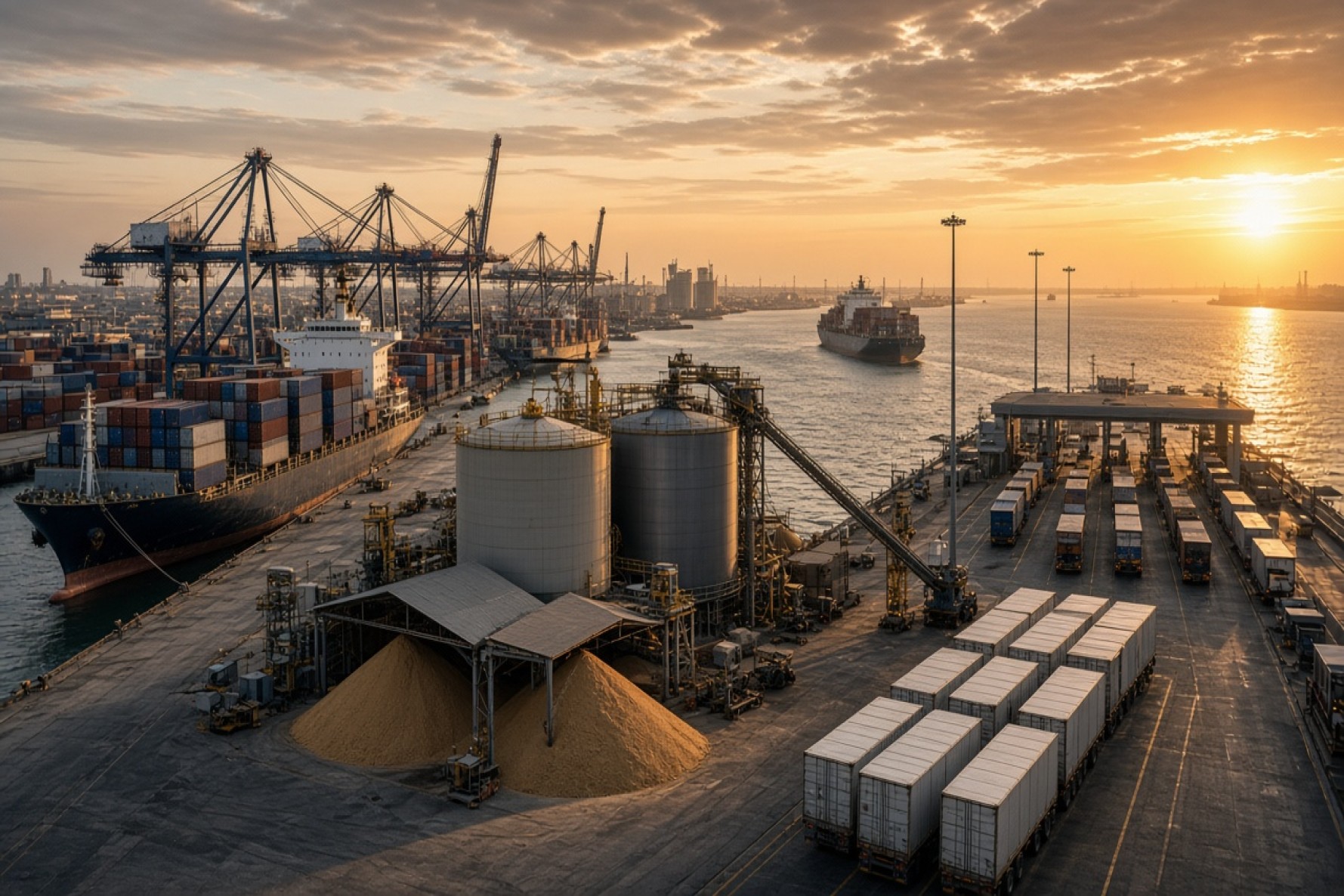
Most of Pakistan's food imports arrive by sea. Karachi Port and Port Qasim in Sindh province are the main gateways for bulk and container cargoes. Products such as palm oil, wheat, soybeans, tea and bulk pulses are largely cleared through these ports.
Karachi Port
Karachi Port is Pakistan's oldest and best-known commercial port. Bulk discharge capacity, oil tanks, general warehouses and links to the national rail and road network make it suitable for grain, oil, tea and general cargoes. Many large importers maintain offices in Karachi; warehousing and distribution networks from the city extend to Lahore, Faisalabad, Islamabad and other centres.
Port Qasim
Port Qasim lies south-east of Karachi near the Korangi Channel. It is very active for heavy bulk cargoes such as coal, iron ore, wheat and palm oil. Specialist oil berths and high bulk-discharge capacity give Port Qasim particular importance for industrial food importers. Discharge time, unloading cost and proximity to nearby warehouses all influence the choice between Karachi and Qasim.
4. Iran–Pakistan Border: Taftan or Gabd–Remdan?
For overland exports from Iran, the two main axes are Mirjaveh–Taftan (Sistan-Baluchestan, Iran / Balochistan, Pakistan) and Remdan–Gabd (Khorasan Razavi, Iran / Balochistan, Pakistan). Border choice should follow production origin in Iran, destination city in Pakistan, product type and required delivery time.
| Border | Iran side | Pakistan side | Typical destination | Approx. transit |
|---|---|---|---|---|
| Mirjaveh – Taftan | Zahedan | Taftan | Quetta, Karachi (via N-40) | 5–8 days |
| Remdan – Gabd | Khaf / Taybad | Gabd – Remdan | Karachi, Gwadar | 3–5 days |
The Remdan–Gabd corridor is usually shorter for producers in north-east and central Iran with destinations in Karachi or southern Balochistan. Mirjaveh–Taftan is more common for producers in southern and central Iran and for destinations such as Quetta. On both routes, inland Pakistan freight — not border distance alone — forms a major share of final price.
When Taftan and when Gabd–Remdan?
- Taftan: Production origin in southern and central Iran, destination Quetta, Balochistan or the N-40 corridor to Karachi.
- Gabd–Remdan: Origin in Khorasan and north-east Iran, destination Karachi, Gwadar or southern Balochistan with shorter transit.
- Both routes: DPP permits required for pulses and dried fruit; border dwell time and customs capacity in season should be checked before loading.
5. Afghanistan Borders: Torkham and Chaman
Part of Pakistan's food trade also passes through eastern borders with Afghanistan or is handled in regional cross-border markets. Two important gateways are Torkham in Nangarhar province and Chaman in Balochistan.
Torkham: The most important eastern land border and gateway to Nangarhar and the Kabul corridor. It matters for goods destined for eastern Afghanistan or for Pakistan–Afghanistan regional trade. Flow volumes at Torkham are affected by border policy, season and security conditions.
Chaman: Located in southern Balochistan near Afghan Kandahar. It is the natural option for cargoes moving from Karachi or southern Pakistan routes toward southern Afghanistan. Iranian exporters planning transit or regional sales must review regulations in all three countries involved.
6. PSW Customs Clearance Steps
Pakistan has developed the Pakistan Single Window (PSW) system to integrate import processes. Food importers must complete the following steps in a coordinated way:
- Register and verify importer identity in PSW and obtain a valid business identifier (NTN).
- File the import declaration with product details, HS tariff code, value, origin and port of entry.
- Submit commercial invoice, packing list, transport document and certificate of origin.
- Obtain pre-arrival permits from relevant bodies (quarantine, PSQCA, DPP where required).
- Pay customs duty, sales tax and other applicable charges.
- Physical inspection of the consignment at port or border by customs.
- Sampling and testing if requested by PSQCA or DPP.
- Confirmation of conformity with mandatory standards or applicable exemptions.
- Issue of delivery order and release authorisation from port or land customs.
- Haul to warehouse and final registration in PSW.
7. Plant Quarantine Regulations
Pakistan's Department of Plant Protection (DPP) controls plant quarantine for imported goods. Pulses, grains, dried fruit, dried vegetables, seeds, starch and some plant-origin raw materials are subject to quarantine review.
- A phytosanitary certificate from the country of origin is mandatory.
- Goods must be free of pests, diseases and prohibited substances.
- If contamination is suspected, DPP may require sampling, treatment or rejection.
- Packaging must prevent pest entry and origin information must be traceable on the pack.
- For some products an import permit is issued before the cargo leaves Iran.
Iranian pulse and dried-fruit exporters should verify import permit status and DPP requirements for the exact tariff code before the first shipment. Dispatch without a pre-arrival permit is one of the most common reasons for consignment holds at the border.
8. Animal Products and Dairy
Imports of animal products and dairy into Pakistan are supervised by the Animal Quarantine Department and PSQCA standards. Milk powder, whole and skim milk powder, evaporated milk, butter and some cheeses feature in the import basket.
Main requirements include veterinary health certificates, halal certification where the market requires it, COA with protein and fat specifications, compliance with the relevant Pakistan Standard (PS) and complete labelling. Cold-chain products add complexity; for land shipments from Iran, shelf-stable products such as industrial milk powder are usually easier to operate than fresh milk.
9. Mandatory PSQCA Standards
The Pakistan Standards and Quality Control Authority (PSQCA) maintains a list of food products under compulsory standards. Import of these goods without compliance with the relevant national standard or a lawful exemption is not permitted.
| Product | Reference standard | Export note |
|---|---|---|
| Whole milk powder | PS 363 | Declare protein and fat on label |
| Skim milk powder | PS 363 | COA per shipment |
| Edible oil | PS 1485 | Acidity and moisture specs |
| Honey | PS 850 | Sugar and impurity testing |
| Tomato paste | PS 1294 | Brix and pH |
| Spice blend | PS 1042 | Ingredient list on label |
| Packed tea | PS 187 | Net weight and grade |
| Biscuits | PS 106 | Composition and expiry date |
| Mineral water | PS 1482 | Microbiological analysis |
10. Tariff Codes and Import Duties
Pakistan import duties are calculated from the HS code and current tariff schedule. Besides customs duty, sales tax and in some cases additional levies apply. Rates may change with government decisions; the exact product code must be confirmed before pricing.
| HS code | Product | Customs duty | Sales tax |
|---|---|---|---|
| 0713.40 | Lentils | 0% | 18% |
| 0713.33 | Red beans | 0% | 18% |
| 1001.99 | Wheat (non-durum) | 0% | 18% |
| 1511.90 | Palm oil | 0% | 18% |
| 0902.40 | Black tea | 10% | 18% |
| 0910.30 | Saffron | 5% | 18% |
| 2002.90 | Tomato paste | 20% | 18% |
| 0402.21 | Whole milk powder | 20% | 18% |
| 0802.51 | Pistachios | 10% | 18% |
Figures above are illustrative and may change with new decisions or temporary exemptions. Importers should query the exact HS code with full product description, packaging and intended use in the PSW system.
11. Real Cost of Food Imports
FOB or factory price is only part of import cost. Professional Pakistani importers calculate delivered (landed) cost.
Cost components
- Purchase price: Based on quality, order volume and payment terms.
- International freight: Sea (bulk or container) or land from the Iran border.
- Insurance: Usually based on CIF value.
- Customs duty and tax: Based on HS code and customs value.
- Discharge and warehousing: At port or border.
- Testing and permits: PSQCA, DPP and other agencies.
- Inland Pakistan freight: From port or border to final warehouse.
- Financial cost: Capital tied up during clearance.
| Cost component | Land (Iran) | Sea (e.g. palm oil) |
|---|---|---|
| Product price | Variable | Variable |
| International freight | $75–120/t | $25–45/t |
| Transit time | 3–8 days | 15–30 days |
| Port discharge | N/A | $8–15/t |
| Inland Pakistan haul | $20–50/t | $15–40/t |
| Best suited to | Pulses, dried fruit, spices | Oil, wheat, bulk tea |
| Cost component | Determining factors |
|---|---|
| Product price | Quality, volume, grade, packaging |
| Haul to border or port | Factory distance, truck type |
| International freight | Land or sea, season, weight |
| CIF insurance | Consignment value and route |
| Customs duty and tax | HS code and customs value |
| PSW and clearance fees | Port or border, product type |
| PSQCA / DPP testing | Product nature |
| Storage and dwell | Clearance speed, demurrage |
| Inland Pakistan freight | Karachi, Lahore, Quetta |
| Loss and damage | Breakage, moisture, heat |
| Financial cost | Capital tied-up period |
Purchase price + freight + insurance + customs duty + tax + discharge + testing + inland haul + loss = warehouse entry cost.
12. Land Freight vs Sea Freight
Transport mode depends on product nature, order volume, supply origin and destination city. Heavy bulk goods such as palm oil and wheat mainly enter by sea. Goods with higher value per tonne, bagged cargo or container loads from Iran often move overland.
Land freight advantages: Shorter transit, smaller shipment flexibility, closer contact with the Iranian producer and flexibility to adjust orders.
Sea freight advantages: Lower cost per tonne at high volume, suitable for bulk cargoes and destinations far from the border.
For Iranian exporters, the optimal pattern is often land haul to the border followed by inland Pakistan transport to Karachi, Lahore or other cities. The cost of this second leg is frequently more important than the border freight alone.
| Criterion | Land (Iran border) | Sea (port) |
|---|---|---|
| Transit time | 3–8 days | 15–30 days |
| Minimum economic volume | One truck or several trucks | Full container or bulk |
| Best suited to | Pulses, spices, dried fruit, paste | Oil, bulk wheat, bulk tea |
| Border / port | Taftan, Gabd–Remdan | Karachi, Port Qasim |
| Main advantage | Speed, flexibility, production proximity | Cost per tonne at high volume |
13. 20-Item Importer Checklist
- Define exact product name and specifications.
- Confirm HS tariff code with Pakistani customs broker.
- Query current customs duty and sales tax.
- Check whether the product is subject to compulsory PSQCA standards.
- Obtain plant quarantine (DPP) or animal permits before cargo movement where required.
- Verify importer NTN and PSW registration.
- Obtain and approve a physical sample before bulk order.
- Record approved sample specs in the contract.
- Request COA or relevant test documents for the shipment.
- Align final label design with the applicable PS standard.
- Coordinate invoice, packing list and certificate of origin before loading.
- Select entry border or port based on destination city.
- Calculate haul cost inside Iran and inside Pakistan separately.
- Clarify clearance responsibility and customs costs in the contract.
- Record payment terms and transaction currency.
- Set acceptance criteria for damaged or short-delivered goods.
- Verify supplier capacity for follow-on orders.
- Specify minimum remaining shelf life at delivery in the contract.
- Define cargo insurance and damage liability for transport.
- Size the first order to real distribution and warehouse capacity.
14. What Information Is Needed for an Accurate Quote?
A request for "food prices for Pakistan" is not enough for a professional offer. Buyers or importers should specify:
- Exact product name and commercial grade
- Required composition or technical specifications
- Pack weight and units per carton
- Approximate order volume (tonnes or FCL)
- Destination city in Pakistan (Karachi, Lahore, Quetta, etc.)
- Preferred border or port
- Transport mode (land or sea)
- Delivery terms (FOB, CIF, DAP)
- Need for COA, halal or phytosanitary certificates
- Need for sample before bulk order
"Lentils for Karachi" is too vague. A professional request should specify grade, moisture, bag weight, container count, preferred border and delivery terms. Buyers can submit these details through Iranco as a purchase request for review of available Iranian supply options.
15. Opportunities for Iranian Exporters
Iran holds competitive advantage in several product groups via the land route. Uniform-grade pulses, pistachios, almonds, saffron, cumin, turmeric, paste and concentrate, honey, dates and some confectionery raw materials are among these opportunities. In dairy, industrial milk powder and milk powder with PSQCA compliance have export potential.
Success in this market requires appropriate product selection. Direct competition with palm oil or bulk Indian tea is usually not recommended for small and mid-size Iranian exporters. Focus on groups where Iran's quality, diversity, proximity or production expertise is active is more logical.
- Grade-one pulses with industrial bagging for Karachi and Lahore wholesale
- Dried fruit and nuts with COA and phytosanitary certificates for premium markets
- Spices and saffron with PSQCA-compliant labels
- Paste, concentrate and sauces for factories and repackers
- Industrial milk powder for Pakistan's dairy and confectionery plants
16. Sourcing via Iranco
In Pakistan food trade, two offers differ by more than price per tonne. One supplier may quote a lower factory price but delay PSQCA documents, use weak road packaging or lack continuous supply capacity. Iranco enables B2B purchase requests with exact specifications — product, grade, pack weight, order volume, destination city, entry border or port and testing requirements — for review of Iranian supply options.
- B2B purchase requests with product specs and delivery terms
- Comparison of Iranian producers by product and Pakistan destination
- Delivery coordination from Mirjaveh, Remdan or shipment to ports
- Expedited COA, certificate of origin and quarantine documents
17. Summary
With annual food imports of about USD 7.9 billion, Pakistan is a major South Asian market for regional exporters. Palm oil, wheat, pulses, tea, spices and dried fruit are the main import pillars. Most of these goods enter through Karachi and Port Qasim, but for Iranian exporters the Mirjaveh–Taftan and Remdan–Gabd land routes create advantage in pulses, dried fruit, spices and raw materials.
Successful market entry requires PSQCA compliance, DPP quarantine permits, PSW clearance processes and delivered-cost calculation. Factory price alone is not the competitive metric; inland Pakistan freight, clearance time and document quality are decisive. Iranian exporters with the right product, standard packaging, complete documents and a credible distribution partner can build sustainable share in selected Pakistan product groups.
18. Frequently Asked Questions
What is Pakistan's largest food import?
Palm oil leads Pakistan's food import basket by value. In FY2024 imports were worth about USD 2.78 billion. Wheat, pulses and tea were also among the largest import lines. This structure shows that a major share of Pakistan's imports is raw materials and staples, not only ready-to-eat consumer foods.
Which port is most important for Pakistan's food imports?
There is no single answer for all products. Karachi Port is very important for containers and general cargo, while Port Qasim has significant specialist infrastructure for edible oil, grain and bulk cargoes. FY2025–2026 figures show more than 3.1 million tonnes of edible oil entered through Port Qasim's liquid terminal alone.
What is the best route for Iranian food exports to Pakistan?
For the Balochistan and Quetta market, the Taftan land route can be practical. For container cargoes destined for Karachi, sea freight should also be compared. Gabd–Remdan is another option for southern Iran. Route choice should follow final delivered cost, transit time, quarantine permits and the buyer's warehouse location.
Do agricultural products need a phytosanitary certificate to enter Pakistan?
Products subject to plant quarantine regulations usually require an import permit and a phytosanitary certificate from the country of origin. Pakistan's Department of Plant Protection may also inspect, sample or treat the consignment at entry where required.
Must all imported food in Pakistan meet PSQCA standards?
No. A specific list of food products carries compulsory standards. Items such as some edible oils, milk powder, butter, black tea, honey, some juices, powdered spices, biscuits and packaged milk appear on this list. The exact product code must therefore be checked before shipment.
What are Pakistan's food import tariff rates?
There is no single fixed rate for all food. Import duty is set by Pakistan's full tariff code and may include basic duty plus additional or regulatory charges. General sales tax is 18% in law, but some goods have exemptions or different arrangements. Calculation must be done separately for each product.
What costs besides product price must be calculated?
International freight, insurance, customs duty, possible surcharges, tax, clearance fees, testing, inspection, terminal charges, warehousing, demurrage, detention and inland Pakistan haul must all be included. For refrigerated cargo, reefer power and cold-storage costs also matter.
What specifications are needed to get food prices from Iran?
Exact product name, grade, processing form, size, technical specifications, order quantity, pack weight, packaging type, Pakistan destination, transport mode and delivery terms must be specified. If the product needs special tests or certificates, those should be stated in the request. These details can be submitted through an Iranco purchase request so supply options are reviewed on that basis.
Is land freight from Iran always cheaper than sea freight?
No. Land freight has advantages for some origins and destinations, but for a full container destined for Karachi, sea freight may be more competitive. Fuel cost, border crossing, truck dwell, inland Pakistan haul and port charges should all be calculated together.


Related Articles



