 Iranco Magazine Team
India date market analysis, Bam Mazafati quality specs, import requirements, tariff codes, packaging, reefer management and pre-Ramadan sales planning
Date Export · Bam Mazafati · India · Cold Chain
Exporting Bam Mazafati Dates to India: Reefer Container Requirements and Ramadan Timing
India market analysis, Bam Mazafati quality specifications, entry requirements, tariff codes, packaging, reefer container management and pre-Ramadan sales planning.
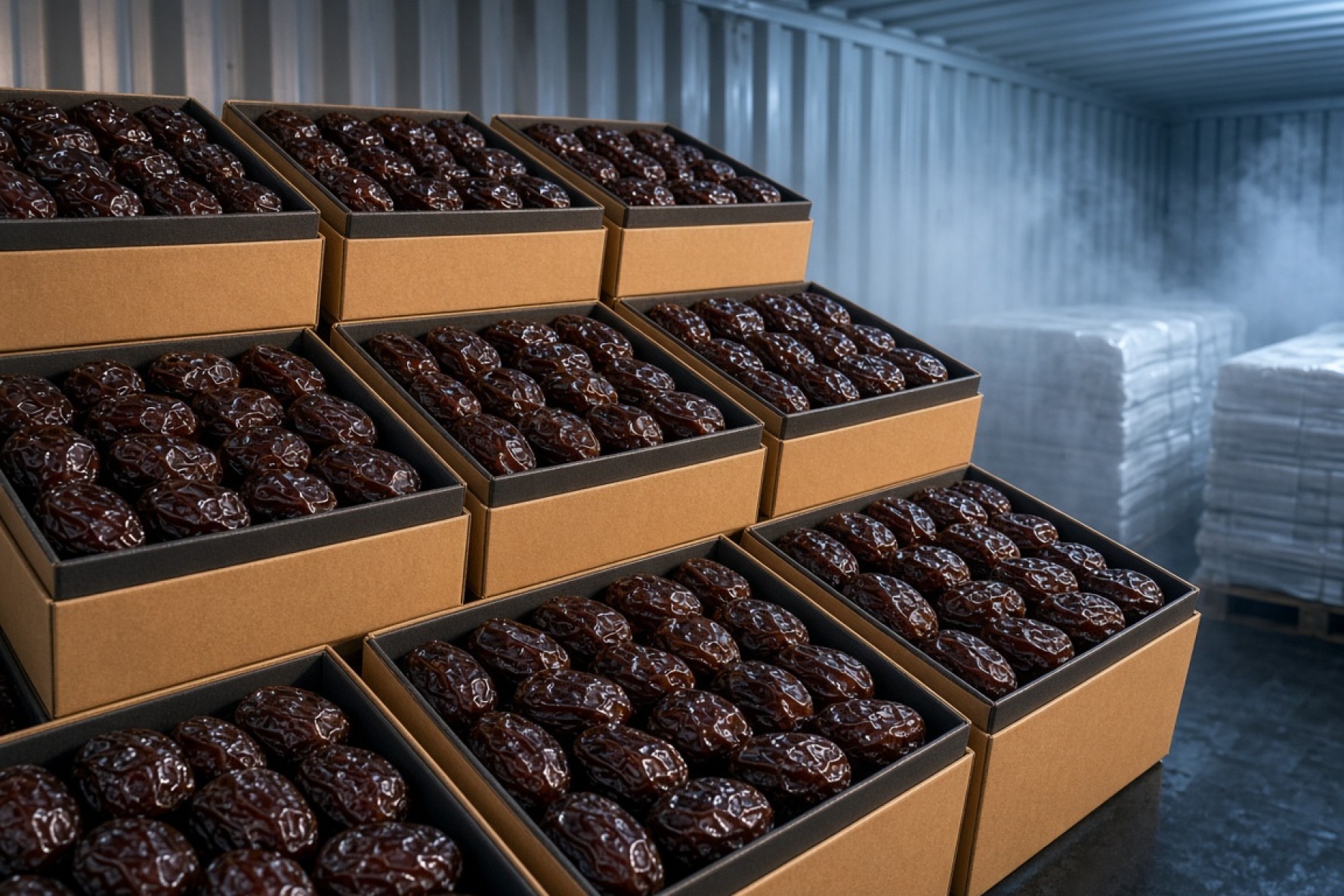
Bam Mazafati dates for the Indian market are not a simple dried-fruit commodity. They are soft, high-moisture and temperature-sensitive; export success depends on precise coordination of product quality, cold chain, packaging and market entry timing. In 2024 India imported more than half a million tonnes of dates and Iran was one of the main suppliers — so for Iranian exporters the core challenge is not only finding a buyer but delivering a commercially saleable shipment at the right time.
| Indicator | Value |
|---|---|
| India date imports (2024) | About 526.6 thousand tonnes |
| Import value (2024) | About USD 286.2 million |
| India imports from Iran (2024) | About 105.1 thousand tonnes |
| Reference cold-storage conditions | About 0°C and 70–75% relative humidity |
India is one of the world's most important large-scale date markets. Import volume reached about 526.6 million kg in 2024 with a value exceeding USD 286 million. In the same year India imported more than 105 million kg of dates from Iran worth about USD 45.3 million. These figures show that Iran–India date trade is not a marginal or trial market but an established commercial flow with room to grow in higher value-added segments.
Not all dates imported into India compete in the same market segment. A large share of trade is economic bulk product, while Bam Mazafati — with its soft texture, higher moisture, dark colour, glossy appearance and direct-consumption profile — requires different management. Mazafati is far more sensitive to heat and cold-chain breaks than dry or semi-dry dates. Rising temperature can accelerate over-softening, syrup leakage, colour change, fermentation and mould growth.
The second factor is the sales calendar. Date demand in India rises as Ramadan approaches, but the right arrival time is not the first day of Ramadan. Importers, wholesalers and distribution networks must clear, distribute and place product in stores before peak consumption. This article examines Bam Mazafati export to India from that angle: product and market, quality control, reefer containers, import regulations and commercial timing.
1. Bam Mazafati's Position in India's Export Market
By import volume, India is one of the largest international date markets. In 2024 the country imported about 526.6 thousand tonnes of fresh or dried dates under six-digit code HS 080410, with a trade value of about USD 286.2 million. The largest supply sources in the same year were the UAE, Iraq and Iran. Recorded imports from Iran were about 105.1 thousand tonnes worth more than USD 45 million; according to international trade data, India was the largest recorded destination for Iranian date exports in 2024.
Code 080410 groups different date types together, so total recorded imports from Iran cannot be equated directly with Mazafati. Exporters must distinguish the general date market from the soft, cold-chain segment.
Why Mazafati appeals in India
Bam Mazafati has several traits suited to direct consumption:
- Very soft, fleshy texture
- Very dark brown to black colour
- Relatively thin skin and high sweetness
- Glossy appearance in premium grade
- Suitability for small retail packs
- Perception of Iranian origin among some professional date buyers
Those same desirable traits increase logistics sensitivity. A date with higher moisture and softness cannot be stored in ordinary warehouse or container conditions like dry dates without temperature control.
The Mazafati market is not the cheap-date market
A common export mistake is comparing average Indian import prices with Mazafati pricing. India imports large volumes of economic dates from countries such as Iraq and the UAE. Mazafati should be compared with soft, direct-consumption products where appearance, uniformity, brand, pack weight, cold chain and quality after opening matter more.
2. What Specifications Should Export Mazafati for India Have?
For professional Mazafati buying, the phrase "Grade A" is not enough. Two sellers may both call their product Grade A while differing in size, moisture, skin separation, softness and defect levels. Purchase specifications should therefore be as measurable as possible.
| Parameter | Order specification | Buyer importance |
|---|---|---|
| Product type | Bam Mazafati date | Prevents substitution with similar cultivars |
| Ripeness stage | Fully ripe, suitable for direct consumption | Affects taste and texture |
| Colour | Very dark brown to black, uniform | Retail appearance |
| Texture | Soft and fleshy, no widespread crushing | Eating quality |
| Moisture | Per agreed spec and test report | Shelf life and cold chain |
| Size | Count per kg or agreed grading | Commercial tier definition |
| Skin | Defined limit for skin separation | Product appearance |
| Foreign matter | No visible extraneous material | Shipment acceptance |
| Pests | No live insects or severe infestation signs | Safety and clearance |
| Mould | No visible mould accepted | Health and quality |
| Packaging | Exact net weight and pack structure | Sales and distribution |
| Delivery temperature | Per cold-chain contract | Transport responsibility control |
How to define size
Instead of vague terms such as large, extra-large or premium, buyer and seller should agree a measurable grading method. Count per unit weight is one practical approach. The smaller the size variation within a lot, the more uniform retail packs appear.
Colour and ripeness
Ripe Mazafati is typically very dark in colour, but colour alone is not a quality indicator — harvest timing and storage temperature also affect it. An approved reference sample should be the comparison baseline; ideally an approved image, technical specification and physical sample are kept together in the purchase file.
3. Quality Control: The Most Critical Pre-Loading Stage
In Mazafati export, many commercial disputes appear only after the container reaches destination. Pre-loading control must be precise enough to reduce the likelihood of quality disagreements.
Moisture
Soft dates carry higher moisture than dry types. Moisture creates desirable texture but also increases sensitivity to microbial activity and temperature change. For dates at about 26% moisture and above, storage near 0°C is recommended for extended periods. Mazafati moisture should not be estimated by touch alone — test method and acceptance range should be agreed in the commercial contract.
Mould, yeast and fermentation
Substandard Mazafati may look acceptable initially but show fermentation odour or microbial growth later in the distribution chain. Sampling must come from different points in the batch, not only cartons the seller selects for display.
- Sour or alcoholic odour
- Foam or gas in the pack
- Surface mould and abnormal syrup leakage
- Watery texture
- Abnormal spoilage stains
Storage pests
Live insects, larvae, webbing, feeding holes or pest residue can cause rejection or serious cost. Pest control methods must align with destination requirements and permitted treatment regulations.
Pesticide residues and contaminants
For commercial export, especially when the buyer has retail or branded pack requirements, agreeing required pre-shipment tests is important. Depending on contract and destination, the following may be requested:
- Agricultural pesticide residues
- Related heavy metals
- Microbiological tests
- Moisture
- Fungal contamination
- Other safety indicators defined by the buyer
A laboratory report must not replace visual control and sampling. Product may pass laboratory tests yet still be unsuitable for retail sale because of texture, uniformity or crushing percentage.
4. Tariff Code and Entry Requirements for Mazafati in India
Dates are classified internationally under HS 080410. India's tariff system subdivides this group further at domestic level. For soft or moist dates, India's classification uses line 08041020 — soft or moist dates. Other lines cover non-moist fresh dates, hard dates and other types. For Mazafati, incorrect declaration can affect customs valuation and clearance. The final code must match actual shipment characteristics and be confirmed with the Indian importer and customs broker.
Food import licensing (FSSAI)
Food imports into India are overseen by the Food Safety and Standards Authority of India (FSSAI). India's food import regulations operate under the 2017 framework, and clearance may include document review, visual inspection, sampling and risk-based testing. India's food clearance system is integrated with customs procedures.
Before shipment, the Iranian exporter should confirm the importer:
- Holds active required food business operator (FBO) licences
- Has a valid importer–exporter code (IEC)
- Can complete food clearance formalities
- Has reviewed labelling and document requirements before loading
Labelling
Retail packaging must comply with Indian food labelling requirements. Relying on relabelling after arrival is not a sound strategy. India may allow correction of limited label deficiencies in a bonded warehouse under customs supervision, but batch ID and date coding are not matters an export plan should depend on correcting at destination. Final label artwork must be approved by the importer before mass printing.
- Product name, net weight and country of origin
- Importer and manufacturer or packer information
- Batch ID, required dates and nutritional information where applicable
- Relevant importer licence number, storage conditions and required FSSAI markings
5. Why Mazafati Must Travel in a Reefer Container
Mazafati cannot be managed like dry dates in a standard container at variable temperature. The main reason is the combination of soft texture, relatively high moisture and heat sensitivity. General date science references about 0°C and 70–75% relative humidity as suitable for long storage of many date types. For soft dates, shelf life at 0°C is shorter than for semi-dry dates but still far better than warm storage. Mazafati research has also used cold storage in the 0–4°C range for shelf-life studies.
These figures do not automatically set the temperature for every commercial contract. Container set-point should be determined from actual product condition, journey duration, packaging, load temperature at stuffing, supplier experience and buyer agreement.
A reefer is not a mobile chiller for warm product
One of the most common operational mistakes is loading warm product straight from the packing hall into a reefer. A reefer is designed primarily to maintain load temperature. Loading product with high core temperature can keep the unit struggling for hours or longer and create thermal imbalance between cartons near air paths and those at the centre of the load. Product should be pre-cooled to the contract range before loading.
Air circulation matters more than the display reading
If the container is set correctly but airflow is blocked, product will not hold the same temperature throughout the load. Cartons must not block cold-air supply and return paths. Stowage must match permitted load lines and reefer floor structure.
Temperature recorders
Placing temperature recorders in the shipment is one of the lowest-cost dispute-management tools. For sensitive loads, more than one recorder at different positions gives a clearer picture of actual conditions. If a dispute arises at destination about softening or spoilage, temperature data can show whether the cold chain deviated in transit.
6. Professional Reefer Container Management for Mazafati
Container control is not limited to temperature setting. A set of pre-loading and loading actions affects shipment quality.
| Stage | Action | Objective |
|---|---|---|
| Pre-loading | Pre-cool product | Prevent warm load entry |
| Pre-loading | Inspect container cleanliness | Prevent odour and contamination |
| Pre-loading | Verify refrigeration performance | Confirm equipment readiness |
| Loading | Maintain airflow path | Even cold distribution |
| Loading | Limit carton stacking pressure | Reduce crushing |
| Transit | Continuous temperature logging | Cold-chain documentation |
| Discharge | Rapid transfer to cold store | Prevent thermal shock |
| Distribution | Maintain agreed temperature | Prevent final-stage quality loss |
Cleanliness and odour
Dates absorb ambient odours. Post-harvest guidance recommends that dates not be stored alongside strongly odorous products. A container that previously carried malodorous cargo, chemicals or products with liquid leakage needs extra inspection.
Pressure on product
Mazafati is soft; if master cartons lack sufficient crush resistance, upper-layer weight can deform packs and press on the fruit. A real pallet-stacking test before a large order — especially for retail packs — is highly valuable.
Condensation
Sharp temperature swings can create surface moisture and condensation. In sweet, high-moisture product, free water on the surface creates unfavourable conditions. Discharging very cold product into a warm humid environment must be managed. The cold chain should continue to destination cold store — it should not end when the container door opens.
7. Packaging Suited to the Indian Market
Mazafati packaging has two simultaneous jobs: physical protection and preparing the product for the sales channel. An attractive pack that does not protect against pressure, syrup leakage or moisture exchange is unsuitable for international trade.
Consumer packs
For retail, small packs allow higher unit value. Pack weight should match the channel: smaller packs suit modern stores and gifting; larger packs can be more economical for family use, wholesale or traditional outlets.
Master cartons
- Adequate crush resistance without severe strength loss in cold store
- Alignment with inner pack dimensions and no excessive void space
- Orderly palletisation capability
Vacuum packing is not always best
Vacuum can help in some projects but should not be chosen automatically for Mazafati. Pack pressure may alter product shape. Samples should be tested under real cold-store and transit conditions before selection.
Buyer private label
Many importers prefer product packed under their own brand. Print files must be approved before final production. Buyers comparing several Mazafati supply options from Iran can include pack specification, net weight, design and order volume in an Iranco purchase request so suppliers are compared on identical specifications.
8. Export Timing for Ramadan in India
Ramadan is not an ordinary date-selling occasion for the Indian market. Consumer attention to dates for iftar rises and the distribution network begins stocking weeks ahead. A professional exporter should not align shipment with the first day of Ramadan — the goal is product ready in the sales network before Ramadan starts.
When is Ramadan 2027?
Calendar estimates for India place the start of Ramadan 1448 AH at about 9 February 2027. The final date depends on moon sighting and local announcement. From a commercial standpoint, what matters is how many weeks before that the shipment reaches the importer.
| Stage | Suggested window | Main action |
|---|---|---|
| Negotiation and spec finalisation | Months before Ramadan | Define quality, pack and volume |
| Sample receipt and approval | Before main production | Physical and lab confirmation |
| Production and cold-store booking | Before peak shipping season | Secure capacity |
| Pack and carton printing | After importer approval | Avoid late corrections |
| Reefer container booking | Before loading week | Reduce equipment shortage risk |
| Main shipment loading | With adequate time margin | Prevent route delay |
| Arrival in India | Weeks before Ramadan | Clearance and warehouse transfer |
| Wholesale distribution | Before consumption peak | Move stock to cities |
| Retail presence | Before Ramadan begins | Capture full peak-demand period |
Exact timing for each stage depends on origin port, destination port, vessel schedule, transhipment, clearance duration and the buyer's distribution network.
Why late shipment is high risk
If a shipment reaches port just at the Ramadan threshold, any small delay — vessel delay, transhipment schedule change, port congestion, sampling, document correction, customs delay, inland transfer and time needed for distribution — has a large effect. For seasonal product, one week of timing can matter more than a small freight price difference.
9. Export Route from Bam to the Indian Market
The real origin of the Mazafati chain is the orchard and cold store in the production region, not the port. If product was held at unsuitable temperature for several days before loading, a reefer container cannot restore lost quality.
- Harvest and collection: Product must be moved with minimum physical pressure. Ripe Mazafati is highly crush-sensitive.
- Sorting and grading: Crushed fruit, product with mould or fermentation, insect-damaged fruit, foreign matter and fruit not matching order grade appearance must be separated.
- Packing: Cartons and inner packs must be ready before order production starts.
- Pre-cooling and holding: Finished product must be held under agreed cold conditions so core temperature reaches the appropriate range at loading.
- Domestic transport: Transfer from Bam to port must be part of the shipment's thermal plan; an unsuitable truck can undo much of the cold-chain control.
- Container loading: Time with the container door open must be controlled. Product should not wait for hours in a warm port yard.
- Sea freight and clearance: Documents should be ready before the vessel arrives. For refrigerated cargo, each extra day of delay adds port cost and quality risk.
10. Competitors and Iran's Real Position in the Indian Market
India's market combines suppliers with different product structures. In 2024 the UAE exported more than 153 thousand tonnes, Iraq about 236 thousand tonnes and Iran more than 105 thousand tonnes of dates to India. Saudi Arabia, Algeria, Tunisia and Oman were also among suppliers.
| Origin | Main competitive trait | Pressure on Mazafati |
|---|---|---|
| Iraq | Very high volume, strong economic-market presence | Price competition in bulk segment |
| UAE | Major trading and distribution role | Strong access to trade networks |
| Iran | Direct presence and products such as Mazafati | Advantage in soft dates and product identity |
| Saudi Arabia | Recognition of certain cultivars | Competition in religious and premium segments |
| Tunisia and Algeria | Known North African products | Competition in specific retail niches |
Mazafati positioning should not be built on direct competition with Iraq's cheapest dates. Iran's main advantage is not geographic proximity alone: a soft product with distinctive sensory characteristics, a real history of date trade between Iran and India, and the ability to supply commercial volume from recognised production areas such as Bam. These advantages become commercial value only when cold chain and quality control are reliable.
11. How Export Mazafati Pricing to India Is Formed
A Mazafati shipment price cannot be compared without its specifications. Two offers both labelled "export Mazafati" may differ greatly in actual quality.
| Factor | Impact |
|---|---|
| Quality and size | Larger, more uniform product with fewer defects costs more to supply |
| Purchase season | Cold-store capacity and remaining harvest volume affect the market |
| Visual grade | Product suited to retail display is not the same as economic dates |
| Pack type | Small consumer packs, multi-colour printing, inner containers and private label cost more |
| Quality control | Tests, third-party inspection and sampling add cost but reduce risk |
| Reefer container | Reefer freight differs from dry container cost |
| Delivery terms | Price at cold store, port or on vessel are not directly comparable |
| Payment and order volume | Payment method, contract size and repeat purchase affect commercial terms |
Buyers should price all suppliers against one identical specification sheet.
Importer Pre-Order Checklist (20 Items)
- Confirm precisely that the product required is Bam Mazafati
- Define quality level and sizing method
- Agree acceptable moisture range
- Obtain a representative production sample
- Retain an approved reference sample
- Define permitted crushing and visual defect percentages
- Specify mould and pest acceptance criteria
- Define required pre-loading tests
- Approve inner pack type
- Confirm net weight per pack
- Confirm master carton crush strength
- Review label text and design against Indian regulations
- Confirm tariff code with importer and customs broker
- Define storage and transport temperature in contract
- Assign responsibility for product pre-cooling
- Define temperature recorder placement
- Specify destination port and shipping route
- Allow adequate time for clearance and testing
- Plan inventory with appropriate lead time before Ramadan
- Define written criteria for destination quality disputes
Information Required for an Accurate Price Quote
- Product name: Bam Mazafati date
- Target quality level and size or grading method
- Desired moisture range and acceptable defect level
- Consumer pack net weight, packaging structure and master carton dimensions
- Private label required or not, label language and specifications
- Order volume and approximate container count
- Destination country and port in India and required delivery timing
- Transport mode, target transport temperature and required tests
- Commercial terms and delivery point
Without these details, comparing two prices is almost meaningless. Buyers can enter the same information in an Iranco purchase request so supply options are reviewed on a single specification basis.
12. Export Supply of Bam Mazafati for the Indian Market
In international Mazafati sourcing, the difference between two offers is not only price per kg. Load temperature, defect percentage, moisture level, carton strength, actual pack weight, cold-store capacity and ability to deliver within the agreed window can change the outcome of the deal. Sourcing should start with a written technical specification, followed by sample receipt and approval, finalised packaging and main-order production against the same criteria.
Iranco allows buyers and importers to submit Mazafati purchase requests with their required details — quality, size, moisture, pack weight, order volume, private-label need, target market and delivery timing — so available Iranian supply can be reviewed on that basis. For Ramadan-focused orders, preparation, packing and shipping lead time should be stated from the start in the request.
Conclusion
Exporting Bam Mazafati dates to India is attractive when the product is managed not as ordinary dry fruit but as a soft, sensitive product with a defined cold-chain requirement. India is a very large date market — more than 526 thousand tonnes imported in 2024 — and Iran, with more than 105 thousand tonnes of recorded exports to the country, is an important supplier.
For Mazafati, market size alone does not guarantee success. Product must be bought and sold against measurable specifications. In logistics, pre-cooling, correct reefer use, adequate airflow, temperature logging and rapid transfer to destination cold store are core elements. For Ramadan sales, arrival timing matters more than departure timing — shipments must enter India early enough for clearance, wholesale distribution and store placement before main demand begins.
Frequently Asked Questions
Does Mazafati export to India always require a reefer container?
For professional export and Mazafati quality retention, cold chain is essential. This is a soft, relatively high-moisture product and rising temperature can accelerate softening, colour change and spoilage. Technical sources recommend conditions near 0°C for extended holding of dates.
What is the appropriate transport temperature for Mazafati to India?
For dates generally, about 0°C and 70–75% relative humidity are cited as suitable storage conditions. Mazafati studies have used the 0–4°C range. Exact commercial transport temperature should be set from actual product condition, journey duration, packaging and buyer contract.
What is the Indian tariff code for Mazafati dates?
Dates fall under six-digit HS 080410. India's classification places soft or moist dates under line 08041020. The final declared code must match shipment characteristics and be confirmed with the Indian importer and customs broker.
When is the best time to ship Mazafati for Ramadan in India?
The goal should not be container arrival in the first days of Ramadan. Importers need time for clearance, cold-store transfer, wholesale distribution and store placement. For Ramadan 2027, the month is expected to begin around 9 February in India.
What is the most important factor when comparing two Mazafati supplier prices?
First confirm both offers truly represent the same quality level. Size, moisture, skin separation, crushed-fruit percentage, pack type, net weight, tests and delivery terms must be defined identically.
Can Mazafati be loaded into a reefer without pre-cooling?
This is not ideal cold-chain practice. A reefer is designed mainly to maintain load temperature; loading warm product can create significant temperature differences across the shipment. Product should be pre-cooled to the agreed range before loading.
What should an Indian importer prepare in advance for date clearance?
The importer should review customs requirements, food import licences (FSSAI), labelling, commercial documents and clearance procedures. Food shipments may be subject to inspection, sampling and testing based on risk assessment.
How can Mazafati be sourced directly from Iran?
Define purchase specifications first — quality, size, moisture range, pack weight, order volume, test requirements, transport temperature and destination. Then approve a sample and produce the main order against the same criteria. International buyers can submit this information through an Iranco purchase request.
Featured Products








Related Articles



