 Iranco Magazine Team
From size selection and split control to aflatoxin sampling, official certificates, EU border checks, packaging and delivery to the German importer
Export Guide · Kalleh Ghouchi Pistachio · Germany Market
Kalleh Ghouchi Pistachio Export to Germany: Strict Aflatoxin Standards & Laboratory Testing
From size selection and split control to aflatoxin sampling, official certification, EU border inspection, packaging and delivery to the German importer.
Kalleh Ghouchi pistachio is an attractive product for parts of Germany's dried-nut market thanks to its large kernels, round shape and distinctive appearance — but successful entry depends less on looks than on aflatoxin management. This guide covers EU requirements, special controls on Iranian pistachio, sampling and laboratory testing, purchase specifications, packaging and the commercial points that matter in an export shipment.
Current EU regulations set limits of 8 and 10 µg/kg for almonds, pistachio and apricot kernels placed on the market for final consumption or use as a food ingredient. Higher limits apply to product that will undergo sorting or physical treatment before final sale.
Germany is not merely a large consumer market for Iranian pistachio exporters — it is a major European hub for nut processing, packaging and distribution. Germany's Federal Statistical Office reported that in 2025 food accounted for roughly two-thirds of the country's import value from Iran, with shelled pistachio at €78 million as the leading food import item.
Kalleh Ghouchi has a clear commercial profile: its large, round kernels carry high visual value in consumer packs where each nut is visible. However, a deal with a German buyer should not be closed on "Kalleh Ghouchi, large size and price per kilo" alone. Aflatoxin is the most critical control point in this trade.
Professional Kalleh Ghouchi export to Germany requires simultaneous management of three areas: commercial product specifications, genuine lot uniformity and laboratory documentation aligned with EU regulations.
1. What market position can Kalleh Ghouchi pistachio hold in Germany?
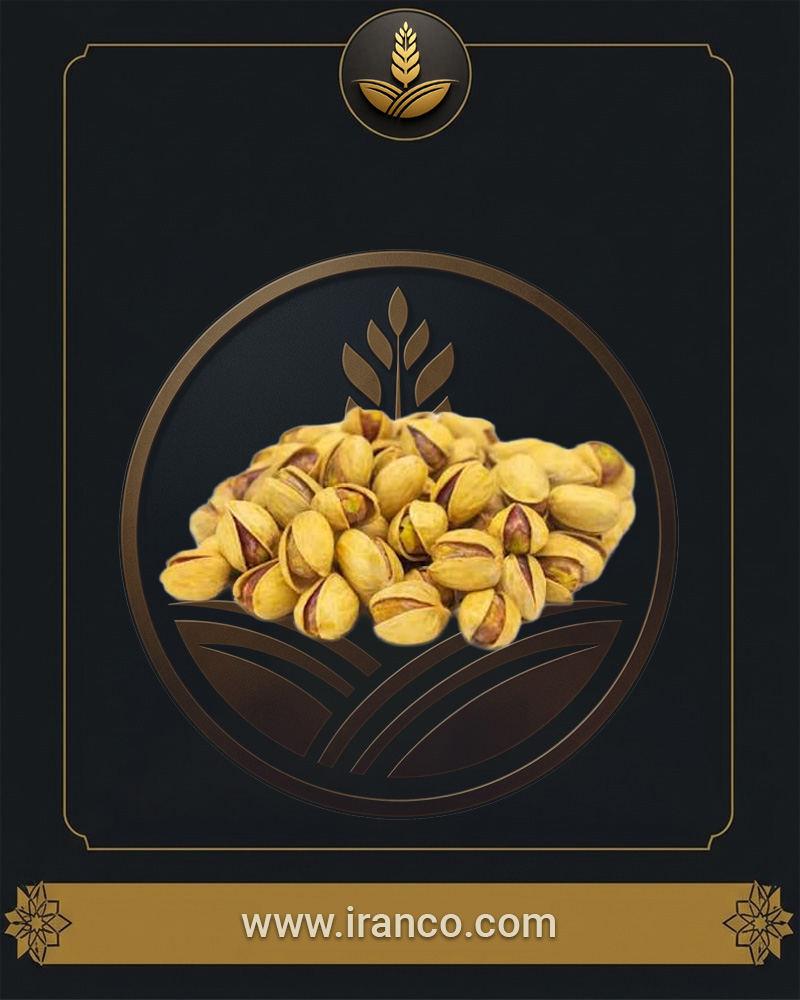
Kalleh Ghouchi is a large, predominantly round Iranian pistachio type often grouped with jumbo pistachios in international trade. Its size, relatively full kernel and striking appearance are the main commercial differences from smaller Iranian types. When buying dried nuts for the German market, two end uses must be distinguished.
In-shell sales
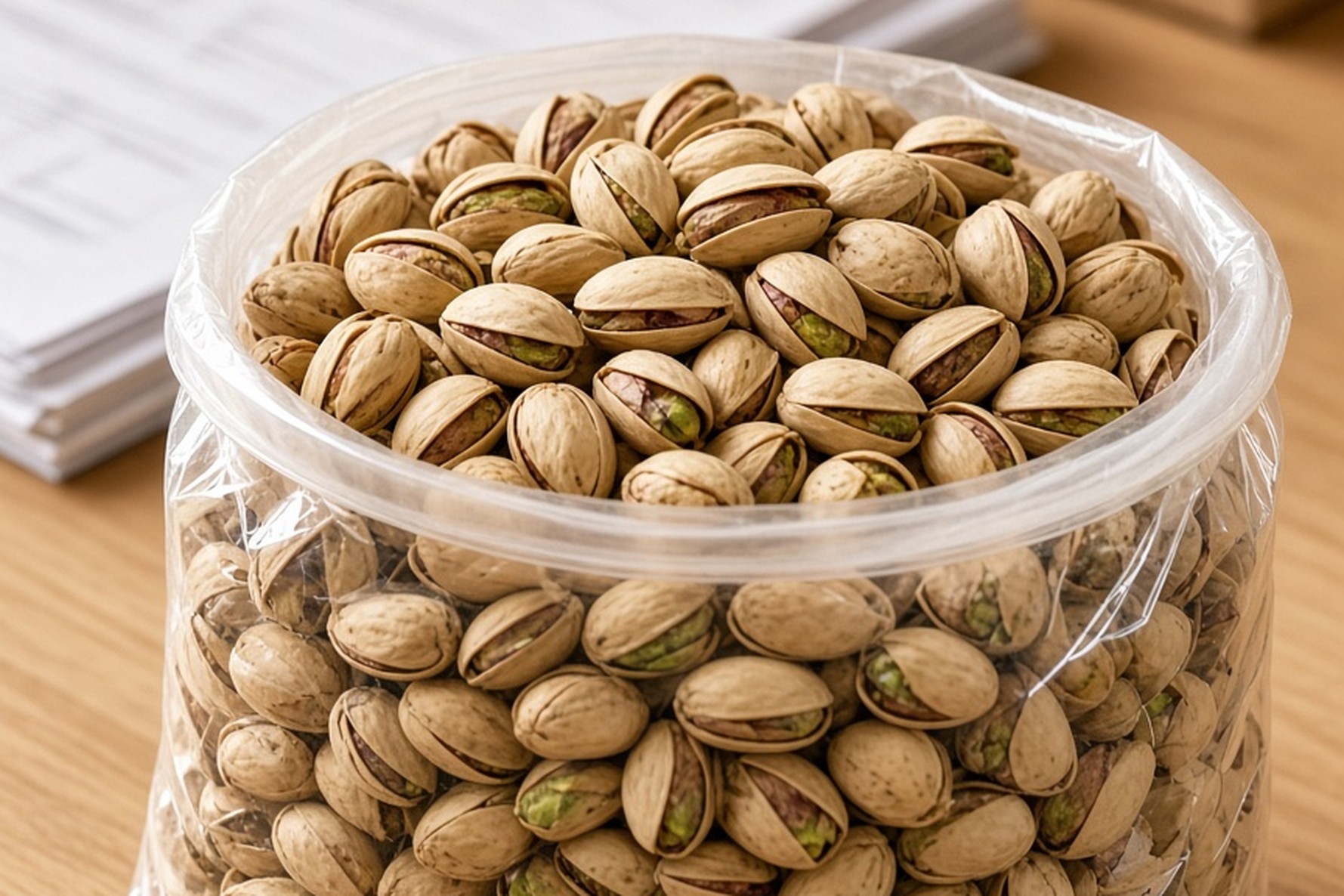
In this channel, visual appearance directly affects purchase decisions. Buyers assess kernel size and uniformity, open-kernel percentage, natural or mechanical split, shell cleanliness, closed-shell percentage, broken and empty kernels, surface stains, insect damage, odour and flavour, and consistency across the lot. Kalleh Ghouchi can perform well here because kernel size is clearly visible in transparent packs or bulk displays.
Post-shelling or processing use
If the importer will shell, crush or feed the product into a food-manufacturing line, visual size matters less. Kernel yield, colour, flavour, real usable-kernel cost and product safety become more important. The exporter must know from the outset whether the buyer wants Kalleh Ghouchi for in-shell sale or for processing.
Commercial Kalleh Ghouchi sizes
Export pistachio size is usually expressed as kernel count per ounce, approximately 28.35 g. The fewer kernels per ounce, the larger the nut. In Kalleh Ghouchi trade, sizes such as 20/22, 22/24 and 24/26 are common, and very large 18/20 also appears in some shipments.
| Size | Commercial meaning | Likely application |
|---|---|---|
| 18/20 | Very large | Premium packs and limited orders |
| 20/22 | Large | Premium retail and mixed-nut packs |
| 22/24 | Large to medium | General in-shell sales |
| 24/26 | More economical within Kalleh Ghouchi | Mixed nuts and volume packs |
Size alone should not be the pricing criterion. Two 20/22 lots may differ materially in natural split percentage, empty-shell rate, shell colour, aflatoxin, moisture, uniformity and cleaning cost.
2. Why is Germany's aflatoxin standard critical for pistachio exporters?
Germany follows harmonised EU rules on food contaminants. The main acceptance criterion for aflatoxin is therefore EU regulation — not a separate standard set by each importer. Under EU rules, for almonds, pistachio and apricot kernels placed directly on the market for final consumption or use as a food ingredient, maximum aflatoxin B1 is 8 µg/kg and the total of B1, B2, G1 and G2 is 10 µg/kg.
For pistachio that will undergo sorting or other physical treatment before final sale, maximum B1 is 12 µg/kg and total of the four aflatoxins is 15 µg/kg. The distinction between these two categories is highly important in export contracts.
| Product status | Aflatoxin B1 | Total B1+B2+G1+G2 |
|---|---|---|
| Final consumption or direct food use | 8 µg/kg | 10 µg/kg |
| Sorting or physical treatment before final sale | 12 µg/kg | 15 µg/kg |
Why is aflatoxin a complex problem in pistachio?
Aflatoxin is not like moisture or salt, which may be evenly distributed through a lot. A small number of highly contaminated kernels can exist within several tonnes of pistachio. That uneven distribution means the issue is not merely "laboratory accuracy" — if the initial sample is not truly representative, even a highly precise test cannot correctly reflect the condition of the whole cargo.
The professional question for a German buyer is: "From which lot, using what sampling method, from how many points, before or after final sorting, and by which laboratory was this result obtained?"
3. What does 50% EU border control on Iranian pistachio mean?
Pistachio and some pistachio products of Iranian origin are subject to intensified EU controls on non-animal food due to aflatoxin risk. Under the current EU implementing regulation, in-shell pistachio under code 08025100 and shelled pistachio under code 08025200 of Iranian origin fall within the aflatoxin control group, with identity and physical check frequency set at 50%.
This does not mean an exporter can predict which container will be sampled. Importers must design import cost and timing so that the possibility of official border control is part of normal trade practice.
Commercial message of these rules
For Iranian Kalleh Ghouchi pistachio, quality control must not end with issuing an analysis report on loading day. The exporter must be able to demonstrate:
- The product batch is traceable.
- Final sorting was completed before sampling.
- The lot was not re-mixed with another cargo after sampling.
- Bags or packs carry traceable identifiers.
- Shipment documents match the physical product.
- The test result relates to the same export batch.
For goods covered by the annex on special import conditions, EU rules also require shipment documentation to include sampling and test results and official certification. This is one reason a German buyer may ask about sampling date, batch number, laboratory name, test method and official documents.
4. Aflatoxin sampling — more important than choosing the test instrument
The biggest mistake in aflatoxin control is selecting an advanced laboratory while sending a sample taken only from a few conveniently available bags in the warehouse. EU implementing regulation 2023/2782 sets sampling and analysis methods for mycotoxins and has replaced the older Regulation 401/2006. Since 2024 this has been the current basis for official mycotoxin control in the EU.
The technical principle is simple: the sample must be as representative of the whole lot as possible. Suppose a container consists of hundreds of bags and contamination is concentrated in a few locations — sampling only from bags at the front of the container may miss all contaminated points entirely.
In some pistachio-related methods, the regulation even defines aggregate sample weight and the number of incremental samples by batch weight. For example, in a special method for some vacuum-packed pistachio shipments, batches of 15 tonnes or more require at least 50 incremental samples and a 20 kg aggregate sample. This illustrates why a 500 g sample from one bag cannot replace a valid sampling plan.
Exporter commercial sampling
An exporter is not necessarily required to replicate official border sampling exactly in internal controls, but the higher the shipment value and buyer sensitivity, the more logical it is to align internal control with official sampling logic. A suitable internal plan should define at minimum:
- Batch ID, batch weight and number of packs or bags
- Sampling locations and times
- Product condition at the time of sampling
- Name of the person responsible for sampling
- Method for forming the aggregate sample and dividing the laboratory sample
- How the reference sample is sealed and retained
5. Which laboratory tests matter for export Kalleh Ghouchi pistachio?
Aflatoxin is the most important test for the German market, but it is not the only quality and safety test relevant to pistachio. A professional buyer should tailor the test programme to end use, contract terms and risk assessment.
| Parameter | Purpose | Importance |
|---|---|---|
| Aflatoxin B1 | Control of key contaminant | Very high |
| Total B1, B2, G1 and G2 | Legal limit compliance | Very high |
| Moisture | Storage stability control | High |
| Pesticide residues | EU MRL compliance | High |
| Relevant microbiological contamination | Product hygiene assessment | Depends on use |
| Insect and storage-pest evidence | Lot quality and integrity | High |
| Empty-shell and closed-shell percentage | Real lot value | High |
| Broken and defective kernel percentage | Commercial grade control | High |
| Size | Contract compliance | High |
| Sensory characteristics | Rancidity and fat deterioration control | High |
Aflatoxin measurement methods
Specialist laboratories may use methods such as liquid chromatography with appropriate detection or mass-spectrometry-based techniques. The phrase "tested" alone is insufficient — the report must state aflatoxin B1 level, total of the four aflatoxins, result units, method limit of detection and which batch the sample represents.
Pesticide residues
Imported pistachio must comply with EU maximum residue limits. This differs from aflatoxin — aflatoxin is a fungal contaminant, while pesticide residues relate to chemical use in the orchard and production chain. For a German buyer importing directly into retail or food manufacturing, a multi-residue programme aligned with EU requirements may form part of the purchase specification.
6. Technical specifications to agree before issuing a proforma invoice
The phrase "export-grade Kalleh Ghouchi pistachio" is not enough for a professional contract. Two sellers may use the same label while their lots differ materially in size, split type, defects, aflatoxin and packaging. Purchase specifications should be as measurable as possible.
| Parameter | Option or specification | Why it matters |
|---|---|---|
| Product | Kalleh Ghouchi in-shell or kernels | Base product definition |
| Processing status | Raw, roasted or other | Defines end use |
| Size | e.g. 20/22 or 22/24 | Direct price effect |
| Split method | Natural or mechanical | Quality and price |
| Closed-shell | Agreed maximum | Yield control |
| Empty kernels | Agreed maximum | Real value control |
| Breakage | Agreed limit | Visual quality |
| Foreign matter | Agreed limit | Lot cleanliness |
| Moisture | Agreed value | Storage stability |
| Aflatoxin | Clear contractual limit | Safety and clearance |
| Packaging | Material and net weight | Logistics and warehousing |
| Batch number | Mandatory in traceability system | Traceability |
| Country of origin | Iran | Trade documentation |
| Reference sample | Retained from each batch | Dispute resolution |
A buyer may set a contractual aflatoxin limit below the EU legal maximum. An exporter preparing a lot exactly at the legal limit has very little operational margin — internal test results and official border sampling results will not necessarily match exactly.
7. How to distinguish Kalleh Ghouchi suitable for Germany from a weak lot
Attractive appearance is necessary but not sufficient. One of the most serious purchase risks is approving a premium sample and receiving a lower-grade shipment.
Size uniformity
If the contract is 20/22, the sample must truly represent that sizing. A mix of noticeably smaller kernels with a few very large ones can make a display sample look attractive while the actual lot is not uniform.
Natural split
For many in-shell buyers, natural split carries greater value. If opening method matters to the buyer, it must be recorded in the purchase specification.
Shell appearance
Excessive shell staining, contamination marks, high breakage and abnormal discolouration can reduce pack value.
Kernel quality
Visual inspection of shells alone is not enough. A number of kernels should be opened to assess full kernel development, natural colour, insect damage, shrivelled kernels, spoilage, stale flavour and foreign odours.
Odour and flavour
Pistachio fat can oxidise under poor storage conditions. A lot acceptable on aflatoxin but with stale, sharp or rancid flavour is unsuitable for premium consumer packs.
8. Tariff codes, import duty and entry documents for Germany
Fresh or dried pistachio is classified in the EU tariff system according to whether it is in shell or shelled. For both groups, the general EU third-country import duty rate is 1.6%.
| Pistachio status | Main code |
|---|---|
| In-shell, fresh or dried | 08025100 |
| Shelled, fresh or dried | 08025200 |
Customs duty is only part of import cost. Food controls, sampling fees, testing, possible shipment hold, port services, warehousing and import VAT must also be included in the importer's total cost calculation.
Trade documents
- Commercial invoice and packing list
- Bill of lading and certificate of origin
- Food-control-related documents
- Required test results
- Official certificate related to special shipment requirements
- Batch and traceability information
Iranian pistachio is subject to special aflatoxin control conditions. Exporters must not treat food-safety documents as a secondary attachment — they are central to whether the shipment can enter the market.
9. Suitable packaging for Kalleh Ghouchi export to Germany
Export packaging is not only about preventing spillage. The pack must protect pistachio from moisture, contamination, foreign odours, insects, mechanical damage and fat oxidation.
Bulk packaging
For an importer who repacks in Germany, bulk packaging is usually more economical. Master bags or cartons must have adequate mechanical strength and a product-contact layer suitable for food use.
Consumer packs
If product is packed in Iran for final sale, label design must align with destination-market requirements. Oxygen and moisture barrier performance, seal quality, net weight and shelf life become more important.
Vacuum or modified-atmosphere packaging
Reducing product contact with oxygen can help protect fat quality, but no packaging technology replaces proper drying, sound product and warehouse control.
Pallets and containers
- Container floor must be dry and free of foreign odours
- No water damage or contamination should be visible
- Bags must not sit directly on wet surfaces
- Stowage must prevent pack damage
- Batch identifiers must be visible on packs
Moisture control on sea routes matters because temperature changes can cause condensation inside the container.
10. How is Kalleh Ghouchi pistachio price determined for a German buyer?
Prices are comparable only when two offers have substantially identical specifications. Comparing the price of natural-split 20/22 pistachio with 24/26 or mechanically split product without adjusting specifications does not produce a valid commercial result.
| Factor | Typical price effect |
|---|---|
| Kernel size | Larger sizes usually command higher value |
| Kalleh Ghouchi supply availability | Short supply can widen price gaps |
| Natural split | Usually valued above lower-quality alternatives |
| Uniformity | Precise sorting adds cost |
| Defects | Lower defects increase processing cost |
| Aflatoxin | EU-ready controlled batches carry higher commercial value |
| Packaging | Specialist packs add cost |
| Number of tests | Broader test programmes increase QC cost |
| Order volume | Affects sorting, packing and freight cost |
| Delivery terms | Delivery point strongly affects cost and risk |
| Purchase timing | Depends on crop year, stock and market conditions |
For a German importer, origin purchase price is not the only economic indicator. A truly comparable price must include product cost, packaging, testing, inland haulage, export formalities, international freight, border control, import duty, port services and capital cost during clearance. A cheaper lot that fails aflatoxin control at the border can end up far more expensive than a fully controlled shipment from the outset.
11. How Iranian pistachio competes with the USA and Turkey in Germany
The EU pistachio market is supplied from several major origins, with the United States and Iran as two leading sources. Competition is not price alone — Iran's Kalleh Ghouchi advantage is meaningful only when the buyer genuinely needs large, round in-shell pistachio.
| Origin | Commercial feature | Buyer review point |
|---|---|---|
| Iran | High variety and access to large Kalleh Ghouchi | Aflatoxin control and batch compliance |
| United States | Industrial supply and broad standardisation | Price, specifications and availability |
| Turkey | Strong presence in European nut and food industries | Size, application and price |
| Other origins | More limited supply | Supply stability and specifications |
If product will immediately be crushed or converted into paste, paying more purely for large shell size may not be economical. Kalleh Ghouchi should not be offered to every customer as a "premium" product by default — it must be shown that size advantage creates economic value in the buyer's final application.
12. Importer checklist before placing an order
Before buying Kalleh Ghouchi from Iran, importers should confirm at least the following in writing. In export orders, these details separate a purchase based on "product name" from a professional specification-based purchase.
- Specify in-shell or shelled pistachio.
- Define raw or processed product status.
- State exact size such as 20/22 or 22/24.
- Define natural or mechanical split if relevant.
- Set maximum closed-shell percentage.
- Set limits for empty and broken kernels.
- Define shell and kernel appearance criteria.
- State acceptable contract moisture.
- Set contractual limits for aflatoxin B1 and total aflatoxins.
- Define pesticide residue testing if required.
- Obtain a representative sample and code it.
- Confirm the sample was taken from the final batch.
- Agree acceptable laboratory for both parties.
- Record dispute procedure for differing test results.
- Define net weight per pack.
- Review product-contact packaging material.
- Review batch numbering system.
- Define delivery location and Incoterms.
- Assign responsibility for control and additional testing costs.
- Reconcile documents before shipment movement.
- Retain a reference sample from the export batch.
- Define lot rejection criteria in the contract.
What information is needed for an accurate quote?
A request for "Kalleh Ghouchi pistachio price for Germany" is not enough to receive a comparable offer. A price request should include at minimum:
- In-shell or shelled pistachio
- Raw or processed status
- Desired size and natural split or other specifications
- Appearance grade and acceptable defect limits
- Target aflatoxin level and supplementary tests
- Pack weight — bulk or consumer format
- Private-label requirement (yes/no)
- Total order weight, destination city or port and transport mode
- Preferred delivery terms and approximate purchase timing
The more precise the purchase request, the smaller the gap between received offers. Through Iranco, supply requests can be submitted with these same specifications so available options are compared on a like-for-like basis.
Kalleh Ghouchi pistachio supply from Iran for the Germany market
In international Kalleh Ghouchi procurement, choosing a seller is only one step. Size, split status, defect limits, moisture, aflatoxin level, packaging type and order volume must first be defined. A sample that truly represents the sellable batch must then be reviewed and a test programme agreed.
For the German market, product approval should occur at two levels: first commercial quality — size, appearance, flavour and uniformity; second safety requirements, especially aflatoxin and pesticide residues where needed. After sample approval, it must be clear whether final product will come from the same batch or an equivalent batch with matching specifications.
Iranco (iranco.com) can be used to submit purchase requests and review available supply options in Iran. Buyers can include specifications such as in-shell Kalleh Ghouchi, desired size, order volume, packaging, Germany as destination country and laboratory requirements in their request.
Conclusion
Kalleh Ghouchi pistachio export to Germany creates real commercial advantage when kernel size and appearance match the buyer's sales channel. For premium nut packs and in-shell retail, large Kalleh Ghouchi sizes can offer strong visual value — but the same feature may not be economically justified in a paste or powder production line.
Aflatoxin is the decisive factor in the transaction. The EU sets limits of 8 µg/kg for B1 and 10 µg/kg for the total of four aflatoxins in ready-to-eat pistachio, and Iranian pistachio remains under intensified control. A test result is valuable only when sampling was performed correctly and the sample truly belongs to the same export batch.
For importers, the best way to compare offers is to fix product specifications first and compare prices second. For exporters, safety margin in aflatoxin control, batch traceability, proper sorting and preventing re-mixing after sampling matter far more than presenting a standalone test report. In the German market, Kalleh Ghouchi is not sold on large kernel size alone — the product must be equally consistent and defensible in quality, documentation and food-safety control.
FAQ
Is Kalleh Ghouchi pistachio suitable for the German market?
Yes, especially when the buyer needs large in-shell pistachio for nut packs, premium mixed nuts or retail sale. Kalleh Ghouchi's round shape and large size are visual advantages. However, commercial suitability depends on size, split type, defect level, price and — above all — aflatoxin compliance with EU regulations.
What is the aflatoxin limit for pistachio in Germany?
For pistachio placed on the market for final consumption or direct use as a food ingredient, maximum aflatoxin B1 is 8 µg/kg and the total of B1, B2, G1 and G2 is 10 µg/kg. For product formally intended for sorting or physical treatment before final sale, limits of 12 and 15 µg/kg apply respectively.
Is a single aflatoxin test report enough for export?
No. The validity of a result depends on sampling method and whether the sample represents the actual lot. Aflatoxin can be highly unevenly distributed. Batch number, sampling date, aggregate-sample method, laboratory and lot traceability must therefore be clear. For Iranian pistachio, official EU entry requirements apply in addition to commercial controls between seller and buyer.
What does size 20/22 mean for Kalleh Ghouchi pistachio?
This number refers to the approximate count of pistachio kernels per ounce of weight. Size 20/22 means roughly 20 to 22 kernels per ounce — so the lower the size number, the larger the kernel. For price comparison, size must be assessed together with split type, defects and overall quality.
What is the tariff code for in-shell pistachio entering Germany?
Fresh or dried in-shell pistachio falls under heading 08025100. Fresh or dried shelled pistachio is classified under 08025200. This distinction matters for customs declaration, import-rule review and duty calculation.
Is Iranian pistachio always tested when entering the EU?
Iranian pistachio is subject to intensified EU control due to aflatoxin risk. Identity and physical check frequency for the relevant group is set at 50%. This does not mean every single shipment is tested, but importers must budget for the time and cost of possible official control.
What should be done before export to reduce aflatoxin risk?
Control must begin with product management and sorting, not end with a final test alone. Separating defective kernels, controlling drying and storage conditions, preventing mixing of different batches, broad sampling from final product and testing the export batch all reduce risk. After sampling, the lot composition must not be changed without control.
How should export Kalleh Ghouchi prices be compared?
Specifications must first be aligned between offers. Size, split percentage, processing status, defect limits, moisture, aflatoxin requirements, pack weight, order volume and delivery terms all affect price. Comparing price per kilo alone without matching these variables can produce misleading results.
How can Kalleh Ghouchi pistachio be sourced from Iran for the German market?
The product must first be defined precisely: in-shell or shelled, size, split status, defect limits, target aflatoxin level, packaging, order volume and destination. Sample and test results are then reviewed. International buyers can submit these details through an Iranco purchase request so available supply options in Iran are evaluated against their requirements.
Is the largest Kalleh Ghouchi size always the best choice for Germany?
No. Very large sizes are attractive for premium packs but may carry a higher purchase price. For general retail, mixed-nut blends or industrial use, 22/24 or 24/26 may be more logical on cost and application grounds. The right choice should align with the buyer's final selling price and distribution channel.
Featured Products


Related Articles



