 Iranco Magazine Team
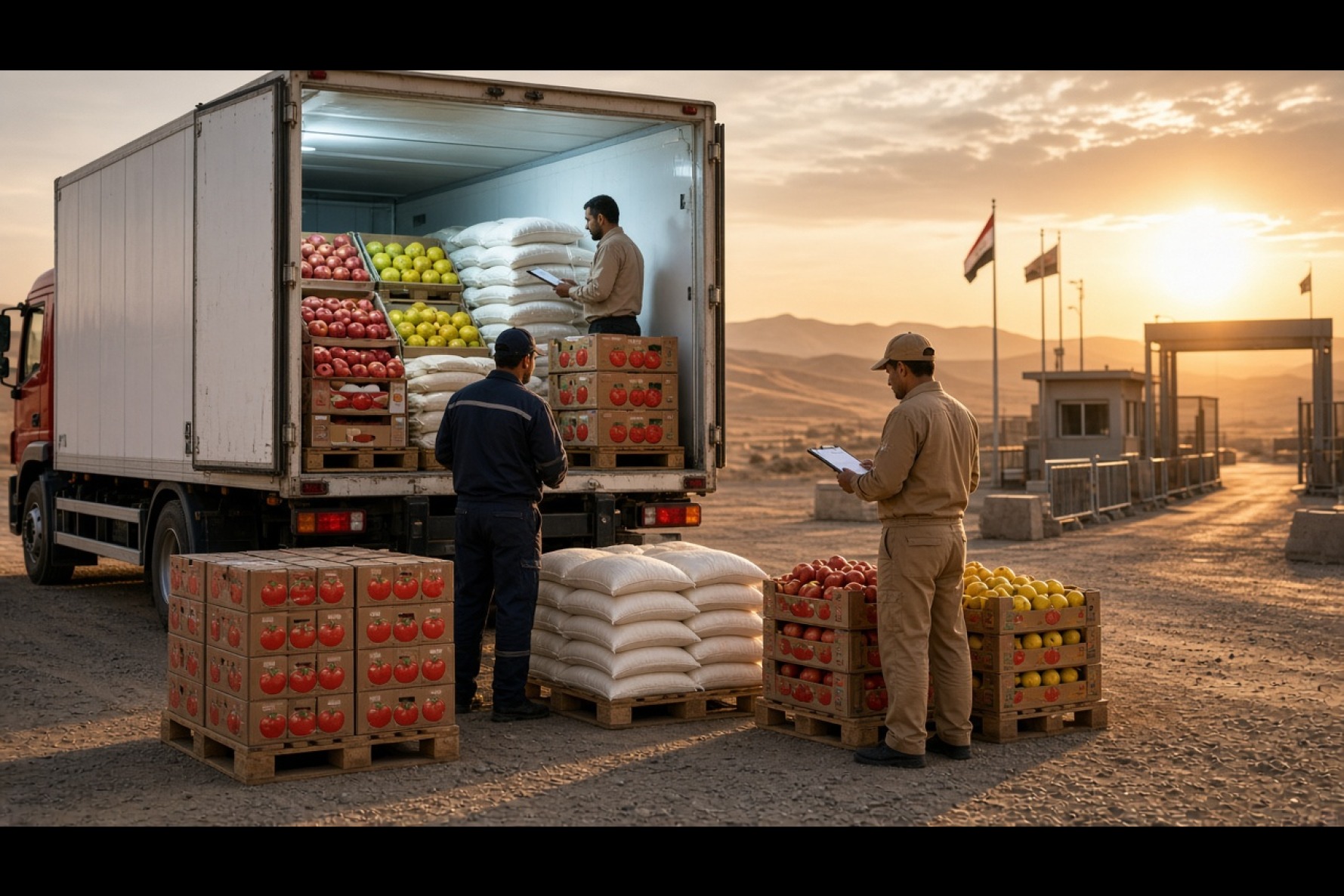
Iraq food market analysis — high-demand goods, Iran's position, land and sea routes, seasonal limits, customs requirements, import costs and practical tips for trading with Iraqi buyers
Market Report & Import Guide 2026
What Foods Do Iraqi Traders and Importers Focus On — and Through Which Routes, Borders, Costs and Regulations Does Import Take Place?
Analysis of Iraq's food market, high-demand products, Iran's position, land and sea routes, seasonal restrictions, customs requirements, import costs and practical notes for dealing with Iraqi buyers.
Iraq is one of the region's most important markets for imported food, but demand alone is not enough for successful entry. An exporter must simultaneously review import licensing, Iraq's agricultural calendar, product standards, certificates of conformity, customs tariffs, the right border crossing and final delivered cost. This report examines the structure of the market and the practical path of food imports into Iraq from both buyer and exporter perspectives.
Analytical Introduction
Iraq's food market offers Iranian exporters a key advantage: short geographic distance combined with high consumer demand. Major cities such as Baghdad, Basra, Erbil, Sulaymaniyah, Najaf, Karbala and Mosul host extensive networks of wholesalers, retailers, restaurants, food industries and distributors — and a significant share of their needs is met through imports.
A simplistic view such as "Iraq buys food, so any Iranian product can be exported" can prove costly. Iraq's import policy has become more active in recent years. The government uses import bans, agricultural calendars, sectoral licences, entry-point controls and support for domestic production for certain agricultural products, livestock and poultry.
In September 2026 Iraq's Ministry of Agriculture announced that imports of 33 items are banned under the domestic production support policy, and 15 other products — including tomato, cucumber, potato, onion and eggplant — face variable restrictions depending on the production season and domestic supply. Imports of whole chicken, chicken parts and chicken products were also subject to a ban from 15 January 2026 to protect domestic industry. A product that showed large import volumes in 2024 is therefore not necessarily freely importable in 2026.
For Iranian exporters, the main advantage is not low freight cost alone. Fast land shipment, access to multiple border crossings, ability to supply fresh and processed products, proximity of consumer tastes and the option to move smaller consignments than in intercontinental trade are more important strengths. Commercial success, however, depends on knowing the import licence for the specific product, choosing the right border, correct product classification and full document coordination before the truck moves.
2024 trade data shows Iraq has significant import markets in groups such as meat, chicken, rice, citrus, fresh fruit, tomato products and some dairy. Even so, 2026 commercial conditions should not be read solely from 2024 figures; government policy to protect domestic production has banned or seasonally restricted imports of certain products.
1. Which Foods Do Iraqi Importers Focus On Most?
The short answer is that Iraq's import demand cannot be reduced to a single food group. Rice, meat, fruit and citrus, dairy products, tomato products, processed foods, snacks, frozen goods and, in some periods, certain fresh vegetables all hold a significant share of the country's food trade.
For commercial analysis, three concepts must be distinguished: consumer demand, historical import volume and legal importability today. Market demand for a product may be high, yet the Iraqi government may not allow entry when domestic production is abundant.
Rice — a core import item
In 2024 Iraq imported about 430 million kilograms of rice worth nearly USD 481.8 million. India was the leading supplier at over USD 343 million; Thailand and the United States also held significant shares. Iran's recorded share was about USD 9.1 million.
In the rice market, Iraqi buyers typically focus on grain length, aroma, broken-grain percentage, cooking uniformity, colour, moisture, product cleanliness, packaging and consistency across successive shipments.
Red meat and meat products
The value of Iraq's meat and edible offal imports in 2024 was about USD 654.4 million. Brazil, India, Turkey and Iran were major suppliers. Frozen beef imports alone exceeded USD 227 million.
The meat market is more sensitive than dry goods to health documents, veterinary status of the country of origin, slaughterhouse approval, halal conditions, production date, transport temperature and the cold chain.
Chicken — large historical market, serious current restriction
In 2024 Iraq imported about USD 392.3 million of chicken meat and edible offal. Brazil, Turkey, Iran, the United States and Ukraine were major sellers. From 15 January 2026, however, Iraq's Ministry of Agriculture enforced a ban on imports of whole chicken, parts and chicken products to support domestic industry.
Large historical statistics in this group should therefore not be read as an open current import opportunity.
Fresh fruit — an important area for Iran
Iran's position in some fruit products is very prominent. In 2024 Iraq imported over USD 80 million of fresh apples, of which about USD 79.4 million came from Iran — meaning Iran was effectively the main recorded supplier in that year.
In citrus, Iraq's total imports in 2024 were about USD 175.9 million, with Iran at about USD 34.7 million among the important sellers.
Tomato and processed tomato products
In 2024 Iraq imported about USD 44.1 million of fresh tomatoes, of which more than USD 37.5 million was from Iran. Fresh tomato entry can, however, be suspended under Iraq's agricultural calendar.
Processed products tell a different story. Imports of preserved or processed tomato under the relevant tariff line in 2024 were about USD 122.8 million, of which Iran supplied more than USD 52.6 million.
This difference shows exporters should not treat "fresh tomato" and "tomato paste or processed tomato" as one market. Regulations, tariff codes, packaging, shelf life, competitors and sales channels differ.
Dairy
Iran also has an important presence in some dairy subgroups. In 2024 Iraq imported about USD 38.9 million of fresh cheese, of which more than USD 19.8 million came from Iran.
Shelf-stable dairy, cheese, cream, UHT milk, milk powder and similar products are separate markets; standard and transport conditions must be reviewed for each.
| Product group | Import demand status | Commercial note for exporter |
|---|---|---|
| Rice | High and structural | Intense competition with India and Thailand |
| Frozen meat | High | Veterinary control and cold chain are decisive |
| Chicken | Historically high; currently restricted | Current import ban must be respected |
| Apple | Important market for Iran | Sort, size, shelf life and fast transport matter |
| Citrus | High imports | Egypt, Iran, South Africa and others compete |
| Fresh tomato | Demand exists | Subject to agricultural calendar and seasonal licence |
| Processed tomato | Large processed market | Brix, net weight and pack type matter |
| Cheese and dairy | Significant | Standard, expiry date and transport temperature matter |
| Confectionery and snacks | Active consumer market | Price, small pack and distribution network matter |
| Frozen foods | Urban and food-service market | Cold chain and quality after thawing matter |
2. What Is the Real Structure of Iraq's Food Market?
Iraq should not be treated as one integrated market with a fixed buying pattern. Baghdad, Basra, central and southern regions and the Kurdistan Region differ in supply routes, distribution structure and even seller preference.
Baghdad
Baghdad is the country's largest consumption and distribution centre. Many consignments entering from Iran, Turkey, Jordan or southern ports ultimately distribute part of their load through Baghdad's market.
For packaged consumer goods, a distributor with a sales network matters far more than simply finding a licensed importer.
Basra
Basra is both a large consumption market and an entry point for sea cargo through Umm Qasr port and for land cargo from the south and east of the country.
For products imported from India, East Asia, Brazil, the UAE and other sea routes, Umm Qasr is the natural entry point.
Erbil, Dohuk and Sulaymaniyah
The Kurdistan Region market has very close access to Turkey and Iran's north-western borders. A large share of Turkish land cargo enters through the Habur–Ibrahim Khalil corridor.
For exporters in western and north-western Iran, crossings such as Bashmaq and Haji Omaran are important for distance to cities in the Region.
Najaf and Karbala
Beyond permanent population, pilgrim traffic and extensive hotel, restaurant and food-service activity affect demand in these two cities. Consumer packs, water and beverages, dairy, kitchen ingredients and food-service products have distinct markets here.
Retail versus wholesale
A product sold in shops is not necessarily the same pack a restaurant or factory needs.
A retail buyer cares about pack design, unit weight, consumer price and shelf life. An industrial or food-service buyer focuses more on price per kilogram, quality consistency, bulk pack, delivery speed and continuous supply.
3. Iran's Position in Iraq's Food Market — Where Is the Real Opportunity?
Iran's advantage in Iraq is not the same across all food groups. In some groups Iran is a main or important supplier; in others it competes with very large global suppliers.
For example, competing with India in rice or frozen meat is harder than competing in fresh apple or some processed products.
| Product | Iran's 2024 data position | Main competitor(s) |
|---|---|---|
| Fresh apple | About USD 79.4M recorded exports to Iraq | Competitor share much smaller |
| Fresh tomato | About USD 37.6M | Syria |
| Citrus | About USD 34.7M | Egypt, South Africa, Syria |
| Processed tomato | About USD 52.6M | China and other suppliers |
| Fresh cheese | About USD 19.8M | Saudi Arabia, Egypt, Jordan |
| Rice | About USD 9.1M | India, Thailand, USA |
| Meat and edible offal | About USD 48.2M | Brazil, India, Turkey |
| Meat products | About USD 8.9M | Brazil, Jordan, UAE |
For Iranian exporters, goods with a favourable value-to-freight ratio or where delivery speed is a competitive factor are more attractive.
Fresh fruit and vegetables are a clear example. An Iranian producer can have shorter transit than a distant supplier. This market is also most exposed to Iraq's seasonal import bans.
In factory foods, geographic advantage gains commercial value when paired with competitive price, suitable packaging for the Iraqi market, stable quality, correct labelling and an active distributor.
For an Iraqi buyer, the cheapest offer is not necessarily the most attractive. If a consignment stops at the border because of incomplete certificates, several days of truck detention can erase any initial price saving.
4. Through Which Routes and Borders Does Most Iraqi Food Import Enter?
Three main import routes are: Umm Qasr ports in the south, the Turkey–Ibrahim Khalil land corridor in the north, and the set of Iranian land borders in the east.
For imports from Asia, Brazil and other distant origins, the Umm Qasr sea route is central. Turkish goods and part of European transit enter mainly through Habur–Ibrahim Khalil. Iranian products enter Iraq through several western Iranian borders depending on final destination.
| Route | Better suited for | Natural destinations in Iraq | Main feature |
|---|---|---|---|
| Umm Qasr | Rice, oil, frozen meat, canned food | Basra, Baghdad and nationwide | Suited to sea trade and high volume |
| Ibrahim Khalil–Habur | Turkish food and European transit | Dohuk, Erbil, Mosul and central Iraq | Main Turkish land corridor |
| Shalamcheh | Iranian products | Basra and southern Iraq | Short route to the south |
| Zurbatiyah–Mehran | Iranian products | Wasit, Baghdad, Najaf and centre | Good access to central Iraq |
| Mundhiriyah and Diyala axes | Iranian products | Diyala and Baghdad | Suited to eastern Iraq |
| Al-Sheeb and south-eastern borders | Iranian products | Maysan and south | Complementary southern route |
| Bashmaq | Iranian products | Sulaymaniyah and the Region | Suited to western Iran |
| Haji Omaran | Iranian products | Erbil and northern Iraq | Important northern route |
| Taribil–Al-Karamah | Jordanian goods and transit | Anbar and Baghdad | Western corridor |
| Safwan–Abdali | Kuwait and Gulf goods | Basra and south | Land access from Kuwait |
Umm Qasr — main sea cargo route
Umm Qasr is especially important for consignments from India, South-East Asia, East Asia, Brazil or other distant origins.
Rice, oil, food ingredients, frozen meat, canned goods and packaged products can arrive in dry or refrigerated containers at this port.
For frozen products, reefer container cost, terminal power, clearance time and demurrage risk gain greater importance.
Ibrahim Khalil — Turkey's land gateway
Ibrahim Khalil border in Dohuk, connected to Turkey's Habur, is one of Iraq's most important land trade axes.
In March 2026 Iraqi customs announced that imported food and medicines through this crossing are subject to pre-arrival declaration, and customs duties and tax deposits must be registered under the defined formal process.
This change shows Iraqi land trade moving toward pre-entry control and digital registration.
5. Which Border Is Most Suitable for Iranian Food Exports to Iraq?
Border choice should be based on the buyer's final destination, not merely the nearest crossing to the Iranian factory.
A truck destined for Basra should not enter only through the north because of a lower initial freight rate. Internal Iraqi haulage and delivery time can change the whole calculation.
Shalamcheh for Basra and the south
For producers in southern, south-western and central Iran, Shalamcheh matters for access to Basra.
This route suits dry and packaged foods and, where cold-chain infrastructure exists, some chilled and frozen products.
Mehran–Zurbatiyah for central Iraq
This axis offers a good position for access to Wasit and Baghdad and then distribution across much of Iraq.
For products whose final destination is Baghdad, Najaf or parts of central Iraq, comparing cost on this route with Shalamcheh matters.
Bashmaq for Sulaymaniyah
For producers in western Iranian provinces, Bashmaq is a natural route to Sulaymaniyah and surrounding areas.
Shorter route cost must be weighed together with clearance costs and how goods enter federal Iraq's market.
Haji Omaran for Erbil
This crossing has commercial importance for entry to Erbil and parts of northern Iraq.
Kurdistan Region and customs procedure differences
Iraq has moved in recent years to integrate tariff structure between the federal government and the Kurdistan Region. A unified tariff framework was approved in 2024, but in January 2026 Iraqi officials were still reporting establishment of customs points in Nineveh, Kirkuk and Diyala to collect tariff differences between Region entries and the federal structure.
For a seller delivering to Erbil or Sulaymaniyah this may not be the main issue, but if goods will later enter Baghdad or other federal provinces, clearance structure and duties must be clear from the start.
6. Iraq Food Import Regulations in 2026
Food entry into Iraq involves several layers: customs, the Central Organization for Standardization and Quality Control (COSQC), the Ministry of Agriculture for related products, the Ministry of Health or veterinary authorities where applicable, and other sector bodies may all play a role in one consignment.
Electronic customs declaration (ASYCUDA)
Iraqi customs has implemented transition from paper to electronic declaration in the ASYCUDA system from 1 January 2025. Electronic manifest, electronic payment, weighbridge and scanner integration and development of pre-arrival declaration have been part of Iraq's customs reform programme.
The practical result for exporters is clear: details on the invoice, certificate of origin, customs declaration, certificate of conformity and transport documents must align with one another.
Product classification
Customs valuation is based on the HS Code. After declaration, Iraqi customs physically inspects the goods and then proceeds to valuation and duty calculation.
Using a broad or incorrect code to reduce duty can cause valuation dispute, consignment hold or declaration correction.
Customs tariff
Iraq's Customs Tariff Law No. 22 of 2010 remains one basis of the country's tariff structure; Iraq's Ministry of Finance publishes its tables. In February 2026 Iraqi customs stated that duty rates are set per commodity within the consignment and rates start from 5%.
Iraqi customs also announced in January 2026 that new duty increases did not cover food, medicine and essential goods.
This does not mean a flat 5% for all food. Each product's rate must be checked against the exact code in Iraq's customs table.
Ministry of Agriculture restrictions
This section is critically important for exporters of agricultural products.
In September 2026 the Ministry of Agriculture announced that besides 33 banned items, 15 agricultural products are subject to variable calendar restrictions. When domestic production is sufficient, imports of products such as tomato, cucumber, potato, onion and eggplant are suspended; in shortage conditions import may reopen.
For fruit and vegetable exports, the first question before freight price is therefore:
Is import of this product permitted on the order date?
7. Standards, Certificate of Conformity, Health and Labelling
Iraq's Central Organization for Standardization and Quality Control (COSQC) is responsible for conformity control of many imported goods, and imported samples may be referred to this body for testing.
Certificate of conformity
Under Iraq's conformity assessment programme, a wide range of covered goods must be reviewed before shipment and receive a certificate of conformity.
In the current programme list, processed foods fall within a broad scope; fresh food is managed differently. COSQC-approved assessment companies can issue conformity certificates for covered products.
A conformity file typically requires:
- Proforma or commercial invoice
- Technical product specifications
- Batch number
- Production and expiry dates
- Relevant test report
- Health or veterinary certificate where applicable
- Halal certificate for products that require it
- Certificate of origin
- Transport documents
Health and phytosanitary certificates
For fresh plant products, phytosanitary health certificate and quarantine requirements matter.
For meat, animal products and dairy, veterinary health certificate and confirmation of origin and production unit may be mandatory.
For animal-origin goods, invoice and certificate of origin alone are not enough for clearance.
Labelling
Country of origin must be clearly stated. Production and expiry dates for canned and preserved foods must be clearly marked on the pack.
For packaged consumer products, label artwork should be aligned with the Iraqi importer and standard requirements for that product before final printing.
Relabelling at the border or relying on last-minute correction stickers should be avoided; mismatch between label, conformity certificate and commercial documents is a common avoidable cause of hold.
| Document or approval | Use |
|---|---|
| Commercial invoice | Value, seller, buyer and product details |
| Packing list | Number of packs, weight and arrangement |
| Certificate of origin | Proof of country of production |
| Bill of lading or transport document | Links consignment to contract and route |
| Certificate of conformity | For goods covered by the standards programme |
| Laboratory report | Proof of technical and safety specifications |
| Health certificate | Depending on food group |
| Veterinary certificate | Animal products |
| Phytosanitary certificate | Covered plant products |
| Halal certificate | Related products, especially meat |
| Import licence | For groups where a sector authority requires it |
8. What Does an Iraqi Buyer Check in Food Quality Control?
"Food" is a very broad group. Quality criteria for tomato paste differ from rice, apple or frozen meat.
An export contract should therefore use measurable indicators instead of phrases such as "export quality."
Rice
Important points can include broken-grain percentage, grain length, moisture, foreign matter, pest damage, odour, colour, cooking uniformity and net weight.
Fresh fruit
Size, weight, colour, ripeness stage, flesh firmness, skin defects, rot, mechanical damage, sort uniformity and loading temperature matter.
For export apple, the seller should define from the outset how the shipment will match the reference sample for calibre, colour and packaging.
Tomato paste and processed tomato
Brix, colour, salt level, acidity, microbiological safety, net weight, can or aseptic pack specifications and seal condition must be controlled.
Dairy
Fat, protein, salt, moisture, total solids, microbiological tests and storage temperature appropriate to the product matter.
Frozen foods
Production date, product temperature, cold-chain status, pack integrity, freezer burn, free water and, where relevant, glaze percentage should be checked.
Sample versus shipment mismatch
One regional trade risk is that the approved sample comes from the best production run while the loaded goods differ in size, colour or packaging.
The professional solution is to convert acceptance criteria into the contract, not to leave a physical sample as the sole basis of agreement.
9. How Is the Cost of Food Imports into Iraq Calculated?
There is no single figure called "cost of import to Iraq."
Real delivered cost has several layers, and land and sea routes differ fundamentally.
A practical landed-cost formula can be seen as:
Product price + origin inland haul + document and test cost + international freight + insurance + border or port cost + customs duty + deposit or related tax + inspection + warehousing + detention + customs broker + Iraq inland haul
Land freight from Iran
On the Iran route, cost depends on:
- Loading city
- Exit border
- Iraqi destination
- Standard or refrigerated truck
- Load weight and volume
- Need for tractor change or cargo transfer
- Border waiting time
- Peak traffic season
- Truck backhaul
- Security conditions and internal Iraqi route
Tehran–Baghdad, Mashhad–Baghdad, Tabriz–Erbil and Shiraz–Basra rates are therefore not directly comparable.
Sea container cost
For sea shipments, terminal and line services must be added to main ocean freight.
For example, one major shipping line in its published 2025 tariff for Iraq quoted destination terminal service for a 20-foot dry container at USD 212 and 40-foot at USD 255. The corresponding figures for a 20-foot reefer were USD 280 and 40-foot USD 300. The same company quoted USD 50 import service per container in another tariff. These figures are indicators of one part of 2025 port cost only and are not total freight or a new contract rate.
Demurrage — a cost not to underestimate
For sea food cargo, especially reefer, clearance delay can create significant cost.
If conformity certificate, licence or original documents arrive late, the container remains in port. Document preparation before vessel arrival is therefore part of cost management, not a side administrative task.
| Cost factor | Land route | Sea route |
|---|---|---|
| International transport | Truck freight | Ocean freight |
| Border or port cost | Border services | Terminal and line services |
| Container | Usually not applicable | Dry or reefer |
| Detention | Truck waiting | Demurrage and container charges |
| Iraq inland haul | Border to destination | Umm Qasr to destination |
| Cold-chain risk | Medium to high | High for reefer cargo |
| Best suited for | Nearby origin and fast cargo | Large volume and distant origin |
10. Transport and Logistics of Food to Iraq
Choice of transport mode should follow product behaviour.
Dry goods
Rice, pulses, canned goods, confectionery, biscuits and many shelf-stable products can move by truck or dry container.
Severe Iraqi heat for much of the year can, however, create problems for chocolate, sensitive oils or some confectionery.
Fruit and vegetables
For fresh product, time matters more than cost.
Cargo should be harvested at the right ripeness, sorted and packed at suitable temperature and pre-cooled where needed.
Every hour of border delay for a high-respiration product consumes part of its commercial life.
Chilled dairy
If the product requires cold storage, recording container or truck temperature is very important.
The contract should specify how delivery temperature is measured and which party bears responsibility for cold-chain break.
Frozen products
Truck or container must reach operating temperature before loading. Using a reefer container to cool product loaded warm is not correct practice.
Delivery method
In Iran–Iraq contracts, delivery terms must state exactly how far the seller is responsible.
Delivery at factory, border, importer warehouse or final destination creates four completely different prices.
Incoterms should be used with an exact place name. A phrase such as "delivery Iraq" without city, border or terminal is not enough for a professional contract.
11. Importer Checklist Before Placing an Order
Before issuing a final proforma or payment, Iraqi importer and exporter should confirm at least the following:
- Exact commercial and technical product name is defined.
- Product HS Code is checked with the Iraqi customs broker.
- Import legality of that product on the order date is verified.
- Agricultural calendar restrictions for fresh product are checked.
- Iraqi standard or accepted specifications are set.
- Need for certificate of conformity before shipment is clear.
- For animal product, veterinary licence and health status are reviewed.
- For plant product, need for phytosanitary certificate is reviewed.
- Pre-contract sample is approved and numeric specifications recorded.
- Shipment acceptance and rejection criteria are written in the contract.
- Net and gross weight per pack are specified.
- Label language, content, country of origin and dates are confirmed.
- Carton type, strength and palletising method are specified.
- For cold goods, loading and delivery temperature are set.
- Entry border is chosen based on buyer destination.
- Freight rate to that destination is calculated.
- Customs duty is checked against the exact code.
- Clearance, inspection and test costs are included in price.
- Original documents are ready before cargo arrival.
- Container or truck free time is reviewed to avoid detention cost.
This checklist is especially important for exports from Iran; short land distance sometimes leads sellers to assume documents can be completed after the truck moves. In practice, transport speed must match document readiness.
12. Practical Strategy for Entering the Iraqi Market and Sourcing from Iran
Success in Iraq does not start with choosing a "best-selling product"; it starts with finding a product that simultaneously meets three conditions: real demand, import permission and a defensible supplier advantage.
For example, 2024 data shows Iraq was a large chicken importer; the 2026 ban has limited that opportunity. Processed products that domestic Iraqi production does not fully meet and that are not on the ban list may offer a more stable trade path.
For fresh products, sales planning must align with Iraq's agricultural calendar. An exporter signing a multi-month fresh vegetable contract without checking ban periods has effectively imported regulatory risk into the contract.
The right market for a small company is not the same as for a large factory
A small company can enter with limited land loads, custom packaging and fast delivery.
A large factory needs a distributor able to absorb several trucks per month, manage stock and cover geographic market reach.
Export sourcing of Iranian food based on buyer specifications
In international food purchasing, the difference between two offers is not price per kilogram alone. Factory location, product quality, order volume, pack type, testing, exit border and destination city can fundamentally change delivered price.
Iranco allows buyers and importers to register requests based on exact product specifications. Product, order quantity, packaging, required standards and Iraqi destination can be stated from the start so supply options are reviewed on that basis.
For products with seasonal market limits in Iraq, the buyer should verify entry permission with the Iraqi party before finalising production and loading.
To review sourcing of Iranian food for Iraq, include product specifications, approximate order volume, packaging and destination city in your purchase request so suitable supply and delivery route can be assessed against that need.
What Information Should Be Sent for an Accurate Price?
A simple request such as "What is the food price for Iraq?" is not enough for a professional quote.
The buyer should provide at least:
- Exact product name
- Quality specifications
- Weight per pack
- Total order volume
- Retail or wholesale use
- Private label requirement
- Label language and design
- Iraqi destination city
- Preferred border or delivery point
- Ambient, chilled or frozen transport
- Required tests
- Required certificates
- Payment terms
- Desired delivery time
For fresh fruit, size, colour, sort and packaging should also be specified. For industrial foods, indicators such as Brix, fat, protein or other technical parameters for that product should be added.
Iraqi buyers can submit this information as a purchase request on Iranco so Iranian supply options are reviewed against real order specifications.
Summary
Iraq is an important import market for food, but its best opportunities cannot be read only from import volume tables. Rice, meat, citrus, fruit, dairy, tomato products and packaged foods have had significant trade in recent years, yet 2026 regulations show domestic production support has become a main decision factor.
For Iranian exporters, fresh products are an opportunity when import is permitted in that time window. Products such as tomato, potato, onion, cucumber and eggplant can face seasonal limits. The chicken market is a clear example where high historical import volume met new import policy that changed conditions.
In logistics, Umm Qasr is the main sea trade hub, Ibrahim Khalil the key Turkish route, and eastern and north-eastern borders the natural path for many Iranian goods. The right choice among Shalamcheh, Mehran–Zurbatiyah, Bashmaq, Haji Omaran and other entries must follow destination city.
Regulatory fit is another decisive factor. Correct tariff code, electronic declaration, conformity certificate for covered goods, health certificates, correct labelling and import licence must be finalised before the consignment moves.
Iraq is a high-risk market for a seller who offers only price; for a supplier who manages product, regulation, transport route and delivered cost as one chain, it is one of the most practical regional markets for Iranian food trade.
Frequently Asked Questions
Which foods have the greatest appeal for Iraqi importers?
Rice, meat, fruit and citrus, some dairy products, tomato products and packaged foods are among Iraq's important import groups. Commercial appeal must, however, be assessed together with import legality. Some agricultural products are temporarily banned during domestic production season and some groups face longer bans.
Is export of Iranian fruit and vegetables to Iraq possible all year?
No. Iraq uses an agricultural calendar to protect domestic farming. In 2026 products such as tomato, cucumber, potato, onion and eggplant are in the variable-restriction group. Exporters should check import permission for that day through the Iraqi importer before buying product, packing and booking a truck.
Which border is most important for Iranian food exports to Iraq?
No single border is best for all destinations. For Basra, Shalamcheh is well positioned. For Baghdad and central Iraq, Mehran–Zurbatiyah is very important. For Sulaymaniyah and Erbil, Bashmaq and Haji Omaran may be better options. Border choice should compare total cost to the buyer's warehouse.
Do imported foods in Iraq require a certificate of conformity?
A large share of processed foods falls under Iraq's conformity assessment programme and covered consignments must obtain the required certificate before shipment. Exact requirements depend on product and commodity code. For each order it must first be confirmed whether the product is on the covered list.
What is the food import tariff in Iraq?
There is no fixed rate for all food. Duty is set by exact HS Code. Iraqi customs stated in 2026 that tariff rates start from 5%, but the final rate for each product must be taken from that product's line in the customs table. Food and essential goods were not covered by duty increases announced for some other goods in early 2026.
What documents are usually required for food export to Iraq?
Commercial invoice, packing list, certificate of origin and transport document are basic papers. Depending on product, certificate of conformity, health certificate, veterinary certificate, phytosanitary certificate, halal certificate, laboratory report or import licence may also be required. The final document list must be set for that product and that border.
Is land transport from Iran always cheaper than sea?
For direct Iran–Iraq trade, land transport is usually more practical, but "always cheaper" is not accurate. For large orders, factory location, final destination, load weight, container type and detention cost can change the result. Sea transport matters more for distant origins and container or bulk volume.
How is the price of Iranian food for the Iraqi market determined?
Real price should be calculated from product specifications, quality, pack weight, order volume, carton type, test and certificate cost, loading city, exit border and Iraqi delivery point. Comparing two offers on factory price alone can mislead; the professional benchmark is delivered price with identical specifications.
How can food be sourced directly from Iran for the Iraqi market?
Product, technical specifications, order quantity, packaging, destination city and delivery terms must first be defined. Supplier, sample, documents and freight price are then compared. Iraqi buyers can register these specifications on Iranco as a purchase request so available Iranian supply is reviewed against their need.
For Iraq food import advisory and connection to Iranian suppliers
Contact Irancoinfo@iranco.com · WhatsApp: +98 913 104 4182 · Telegram: @irancofood
Featured Products




Related Articles



