 Iranco Magazine Team
From relative dryness and visual uniformity to size, wrinkling, pest-free condition and packaging — how to separate verifiable Zahedi quality from marketing claims
Export Guide · Zahedi Dates · Global Market
Iranian Zahedi Dates in the Global Market: From Relative Dryness and Visual Uniformity to Size, Wrinkling, Pest-Free Condition, and Packaging
How do you separate verifiable Zahedi date quality from marketing claims? Actual moisture, size, colour, wrinkle percentage, lot uniformity, pit condition, pest evidence, defects, and packaging quality — a guide to turning these attributes into measurable specifications you can include in a purchase contract.
Zahedi dates are one of Iran's suitable varieties for volume trade and relatively long transit routes; but commercial value does not come from the variety name alone. For a professional buyer, actual moisture, size, colour, wrinkle percentage, lot uniformity, pit condition, pest evidence, defects, and packaging quality determine where a shipment sits in the commercial hierarchy.
Zahedi dates cannot be evaluated using the same logic as soft, very moist varieties. A major part of this variety's commercial advantage in many markets comes from a relatively firm texture, lower moisture, greater handling resistance, and simpler distribution-chain management. These characteristics make Zahedi worth considering for buyers seeking economical dates for wholesale, repacking, volume markets, or industrial use.
The problem begins when terms such as "Grade A", "export quality", "golden", "super", "premium", or "hand-picked" replace technical specifications. None of these words alone defines what percentage of the lot is severely wrinkled, what the size distribution is, what the average moisture is, how insect damage has been controlled, or what share of fruit falls outside the agreed colour range.
For professional Zahedi trade, higher value is defensible only when quality is converted into measurable indicators. If a buyer is willing to pay more for a shipment, they need to know what that premium is for: larger size? greater uniformity? lighter colour? a lower percentage of severe wrinkling? better removal of defective fruit? tighter pest control? stronger packaging? Or a combination of these factors?
Another important point is that global trade statistics usually do not show Zahedi as a separate variety. HS code 080410 groups fresh and dried dates in one commodity line. Iran's date export figures should therefore not be mistakenly attributed to "Zahedi exports". A realistic Zahedi market analysis must combine total date trade data with variety knowledge, production regions, demand structure, and shipment specifications.
1. The Position of Zahedi Dates in Iran's Date Export Portfolio
Zahedi, known in international trade as Zahidi and sometimes Zahedi, is one of the long-established date varieties of the Middle East and is also cultivated in Iran's southern and south-western date-growing regions. Fars and Bushehr are recognised production areas, and the variety is also seen in other tropical parts of the country.
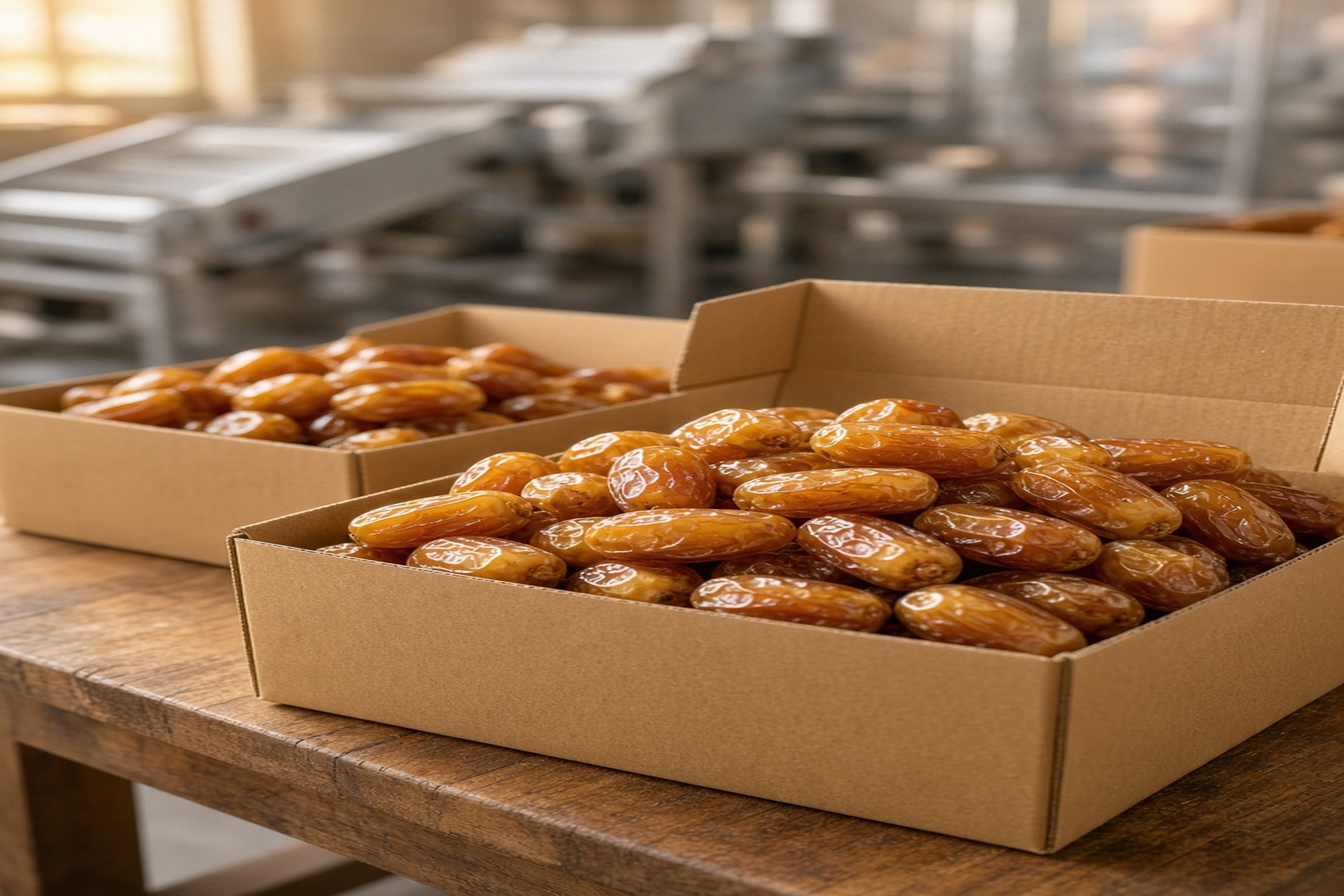
Commercially, Zahedi usually falls in the semi-dry to dry date family. At the market-ready stage its colour can range from golden yellow and amber to light brown. The fruit shape is generally oval or short-elongated, and the texture is firmer than soft varieties such as Mazafati.
These physical characteristics change its market model. Very soft dates usually require stricter temperature control, greater protection against compression, and a more sensitive distribution chain. Zahedi, when properly conditioned and packed, tolerates warehousing, container handling, and bulk distribution better.
That does not mean warehouse control is unnecessary. Dates remain a sweet, hygroscopic food and are not immune to contamination, storage pests, moisture uptake, extreme heat, or spoilage under poor conditions.
A Volume Market, Not Necessarily a Cheap Market
A common misconception is that every semi-dry, transport-resistant date must be a low-price product. In practice, the Zahedi market also has several quality tiers. A lot with uniform fruit, appropriate size, relatively homogeneous colour, clean surface, controlled wrinkling, no live infestation, and professional packaging can command a higher position than mixed, small, heavily wrinkled, or poorly sorted product.
Buyers must therefore distinguish between two concepts: an economical variety for bulk trade and low quality. They are not the same. Zahedi can be chosen for volume markets while still meeting strict specifications and good commercial uniformity.
2. Which Attributes Move Iranian Zahedi into a Higher Commercial Tier?
A higher price is logical only when attributes exist that the buyer can confirm during inspection, sampling, or testing.
| Factor | Standard lot | Higher-tier lot | Proof method |
|---|---|---|---|
| Moisture | Vague terms such as "dry" | Agreed numerical range | Moisture test |
| Size | Mixed | Defined weight range or count per unit weight | Weighing and counting |
| Colour | Wide spread | Relatively homogeneous colour range | Reference sample and inspection |
| Wrinkling | Undefined | Specified maximum severe-wrinkle percentage | Sample count |
| Uniformity | Mixed quality levels | Narrower size and appearance distribution | Sampling |
| Pest | "Clean" claim | No live infestation and defined defect criteria | Inspection |
| Pit | Undefined size and ratio | More stable specifications suited to variety and size | Cutting and sample weighing |
| Packaging | Generic carton | Strong, clean pack suited to load weight | Physical check |
| Defects | "Export quality" label | Numerical defect tolerance | Counting and percentage recording |
This table illustrates an important date-buying principle: "premium" is not a technical specification. If a seller offers "export-grade Zahedi", the buyer should ask exactly which specifications that phrase translates into.
3. Relative Dryness and Moisture: How Is Zahedi's Main Advantage Measured?
Moisture is one of the most influential indicators in date trade because it affects texture, stickiness, weight, the risk of certain microorganisms, storage stability, appearance, and even packaging choices.
Zahedi is naturally regarded as lower in moisture than softer Iranian date varieties. Even so, fixing one number for all Iranian Zahedi is wrong. Production region, harvest timing, ripening stage, drying conditions, storage, and even final preparation can change the finished moisture.
Codex standard CXS 143-1985 places Zahedi among invert-sugar varieties and sets a maximum moisture of 30% for this group. That figure is the general ceiling of the standard, not the suggested specification for a premium commercial contract.
In professional buying, terms such as "dry", "semi-dry", or "low moisture" are not enough. The contract should define a specific moisture range that the seller can actually supply.
Very Low Moisture Is Not Always an Advantage
Reducing moisture to any level does not automatically improve quality. If the product is overdried, texture can become very hard, wrinkling can increase, or sensory acceptance in some markets can fall.
Buyers should therefore assess moisture together with texture and end use. For consumer packs, appearance, chew, and mouthfeel may matter more. For some industrial uses or wholesale markets, stability and ease of handling may be the higher priority.
4. Colour, Size, Wrinkling, and Uniformity: Four Drivers of Visual Value
Colour
Zahedi colour is usually seen in a range from golden yellow and amber to light brown. Expecting every fruit to be exactly the same colour is unrealistic because dates are agricultural products and ripening and production conditions affect appearance. Excessive colour spread, however, can indicate mixed ripening stages, several production batches, or weak sorting.
If colour matters in the destination market, the word "golden" is not enough. A pre-contract approved sample should be kept as a visual reference, and the acceptable colour variation range should be defined.
Size
One of the most verifiable ways to separate grades is fruit weight or count per unit weight. The Codex standard for pitted dates offers the following optional classification:
- Large: fewer than 80 fruits per 500 g
- Medium: 80 to 100 fruits per 500 g
- Small: more than 100 fruits per 500 g
This classification is a general reference and is not necessarily the same as Iranian sellers' commercial grades. If a seller uses other size names, the numerical equivalent must be recorded in the order. The general Codex minimum weight is 4.75 g for pitted dates and 4 g for unpitted dates.
Wrinkle Percentage
Wrinkling is natural to some extent in low-moisture dates, and not every crease is a defect. The issue arises when a significant share of the product is overly shrivelled, low-flesh, or visually unacceptable. "Wrinkle-free" can therefore be unrealistic for Zahedi. A better specification is to define "severe wrinkling" and set the permitted percentage.
For example, buyer and seller can use a reference image set to decide what level of natural shrivelling is acceptable and from what point fruit enters the severe-wrinkle group. The acceptance percentage should be defined in that transaction's contract, not by a generic label.
Uniformity
A lot with a good average size is not necessarily uniform. Average weight may be acceptable while the product mixes very small and very large fruit. For retail, uniformity usually matters more than a simple average. A pack where one fruit is large and the next is half its size creates weak shelf appeal. In sensitive orders, acceptable range and out-of-grade percentage should be specified in addition to average size.
5. Marketing Claims Versus Verifiable Specifications
This is one of the main differences between professional buying and price-only buying.
| Common claim | Problem with the claim | Verifiable specification instead |
|---|---|---|
| Premium dates | No fixed definition | Size, moisture, defects, and uniformity |
| Export quality | Destination and standard not defined | Target-market standard and specifications |
| Hand-picked | Does not fix output quality | Defect tolerance and approved sample |
| Golden | Exact colour not defined | Colour reference sample |
| Pest-free | Must be confirmed by inspection | No live infestation and pest-evidence control |
| Fresh crop | Does not define warehouse condition | Harvest year, storage conditions, and current status |
| Best Zahedi | Not comparable | Technical shipment indicators |
| Large size | No unit defined | Count per 500 g or weight per fruit |
The most important advice for procurement managers is to turn every descriptive attribute into a numerical or inspectable question. Seller says "premium sort"? Ask what percentage shows stain, tear, severe wrinkle, or out-of-size fruit. Says "dry and export suitable"? Request the moisture range. Says "large size"? Define count per 500 g. Says "pest-free"? Put control method and acceptance criteria in the contract. This process materially reduces disputes after loading.
6. Defects, Pest, and Quality Control for Zahedi Dates
Export date control should not be limited to opening a few cartons and looking at colour. The Codex standard for dates defines specific defect groups, including surface spots and abnormalities, physical damage, immature fruit, unfertilised fruit, foreign-matter contamination, insect and mite evidence, fermentation, mould, and decay.
For dates intended for direct consumption, Codex also does not permit live insects, insect eggs, or mites.
| Defect group | Maximum permitted under Codex standard |
|---|---|
| Defined surface spots and abnormalities | 7% by count |
| Combined damage, immature, and unfertilised fruit | 6% by count |
| Combined soil/foreign-matter contamination and insect-related defect | 6% by count |
| Combined fermentation, mould, and decay | 1% by count |
| Live infestation | Not permitted |
These limits are general product standards. A buyer may request tighter tolerance for a higher commercial grade, provided it is written into the contract.
Do Not Look for Pest Only on the Fruit Surface
Insect damage may involve holes, frass, particles, damaged flesh, or internal contamination. In some samples surface inspection is not enough, and opening a number of fruits can provide more information. For export shipments, pest control should cover intake, sorting, storage, and packing. A clean product can be re-exposed to storage pests in a contaminated warehouse.
Pit Inspection
Zahedi is often traded pitted. For consumer buyers, fruit uniformity and the flesh-to-pit ratio affect eating experience. In a study of Zahidi physical properties, fruit and pit weight were measured separately and showed a significant difference in flesh and pit mass. Figures from such studies should not be copied directly into contracts for all Iranian Zahedi, because production region and test sample differ. The correct use of this information is to show that flesh-to-pit ratio is a measurable parameter, not a marketing claim.
Tests Worth Considering for a Professional Order
Depending on destination market and product use, the control programme may include:
- Moisture
- Pest and insect-damage inspection
- Mould and spoilage
- Foreign matter
- Net weight
- Size distribution
- Percentage of defective fruit
- Sensory condition including abnormal odour and taste
- Microbiological tests requested by buyer or destination market
- Pesticide residues according to destination-country regulations
- Chemical contaminants where required by market or contract
Regulatory testing must be defined by destination country. Maximum residue limits for a pesticide or contaminant should not be extrapolated from one country to another.
7. Zahedi Dates in the Global Market: What Do the Data Show?
The main limitation in Zahedi trade analysis is that the HS system does not separate date varieties. Code 080410 is used for "fresh or dried dates", and Mazafati, Zahedi, Piarom, and other Iranian varieties are usually not split in international customs statistics. Any figure presented as "global Iranian Zahedi exports" on the basis of this code therefore needs caution.
Importer-reported data for 2023 show Iranian dates present in major markets such as India, the European Union, Turkey, the UAE, Pakistan, Kazakhstan, and Uzbekistan. These figures cover all Iranian dates, but they are useful for understanding real demand geography.
| Market | Import volume | Note for Zahedi |
|---|---|---|
| India | approx. 86,000 t | Large, price- and volume-sensitive market; suitable for economical varieties |
| Pakistan | approx. 50,500 t | High-volume date trade with Iran; product specs should be split by buyer |
| Kazakhstan | approx. 28,700 t | Significant market for Iranian dates |
| Turkey | approx. 28,400 t | Both consumption market and regional trade hub |
| UAE | approx. 21,800 t | Consumption, packing, and re-export market |
| European Union | approx. 11,300 t | Higher importance for control and documentation |
| Uzbekistan | approx. 11,200 t | Significant Central Asian market |
These figures should not be attributed to Zahedi dates; their value for Zahedi exporters is in showing existing channels for Iranian date trade.
Competition Is Not Only Between Similar Varieties
On the global shelf, Zahedi does not necessarily compete only with Iraqi Zahedi. Depending on the sales channel, it may compete with other economical semi-dry or dry dates. The global date market spans a wide range from premium large fruit with high unit value to bulk dates for daily consumption or food industry use.
In 2024, countries such as Saudi Arabia, Tunisia, Egypt, Iraq, and Pakistan appear among notable exporters under code 080410. Product structure and average export unit value are not identical, so export rank alone is not a direct competition metric against Zahedi. For an Iranian exporter, the right question is not "which country is the world's largest exporter?" but "in my target market, which dates with similar size, texture, packaging, and price level compete with Zahedi?"
8. How Can Iranian Zahedi Be Sold in a Higher Tier?
Upgrading Zahedi's position does not happen by changing the product name. Higher value comes from process control and reduced buyer uncertainty.
Tighter Sorting
Greater uniformity is usually the first visible change. If size, colour, and wrinkle level are more consistent across cartons, the buyer can place the product in consumer packs more easily.
Grades Defined by Numbers
Grades such as A, AA, or premium are useful only when each grade is written down. For example, a commercial grade should specify:
- What is the size range?
- What is the target moisture?
- How much colour variation is accepted?
- What percentage is severely wrinkled?
- What is the surface-defect tolerance?
- How is pest condition controlled?
Without these items, a grade name cannot be compared between two suppliers.
Consistency Between Sample and Shipment
One of the most important trust factors in date trade is that the pre-sale sample is a true representative of the goods. A hand-picked sample from the best part of the warehouse that differs from a 20-tonne shipment may ease the first deal but damages the commercial relationship. The professional method is to sample from a batch sorted the same way as final production and to keep the reference sample until shipment acceptance.
Quality-Control Documentation
For a professional buyer, a traceable batch report is worth more than a few promotional adjectives. If the QC report includes date, batch number, moisture result, weight, defect status, and agreed test results, the buyer can compare shipments over time. That transparency is one foundation of higher-tier sales.
9. Packaging and Shipping: Where Zahedi's Advantage Can Be Preserved or Lost
Zahedi's semi-dry or dry condition makes handling simpler than soft dates, but poor packaging can erase much of the product advantage. The pack must protect against pressure, dust, contamination, moisture uptake, and damage during movement.
| Supply type | Suitable packaging | Main priority |
|---|---|---|
| Industrial bulk | Food-grade inner pack in master carton | Price and physical protection |
| Wholesale | Multi-kilogram carton | Strength and warehouse handling |
| Repacking at destination | Clean, traceable bulk pack | Batch uniformity |
| Retail | Small packs with proper barrier and full labelling | Appearance, hygiene, and shelf life |
| Private label | Pack to destination design and requirements | Specification control and printing |
Why Carton Strength Matters
Dates are a dense product, and cartons on the lower pallet tiers bear significant pressure. If crush resistance is not matched to net weight, pallet height, and route humidity, carton deformation can compress the fruit. This matters even more in container transport. High temperature, humidity, and transit time can worsen weak packaging performance.
Packaging Must Not Ignore Moisture
Even low-moisture dates can absorb ambient humidity. Inner wrap type, closure method, and warehouse conditions should therefore match product characteristics. Buyers should ask not only "how many kilograms per carton?" but also inner-pack specification, food-contact material, carton strength, units per carton, and pallet pattern.
Longer Transit
One of Zahedi's attractions for international trade is easier transit management than very soft varieties. But the choice between ambient and controlled container transport should be based on product moisture, route time, season, ambient temperature, packaging, and buyer requirements. A single fixed temperature is not a professional global shipping rule for Zahedi. A short land route is not the same as a multi-week sea container.
10. How Should Zahedi Date Prices Be Compared?
Two Zahedi offers are comparable only when the goods truly have similar specifications. A lower price for a mixed lot with 15% out-of-grade fruit may in practice cost more than a higher-priced uniform lot, because re-sorting, weight loss, and customer complaints add to the initial price.
For a real comparison, the following factors should be equal or adjustable:
- Harvest year and season
- Production region
- Moisture
- Size
- Colour range
- Severe-wrinkle percentage
- Defect percentage
- Uniformity
- Pitted or unpitted
- Packaging
- Net weight
- Testing and inspection cost
- Order volume
- Delivery terms
- Destination and freight cost
Price per Kilogram Is Not Enough
Suppose one supplier offers cheaper product but the buyer must separate part of it after arrival. Effective price should be calculated on saleable weight, not gross purchase weight. The same logic applies to packaging. A weak carton may be cheaper, but cargo damage or repacking at destination can create higher total cost.
For buyers comparing several Iranian suppliers, recording product specifications before requesting price is essential. At Iranco (iranco.com), purchase requests can also be submitted with grade, size, target moisture, packaging, order volume, and destination so supply options are reviewed on the same specification basis.
11. Importer Checklist Before Placing a Zahedi Date Order
Before confirming a commercial order, at least the following should be clear:
- State the variety explicitly. The name Zahidi or Zahedi should appear on commercial documents.
- Specify production region or origin where it matters. Origin differences can affect appearance and shipment characteristics.
- Ask for harvest year. "Current stock" alone is not enough information.
- Set a moisture range. "Semi-dry" does not replace a number.
- Make size numerical. Define fruit weight or count per unit weight.
- Define acceptable colour range. A photo or physical reference sample is useful.
- Define severe wrinkling. Then set the permitted percentage on the sample.
- Record defect tolerance. Review stain, tear, immature fruit, decay, pest, and foreign matter separately.
- Request a representative sample. It should be prepared from product as similar as possible to the final shipment.
- Treat live infestation as a red line. Storage-pest control is critical for dry dates.
- Specify packaging fully. Write net weight, inner pack, master carton, and pallet pattern.
- Define destination-market tests before loading. Especially pesticide-residue and food-safety requirements.
- Set acceptance criteria for inspection. Agree how many cartons will be sampled and by what method.
- Control net weight. Pack weight and tolerance must match destination requirements.
- Fix shipping conditions before final price. Price comparison without delivery terms can mislead.
- Request batch number and traceability. The shipment should be traceable to packing location and production batch.
- Approve destination-market labelling before printing. Product name, country of origin, weight, dates, and mandatory information must comply with destination rules.
- Write sample-to-shipment variance criteria into the contract. "Equal to sample" should be backed by numerical limits.
12. What Information Should Be Sent to Receive an Accurate Price?
A Zahedi price request that only says "price for one container of Zahedi" usually leads to offers that cannot be compared. A professional purchase request should include:
- Product: Zahedi dates
- Pitted or unpitted
- Desired harvest year
- Grade or quality criteria
- Moisture range
- Size or count per unit weight
- Desired colour
- Severe-wrinkle tolerance
- Defect tolerance
- Pest requirements
- Weight per pack
- Inner-pack type
- Master-carton weight
- Private-label requirement or not
- Order quantity
- Destination country
- Port or delivery city
- Requested delivery terms
- Required tests or inspections
- Labelling requirements
The more precise this request is, the less the price difference will reflect "quality" versus "specification ambiguity".
13. Standards, Tariff Code, and Documents: What Should the Buyer Know?
The six-digit HS code for fresh or dried dates is 080410. This code does not separate varieties, so Zahedi's share of Iran's date trade cannot be extracted from it alone.
Codex standard CXS 143-1985 is also an important general reference for dates intended for direct consumption. It defines product, invert-sugar groups, moisture, minimum weight, defects, and general requirements.
For trade in some markets, the UNECE commercial standard for dates is also a notable reference for quality classification and product trade. This standard has been under review in recent years. But an international standard does not remove national regulations in the destination country.
The importer should separately review:
- Permitted pesticide-residue limits
- Contaminant regulations
- Plant-product import rules
- Required health or quarantine documents
- Labelling requirements
- Label language
- Country-of-origin declaration
- Importer details
- Food-contact packaging requirements
In markets such as the European Union, pesticide-residue control must be aligned with that market's legal limits. A generic test sheet is not enough unless the tested substances match destination regulations.
14. Suggested Specifications for a Zahedi Purchase Request
Buyers can use the table below as an initial negotiation template. Final values should be set according to real market need.
| Parameter | What to specify in the order | Why it matters |
|---|---|---|
| Variety | Zahedi | Prevent mixed varieties |
| Supply form | Pitted/unpitted | Price and application |
| Moisture | Numerical range | Texture and stability |
| Size | Count per 500 g or fruit weight | Commercial uniformity |
| Colour | Agreed range | Pack appearance |
| Severe wrinkling | Agreed maximum percentage | Visual grade |
| Out-of-grade fruit | Maximum percentage | Uniformity control |
| Defects | Limit per group | Reduce disputes |
| Live pest | Zero | Safety and acceptance |
| Packaging | Exact type and weight | Product protection |
| Net weight | Amount and tolerance | Commercial compliance |
| Reference sample | Approved before production | Comparison benchmark |
| Testing | According to destination | Legal compliance |
| Batch number | Mandatory | Traceability |
This type of specification makes offers from several sellers truly comparable.
15. Export Supply of Zahedi Dates Based on Buyer Specifications
In international Zahedi buying, the gap between two offers usually comes from more than price alone. One seller may offer small mixed Zahedi in a bulk carton while another supplies sorted product with a narrow size range, defect control, and retail-suitable packaging. Comparing those prices without a common specification sheet does not produce a reliable result.
Supply should start with need definition: variety, moisture, size, colour, acceptable wrinkle level, pest condition, pack type, order quantity, and destination country.
Iranco (iranco.com) allows buyers and importers to submit purchase requests with these details so available supply options from Iran can be reviewed against product need. Where samples matter, required specifications should be clear before sample coordination so the sample is not merely "a good date" but a representative of the requested grade.
If you need Iranian Zahedi dates for your market, include technical specifications, pack weight, approximate order volume, and destination in the purchase request so supply can be assessed on that basis.
Summary
The position of Iranian Zahedi dates in the global market depends less on labels such as "Grade A" or "export quality" than on the supplier's ability to deliver a measurable, repeatable product.
Zahedi's main characteristic — relative dryness and a more resistant texture — makes it attractive for volume trade, warehousing, and longer transit routes. But that advantage becomes real economic value only when moisture is controlled, size is clearly defined, colour and wrinkling sit within agreed limits, pests and defects are managed, and packaging matches the distribution route.
For the professional buyer, the most important change in buying method is to compare specification sheets instead of choosing between "regular", "Grade A", and "premium". Measure size by count or weight, test moisture, percentage wrinkling and defects, keep a reference sample, and set shipment acceptance criteria before loading.
Market-data limitations must also be kept in mind. Global HS 080410 statistics show total fresh and dried date trade and do not separate Zahedi's share. Sound commercial decisions therefore come from combining date-trade data with real product information and destination-market need.
Zahedi can move from an ordinary bulk commodity to a higher-position product when "quality" changes from a marketing claim into a set of verifiable specifications.
Frequently Asked Questions (FAQ)
Is Zahedi suitable for long-distance shipping?
Zahedi's lower moisture and relatively firm texture give it better suitability than many soft dates for longer transit and distribution. Greater resistance does not mean temperature, humidity, pest, and packaging control are unnecessary. Exact shipping conditions should be set according to season, transit time, product moisture, pack, and destination market.
What colour should high-quality Zahedi have?
Zahedi can range from golden yellow and amber to light brown, and there is no single colour for all regions and batches. For professional buying, colour uniformity matters more than a trade name such as "golden". If colour is an important market criterion, an approved reference sample and acceptable variation range should be defined.
Does wrinkling on Zahedi indicate low quality?
No. Zahedi is a relatively low-moisture product and some creasing is natural. The issue is severity and frequency. A product with a high percentage of very shrivelled, low-flesh, or misshapen fruit may fall into a lower grade. It is better to define "severe wrinkling" in the contract and set the permitted percentage.
How should Zahedi size be specified?
Instead of small, medium, or large without definition, record count per specified weight or average fruit weight. Codex classifies pitted dates as large below 80 per 500 g, medium at 80 to 100, and small above 100. A seller's commercial grade may differ and must be converted to numbers.
Is there a separate tariff code for Zahedi?
At the six-digit Harmonized System level, fresh or dried dates are classified under HS 080410 and Zahedi has no separate code. Customs statistics for this code therefore include several date varieties and the full recorded export volume cannot be treated as Zahedi exports.
How important is pest control when buying Zahedi?
Very important. Storage pests are a serious risk for dried fruit and dates. Codex does not permit live infestation in the product. Inspection should cover not only the fruit surface but also signs of insect damage, insect remains, frass, and internal condition of samples where needed.
What information must be the same to compare two suppliers' prices?
At minimum, variety, moisture, size, colour range, severe-wrinkle percentage, defect tolerance, pack type, net weight, order quantity, and delivery terms must be defined. Otherwise a lower price per kilogram does not necessarily mean a more economical offer, because sorting loss, repacking, and unsaleable product can raise final cost.
How can Zahedi dates be sourced from Iran?
First define purchase specifications including grade, moisture, size, colour, acceptable defect level, pack type, order quantity, and destination. Then review a representative sample and quality-control documents and record shipment acceptance criteria before final production. These specifications can also be submitted through Iranco as a purchase request so available supply options in Iran are reviewed against buyer need.
Is the term "export Zahedi dates" enough for buying?
No. "Export quality" is not a complete technical specification. Two sellers may offer very different products under that label. A purchase request should specify at least moisture, size, colour, wrinkle level, defect tolerance, pest condition, net weight, and packaging type.
Featured Products








Related Articles



