 Iranco Magazine Team
Physicochemical specs, industrial calibration, autoclave cook behaviour, logistics chain and step-by-step bulk & export buying
Export Guide · Pulses
Iranian White Beans; Bulk Supply Guide for Markets and Food Industry
Specialist assessment of physicochemical indicators, industrial calibration, autoclave cook behaviour, logistics chain and a step-by-step bulk and export buying guide for procurement managers, canneries and international traders.
This practical guide analyses market structure, technical specifications and processing requirements for Iranian white beans. Lab tests, seed hydration behaviour, packaging standards and customs procedures provide the tools to optimise the supply chain and prevent quality risks.
| Key indicator | Value / technical trait |
|---|---|
| Customs HS code | 07133390 |
| Standard storage moisture | 12–14% |
| Industrial water absorption | 2.0–2.2× dry weight |
| Share of main production hubs | Over 70% in Lorestan and Markazi |
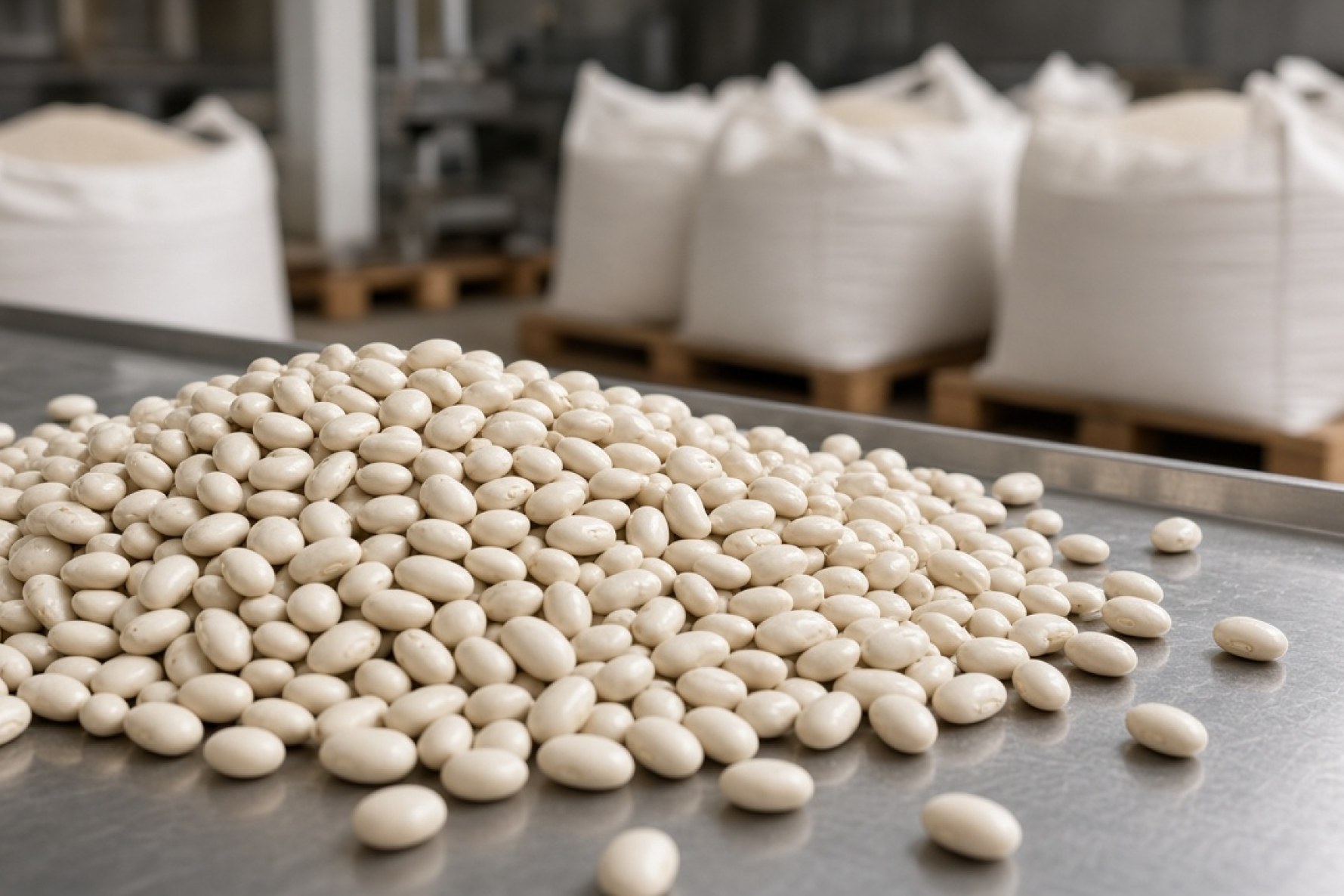
White beans are a core protein pulse in food security and converting industries. At industrial scale they underpin canned beans in tomato sauce, heat-treated ready meals and protein fortifiers. Iran’s plateau — especially Zagros foothills — yields high starch density, a flexible seed coat and bright white colour. Origins such as Khomeyn and Azna deliver distinctive organoleptic value.
Bulk industrial sourcing still faces calibre heterogeneity, mixed crop years, warehouse moisture drift and uneven starch behaviour in the autoclave. Professional buying needs deep knowledge of cook behaviour, national and international standards, modern packaging and RFQ mechanics. This article provides a documented commercial and technical decision framework.
1. Position of Iranian white beans in regional markets and main production hubs
Estimates put annual Iranian bean production at 230–250 thousand tonnes, mostly irrigated with intensive agronomy. Lorestan, Markazi and Fars lead output. Best white-bean quality comes from cool nights and sunny days.
Khomeyn hub (Markazi)
Khomeyn is often called Iran’s pulses research and processing capital. The national bean research station develops certified, drought-tolerant seeds resistant to diseases such as common bean mosaic virus. The densest network of cleaning workshops, gravity separators and optical sorters sits here. Field-stabilised moisture gives strong warehouse physical stability and negligible weight loss.
Azna and Aligudarz (Lorestan)
Alluvial plains of Azna and areas around Aligudarz below Oshtoran Kuh produce large elongated white beans. Yields exceed the national average. Bright white colour, smooth coat and high protein make Azna the top trader preference for Gulf and Iraq exports.
Shazand and Eqlid
Cool mountain Shazand grows thin-skinned, texture-uniform white beans with faster water ingress — ideal for short-cycle food plants. Highland Eqlid in Fars produces high dry-matter density and strong mechanical resistance to transit stress.
Crop calendar and harvest window
- Sowing in cool/temperate climates: late Ordibehesht to mid-Khordad (May–early June).
- Growth period: typically 90–100 days.
- Mechanical harvest and threshing from mid-Shahrivar; Mehr–Aban peak new-crop arrivals.
- Tissue moisture then usually 12–13.5% — ideal for uniform supply contracts and adjusted pricing.
2. Commercial types and seed calibration
Trade classifies white beans by morphology, geometric calibre and post-harvest processing.
- Small / canning (Navy / Pea Bean): oval–near-spherical, 4–6 mm; dense pack in cans and high sauce contact; excellent pressure-cook resistance and low mushing in autoclave.
- Medium / elongated (fasolia class): 7–9 mm, kidney-like; dominant Lorestan farm type; soft cooked texture and desirable starch glaze.
- Large / almond (Great Northern): over 9 mm, hundred-seed weight over 30 g; bulk, retail packs and HORECA; less used in canning due to coat-split risk.
| Commercial trait | Small canning | Medium elongated | Large almond |
|---|---|---|---|
| Calibre (sieve diameter) | 5–6.5 mm | 7–8.5 mm | 9 mm+ |
| Hundred-seed weight | 18–22 g | 24–28 g | 30–35 g |
| Geometry | Small dense oval | Elongated mild curve | Flat, almond, bulky |
| Standard physical purity | ≥ 99.2% | ≥ 99.5% | ≥ 99.0% |
| Canning yield | Very high, shape stable | Medium with glazing | Unsuitable (tissue rupture) |
| Main use | Canning & ready soup | Export & retail packs | Bulk & restaurants |
3. Technical specs, laboratory tests and quality factors
Corporate bulk orders require physicochemical specs under Iran National Standard No. 38 and Codex (CODEX STAN 171-1989).
Moisture content
Standard moisture is 12–14%:
- Above 14.5%: fungal activity, off odour and souring, aflatoxin risk and warehouse weight loss.
- Below 10%: brittle coat, higher breakage in handling and more hard-to-cook seeds.
Physical defects and foreign matter
- Max impurity for export-sorted lots: under 0.5%.
- Organic foreign matter (straw, pods, weeds): max 0.3%.
- Mineral matter (sand, stone): absolute zero preferred or max 0.05% — grit damages fillers.
| Parameter | Limit | Test method | Buying relevance |
|---|---|---|---|
| Moisture | 12.0–14.0% | ISO 24557 (105°C) | Prevent fungal spoilage |
| Physical purity | ≥ 99.5% | ISO 605 | Less re-cleaning cost |
| Stone & soil | ≤ 0.05% | Wash & sieve | Equipment safety |
| Broken / splits | ≤ 1.0% | Sieve inspection | Avoid cloudy sauce |
| Insect-damaged | ≤ 0.5% | Macroscopic count | Phytosanitary fit |
| Total aflatoxin | 4–10 µg/kg | HPLC | Safety & export rules |
| 12 h hydration | ≥ 100% weight gain | Ambient soak | Process yield |
4. Canning process challenges and two-phase texture defect
Canned beans under Iran National Standard No. 9539 (beans in brine) must keep seed geometry after heavy autoclave heat. The “two-phase” texture defect leaves some seeds ruptured with starch clouding the sauce while others stay dense, undercooked and hard.
Defect mechanism
- Mixing new crop with carry-over: cross-linked protein/pectin in aged seeds slows hydration; at 121°C new seeds rupture first.
- Genetic / origin mix: rain-fed thick coats mixed with irrigated Khomeyn lots create dual water-uptake behaviour.
Quality Iranian white beans more than double their weight within 12 hours of soaking. That weight gain sets dry-bean fill per can and post-sterilisation density against national standards.
5. Quality risks and distinguishing new crop from aged lots
Visual markers of aged lots
- Coat colour: new crop icy to ivory white; aged yellow, dark cream or dull.
- Hilum: clear white on new lots; brownish or dark on carry-over.
- Uneven wrinkling and odour drift toward musty, earthy or sour notes.
Hard-to-cook defect
Long storage above 25°C with high RH frees phytase-driven Ca/Mg ions that form insoluble pectates — a water-impermeable structure that stays hard even under pressure cooking.
| Indicator | New crop | Aged | Test |
|---|---|---|---|
| Coat colour | Bright uniform white | Dull yellow / dark cream | Colorimeter |
| Cook time | 40–50 min | > 80 min or hard | Boiling cook |
| Water uptake uniformity | > 95% swell together | Variable flinty seeds | 22°C soak |
| Cotyledon texture | Creamy, tender | Gritty, dry, layered | Texture & sensory |
| Dry lot odour | Neutral / grassy | Musty, earthy, off | Sensory panel |
6. Export target markets and regional preferences
Geographic proximity gives Iran durable transit advantages into the Middle East and Caucasus; demand patterns follow local food culture.
- Iraq: largest import market; “marq al-fasoulia”; prefers elongated large white seeds; 20–30 kg bags; post-cook colour stability is the top criterion.
- UAE & GCC: retail chains and catering; laser-sorted, 25 kg laminated bags, near-zero stained-seed tolerance.
- Russia & Eurasia: demand for small canning calibre; strict live pest, radioactivity and pesticide controls.
| Country | Calibre & form | Pack | Channel | Entry sensitivity |
|---|---|---|---|---|
| Iraq | Elongated large 7–9 mm | 20/30 kg PP | Traditional wholesale | Border phytosanitary |
| UAE | Medium laser-picked | 25 kg laminate | Retail & re-pack | GCC pesticide MRLs |
| Russia | Small canning 5–6.5 mm | 1 t big bag / 50 kg | Canneries | Phyto & microbial |
| Qatar & Oman | Large polished elongated | 25/30 kg laminate | Hotels & micro-dist. | Gregorian/Arabic dates |
7. Competitive analysis: Iran vs rivals
Canada offers precise calibration and near-zero impurity, but high landed cost and 30–45 day sea transit create room for Iran. Uzbekistan and Ethiopia are cheaper yet thicker coats, calibre mix and higher hard-to-cook risk hurt industrial buyers.
| Supplier | Advantage | Constraint | Price band | Cook performance |
|---|---|---|---|---|
| Iran | Uniform cook, short distance | Water-driven acreage swings | Competitive | Meaty flexible texture |
| Canada | Mechanised standards, volume | Costly ocean logistics | Premium | Very retort-resistant |
| Uzbekistan | Low price | Calibre mixing | Economy | Hard-cook risk |
| Turkey | Branding & agile logistics | Often reprocesses imports | Mid to high | Good after re-sort |
8. Customs standards, tariff codes and clearance documents
Documents typically required for export clearance:
- Phytosanitary certificate (free of four-spotted bean weevil)
- Valid laboratory COA
- Commercial invoice and packing list with net/gross weights
- Certificate of origin from the chamber of commerce
- Through bill of lading stating agreed Incoterms
9. Packaging, standard storage and logistics
- Laminated PP bags: 20, 30 and 40 kg — barrier to moisture and dust.
- 1-tonne big bags: bottom discharge spout for canneries, less manual handling.
- MAP / vacuum: retail 500 g–5 kg; shelf life can exceed 24 months.
Warehouse parameters
- Temperature: ideally 10–15°C; above 22°C accelerates hard-to-cook.
- Relative humidity: strictly under 60%.
- Palletising: ≥ 15 cm off floor; ≥ 50 cm from walls for airflow.
Persian Gulf 20-ft containers usually load 22–24 tonnes. Calcium chloride desiccant bags and PE overwrap on top pallet rows mitigate container rain. Covered waterproof trucks suit land transit to Iraq or Turkey.
10. Wholesale price formation and market economics
Autumn–winter industrial demand, tariff policy and Zagros rainfall also move prices. Professional buyers can register technical specs on Iranco and compare industrial-standard quotes.
11. Industrial application matrix and grade split
- Canning: small canning grade; sauce uptake, intact structure, clear covering liquid.
- Pulse flour / gluten-free: cleaned splits and broken seeds with verified microbial load.
- Ready meals & frozen: binder/texture agent stable through freeze–thaw.
| Use case | Suggested grade | Priority trait | Wrong-grade effect |
|---|---|---|---|
| Tomato-sauce canning | Small laser-sorted | Autoclave stability | Mushing & sauce gelation |
| Restaurant / catering | Large hand-picked elongated | Uniform cook | Uneven plate appearance |
| Gluten-free flour | Clean splits/broken | Moisture < 11% | Mill yield loss & souring |
| Premium retail packs | Medium–large polished | Snow-white, spot-free | Shelf appeal loss |
12. Importer checklist before placing an order
- Define commercial type and millimetre calibre range.
- Request a sealed ≥ 5 kg representative sample from multiple lot points.
- Run a plant cook test (uptake and autoclave resistance).
- Contract moisture ceiling of 12–14%.
- Zero tolerance for live storage pests.
- Caps on broken, splits, shrivelled and off-colour seeds.
- Written undertaking that 100% of the lot is last harvest year.
- Bag film specs (grammage, PP, laminate barrier).
- Bilingual labelling, net weight, dates and country of origin.
- Independent inspection company at origin.
- Clear Incoterms 2020 and delivery point.
- Damage remedy formula if defects exceed agreed tolerances.
13. What information is needed for an accurate price quote?
Vague enquiries produce misleading quotes. A real RFQ needs:
- Commercial type (small canning, medium elongated or large almond)
- Processing level (machine clean, hand-pick, double laser sort, polish)
- Calibre range (e.g. 5.5–6.5 mm for canning lines)
- Max moisture and broken/stained tolerances
- Total volume and delivery-lot schedule
- Pack type and weight (25/30/40/50 kg or 1 t big bag)
- Private-label / printed-bag needs
- Delivery point and Incoterms
- Destination health certificates list
14. Direct Iranian white-bean supply via Iranco
Deal outcomes are not only about first purchase price; physical purity stability, cook uniformity and supply-chain transparency decide the result. Iranco bridges bulk buyers with credible sorting and processing hubs such as Khomeyn and Azna so technical specs, QC monitoring, representative samples and standard contracts can be executed with clarity.
Analytical summary
Iranian white beans combine high protein, uniform starch density, tender hydrated texture and pleasant flavour — strong regional and industrial potential. Sustainable commercial success requires replacing opaque traditional buying with modern technical protocols. For converting plants, vigilance against mixed and aged lots is paramount — the root of two-phase texture. Moisture under 14%, sieve calibration, optical sorting and laminated packaging protect productivity and margin.
FAQ
Which Iranian white bean is best for commercial use?
Khomeyn for industrial uniformity (national research station, laser lines); Azna for traditional and export demand thanks to meaty elongated seeds.
Why do some seeds mush while others stay hard in one can?
Two-phase defect from mixing current crop with aged lots; aged seeds hydrate slowly so new seeds rupture while old ones stay hard in the autoclave.
What moisture range is safe for long storage?
12–14%; above 14% raises fungal/souring risk; below 10% brittle coats and weaker water uptake.
Are special health approvals required for export?
Yes — phytosanitary clearance free of storage pests and pesticide MRLs; factory use may also need food-authority approvals.
When is the best season for bulk contracts?
Mehr–Aban (new-crop harvest/processing in Khomeyn and Azna) for peak freshness, uniformity and balanced pricing.
Which calibre suits canning lines?
Small canning 5–6.5 mm — holds geometry at 121°C, fills can voids and keeps sauce viscosity uniform.
What is a safe path for bulk buying from Iranian origins?
Write a tech sheet, set defect tolerances, evaluate a representative sample and inspect sorting lines; registering needs on Iranco connects you to first-hand producers.
What data is needed for a firm price offer?
Bean type, processing grade, calibre, volume, packaging and Incoterms — the same RFQ basis used on the Iranco platform.
Featured Products




Related Articles



