 Iranco Magazine Team
Specialist guide to Akbari, Ahmad Aghaei, Kalleh Ghouchi and Fandoghi — sizing, quality, export markets, standards, packaging and bulk purchase tips
Export Guide · Iranian Pistachio · Types & Markets
What Types of Pistachio Does Iran Produce, How Do They Differ, and Where Are They Exported?
A specialist guide to Akbari, Ahmad Aghaei, Kalleh Ghouchi and Fandoghi pistachio — sizing, quality, export markets, standards, packaging and bulk purchase considerations for importers and food industry buyers.
Analytical introduction
Iranian pistachio is not a single product sold in different sizes. The four main commercial types differ markedly in shape, size, shell appearance, market availability and commercial application — and those differences directly affect price and destination market. This guide explains how wholesale buyers, importers and food industry professionals should choose the right type and which countries form Iran's principal pistachio export markets.
Pistachio is a product where country of origin, cultivar, size and processing quality all influence the buyer's decision at once. A professional buyer rarely asks only "what is the price of Iranian pistachio?" — they specify whether they want Akbari, Ahmad Aghaei, Kalleh Ghouchi or Fandoghi, the required size, whether the product is naturally or mechanically split, what percentage of closed or defective kernels is acceptable, and what aflatoxin control level the shipment must meet.
Iran remains one of the world's main pistachio production and trading centres. Commercial orchards have developed across several regions; Kerman, Razavi Khorasan, South Khorasan, Yazd and Semnan are among the most important production areas. Rafsanjan and other districts in Kerman province remain the best-known names in Iran's pistachio chain, but in recent years a significant share of orchard expansion has moved to other arid and semi-arid provinces.
Iran's commercial advantage is not limited to raw production. Shape and size diversity, and the ability to supply in-shell pistachio, whole kernels, green kernels, slivers, powder and other processed forms, allow different markets to buy different products from Iran.
In 2024 trade data, China, Turkey, India, Germany and several European and Middle Eastern markets appear as important destinations for Iranian pistachio. Market structure is not fixed, however. In the 2025/26 trade year, the share of CIS countries, the Indian subcontinent and re-export hubs such as Turkey and the UAE has increased, while Far East share has fallen noticeably compared with the previous period. A precise answer to "where does Iran export pistachio?" must consider both historical market presence and shifting trade routes.
1. Iran's pistachio position and main production regions
Pistachio is well suited to the dry and semi-arid climate of much of the Iranian plateau. Hot, dry summers, winters with adequate chilling and relatively low humidity in many central, eastern and south-eastern regions create favourable conditions for commercial orchards.
Kerman is the oldest and best-known production centre, with counties such as Rafsanjan, Sirjan, Zarand, Anar, Ravar and Shahr-e Babak having long experience with the crop. Alongside Kerman, Razavi Khorasan, South Khorasan, Yazd and Semnan have gained significant commercial production importance.
Harvest timing varies by region and cultivar. Some types mature earlier; Akbari and Ahmad Aghaei fall into later-maturing groups. In practice, the main processing of dry export product moves into serious volume from late summer through autumn.
An important point for importers: "product from Iran" does not necessarily mean a fully homogeneous lot. Production region, harvest timing, hulling method, drying speed, warehouse conditions and sorting quality can make two shipments of the same nominal type and size differ in shell colour, stain percentage, flavour, split rate and aflatoxin risk.
For large contracts, crop year should be written into order specifications. Freshly harvested product and product stored longer may differ in aroma, texture and fat oxidation status. Pistachio production is also affected by alternate bearing, water availability, flowering-period temperature and climatic conditions — so Iranian supply is not constant every year and long-term contracts are best aligned to the crop of that season.
2. Main Iranian pistachio types and how they differ
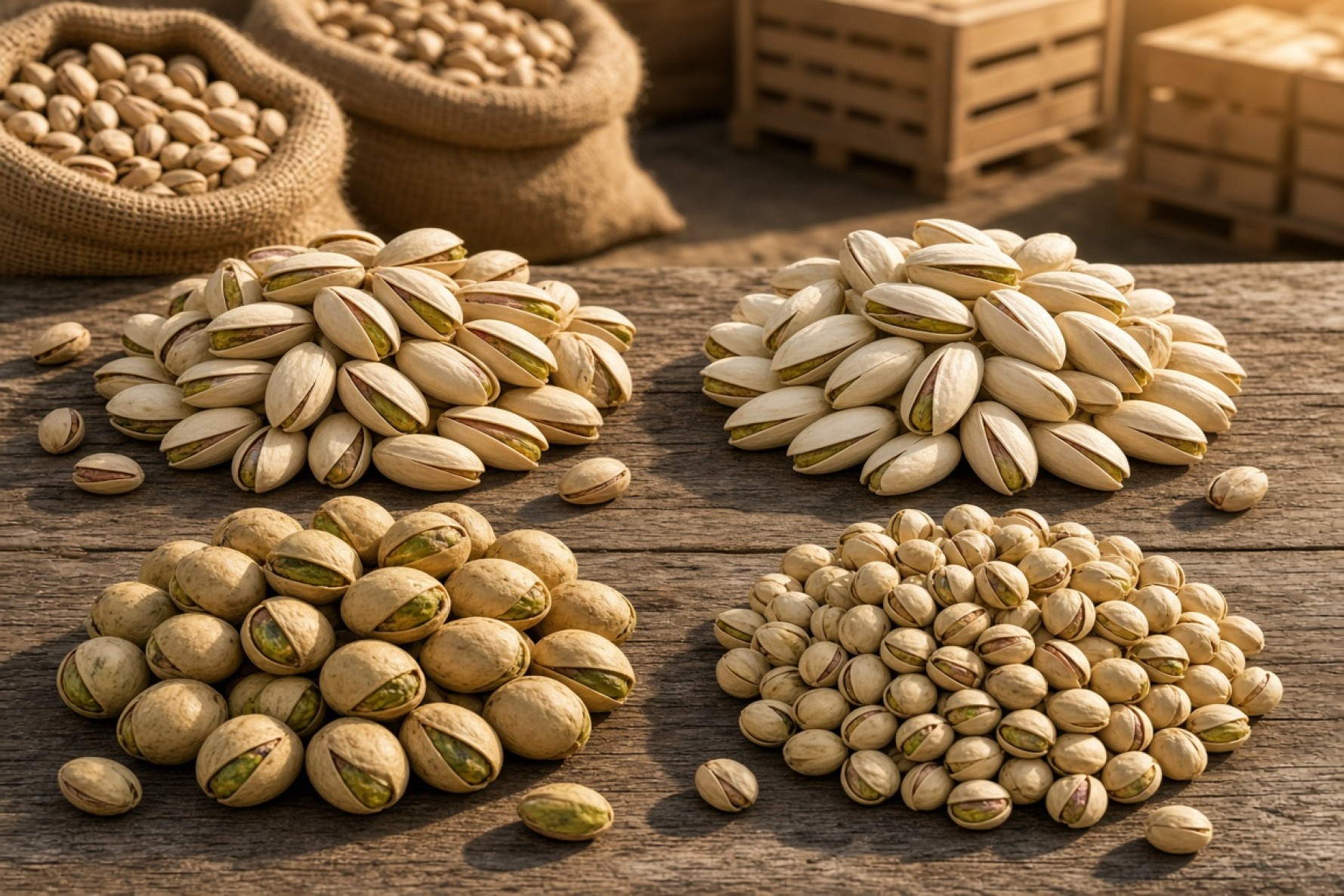
Although local names and additional cultivars exist in Iranian orchards, bulk export trade is mainly organised around four types: Akbari, Ahmad Aghaei, Kalleh Ghouchi and Fandoghi. The Iran Pistachio Association also identifies these four groups as the main commercial types.
By shape, Iran's commercial pistachios divide broadly into elongated and round families. This visual difference matters to buyers because kernel shape affects consumer packaging, mixed-nut appearance, pricing and end-customer perception.
| Type | Shape | Common commercial sizes | Key characteristic | Best application |
|---|---|---|---|---|
| Akbari | Very elongated | 20/22, 22/24, 24/26; 18/20 more limited | Long length, premium appearance | Luxury nuts, gift packs, premium retail |
| Ahmad Aghaei | Elongated | 22/24, 24/26, 26/28 and some smaller grades | Light shell, uniform appearance | Retail, mixed nuts, general export |
| Kalleh Ghouchi | Large and round | 20/22, 22/24, 24/26; 18/20 more limited | Bold, bulky appearance | Premium nuts, display packs |
| Fandoghi | Round and smaller | 28/30, 30/32, 32/34; 26/28 more limited | Wide availability, lower price point | Volume nuts, processing, kernel production |
Size ranges above are common commercial bands; actual availability of each size depends on the crop year.
Akbari pistachio
Akbari is the best-known elongated commercial type from Iran. Kernel length exceeds width, and this elongated appearance gives it a premium position in markets where product look carries high weight. Sizes 20/22 and 22/24 are among the most recognised Akbari grades; 18/20 may also be available but usually in more limited volume.
When buying Akbari, length alone should not be the criterion. Length uniformity, split percentage, shell colour, shell stains, closed kernels, empty shells and sound-kernel percentage must all be checked. Akbari suits premium nut mixes, gift packaging and retail channels where kernel shape is part of product value.
Ahmad Aghaei pistachio
Ahmad Aghaei also belongs to the elongated family but usually has a different form from Akbari and a wider size range. Its relatively light shell is one reason for its popularity in export trade. This type has a notable demand history in the Indian market, and the Iran Pistachio Association cites India as one of the markets where Ahmad Aghaei has gained commercial acceptance.
Ahmad Aghaei is important for buyers seeking balance among premium appearance, commercial availability and price level. However, a light shell makes stains, remaining green hull residue or visible damage easier to see — so precise sorting matters greatly.
Kalleh Ghouchi pistachio
Kalleh Ghouchi — often grouped internationally among jumbo or large round pistachios — is rounder and bulkier than Akbari. Its large sizes are especially attractive in packs where kernel size is visible to the customer.
Buyers should not compare Kalleh Ghouchi and Akbari on size number alone. Two products graded 22/24 may have a similar count per unit weight, but one will look elongated and the other wider and rounder. Kalleh Ghouchi suits markets where visual bulk is a key sales factor.
Fandoghi pistachio
Fandoghi is rounder and usually smaller than the other three types. Sizes 28/30, 30/32 and 32/34 are very well known in this group. Smaller size does not mean lower quality — a fresh, naturally split, flavourful, low-defect Fandoghi lot with satisfactory test results can have greater edible value than a large but weak kernel.
Fandoghi suits more economical nut mixes, volume retail, kernel production and some industrial uses, and because of wider availability it often plays a major role in bulk deals.
3. How pistachio size is read
One of the most common mistakes among new buyers is misreading numbers such as 20/22 or 28/30. In in-shell pistachio trade, these figures indicate the approximate number of kernels in one ounce — about 28.35 grams. The smaller the number, the larger the kernel.
- 20/22 pistachio is larger than 28/30.
- 22/24 is larger than 24/26.
- Size comparison should preferably be made within the same cultivar.
This last point is critical. Akbari 22/24 and Kalleh Ghouchi 22/24 are close in average kernel weight but not identical in shape. A purchase request that says only "22/24 pistachio" is incomplete. The buyer should specify at minimum cultivar, size, natural or mechanical split, raw or roasted status, crop year and defect criteria.
Natural split vs mechanical split
In naturally split pistachio, the shell opens during normal fruit growth. In mechanically split product, closed kernels are opened during processing. These two products are not equivalent in price or in how buyers perceive quality. If natural split is mandatory for your market, that condition must be stated explicitly in the contract and approved sample.
Closed-kernel percentage must also be specified numerically. Phrases such as "export quality" without numeric limits for closed shells, empty shells, stains or insect damage leave too much room for dispute.
4. Technical specifications expected by professional buyers
Bulk pistachio purchase becomes comparable only when sellers quote against a shared technical specification.
| Parameter | What to specify | Importance |
|---|---|---|
| Cultivar | Akbari, Ahmad Aghaei, Kalleh Ghouchi or Fandoghi | Defines appearance and size range |
| Size | e.g. 20/22 or 28/30 | Direct price effect |
| Shell status | Natural split, mechanical or closed | Defines commercial value |
| Processing | Raw, roasted or salted roasted | Defines use and shelf life |
| Moisture | Specific contract limit | Mould control and storage quality |
| Closed & empty shells | Acceptable percentage | Protects real yield |
| Shell stains | Acceptable limit | Important for retail markets |
| Insect damage | Acceptance criterion | Safety and appearance |
| Aflatoxin | Aligned with destination country | Determines customs clearance |
| Crop year | Harvest year | Freshness comparison |
| Packaging | Material and net weight | Protection and freight cost |
| Reference sample | Approved sample before loading | Shipment conformity control |
Moisture — a number that must not stay vague
In commercial standards published by the Iran Pistachio Association, maximum free moisture for raw dry pistachio is 5% and for roasted pistachio 3%. UNECE DDP-09 for in-shell pistachio sets a 6.5% moisture ceiling. This difference shows that purchase contracts can be stricter than general standard limits. For export buyers, the required figure should be written directly in the contract — not merely "standard moisture".
Visual defects
Defects to review in sample and contract include closed kernels, empty shells, remaining hull residue, shell stains, shell breakage, discoloured kernels, insect damage and foreign matter. In large deals, each defect type should have its own acceptance limit. A single overall defect percentage may be insufficient because two lots with the same total defect rate can differ completely in defect type.
5. Aflatoxin, testing and quality control
In sensitive markets, the largest pistachio is not necessarily the most valuable. A lot that looks good but cannot meet destination food safety requirements is commercially problematic. Aflatoxin is the best-known hazard in pistachio trade. Moulds that produce these toxins can create risk at orchard, harvest, processing and storage stages. Timely harvest, rapid hull removal, correct drying, removal of damaged kernels and proper storage are key risk-reduction factors.
European Union regulations
Under current EU rules, for pistachio to be sorted or physically processed before consumer sale, maximum aflatoxin B1 is 12 µg/kg and total of the four main aflatoxins is 15 µg/kg. For pistachio sold directly to the end consumer or used as a food ingredient without that contamination-reduction step, the limits are 8 and 10 µg/kg respectively. EU rules also set separate limits for ochratoxin A in pistachio.
From June 2026, pistachio and pistachio products of Iranian origin remain within the EU's strengthened aflatoxin risk controls, with identity and physical check frequency for this group set at 50%. European sourcing therefore depends on sampling, traceability and real lot consistency. One satisfactory test on a small commercial sample does not replace representative sampling from the final shipment.
Which tests matter for purchase?
Required tests depend on destination country and product form, but a professional order usually includes:
- Aflatoxin
- Moisture
- Pesticide residues where requested by the destination market
- Microbiological contamination appropriate to processing type
- Pest and insect status
- Sensory characteristics including off-flavour and off-odour
- Net weight and size uniformity
In markets with specific regulations, the buyer should communicate destination requirements to the supplier before final production or packaging.
6. Which countries does Iran export pistachio to?
In short: China, Turkey, India, Germany and other European countries, Middle Eastern markets, Central Asia and some North American buyers are among Iran's pistachio customers.
| Market | Reported imports from Iran | Approx. value | Market role |
|---|---|---|---|
| China | ~40.7 thousand tonnes | ~$268.5 million | Large in-shell consumption market |
| India | ~20.3 thousand tonnes | ~$123.5 million | Major nut and household consumption market |
| Turkey | ~13.0 thousand tonnes | ~$129.6 million | Consumption, processing and re-export |
| Germany | ~4.7 thousand tonnes | ~$76.3 million | Consumption and European distribution hub |
| Jordan | ~1.9 thousand tonnes | ~$22.9 million | Regional market |
| Italy | ~1.7 thousand tonnes | ~$20.0 million | Food and confectionery consumption |
| Lebanon | ~1.2 thousand tonnes | ~$14.4 million | Nuts and confectionery |
| Spain | ~1.1 thousand tonnes | ~$15.6 million | Consumption and processing |
| Canada | ~966 tonnes | ~$12.4 million | Retail and food industry |
Figures relate to 2024 and should not be treated as a fixed market mix for later years.
Market shift in the 2025/26 trade year
More recent industry data shows Iran's export direction changed in 2025/26 compared with 2024. Through July 2026, CIS countries, the Indian subcontinent and re-export centres Turkey and the UAE together accounted for about 76% of registered exports, while Far East share fell to around 7%.
This creates an important market analysis point: the country recorded at customs is not always the final consumption destination. Turkey and the UAE can be buyer, processor and re-export hub at the same time. An exporter who looks only at country rankings may misread the real sales chain structure.
7. Demand differences in main markets
China
China is one of the world's largest in-shell pistachio markets. 2024 data shows significant Chinese imports of in-shell pistachio from Iran, with Iran among the main suppliers. In-shell product holds a major share here, and size, uniformity, split rate and appearance strongly influence commercial decisions. Trade licence changes and import conditions can, however, shift purchase volume from one origin year to year.
India
India is another important market for Iranian pistachio. In 2024 total Indian pistachio imports exceeded 40,000 tonnes, with Iran and the United States as the two main suppliers. Reported Indian imports from Iran exceeded 20,000 tonnes. Ahmad Aghaei has a history of popularity in India because of its elongated shape and shell appearance, but Indian buying is not limited to one cultivar. Beyond nut retail, India also has confectionery and festive consumption capacity, and festival seasons and gift demand can affect order timing.
Turkey
Turkey is itself a major pistachio producer but also imports pistachio. Part of imports can enter processing industries, confectionery production and re-export chains. Domestic production therefore does not automatically mean no market for Iranian pistachio. Product mix, price, supply timing and processing industry need determine how far imports remain economical.
Germany and the European Union
Germany is one of Europe's most important nut trading gateways. Part of product imported into Germany is consumed there; part may move through the wider European distribution chain. In Europe, contaminant control matters far more than kernel size alone. Importers typically pay serious attention to traceability, valid test results, sample-to-shipment alignment and processing quality.
For European supply, a Fandoghi lot with strong food safety control can be a more suitable commercial option than a very large pistachio lacking adequate control.
Middle Eastern countries
Jordan, Lebanon, Qatar, Kuwait, Oman and other regional markets appear in Iran's pistachio trade statistics. Nut consumption, confectionery, hospitality and food-service channels are important uses in this region. For premium retail, large appearance-focused types such as Akbari and Kalleh Ghouchi can be attractive. In confectionery and processing, kernel percentage, kernel colour, flavour and price per kilo of edible material matter more.
8. In-shell pistachio, kernels and industrial products
Cultivar name is only part of the commercial specification. After primary processing, product can be sold in several forms.
In-shell pistachio
The most common form for the nut market. Product may be raw, roasted or salted roasted. Size, split percentage, shell uniformity, colour, closed-kernel rate and empty-shell percentage all carry high importance. The main HS code for fresh or dry in-shell pistachio is 080251.
Pistachio kernels
Pistachio without hard shell is classified under HS code 080252. Iran exported roughly 17.9 thousand tonnes of kernels under this code in 2024. Kernels are used in confectionery, ice cream, chocolate, bakery, nut creams and industrial processing. For kernels, green colour, whole-kernel percentage, breakage, remaining thin shell, size and flavour matter more than external shell appearance.
Green peeled kernels
This product has high value for industries where pistachio green colour is part of the final product appearance. Kernels can be graded by green intensity and supplied whole, as slivers or in smaller pieces. For ice cream, premium confectionery, pastry decoration and some chocolate products, kernel colour may matter even more than kernel size.
Slivers, pieces and powder
Food industries do not always need to pay for large display-grade product. Where product will be chopped or ground, raw material specifications should be based on kernel yield, colour, flavour, moisture and food safety. In these uses, Fandoghi or kernel from smaller sizes can be more economical than premium Akbari.
9. Export packaging, storage and transport
Dry pistachio has low respiration activity, but its high fat content makes it sensitive to oxidation and rancid flavour development. Inappropriate moisture can also worsen mould risk. Rapid drying after harvest is critical. In Iran's commercial processing, the aim is to bring dry product to low, storage-suitable moisture levels; industry technical information indicates product reaches below 5% moisture after drying and final aeration.
Storage conditions
For longer storage, lower temperature preserves quality better. University of California post-harvest guidance considers 0–10°C suitable for pistachio storage and recommends warehouse temperature should not exceed 20°C to reduce fat oxidation. In real trade, refrigerated transport is not mandatory for every dry pistachio shipment — packaging type, route length, shipping season, ambient temperature and storage duration must all be considered in logistics decisions.
Bulk packaging
Traditional trade uses bulk bags; Iran's industry has a history of roughly 50 kg packs and larger industrial bags. For kernels and higher-value products, moisture- and oxygen-barrier packs, vacuum or nitrogen-flushed packaging can prevent quality loss. Post-harvest studies report vacuum and reduced oxygen as useful for limiting oxidation and preserving pistachio quality.
Important transport risk
A common mistake is loading cold product in conditions where condensation forms on packs or product after a climatic change. Humidity control, container condition, dry floors and walls and prevention of water ingress are critical. Pistachio should not be loaded alongside goods with strong odours, because odour absorption can reduce sensory quality.
10. Iran compared with the United States and Turkey
Iran, the United States and Turkey play central roles in international pistachio trade, but their supply structures differ.
In 2024 the United States exported roughly 354.9 thousand tonnes of in-shell pistachio. Iran exported about 81 thousand tonnes and Turkey about 21.9 thousand tonnes in the same category. For kernels, the United States exported about 32.2 thousand tonnes, Iran about 17.9 thousand tonnes and Turkey about 17.3 thousand tonnes.
| Origin | Key commercial feature | Buyer focus |
|---|---|---|
| Iran | Wide shape and size diversity; four main commercial types | Cultivar selection, size and precise quality control |
| United States | Very high volume and standardised industrial supply | Supply stability and large retail programmes |
| Turkey | Strong domestic production and active processing industry | Kernels, confectionery and nearby European markets |
For a professional importer, origin choice should not be based on price per kilo alone. Comparable evaluation should use sellable product price or real raw-material yield. Suppose a cheaper pistachio has a higher percentage of closed, empty or defective kernels — the real cost per kilo of sellable product may exceed a more expensive offer. The same applies to kernels: for an ice cream or confectionery factory, green percentage, breakage, flavour and grindability may matter more than cultivar name.
What drives Iranian pistachio price?
Pistachio price is not a fixed number for "one kilo of Iranian pistachio". Several variables can make two offers from the same country completely different:
- Cultivar
- Ounce size grade
- Natural or mechanical split
- Raw or roasted status
- Crop year
- Closed and empty-shell percentage
- Shell stain and defect level
- Kernel quality and colour
- Aflatoxin and other test results
- Order volume
- Packaging type
- Private label or bulk pack
- Delivery point and Incoterms
- Freight cost
- Current-season product status
Comparing Akbari 20/22 with Fandoghi 30/32 therefore has limited meaning. Even two Akbari 20/22 offers are not comparable until split condition, defects, moisture and test results are aligned.
11. Importer checklist before placing an order
Before bulk purchase, importers should review the following. In export orders, gaps between buyer expectations and actual product specifications usually arise when technical criteria were not defined precisely from the start.
- Specify the exact cultivar: Akbari, Ahmad Aghaei, Kalleh Ghouchi or Fandoghi.
- Define the required size numerically, e.g. 22/24.
- State whether you require natural split or whether mechanical split is acceptable.
- Write acceptable limits for closed and empty kernels in the contract.
- Define shell stains, insect damage, breakage and foreign matter limits.
- Include crop year.
- Obtain a representative sample before the commercial contract.
- Require aflatoxin test results aligned with destination regulations.
- For sensitive markets, define shipment sampling method.
- Write acceptable moisture as a number.
- Specify raw, roasted or salted roasted status.
- Define net weight per pack and packaging material.
- For kernel purchases, define whole-kernel percentage, breakage and colour.
- Assess the seller's real capacity to supply the full contract volume.
- Keep the pre-contract sample as the reference sample.
- Document shipment acceptance criteria for pre-loading inspection.
- Review customs and food safety documentation required by the destination country before loading.
- Specify delivery terms, destination port or city and freight cost responsibility.
12. What information is needed for an accurate quote?
A professional price request for Iranian pistachio should include:
- Product: in-shell pistachio, kernel, green kernel, slivers or other form
- Cultivar: Akbari, Ahmad Aghaei, Kalleh Ghouchi or Fandoghi
- Size: e.g. 20/22 or 28/30
- Split status: natural or mechanical
- Processing: raw, roasted or salted
- Quality level: acceptable defect percentages
- Testing: aflatoxin, moisture and other required tests
- Packaging: pack material and net weight
- Order quantity: sample, pallet, container or annual volume
- Destination country: to determine market requirements
- Delivery city or port: for freight calculation
- Delivery terms: under Incoterms
- Private label: if required
- Required delivery timing: for inventory and processing planning
The more precise this information, the more comparable supplier offers will be. Buyers reviewing supply options from Iran can enter these specifications in an Iranco purchase request so sourcing is reviewed by cultivar, size, order volume, packaging and destination.
Export pistachio supply path from Iran
In international pistachio buying, the difference between two offers is usually not price alone. One seller may offer natural split and another mechanical split; one lot may be more uniform in size and another have more closed kernels; one may be prepared for Europe with aflatoxin control and another for a market with different specifications. Supply should begin with precise need definition: product, cultivar, size, order volume, defect level, packaging and destination country. Comparable samples should then be obtained and required tests reviewed. The next step is agreement on a reference sample and shipment acceptance criteria.
Iranco (iranco.com) allows buyers and importers to submit pistachio purchase requests with these specifications so available supply options in Iran are reviewed against order requirements. Requests can specify cultivar, size, processing form, pack weight, approximate quantity and destination.
For export order review, it is better to begin with technical specifications rather than asking only for price per kilo. This increases the likelihood of comparable offers and reduces disputes at delivery.
Conclusion
Understanding Iranian pistachio types gains commercial value when visual differences between cultivars become measurable specifications. Akbari, with its very elongated form and large sizes, suits appearance-driven markets; Ahmad Aghaei balances elongated shape, light shell and commercial availability; Kalleh Ghouchi, with its large round form, serves premium nut segments; and Fandoghi, with smaller size and wider availability, suits volume trade and many processing uses.
Cultivar name alone does not define quality. Size, natural split percentage, empty shells, closed kernels, stains, insect damage, moisture, crop year, freshness and especially aflatoxin status must all be reviewed together. From a market perspective, China, India, Turkey, Germany and a set of European, Middle Eastern and Central Asian countries have been important Iranian pistachio destinations. This market mix changes year to year, and hubs such as Turkey and the UAE play roles in re-export as well as consumption.
For professional buyers, the best approach is not to find the cheapest pistachio type first. Application must be clear first: premium nuts, volume retail, confectionery, ice cream, kernel production or industrial raw material. Then cultivar, size and quality level should match that use. When technical specifications are precise, price comparison and supplier evaluation gain real meaning.
FAQ
Which is the best type of Iranian pistachio?
There is no single answer for all uses. For premium packaging and elongated appearance, Akbari is usually the focus. If light shell and elongated form with good commercial availability matter, Ahmad Aghaei is important. For large round kernels, Kalleh Ghouchi; for volume orders or processing, Fandoghi may be more suitable. Final quality must be assessed separately from cultivar name.
What is the difference between Akbari and Ahmad Aghaei pistachio?
Both are elongated, but Akbari usually has greater length and is also offered in very large sizes. Ahmad Aghaei typically has a lighter shell and is available across several commercial size grades. Choice between them depends on desired appearance, size, price, destination market and that year's crop availability.
Is 20/22 better than 28/30 pistachio?
20/22 is simply larger than 28/30 — the number alone does not indicate better quality. A 28/30 lot may have much higher quality in freshness, flavour, split rate, moisture and defect percentage. Size should be one purchase criterion, not the only one.
Which countries does Iran export pistachio to most?
In 2024 data, China, India, Turkey and Germany were among the most important reported buyers of Iranian pistachio. Other European countries such as Italy and Spain and Middle Eastern markets such as Jordan and Lebanon also had notable imports. In the 2025/26 trade year, the share of CIS countries, the Indian subcontinent, Turkey and the UAE has increased.
What is the difference between natural and mechanical split pistachio?
In natural split pistachio, the shell opens during fruit growth. In mechanical split product, closed pistachios are opened during processing. This difference affects price and market acceptance. If the buyer requires natural product only, that condition must be stated explicitly in order specifications and shipment acceptance criteria.
What is the most important export pistachio test?
Required tests depend on the destination market, but aflatoxin is among the most important in international pistachio trade. Moisture, pesticide residues and some microbiological tests also matter depending on country and product type. In Europe, aflatoxin control for Iranian pistachio carries particular importance.
How is pistachio packaged for export?
In-shell pistachio in bulk trade is often supplied in bags or industrial packs. For kernels and higher-value products, moisture- and oxygen-barrier packs, vacuum or nitrogen-flushed packaging are more common. Pack weight should be defined before pricing because it affects packaging, palletisation and freight cost.
Which pistachio is suitable for ice cream and confectionery factories?
Industrial use does not necessarily require buying the largest in-shell pistachio. The factory should compare kernel yield, green colour, flavour, breakage percentage, moisture and price per kilo of usable material. Green kernels, whole kernels, pieces or slivers may be more economical than in-shell purchase depending on the final product.
What specifications are needed to receive a pistachio price quote from Iran?
At minimum, specify cultivar, size, natural or mechanical split, raw or roasted status, order quantity, packaging, destination and delivery terms. In professional orders, moisture, defect percentages and aflatoxin testing should also be defined. These specifications can be entered in an Iranco purchase request so supply options are reviewed against a common standard.
Featured Products








Related Articles



