 Iranco Magazine Team
Technical specs, lab standards, impermeable packaging tech, cold-chain logistics and international target-market assessment
Export Guide · Confectionery · Packaging & Cold Chain
Iranian Pashmak: Wholesale Buying, Packaging and Export Guide
Technical specifications, laboratory standards, moisture-barrier packaging technologies, cold-chain logistics and international target-market assessment — published in the Iranco magazine.
| Key indicator | Value or technical specification | Supplementary notes |
|---|---|---|
| International tariff code (HS Code) | 17049040 / 1806 | Heading 17049040 covers plain sugar pashmak; Chapter 18 headings apply to chocolate-coated pashmak. |
| Reference national standard | ISIRI 6084 | Standard for pashmak characteristics, chemical limits and test methods. |
| Critical product moisture | Maximum 2.5% by weight | Exceeding this threshold collapses the porous structure and causes rapid clumping of fibres. |
| Container storage temperature | 15 to 18 °C | Stabilise relative humidity below 45% to limit sugar glass transition and fat bloom. |
This comprehensive report analyses supply chains, biochemical specifications, processing requirements and physical-barrier strategies in Iranian pashmak export. Traders, importers and food-industry procurement managers can extract criteria for grade differentiation, quality-loss control in sea and road transport, standard compliance and wholesale contract risk management. The information presented supports sustainable, economical sourcing of this product for regional and international destinations.
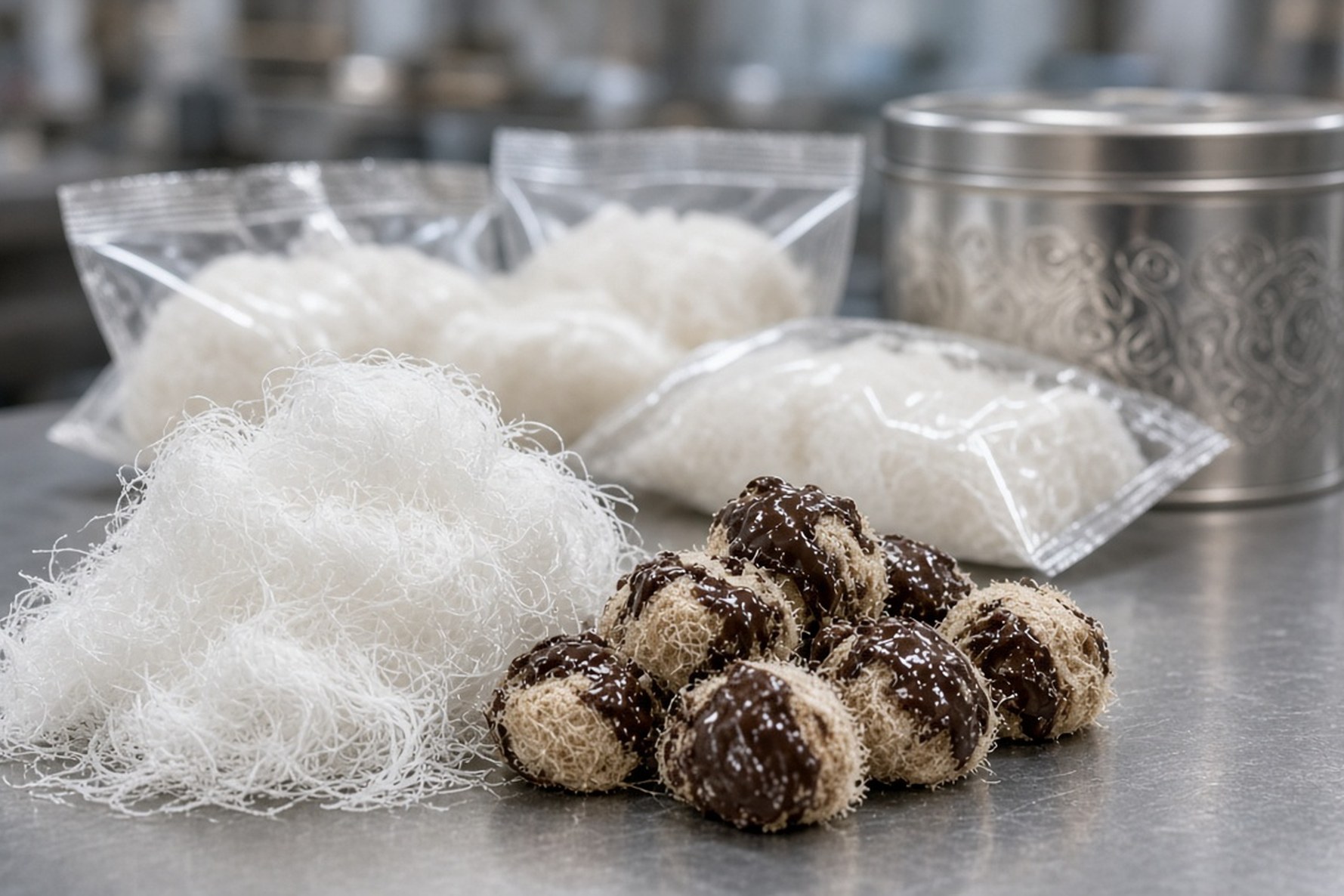
Iranian pashmak (spun-sugar confection) has evolved from an authentic Middle Eastern confectionery tradition into a high value-added item in Iran’s processed-food export basket. Unlike familiar Western spun sugar such as fairground cotton candy—made only by melting and centrifugal stretching of sugar—pashmak is a multi-component system that stabilises sucrose threads with processed wheat flour and edible oils. That process yields a silky, layered, brittle texture that, with precise formulation, can achieve long commercial shelf life.
Structural advances over the past two decades in machinery and food technology—especially in East Azerbaijan and Yazd—have moved the industry from manual workshops to fully automated lines. Bite-size moulding, controlled compression and continuous enrobing with cocoa and fruit coatings have markedly improved physical stability under logistics stress. Even so, the strongly hygroscopic glassy sugar phase makes pashmak one of the most temperature- and humidity-sensitive export confectionery lines.
Success in bulk trade and chain retail in targets such as the Gulf, Central Asia, the Russian Federation and European markets requires deep understanding of food chemistry, packaging engineering, customs processes and quality inspection. Professional importers and international distributors must identify variables affecting texture, fat oxidation and rheological behaviour to protect shipments and margins. This technical report examines every dimension needed for lower-risk, profitable wholesale buying and export decisions in pashmak.
1. Industry Structure and Geographic Production Hubs in Iran
Pashmak production in Iran is tightly linked to agricultural inputs, sugar supply and the flour and oil industries. From an economic-geography perspective, the sector concentrates in two hubs with distinct production strategies.
Yazd: traditional and historic hub
Yazd on Iran’s central plateau is the historic birthplace of the product. Workshops and plants there focus mainly on plain fibrous pashmak with botanical and organic flavouring—distilled rosewater, green cardamom and ground saffron. Yazdi pashmak is distinguished by extremely fine fibre diameter and light texture. Traditional Yazd practice often uses quality sesame paste oil in toasting flour, giving a distinctive aroma, but higher oxidation of unsaturated fatty acids demands strict packaging discipline on long transits.
Tabriz: industrial and mechanised pole
East Azerbaijan province and especially Tabriz are the Middle East’s centre for pashmak engineering and industrialisation. Modern factories use mechanised cooking, continuous mechanical pulling, hydraulic moulding presses and advanced chocolate enrobing lines, lifting daily output from workshop scale to export tonnage. Tabriz led national standard development and bite-format commercialisation, playing a decisive role in international market uptake. Proximity to advanced packaging industries and land corridors toward Turkey, the Caucasus and Europe make Tabriz the main pashmak export hub.
Iran’s value-chain advantage rests on reliable domestic raw materials, competitive energy costs in cooking and flour heat treatment, and skilled labour in confectionery machinery. These factors make the cost per kilogram of quality pashmak in Iran materially lower than in several neighbouring countries.
2. Classification and Commercial Diversity of Export Pashmak
Knowing commercial types and formats lets procurement managers match product to destination taste and logistics. Export pashmak is grouped by shaping process, coating structure and flavour formulation:
Traditional fibrous pashmak
Without secondary compression, this grade consists of open, bulky, very light masses of sugar threads coated with toasted flour. Texture is highly fragile, brittle and quick-melting in the mouth. Apparent density is very low and volume is high. Although fibrous pashmak remains popular in local and traditional markets, poor volume-to-weight ratio (dead weight in containers) raises international sea freight cost per kilogram.
Compressed moulded bite pashmak
After pulling, fibres enter special moulds and are uniformly compressed into cubic, cylindrical or pillow shapes. Compression sharply reduces trapped air between fibres, raising apparent density up to threefold and optimising container loading. Denser structure also slows ambient air and water-vapour ingress and extends shelf life.
Bite pashmak with cocoa and chocolate coating
This group holds the largest share of Iran’s foreign-trade value in pashmak. Compressed bites pass through enrobing tunnels and receive a continuous layer of dark, milk or cocoa-butter substitute (CBS) coatings. The chocolate layer adds richness and acts as a hydrophobic barrier against atmospheric moisture reaching the pashmak core, securing shelf life in variable climates.
Modern flavoured and fruit pashmak
Natural food essences—strawberry, mint, orange, blueberry, coffee, ginger—with permitted colours have broadened the export portfolio. That variety lets foreign distributors position pashmak as a modern snack for children and teens in supermarket aisles.
Diet and wellness-oriented pashmak
As global consumers shift toward reduced sugar, new formulations use sugar alcohols such as isomalt, sorbitol and maltitol with prebiotic fibres such as inulin. These grades have lower glycaemic index and target dietetic and pharmacy channels in developed markets.
| Export pashmak type | Apparent density (g/L) | Moisture permeability index | Preferred market use | Guaranteed shelf life in barrier pack |
|---|---|---|---|---|
| Plain fibrous | 50 to 80 | Very critical (immediate ingress) | Gift packs, confectionery, dessert garnish | 4 to 6 months |
| Moulded bite | 180 to 260 | Moderate due to fibre compaction | Chain retail, economy distribution | 6 to 9 months |
| Dark chocolate coated | 420 to 550 | Very low due to fat layer | Long sea transit, premium markets | 10 to 12 months |
| Fruit-flavour coated | 400 to 520 | Low | Children’s snacks, novelty markets | 9 to 12 months |
| Sugar-free (isomalt-based) | 220 to 280 | High (polyol-dependent) | Health stores and pharmacy channels | 6 to 9 months |
3. Biochemical Foundations and Standard Technical Specifications
Microscopically, pashmak is a unique system of sugar, starch and fat phases. Controlling physicochemical properties during cooking and processing determines texture, fibre brittleness and product stability. Bulk buyers and technical managers should evaluate specifications against limits in Iran’s national standard ISIRI 6084.
Sugar-phase dynamics and amorphous glass formation
Pashmak is mainly crystalline sucrose melted in water at 135–145 °C and then rapidly cooled. Fast cooling of concentrated syrup prevents reformation of an ordered crystal lattice and traps sugar in the unstable physical state known as frozen amorphous glass. For fibrous texture, syrup must contain defined invert sugar (glucose and fructose). Citric acid catalyses controlled sucrose hydrolysis. If invert is below 10% by weight, sugar recrystallises during mechanical pulling and fibres break; above 20%, the product becomes hygroscopic and fibres turn soft and sticky.
Rheological role of toasted wheat flour
Flour should be medium-protein star or nool grade (10–11.5%) with very low ash. It is toasted in rotary vessels with oil under mild, controlled heat. That heat partially gelatinises starch and inactivates fat-degrading enzymes such as lipase. Toasted flour particles coat liquid sugar threads during pulling and prevent fibres from re-fusing. Mild Maillard reactions between flour protein and sugars also create a distinctive aroma.
Edible oils and fatty-acid stability
Fat in the formulation aids mechanical lubrication during pulling and stabilises mouthfeel and brittle texture. Hydrogenated vegetable oils with melt point 38–42 °C are most common. Traditional and specialty export grades may use sesame or dairy butter. The critical selection criteria are fatty-acid profile and oxidative stability; oils high in polyunsaturated acids oxidise quickly across pashmak’s spongy contact area, so oils with high oxidative resistance are essential.
| Physicochemical parameter | Reference standard range | Standard test method | Importance in bulk shipment assessment |
|---|---|---|---|
| Total moisture | 1.5 to 2.5% by weight | Vacuum-oven drying at 70 °C | Controls stickiness and sugar recrystallisation risk |
| Total sugar as sucrose | 48 to 55% by weight | Polarimetry after clarification or Lane–Eynon method | Sets sweetness, texture and energy value |
| Reducing sugars before hydrolysis | 10 to 20% by weight | Fehling titration (Lane–Eynon) | Elastic stability of fibres during shaping |
| Total extractable fat | 14 to 22% by weight | Soxhlet extraction with petroleum ether | Body, reduced stickiness and texture lubrication |
| Fat peroxide index | Maximum 2 milliequivalents per kg | Iodometric titration on cold fat | Degree of oxidative spoilage of oil used |
| Acidity of extracted fat | Maximum 0.3% (as oleic acid) | Acid–base titration with NaOH and phenolphthalein | Confirms no fat hydrolysis during toasting |
| Total acid-insoluble ash | Maximum 0.05% by weight | Ignition at 550 °C and digestion in hydrochloric acid | Absence of mineral impurities such as sand in flour |
4. Laboratory Assessment, Quality Control Parameters and Hygiene Requirements
Export pashmak lots must be tested before customs seal for chemical, biological and food-safety indicators. Results must align with GCC standardisation bodies and destination food-safety agencies for clearance.
Microbiological indicators
Although water activity in dry pashmak is below 0.45 and microbial growth is arrested, spores and some resistant bacteria may persist. Microbiological standards therefore monitor factory hygiene:
- Total aerobic mesophilic bacteria: maximum 10⁴ CFU/g.
- Coliform group: maximum 10 colonies per gram.
- Escherichia coli: not detected in 1 g sample.
- Mould and yeast: maximum 10² CFU/g.
- Salmonella: not detected in 25 g sample.
Aflatoxin and pesticide residue testing
Nut-inclusive pashmak with pistachio, hazelnut, walnut or sesame requires mycotoxin testing. Under strict destination rules, total aflatoxin must not exceed 10 micrograms per kg (ppb) and aflatoxin B1 must not exceed 5 micrograms per kg. Laboratories perform these tests by high-performance liquid chromatography (HPLC) with fluorescence detection.
Sensory and organoleptic tests
Trained assessors run sensory tests per in-factory quality protocols. Key factors include uniform colour (milky white on plain grades, without burnt particles from poor flour toasting), aroma free of rancidity and sharp off-notes, and brittle texture with clean fracture in the mouth without a gummy film on teeth.
Halal certification and international standard alignment
Shipments to Islamic countries need valid Halal certificates. In pashmak formulation, Halal Critical Control Points include emulsifiers in chocolate coatings (lecithin and mono- and diglycerides of fatty acids) and any gelatin source, which must be 100% plant-based or from approved Halal slaughter. Use of flavour solvents with non-compliant alcohol purity in flavouring is prohibited.
5. Physicochemical Quality Loss Phenomena and Commercial Defects
Pashmak is more vulnerable to environmental factors than most confectionery. Understanding sugar thermodynamics and biochemical degradation helps control cargo loss risk in foreign trade.
Glass transition and sticky texture
Sugar in pashmak fibres exists as an unstable frozen amorphous structure. Stability depends on glass transition temperature (Tg). Pure sucrose Tg is about 62 °C, but water as a strong plasticiser sharply lowers it. If packaging defects let in-pack relative humidity above 50%, fibre Tg can fall below warehouse ambient (around 20 °C). Pashmak then passes from glassy solid to rubbery, sticky state; fibres fuse, air is expelled and the mass becomes a dense caramelised block unfit for sale.
Fat bloom on chocolate-coated pashmak
Fat bloom is among the most common commercial defects on shipments to hot climates. It stems from unstable crystalline phases in coating fat. Thermal swings above 25 °C melt low-melt triglycerides, which migrate to the surface and recrystallise in unstable polymorphs as a powdery white haze. Bloom is not a safety hazard but makes product look stale to buyers.
Rancidity and fat oxidation
Pashmak’s very large surface area accelerates spontaneous fat oxidation. Unsaturated double bonds break under light and heat, forming hydroperoxides that decompose into aldehydes, acids and ketones with undesirable sharp taste and heavy stale odour.
| Commercial defect | Physicochemical mechanism | Technical cause in production or logistics | Corrective and preventive action |
|---|---|---|---|
| Stickiness and fibre weeping | Tg drop due to moisture uptake | Permeable wrap or poor heat-seal integrity | Three-layer films with aluminium and reliable seal |
| White haze on chocolate coating | Fat migration and unstable recrystallisation | Thermal shock in transit or poor chocolate tempering | Cold chain at 16–18 °C |
| Sharp taste and off fat odour | Oxidation of flour fats near free oxygen | Oxygen in pack and direct light exposure | Nitrogen flush (MAP) and opaque pouches |
| Volume loss and physical collapse | Air escape between fibres under mechanical stress | Poor carton stacking or crushing in handling | Five-layer crush-resistant cartons and reinforced pallets |
| Waxy mouthfeel from oil | High melt point of formulation fat | Low iodine value oil with melt above 42 °C | Reformulate to 36–38 °C melt point oils |
6. Advanced Packaging Engineering and Moisture-Protection Technologies
In international trade, pashmak packaging is a precise physical barrier between profit and spoilage loss. Export systems are designed in primary, secondary and tertiary layers.
Modified atmosphere packaging (MAP)
Flushing retail packs with inert nitrogen (N₂) above 99.8% purity is the most effective quality retention method. It cuts residual oxygen below 0.5%, halting fat oxidation and extending organoleptic life. Gas expansion in pillow packs also cushions against road and sea vibration, reducing fibre breakage and compression.
Engineered multilayer polymer films
Single-layer polymers such as standard polyethylene are unsuitable for pashmak export because of high water vapour transmission rate (WVTR) and oxygen transmission rate (OTR). Laminated structures below are recommended export engineering standards:
- Outer layer: biaxially oriented polypropylene for tensile strength, clarity and print quality (BOPP, 20 µm).
- Middle layer: metallised polyester or aluminium foil driving moisture and oxygen permeability near zero (VM-PET 12 µm or 7 µm aluminium foil).
- Inner layer: linear low-density polyethylene for heat-seal integrity (LLDPE, 30–40 µm).
Metal cans and rigid impermeable polymers
For higher-income markets, tin-plated cans with peelable aluminium lids and protective plastic overcaps are the premium solution. They preserve plain fibrous pashmak even above 85% relative humidity in tropical zones. Modern formats also use injection-moulded polypropylene (IML) tubs with induction-sealed aluminium foil on the rim.
Master-carton engineering and palletisation
Export master cartons should use heavy five-layer board with moisture-resistant semi-kraft liners. To prevent column crush on bottom pallet tiers during long sea transit, cartons need standard edge crush test (ECT) ratings. Corner boards, stretch film at least 30 µm thick and strapping per ISO practice for 100 × 120 cm pallets are mandatory.
7. International Logistics, Cold-Chain Management and Thermal-Shock Prevention
Pashmak logistics depend on route climate and product thermodynamics. Heat sensitivity requires specialised transport planning.
- Tarpaulin trucks: Permitted only in cool seasons (mid-November to late March) for nearby destinations such as Iraq, Turkey, Azerbaijan and Armenia. In other seasons, uncooled trucks to hot countries guarantee cargo spoilage.
- Isothermal and refrigerated road: Mandatory in spring and summer for all Middle East land transits. Reefer unit temperature must stay continuously at 16–18 °C.
- Refrigerated sea containers: Shipments from southern Iranian ports (Bandar Abbas and Bushehr) to the UAE, Qatar, Oman, India, South Africa or Far East ports require high-cube 40 ft reefers. Set point 18 °C with minimum fresh-air exchange to keep relative humidity low.
Dew point and container condensation control
On long voyages through varied climates, metal container wall temperature swings cause dew point (Dew Point) condensation. Moist air against colder steel drips onto top cartons. Logistics teams should use container thermal liners and high-capacity clay or silica gel desiccants in corners and on pallets. At least two digital temperature and humidity loggers (USB or wireless) inside the load are essential for insurance claims.
| Logistics corridor | Optimal transport mode | Approximate transit time | Temperature and humidity control | Primary logistics risk |
|---|---|---|---|---|
| Iran to Iraq (Baghdad/Basra) | Refrigerated truck | 2 to 4 business days | 16–18 °C | Border delays and summer heat |
| Iran to UAE (Jebel Ali) | Sea with landing craft or reefer container | 3 to 6 days at sea | Stable 18 °C | Intense Gulf port humidity at discharge |
| Iran to Russian Federation (Moscow) | Caspian sea plus land or Caucasus road | 10 to 15 days | Monitored heating/cooling | Severe winter freeze and texture change |
| Iran to Central Asia | Covered rail or isothermal road | 7 to 12 days | Adequate ventilation and five-layer packs | Rail vibration and mechanical shock |
| Iran to Western European ports | Scheduled container liner service | 25 to 35 days | Active reefer with online monitoring | Tropical-route condensation |
8. Export-Market Geopolitics and Regional Consumption Patterns
Iranian pashmak occupies a distinct place in consumption habits and distribution structure in each regional market. Consumer behaviour analysis underpins production planning.
Iraq and the Kurdistan Region
Iraq is the oldest and highest-volume destination for Iranian confectionery exports. In southern and central cities such as Basra, Najaf, Karbala and Baghdad, bulk buyers favour economical clear packs, simple moulded pashmak and fibrous formats in crystal jars at competitive base prices. Demand peaks around Muharram and Safar, Arbaeen pilgrimage and Ramadan. The Kurdistan Region (Erbil and Sulaymaniyah) shows much stronger preference for luxury chocolate-coated pashmak in hardbox gift packaging and modern designs.
United Arab Emirates and GCC markets
Gulf countries emphasise quality, packaging aesthetics and flavour variety. In the UAE market, traditional saffron pashmak with natural pistachio in decorative turquoise metal tins or wooden gift boxes commands the highest margins. Main distribution runs through premium supermarkets and international hypermarkets. All imports must fully comply with strict GSO 9 labelling—Arabic on pack, production and expiry dates, importer name and nutrition facts.
Russia and Commonwealth of Independent States (CIS)
In Russia and the Caucasus, tea culture is inseparable from daily life; bite pashmak with dark and milk chocolate coating is an ideal hot-drink accompaniment. Russian taste leans toward balanced sugar and fruit flavours with slight acidity. Entry into chains such as Magnit and Pyaterochka requires Russian-language packaging and Eurasian Economic Union technical conformity.
Diaspora markets (Canada, Australia and Europe)
In Western countries, consumption was mainly among Iranian, Turkish, Arab and Afghan diaspora communities, but innovative marketing has placed Iranian sugar-thread pashmak on modern café dessert menus. Imports are often arranged through resident traders; long logistics strongly favour coated durable grades or nitrogen-flushed metal packs.
| Target country / region | Consumption pattern and dominant preferences | Best-selling pack format | Peak demand period | Main commercial and customs challenge |
|---|---|---|---|---|
| Iraq (south and centre) | Economy moulded and traditional fibrous pashmak | Clear PET jars and bulk cartons | Religious holidays, Arbaeen and Ramadan | Intense price competition and border volatility |
| UAE and Qatar | Luxury chocolate and nut saffron pashmak | Decorative metal tins and hardboxes | Ramadan, Eid al-Fitr and New Year | Strict Arabic GSO 9 labelling |
| Russia and Belarus | Bite with dark and fruit chocolate coating | Metallised 200–350 g packs | Autumn and winter cold seasons | Eurasian customs registration and Cyrillic translation |
| Oman and Kuwait | Mixed bite and cocoa flavours | Hospitality gift cartons | Eid al-Fitr and family celebrations | Additive and colour laboratory controls |
| Canada and Australia | Authentic cardamom and saffron fibrous pashmak | Sealed metal tins and novelty boxes | Yalda night, Nowruz and seasonal holidays | Strict pesticide residue and aflatoxin testing |
9. Competitive Analysis: Iranian Pashmak vs Turkish Pişmaniye
Iran’s main regional and global rival in this category is Turkish traditional confection pişmaniye (also written pishmaniye). Both share a sugar–flour–fat base but differ in process, structure and marketing strategy.
The Turkish word pişmaniye derives from Persian pashmak or pashmine. In Ottoman times the sweet was also known as tel helva; traditional development centred on Kandıra district in Kocaeli province. Classic pişmaniye is sold as compact round loaves (topuk) dusted with pistachio powder. Turkish fibres are slightly thicker with a more pronounced toasted-flour share, yielding denser chew resistance. Iranian traditional pashmak—especially Yazdi and Tabrizi grades—uses finer threads that melt quickly in the mouth with a very light, silky sensation.
Turkey has focused export on plain pişmaniye in cardboard gift boxes and airport duty-free branding. Iranian industrial plants pioneered continuous lines for moulded chocolate-coated pashmak, two-tone fruit coatings and varied nut inclusions. Turkey’s production cost is higher on energy and labour; Iranian producers offer more competitive bulk pricing thanks to energy rates and domestic supply chains.
| Assessment criterion | Iranian pashmak | Turkish pişmaniye |
|---|---|---|
| Fineness of sugar threads | Extremely fine, soft and silky | Slightly thicker, denser with more chew |
| Coating and format range | Wide dark, milk, fruit and two-tone enrobing | Mostly classic forms focused on pistachio and vanilla |
| Moulding packaging technology | Bite compression and advanced hydraulic forming | Traditional compact loaf formats (topuk) |
| Global competitive edge | Competitive cost and favourable energy rates | International distribution and airport retail packs |
| Dominant export markets | Middle East, Gulf, Central Asia and Russia | European Union, North America and tourist retail |
10. Industrial Applications and Modern Confectionery Uses
Beyond standalone retail packs, pashmak is a strategic ingredient in complementary food industries, hotels and restaurants.
Confectionery and premium dessert garnish (HoReCa)
Pastry chefs worldwide use plain fibrous pashmak with natural rosewater and cardamom aroma as a volumising and decorative element on wedding cakes, cheesecakes, premium ice cream and fusion desserts. Pashmak’s contrast between creamy base and brittle threads adds strong visual and sensory value. Iranian plants export controlled-fat fibrous grades in bulk commercial packs for hotels and catering chains.
Industrial ice-cream combinations
Ice cream paired with pashmak is an emerging trend in Asian and Middle Eastern markets. In modern packed ice cream, dry pashmak sachets are placed in secondary packaging so consumers add them just before eating, avoiding premature moisture contact and preserving fibre texture until consumption.
Pashmak sohan and composite sweets
A traditional Iranian innovation combines brittle sohan texture with a compressed saffron pashmak core. Pashmak balances texture and reduces the heavy density of sohan. Chocolate enrobing lines also use compact bite pashmak as a lower-cost, attractive centre versus conventional fatty cream fillings in bulk chocolate bars.
11. Customs Tariff Regimes and Required Trade Documents
Accurate pashmak declaration on customs documents prevents legal disputes, border holds and tax penalties.
- Pashmak without cocoa: Classified in Chapter 17. In Iran’s customs tariff, pashmak has dedicated eight-digit national code 17049040. In the six-digit WCO nomenclature it falls under 170490 as other sugar confectionery without cocoa.
- Cocoa-coated pashmak: Once cocoa powder or butter is added to the coating, the product leaves Chapter 17 for Chapter 18. Chocolate-coated pashmak is usually declared under 18063100 or 18069000.
For definitive clearance of pashmak shipments, the following documents must be prepared and attached:
- Commercial invoice and packing list
- Certificate of origin issued by the Iran Chamber of Commerce
- Phytosanitary and human-health certificate from the Food and Drug Organization
- Certificate of analysis (COA) from accredited laboratories recognised by the standards body
- International Halal certificate per GSO 2055-1
- International bill of lading stating container holding temperature when reefer equipment is used
12. Wholesale Pricing Dynamics and Supply Economics
Export pashmak pricing reflects a matrix of raw-material costs, conversion technology and packaging. Sugar accounts for 45–55% of plain pashmak weight, so domestic sugar price swings move base cost directly. On coated grades, cocoa powder and CBS price volatility is severe. Metal tins, hardboxes and nitrogen-flushed three-layer laminate can represent 20–35% of final invoice value.
Export demand is cyclical; months leading to Nowruz, Ramadan, autumn and winter peak export orders. Importers who sign supply contracts in spring and summer (seasonal demand trough) can secure meaningful commercial discounts provided they organise cool transport correctly.
Importer checklist before placing an order
- Define exact product type (plain fibrous, compressed bite, cocoa-coated bite or fruit-flavoured) with precise flavouring specification.
- State maximum permitted moisture on the contract technical sheet (maximum 2.5% by weight).
- Set maximum fat peroxide index (2 milliequivalents per kg) and fat acidity (maximum 0.3%).
- Specify primary film structure (multilayer metallised film or lidded metal can).
- Require nitrogen flush above 99.8% purity in pillow packs and cans.
- Specify five-layer master-carton moisture and crush resistance requirements.
- Obtain approved pre-production physical samples and retain as reference retain.
- Review and approve label artwork including nutrition facts, destination languages, importer name and Gregorian dating.
- Require valid Halal certificate from competent authorities aligned with GSO standards.
- Define container transport terms (mandatory reefer at controlled 16–18 °C).
- Require at least two temperature and humidity data loggers inside shipment pallets.
- Set tolerance for appearance defects such as breakage or bite compression (below 1.5% by weight).
- Mandate valid COA from official partner laboratory for each production batch.
- Clarify pre-loading third-party inspection at origin by international inspection firms.
What information is needed for an accurate price quote?
- Physical form (traditional fibrous, moulded uncoated bite, dark or milk chocolate coated bite, or fruit flavours).
- Net weight per consumer unit (e.g. 60, 150, 350, 500 or 1000 g packs).
- Primary pack material (metallised pillow pouch, easy-open metal can, clear polymer jar or gift hardbox).
- Master pack (units per master carton and five-layer kraft carton structure).
- Total order volume (kg, carton count or 20/40 ft container count).
- Destination country and final customs port or border point.
- Requested Incoterm (EXW, FOB Bandar Abbas, or CIF destination port).
- Brand status (manufacturer brand or buyer private label).
- Destination-specific standards and mandatory packaging languages.
Direct export pashmak supply from Iran with Iranco
In cross-border food trade, the line between profit and economic loss often sits in technical detail. Small shifts in moisture percentage, chocolate-coating fat quality or seal weakness can transform pashmak structure during container transit and remove product from saleable standard. International companies prioritise suppliers who can stabilise these biochemical indicators at industrial scale.
Iranco is a reference platform for trade with Iran’s food industries and structures registration and tracking of export pashmak technical specifications for international buyers. Economic operators can record product type, barrier-film specifications, container volume and destination port through Iranco so production feasibility at mechanised Tabriz plants and selected Yazd workshops can be assessed. The platform aligns reference-sample dispatch, standard documentation and pre-loading laboratory testing with destination hygiene requirements.
Analytical summary
Iranian pashmak has upgraded from a traditional product with limited markets to an industrial confectionery line with high value added. Core advantages include exceptionally fine texture from toasted flour and amorphous sugar, diversity in chocolate enrobing lines and competitive cost of goods from domestic inputs. Even so, hygroscopic sugar and oxidation-sensitive flour fats impose strict packaging and logistics requirements.
Sustainable success for traders and bulk importers depends on choosing physical format suited to route length, impermeable nitrogen-flushed packs, container cold chain at 16–18 °C and rigorous testing under ISIRI 6084. Merchants who embed scientific indicators such as glass transition temperature and fat oxidative stability in supplier contracts secure durable share and safer margins in global markets.
Frequently asked questions
What is the main textural difference between Iranian pashmak and Western cotton candy?
Western cotton candy is made only by melting and mechanically stretching pure sugar; without a protective layer, its airy texture collapses quickly in air. Iranian pashmak combines molten sugar, toasted wheat flour and edible oil through hundreds of pulling stages. Flour and oil particles keep sugar threads from fusing, creating fibrous, silky, stable texture that supports long commercial shelf life.
Which pashmak type is best for export to hot climates and distant destinations?
Moulded bite pashmak with chocolate and cocoa coatings is the best option. The fat coating acts as a physical and hydrophobic barrier against environmental moisture. Mechanical compaction in moulding also greatly increases resistance to breakage from container vibration.
What role does glass transition temperature play in pashmak spoilage?
Glass transition temperature (Tg) is the thermal threshold where sugar moves from glassy solid to very viscous, sticky liquid. If moisture rises above 2.5% because of poor packaging, water molecules pull sugar Tg below warehouse temperature. Fibres then lose porous structure, collapse and turn into a dense, hard mass.
What packaging is mandatory for plain fibrous pashmak in humid regions?
The reliable solution for plain fibrous pashmak in high relative humidity is tin-plated cans with peelable aluminium lids where the headspace is replaced with pure nitrogen before closing. That pack drives moisture, light and oxygen ingress near zero and preserves fibre brittleness through expiry.
How do Iranian pashmak and Turkish pişmaniye differ organoleptically?
Iranian pashmak has much finer, gentler fibres that melt quickly in the mouth with a light sensation. Turkish pişmaniye has slightly thicker threads, a more noticeable flour share and a chewier texture. Iran’s industry also offers wider coated bite formats—cocoa and fruit—compared with classic Turkish styles.
Is summer transport in standard dry containers possible for pashmak?
No. Moving pashmak in uncooled dry containers in warm seasons raises internal temperature above 50 °C, melting chocolate coatings, causing fat migration and severe clumping of the spongy structure. Controlled reefer containers at 16–18 °C are mandatory in those conditions.
How can export pashmak be purchased directly from reputable Iranian factories?
International buyers should first define technical requirements—product type, pack weights, barrier film and destination port. Importers can register these details as a purchase request on Iranco so qualified plants can be assessed, samples coordinated and standards aligned with the target market.
What inputs are required for a firm bulk price quotation?
Suppliers need pashmak type (fibrous, moulded or coated), unit weight, wrap material, units per carton, order volume by container, requested Incoterm and destination hygiene and Halal requirements. On Iranco, price enquiries are registered against these variables so supply options can be compared on realistic market terms.
Featured Products


Related Articles



