 Iranco Magazine Team
Technical review of commercial grades, calibration indices, hygiene standards, packaging and international target-market analysis
Dried plums · Bukhara · Haj Hasani · Calibration · Export
Iranian Dried Plums: Wholesale Buying, Grading & Export Guide
Technical review of commercial types, calibration indices, hygiene standards, packaging, and analysis of international target markets.
This specialist guide analyses orchard structure, processing, calibration, and food-safety requirements for dried plums in Iran, providing a practical framework for importers, procurement managers, and exporters. Studying this report supports precise variety selection, reduced laboratory risk, control of moisture loss, and drafting international contracts grounded in standards.
Iran is among the world’s leading origins for dried stone fruit thanks to semi-arid climates, sustained sunny days in late summer and autumn, and pronounced day–night temperature swings in foothill zones. In non-oil exports, dried plum is strategic because it serves both as a food-industry raw material and as a finished snack and culinary product. A large share of productive orchards lies in Razavi Khorasan Province—especially Nishapur and Zibakhan counties—alongside East Azerbaijan hubs such as Maragheh and Tasuj, which together form the core of domestic supply and regional export.
Despite this natural capacity, international dried-plum trade demands mastery of many quality, technology, and legal variables. Bulk buyers today expect documented standards for size uniformity, water activity, maximum permitted preservative residues—especially sulfur dioxide—and microbiological safety. Failure to distinguish structural differences between traditional types such as Bukhara and larger commercial varieties like Haj Hasani, or neglect of modified-atmosphere packaging and sugar bloom control, can severely erode margins for both exporter and importer.
1. Orchard geography and plum production in Iran
Plum trees need adequate winter chill and hot summers with low relative humidity so excess moisture does not drive fungal diseases such as brown rot. Foothill conditions in the Alborz and Zagros ranges—and especially the southern slopes of the Binalud range—provide that environment. Dry yield versus fresh fruit in Iran’s top orchards reflects high soluble solids (Brix) in roughly a 3.5:1 to 4:1 ratio; that is, 3.5 to 4 kg of fresh plum yields 1 kg of dried plum with fleshy, flexible texture.
Razavi Khorasan (Nishapur, Zibakhan, and Khor)
This region is the undisputed centre of dried-plum production in the country. Khor—often called the capital of Iranian plums in orchard terms—relies on sun-facing valleys and terraced orchards to produce a major share of the province’s commercial crop each year. Nishapur and Zibakhan counties, with dense orchards, harvest more than 40,000 tonnes of fresh plum annually, most of which enters peeling and drying. Distinctive soil and minerals in groundwater here produce very dense pulp and reduce flesh adhesion to the pit after full ripening.
East Azerbaijan (Maragheh, Tasuj, and Azarshahr)
This zone focuses more on dark-skinned varieties with tough peel. Cooler climate lengthens the growing season and yields a sharper, more tart-sweet sugar–acid balance in the finished product. Plums here are often processed by lye and sulfur smoking and move in large tonnage to Eurasian and Caucasus markets as barghāni (dark-skinned) dried plum.
Alborz and Semnan (Shahroud and Damghan)
Shahroud and Semnan orchards, on alluvial soil with desert–foothill weather, supply part of early varieties and large Shablon plums. Dried output from these orchards is used mainly as dried fruit chips and industrial inputs for processing plants.
Seasonal harvest cycle and supply windows
Picking starts from mid-Shahrivar depending on variety and region and continues through late Mehr. Peak workshop processing concentrates in Shahrivar and Mehr. Freshly processed dried plum reaches origin warehouses from early Aban. From Bahman onward, lots move to refrigerated facilities and supply continues through spring and summer of the following year from cold-store reserves.
2. Commercial types of Iranian dried plum and structural differences
Scientific understanding of appearance, texture, and organoleptic differences among commercial Iranian dried plums is mandatory for every bulk buyer and trade specialist. Incorrect separation can mismatch shipments with end-customer needs and sharply reduce added value.
Bukhara plum (ordinary and premium)
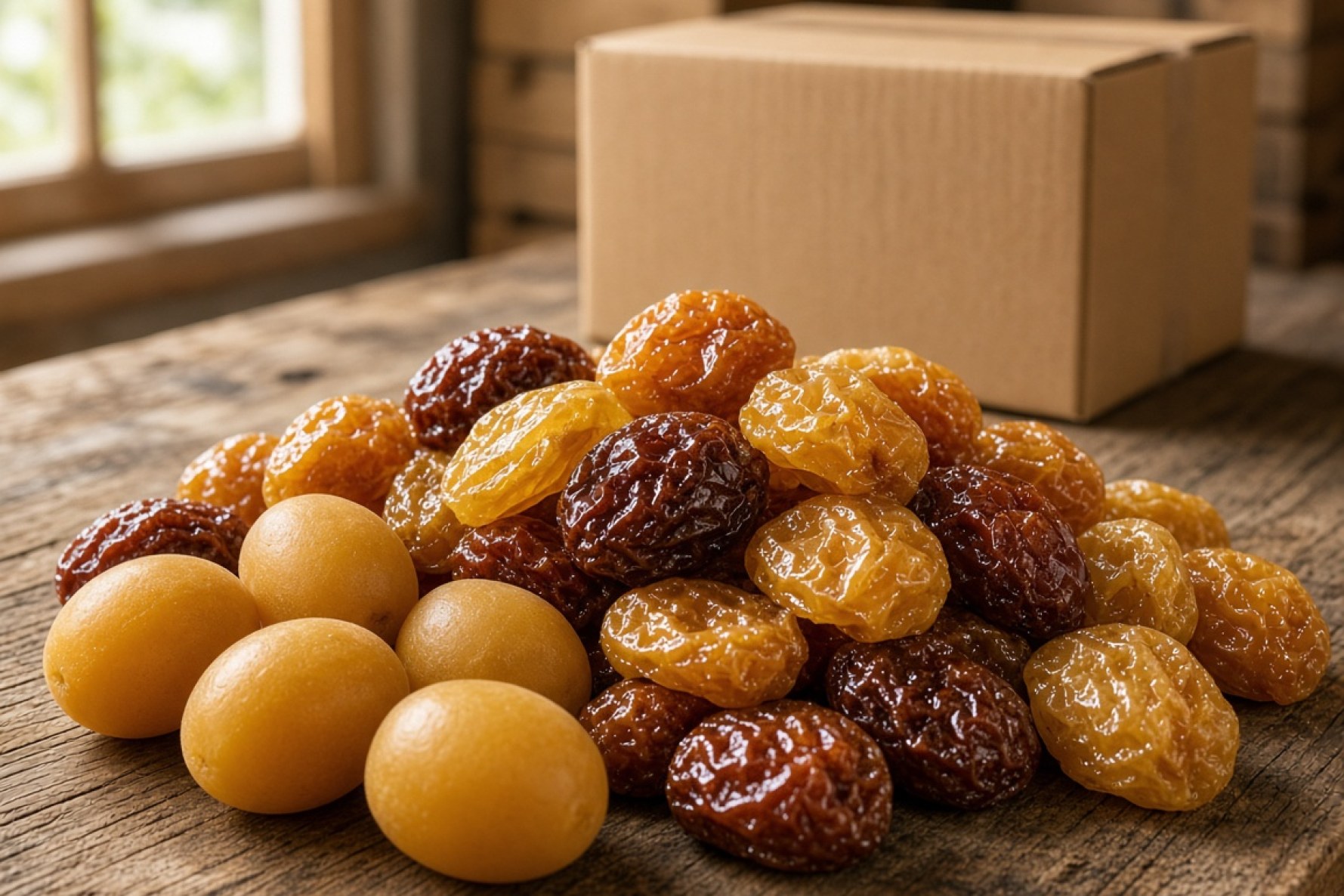
Bukhara is Iran’s best-known dried-fruit identity in international markets. Fresh fruit is elongated oval to round, with thin skin and golden flesh, and is always processed peeled.
- Ordinary grade: Packed directly after peeling and initial drying without separating small and large sizes; high demand in India, Pakistan, and Bangladesh.
- Premium grade: Undergoes multi-stage sorting, precise pitting, and rejection of defective units; fruit size is fully uniform and calibrated, with soft flesh and bright amber colour.
Haj Hasani plum
The largest, fleshiest, and most commercial golden plum type in Khorasan. Geometry is fully spherical and dimensions are much larger than Bukhara. Flesh thickness relative to pit size is very high, with a pleasant blend of dominant sweetness and mild tart notes. This is the primary export product to the UAE, Kuwait, and Canada.
Shams, Torghabeh, Kabrai, Barghāni, and Shablon
- Shams and Torghabeh: Medium round form; Shams from lemon-yellow to golden with firmer texture; Torghabeh with higher acidity for seasoning, plum paste, and catering.
- Kabrai: Soft, sugary texture and easy flesh separation from pit; competitive Bukhara substitute in Pakistan and India.
- Barghāni: Processed with skin; alkaline dip and sulfur smoke; dark brown to deep red colour; active market in Russia and the Caucasus.
- Shablon and Santarza: Large Japanese varieties with dark purple skin; dried whole or sliced (plum chips); popular in Russian snack markets.
| Commercial type | Shape and colour | Skin | Taste and texture | Flesh-to-pit ratio | Target markets |
|---|---|---|---|---|---|
| Bukhara ordinary | Elongated oval / amber | Peeled | Tart-sweet, elastic bite | Medium (~70%) | Pakistan, India, Bangladesh |
| Bukhara premium | Uniform oval / clear golden | Peeled | Mild tart-sweet, dense flesh | Good (~78%) | UAE, Australia, snack retail |
| Haj Hasani | Large round / honey to golden | Peeled | Sweet with light tartness, very fleshy | Excellent (above 84%) | Gulf, Canada |
| Kabrai | Wide round / light golden | Peeled | Sweet, soft, pit separates easily | Good (~75%) | Food industry, India, Pakistan |
| Barghāni | Irregular wrinkled / red to jujube tone | With skin | Tart-leaning tart-sweet, gelatinous | High (~80%) | Russia, Kazakhstan, stews |
| Dried Shablon | Flat or sliced / purple to black | With skin | Tart and sweet, fibrous elastic bite | High (above 82%) | Russia, Belarus, EU |
3. Processing methods and their impact on quality indices
Processing method is directly linked to shelf life, hygiene and safety indices, physiological texture, and landed cost. For golden Khorasan varieties such as Bukhara and Haj Hasani, peeling before drying is mandatory because cuticular waxes block natural moisture escape and can delay drying by weeks.
- Traditional peeling: 30 to 60 seconds in boiling water (short blanch), cold-water shock, then manual peel removal from the blossom end.
- Industrial steam peeling: Short steam pressure chambers with sudden pressure drop; lowers initial microbial load and removes hand contact.
- Natural sun drying: No chemical treatment; dark brown to black colour; favoured in Western Europe; shorter shelf life in non-refrigerated storage.
- Sulfur smoking: Most common for golden plums; SO₂ gas inhibits oxidative enzymes and stabilises carotenoid pigments; smoking typically lasts 4 to 8 hours.
- Lye method: Mainly for barghāni; brief dip in food-grade potassium carbonate or sodium hydroxide solution; accelerates moisture evaporation through the skin.
4. Calibration standards and international grading
Bulk dried-plum trade is defined by count-based calibration codes (Count Per Unit Weight) and precise physical measurements aligned with the United Nations Economic Commission for Europe standard (UNECE DDP-07) and Iranian National Standard No. 65. Calibration is measured as the number of dried plum units in 500 g at standard moisture; fewer units mean larger fruit and higher unit price.
| Commercial grade name | Count range per 500 g | Appearance and use |
|---|---|---|
| Super jumbo | < 32 | Hand-selected luxury Haj Hasani |
| Jumbo | 33–44 | Extra-premium Gulf export |
| Extra large | 45–55 | Grade-one standard for Haj Hasani and Bukhara |
| Large | 56–66 | Popular commercial grade for premium Bukhara |
| Medium | 67–77 | Economic and ordinary grades for bulk export |
| Small | 78–99 | Industrial use, confectionery, and stews |
Size uniformity coefficient: The weight ratio of the 10 largest to the 10 smallest units in a random carton; maximum 1.5 for super and premium grades, 1.7 for grade one, and 2.0 for ordinary is acceptable.
| Index | Super premium | Export grade one | Ordinary and industrial |
|---|---|---|---|
| Count per 500 g | 35 to 50 | 51 to 65 | 66 to 85 |
| Uniformity coefficient | Maximum 1.4 | Maximum 1.65 | Maximum 1.9 |
| Moisture by weight | 21% to 24% | 22% to 25% | 18% to 22% |
| Reconstituted juice Brix | Above 65 | 60 to 65 | 55 to 60 |
| Extraneous vegetable matter | Zero tolerance | Less than 0.2% | Less than 0.5% |
| Skin defects and crushing | Less than 1.5% | Less than 4% | Less than 7% |
| Live insect infestation | Zero tolerance | Zero tolerance | Maximum 0.5% (dead) |
| Fermentation / mould / souring | Zero tolerance | Less than 0.5% | Less than 1% |
5. Hygiene requirements, contaminant limits, and laboratory testing
Entry of agricultural shipments into advanced customs territories requires a valid certificate of analysis (COA) from accredited international laboratories. Under Iranian National Standard No. 65, the maximum permitted moisture in ordinary dried plum is 25%.
- Moisture above 25%: Creates conditions for toxigenic moulds and acid-loving yeasts and alcoholic fermentation.
- Moisture below 18%: Sugar crystallisation, leathery texture, and commercial weight loss.
- High-moisture plum: If the buyer requests 28% to 32% moisture, potassium sorbate addition or vacuum pasteurisation is mandatory.
Sulfur dioxide (SO₂): The European Union and UK typically cap at 1000 to 2000 mg/kg; Gulf Cooperation Council countries often allow 1500 to 2000 ppm; India and Pakistan accept up to 2000 ppm for bulk lots. Sulfite presence labelling is mandatory in many markets.
Aflatoxin and ochratoxin: In the EU, aflatoxin B1 is capped at 2 µg/kg and total aflatoxins at 4 µg/kg. Under Iranian national rules and Codex, total aflatoxins up to 10 ppb may be accepted. Ochratoxin A limits are typically 8 to 10 ppb. Pesticide residues must not exceed destination-country MRLs; lead and cadmium should be controlled below 0.1 and 0.05 mg/kg respectively.
6. Export target market analysis and demand trends
- Indian subcontinent: Largest buyer by weight; ordinary Bukhara and Kabrai with medium calibration of 65 to 75 count per 500 g; 10 kg bulk cartons; Pakistan is the main re-export corridor to India and Bangladesh.
- Persian Gulf: Super-premium Haj Hasani and hand-selected golden Bukhara with calibration below 45 count; luxury hospitality and five-star hotels; Dubai is a major re-export hub.
- Russia and Eurasia: Lye-treated tart-sweet barghāni and skin-on black Shablon for compotes, cakes, and winter snacks.
- EU, Australia, and Canada: Organic sun-dried plum or lots with SO₂ below 1000 ppm; non-GMO certification and confirmation of peeling without unauthorised substances.
| Destination | Dominant type and grade | Processing | Common packaging | Regulatory sensitivity |
|---|---|---|---|---|
| India | Ordinary Bukhara and Kabrai | Golden sulfured | 10 kg bulk carton | Quarantine, absence of larvae and mites |
| Pakistan | Nishapur ordinary Bukhara | Sulfured and lye-treated | 5 and 10 kg cartons | Phosphine fumigation |
| UAE | Super-premium Haj Hasani | Bright honey sulfured | 5 kg shrink-wrapped carton | Uniform calibration, Gulf standards |
| Russia | Barghāni and black Shablon | Lye or sun-dried | Heavy five-layer carton | Eurasian standards, moisture control |
| Germany | Organic sun-dried Bukhara | Unsulfured | Vacuum or bag-in-carton | Aflatoxin below 4 ppb |
7. Customs classification, tariffs, and documentation
- HS 08132000: Primary heading for all dried plum types (with/without skin, with/without pit).
- HS 08134000: Other dried fruit; only for fruit mixes, powder, or secondary blends—listing pure plum under this code is incorrect.
The mandatory export document set includes:
- Phytosanitary Certificate
- Health Certificate
- Third-party quality and weight inspection certificate (SGS / IGI)
- Certificate of Origin
- Commercial Invoice and Packing List
- Fumigation Certificate on long transit routes
8. Packaging engineering, storage, and container logistics
Dried plum at roughly 22% average moisture is vulnerable to ambient moisture exchange. Standard export structure is usually a 5 or 10 kg five-layer carton with a 60 to 80 micron polyethylene liner and sorted product at standard moisture.
- Warm sea routes: Refrigerated container (Reefer) at 8 to 12°C with active ventilation.
- Road routes and cold seasons: Dry van container with secure palletisation and anti-condensation insulation.
- Modified atmosphere (MAP): For luxury retail with nitrogen and carbon dioxide blends.
- Surface sugar bloom: Crystallisation of glucose and fructose on the surface; not a health hazard but hurts commercial appearance. Prevention uses stable temperature, 55% to 65% relative humidity, and impermeable liners.
- 20-foot capacity: Typically 18 to 21 tonnes with 10 kg pallets; reefer is mandatory in hot months.
9. Pricing structure, quality risks, and competitiveness
The main price differentiator is fruit calibration and the uniformity coefficient; super jumbo Haj Hasani can trade up to 45% above small ordinary grades. The lowest origin prices form from Shahrivar through Aban at peak local supply; from Azar onward, cold-storage cost drives an upward slope.
| Country | Strengths | Limitations | Price level | Key markets |
|---|---|---|---|---|
| Iran | Tart-sweet taste, golden colour, peeled types | Partial reliance on traditional workshops | Economic to competitive | Subcontinent, Gulf, Eurasia |
| Chile | Mechanised lines, stable calibration | Focus on dark varieties | Mid to upper mid | Western Europe, China |
| USA | Advanced pitting, pit-free standard | Very high cost base | Highest tier | Japan, UK, Germany, Canada |
| Uzbekistan | Low-cost rail network to Russia | Moisture and sort-quality swings | Low cost | Russia, Kazakhstan, Ukraine |
10. Industrial uses of dried plum in food manufacturing
- Purée, marmalade, and confectionery fillings: Kabrai and Shams with high pectin resist breakdown and weeping in industrial cooking.
- Sauces, pickles, and seasonings: Barghāni and small ordinary grades as natural thickeners and flavouring.
- Ready meals and canned stews: Premium Nishapur Bukhara has elastic texture to withstand 121°C sterilisation.
- Diet and meat products: Soluble fibre and sorbitol; malic acid and phenolic antioxidants as natural preservatives in sausage and burger formulations.
11. Importer checklist before placing a bulk order
- Explicit commercial type (premium Bukhara, grade-one Haj Hasani, lye barghāni, etc.)
- Calibration range (e.g. 50–60 count per 500 g) and uniformity coefficient below 1.6
- Processing method specified (pure sun-dried, golden sulfured, or lye-treated)
- Maximum sulfur dioxide residue fixed per destination regulations
- Target moisture range by weight (usually 21% to 24%)
- Physical defect tolerance table and zero tolerance for insect contamination
- Receipt and sealing of a minimum 1 kg witness sample
- Standardise five-layer cartons, polyethylene liner, ISPM 15 pallets
- Name third-party inspection company in the contract
- Define Incoterms and dry or refrigerated container type
12. What information is needed for an accurate quote?
- Commercial plum type (Bukhara, Haj Hasani, Kabrai, barghāni, or Shablon)
- Calibration and count per 500 g
- Processing and sorting grade (hand-selected premium, factory, or ordinary)
- Processing type and SO₂ ceiling
- Target moisture and order volume (tonnes or number of 20-foot containers)
- Packaging system and private-label requirements
- Destination port and Incoterms
- Required destination tests and certificates
For buyers seeking direct supply with engineered specifications from Nishapur orchards and Iranian processing centres, Iranco provides an integrated platform to submit RFQs, receive matching options, and compare supply choices transparently.
Export dried plum supply from Iran through the Iranco network
In dried-plum trade, a balanced commercial offer goes beyond nominal price per kilogram. Variables such as actual moisture loss in transit, calibration match to order specs, lot homogeneity, and control of chemical residues against destination customs standards shape transaction success.
As a specialist food-supply-chain platform, Iranco connects bulk buyers and international trade managers directly with verified supply pools, mechanised sorting workshops, and premium Iranian orchards. Buyers can register needs by type, calibration, moisture percentage, sulfur ceiling, and packaging format, then evaluate sealed witness samples after supply options are verified.
Analytical summary
International trade in Iranian dried plum has strong commercial potential driven by high fruit Brix, exceptional orchard climate in Khorasan and Azerbaijan, and genetic diversity of native cultivars. Golden Bukhara and Haj Hasani are unique in the global dried-fruit market for organoleptic character, elastic texture, and tart-sweet flavour. Successful importers and exporters base decisions on count-based calibration standards, tight moisture control in the 21% to 24% band to prevent sugar bloom, and laboratory alignment of sulfur with importer-country rules.
Frequently asked questions
What is the fundamental difference between Bukhara and Haj Hasani dried plum?
Bukhara is medium-sized with elastic texture and tart-sweet balance, used mainly in stews and rice dishes in South Asia. Haj Hasani is much larger, fully spherical, with very thick flesh and dominant sweetness, established as a luxury snack in Gulf and Canadian markets.
What is the maximum permitted sulfur dioxide residue in export dried plum?
It depends on the importing country. Codex and markets such as India and Pakistan accept up to 2000 mg/kg for bulk use. The Gulf typically applies 1500 to 2000 ppm and the EU often 1000 to 2000 ppm. Fully organic markets allow only unsulfured sun-dried product.
How is dried plum calibration assessed?
International calibration is based on counting units in 500 g of product. Fewer units mean larger fruit. Lot uniformity is also measured by the weight ratio of the largest to smallest units in a carton.
What causes a white mould-like layer on dried plum?
In most cases this white layer is not fungal mould but surface sugar bloom from migration and crystallisation of glucose and fructose due to temperature swings. Storage below 65% relative humidity, stable cool temperature, and impermeable polyethylene bags prevent it.
What is commercial shelf life of dried plum?
With stable moisture below 25%, at ambient temperature under 20°C, product is usually storable for 6 to 9 months. In cold store at 4°C to 8°C with controlled humidity, shelf life of 18 to 24 months can be assured.
Which plum type suits Russia and Eurasia best?
The Russian market strongly prefers dark-skinned plums with tart-leaning tart-sweet flavour. Lye-treated Maragheh barghāni and whole or sliced black Shablon best match consumption patterns.
How can uniform quality be assured in high-tonnage shipments?
The most reliable approach is fixing the size uniformity coefficient in the contract, setting a maximum for defective units, receiving a sealed witness sample before loading, and requiring physical and laboratory inspection by accredited third-party firms at origin customs.
How can dried plum be sourced directly from Iranian suppliers?
Buyers should document technical order specs including product type, calibration, moisture, sulfur ceiling, carton type, and Incoterms. Submitting these through a purchase request on Iranco identifies verified production options and enables sample review and direct contracting.
Featured Products


Related Articles



