 Iranco Magazine Team
Iraq market capacity, export doogh specs, QC and labelling requirements, packaging, cold chain and supply routes for Najaf, Karbala and Basra
Export guide · Doogh · Iraq · Najaf · Karbala · Basra
Iranian Doogh Export to Iraq: High-Demand Traditional Beverage Market in Najaf, Karbala and Basra
Iraq market capacity, export doogh specifications, quality control and labelling requirements, packaging, cold chain and supply routes for Najaf, Karbala and Basra
Doogh is not unfamiliar in Iraq; fermented salty dairy drinks sit alongside meat dishes, kebab, rice and family meals. For Iranian exporters, short geographic distance, industrial production experience and prior presence of Iranian dairy in Iraq create practical advantage — but commercial success depends on stable quality, robust packaging, Arabic labelling and a controllable cold chain.
Four key indicators
2024 data shows Iran was the main registered supplier to Iraq in heading 040390 — other fermented or acidified milk and cream. This line is not doogh-only and must not be read as total doogh trade, but it is an important gauge of Iran's position in fermented dairy in Iraq.
Introduction
The doogh market in Iraq has an important feature for Iranian producers: the product does not need to be introduced from zero culturally. Fermented salty dairy drinks are known across much of the Middle East and in Iraq are consumed with meat dishes, kebab, rice, restaurant meals and family dining.
For Iran, geographic proximity matters especially. Unlike many dry goods, doogh is a product where freight cost and cold-chain quality can directly affect importer margin. Shorter distance from western and south-western Iranian plants to Iraqi markets enables road planning, repeat orders and lower inventory dwell time.
In trade terms Iran also has a notable presence in related dairy in Iraq. 2024 data for heading 040390 shows about $5.304M of Iraqi imports in this group, of which $3.466M came from Iran.
However, export success is not achieved by taste alone. Professional importers care about flavour stability, salt level, shelf behaviour, unwanted separation, robust packaging, Arabic label information, compliance documents and reliable delivery.
A professional doogh transaction should therefore begin with answers to several questions before a proforma invoice is issued: Is the product plain, carbonated or flavoured? Is it heat-treated or live-culture? What pack size and label language are required? Which laboratory results must accompany the shipment? Through which channel will the buyer distribute in Najaf, Karbala or Basra? And what remaining shelf life is required at delivery?
1. Position of Iranian doogh in the Iraq market
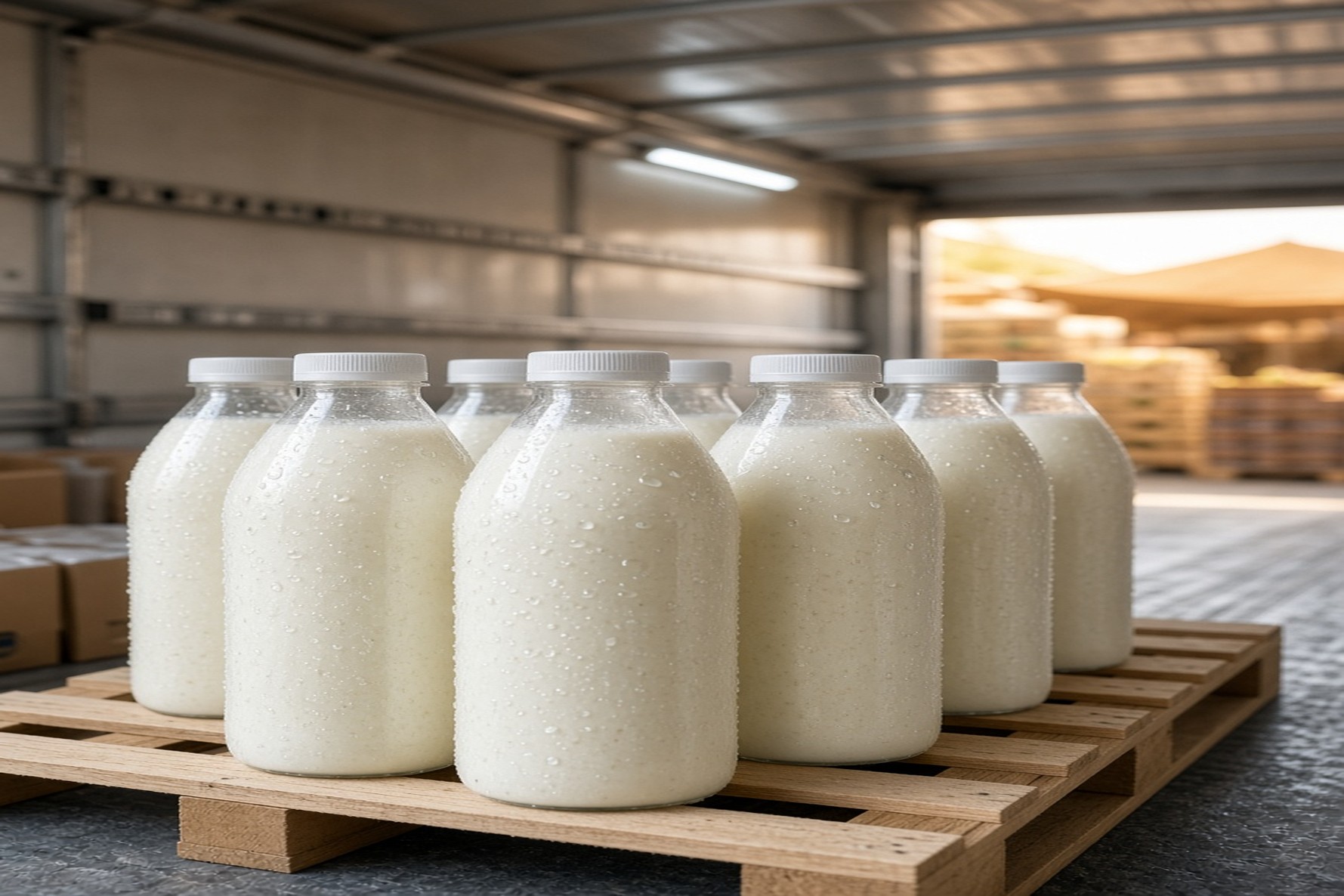
Doogh is one of the few Iranian drinks with both traditional heritage and full industrial production. Regional Codex standard CXS 332R-2018 defines doogh as a fermented-milk-based beverage that may be made by combining yoghurt with drinking water and, where used, edible salt.
A dedicated regional standard matters commercially. In Codex regional standard documents, Iranian national standard 2453 is cited as the standard linked to physical, chemical, microbiological and sensory characteristics of Iranian doogh.
Why is Iraq a more natural market for Iranian doogh?
- Similar food consumption patterns; doogh is usually consumed with meals and has steady demand in Iraqi restaurants, eateries and households.
- Shorter haul distance than many competitors; plants in western and south-western Iran can reach Najaf, Karbala and Basra by regular road freight.
- Prior presence of Iranian dairy in Iraq; import data for heading 040390 shows an active trade chain between the two countries.
2. Export-suitable doogh vs product suited only to the domestic market
For doogh export to Iraq, product choice should not be based only on the factory's best-selling domestic SKU. The main difference is specification stability. The importer expects the next month's shipment to match the approved sample in taste, salt, viscosity, gas, texture and appearance.
Codex CXS 243-2003 distinguishes fermented milk with live micro-organisms from product heat-treated after fermentation. The generic term one-litre doogh is not enough for an export contract.
| Product type | Main feature | Likely commercial use |
|---|---|---|
| Plain still doogh | Easy consumption, lower pack pressure | General retail and food service |
| Carbonated doogh | Distinct mouthfeel and traditional profile | Consumers who prefer fizzy doogh |
| Flavoured doogh | Herbs or permitted flavourings | Shelf differentiation |
| Heat-treated after fermentation | Different microbiological and sensory rules | Programmes where shelf life weighs more |
| Live-culture doogh | Live fermenting micro-organisms | Markets wanting fresher fermented product |
Regional standard CXS 332R-2018 defines plain, flavoured, heat-treated and non-heat-treated types with specific rules for additives and preservatives. In plain or non-heat-treated flavoured doogh, preservatives are generally not permitted. The exporter must align the final formula with this framework.
Plain or flavoured doogh?
For initial market entry, plain product usually allows more direct comparison with competitors. Flavoured product should be chosen when the importer knows the sales channel and consumer response well enough.
Additives and preservatives
The updated regional Codex standard for doogh regulates specific additive groups according to plain, flavoured, heat-treated or non-heat-treated formats. Preservatives are generally not permitted within that framework for plain or non-heat-treated flavoured doogh. The exporter must align the final formula with this framework before label artwork is approved.
If the Iraqi buyer requests a longer commercial shelf life, the discussion should move from informal promises to validated heat treatment, approved additives or a defined storage-temperature programme — not to undeclared formula changes between sample and shipment.
3. How do Najaf, Karbala and Basra markets differ?
Iraq is not one market on the map. Najaf, Karbala and Basra differ in demand mix, consumption pattern, haul route and cold-chain sensitivity. A professional importer should tune distribution strategy by destination city, not only by nearest border.
Najaf
Najaf combines household, retail, restaurant demand and traffic linked to visitors and pilgrims. For an importer distributing in Najaf, stock turnover speed matters greatly.
Single-serve and family packs can play different roles. Small packs suit restaurants and immediate consumption; larger packs are more economical for household purchase.
Karbala
Demand spikes during high religious traffic periods can make inventory planning more sensitive. Exporters should not treat a peak-period order increase as fixed monthly consumption.
Factory capacity for planned production and phased delivery matters more than sending one large shipment without a sales plan.
Basra
Access to southern Iraq from south-western Iranian border corridors can create practical advantage for Basra distribution.
In Basra, cold-chain management is especially important. Warehouse temperature, truck stops, unloading and retail chiller conditions all affect consumer experience.
| Market | Main decision axis | Pack formats to review | Key risk |
|---|---|---|---|
| Najaf | Fast turnover and restaurant coverage | Small and family | Inbound volume not matching sales |
| Karbala | Managing variable demand | Single-serve and multi-serve | Excess stock after peak periods |
| Basra | Haul efficiency and cold chain | Road-resistant packs | Temperature breaks in haul and distribution |
There is no reliable public city-level data to name one of these three as Iraq's largest doogh market. For choosing a first entry city, the importer's real sales data is more valuable.
4. Technical specifications expected by Iraqi buyers
The buyer's main task is to turn the generic name doogh into a precise purchase specification. A purchase request should not list only bottle volume and carton count.
Contracts should also define an approved reference sample. Sensory attributes such as saltiness, acidity intensity, herbal aroma and texture uniformity cannot always be described by numbers alone.
| Parameter | Option under review | Importance to buyer |
|---|---|---|
| Doogh type | Plain, carbonated, flavoured, heat-treated | Defines product nature |
| Production base | Yoghurt and water or direct fermentation | Affects sensory and technical profile |
| Fat content | Per formula and label | Affects taste, texture and nutrition |
| Salt level | Defined amount in final formula | Palate fit and label compliance |
| Acidity and pH | Per manufacturer spec | Batch stability control |
| Starter culture | Culture type and live status | Fermentation quality |
| Gas | Still or controlled carbonation | Packaging and drinking experience |
| Net volume | By sales channel | Unit price and turnover |
| Shelf life | Supported by plant validation | Inventory management |
| Label language | Iraq market requirements | Clearance and listing |
| Additives | Per CXS 332R-2018 | Legal compliance |
| Preservatives | Permitted or not | Shelf life and acceptance |
| Storage temperature | Per label and validation | Cold chain |
| Batch number | Mandatory for traceability | QC and recall |
Iraqi buyers usually evaluate a real production sample before bulk orders. Technical specs should be provided with COA and a microbiological test plan.
5. Quality control: what to check before loading
Doogh looks like a simple formulation, but QC is multi-layered. Milk and water quality, fermentation, salt, permitted additives, filling, capping, cooling and storage can all change the final result.
Visual inspection
- Abnormal bottle deformation
- Leakage from cap or seal
- Pack surface contamination
- Unexpected swelling
- Incomplete production or expiry print
- Noticeable colour or appearance difference between units
- Sediment or separation outside product spec
- Damage to master carton or pallet in warehouse
Physicochemical control
- pH and titratable acidity
- Salt and fat content
- Net weight or volume
- Pressure or gas level in carbonated product
- Physical stability check
- Texture uniformity within a batch
- Viscosity and thickness
- Product temperature at loading
Microbiological control
Doogh is a dairy product and microbiological control is inseparable from release. Iraqi food standards also include microbiological requirements; export sampling must follow a product-appropriate test plan.
The test plan should follow doogh type and applicable standards. COA must be linked to batch number.
End-of-shelf-life sample control
Approving a fresh sample alone is not enough. For professional export contracts the manufacturer should provide shelf-life test data so the importer can contract remaining shelf life at delivery.
| Test | What it shows | Commercial importance |
|---|---|---|
| pH and acidity | Fermentation status and product stability | Very high |
| Salt and fat | Formula composition | High |
| Net volume | Pack fill compliance | High |
| Carbonation level | Gas pressure in fizzy doogh | High for carbonated SKUs |
| Total count | Hygiene status | Very high |
| Yeast and mould | Spoilage risk | Very high |
| Coliforms | Process hygiene indicator | High |
| Sensory panel | Taste, aroma and texture | High |
| Shelf-life validation | Behaviour through stated life | Critical for export contracts |
6. Standards, labelling and entry of doogh into Iraq
In Iraq, the Central Organisation for Standardisation and Quality Control oversees compliance of many imported goods with approved standards. In 2026, development of a national supplier registry and inspection of import shipments was also formally reviewed by Iraq's higher import policy committee.
For export doogh, label design must be agreed with the importer before final printing. Export labels should not be designed after the truck reaches the border.
Label information
- Product name and ingredients
- Milk-related allergens
- Net weight or volume
- Manufacturer name and country of origin
- Batch number, production and expiry dates
- Storage conditions and nutrition facts where required
- Carbonation or special feature statement
- Language accepted in the Iraq market
- Barcode and product code where needed
- Standard mark or certificate where required
- Production registration or licence number
- Usage instructions
- Importer address for private label
- Cold-storage warning where required
Labels must match customs documents and commercial invoice. Any mismatch between label product name and declaration description can delay clearance.
Shipment conformity file
Instead of focusing on one form name, the exporter should prepare a shipment conformity file linking all information needed for inspection and sampling.
| Document | Issuer or preparer | Purpose |
|---|---|---|
| Commercial invoice | Exporter | Value and deal specifications |
| Packing list | Exporter | Quantity, weight and shipment layout |
| Certificate of origin | Relevant authority | Proof of origin |
| CoA | Laboratory or producer per agreement | Proof of technical specifications |
| Health certificate | Authorised authority | Shipment health file |
| Technical specification | Producer | Product definition |
| Label artwork | Producer and buyer | Information conformity control |
| Temperature log | Haulier or exporter | Cold-chain evidence |
| Conformity certificate if applicable | Authority or approved company | Import conformity control |
7. Doogh tariff code and customs classification note
Doogh's main family in the Harmonized System is Chapter 04 under heading 0403. In this structure 040320 is yoghurt and 040390 covers other products in the group.
Doogh's exact national subheading cannot be declared without reviewing formula and Iraq's applied tariff table. Classification should be confirmed with an Iraqi customs broker before loading is finalised.
Total Iraq imports in 040390 in 2024 were about $5.304M with volume 2,505,250 kg. Imports from Iran were about $3.466M, giving Iran roughly a 65% share of this heading's value.
Iran's share of this group value was about 65%; with the caveat that heading 040390 as a whole must not be called Iraq's doogh market.
- Total Iraq imports in 040390: about $5.304 million
- Volume: about 2,505,250 kg
- Imports from Iran: about $3.466 million
- Volume from Iran: about 1,637,000 kg
These figures are useful for market sizing and supplier positioning, but the Iraqi importer and customs broker should still verify the final declarable code, applicable duties and required documents before shipment dispatch.
8. Suitable doogh packaging for Iraq
Export doogh packaging must be designed for both marketing and logistics. Bottle, cap, label, master carton and pallet layout all affect freight cost, turnover and consumer experience.
Single-serve pack
Small packs matter for restaurants, eateries and meal accompaniment sales. Trade data on similar ayran products entering Iraq also shows packs around 293 ml.
Single-serve raises packaging cost per litre but increases turnover in restaurant and small-store channels.
Family pack
Trade documents on similar products imported into Iraq also show one-litre and 1.5-litre packs. Family size lowers packaging cost per litre.
For households, larger packs are more economical but must be stored properly in the fridge after opening; this affects cap design and pack size.
Bottle and cap
For carbonated doogh, bottle and cap choice must match actual product pressure. In road haul, carton crush resistance and pallet strapping also matter.
| Factor | Small pack | Family pack |
|---|---|---|
| Immediate consumption | Very suitable | More limited |
| Restaurant sales | Suitable | Suitable for bulk serve |
| Packaging cost per litre | Higher | Lower |
| Household sales fit | Medium | High |
| Shelf turnover speed | High | Medium |
| Haul damage sensitivity | Medium | Higher |
Master carton
- Bottles per carton and gross weight
- External dimensions and stacking strength
- Cartons per layer and layers per pallet
- Final pallet height and strapping method
- Product code and batch print on carton
- Moisture and crush resistance
- Truck stacking without damage
- Maximum weight per pallet
- Cold-chain shipping label where required
9. Hauling doogh from Iran to Iraq and cold-chain management
The cold chain is where doogh shipment profit or failure is often decided. Haul temperature must follow the product's validated storage conditions and label instructions exactly.
Before loading
Product must reach appropriate temperature before entering the truck. Loading warm product into a refrigerated truck lengthens time to target temperature and raises quality risk.
- Product must reach appropriate temperature before truck entry
- Cargo-space temperature and refrigeration unit health
- No blocked air circulation from poor stacking
- Carton count matches documents and adequate remaining shelf life
- Cap and seal integrity check
- Production and expiry date control
- Batch number matches COA
- Correct pallet strapping
- Initial product temperature recorded
Temperature logging
For regular commercial shipments, temperature loggers are important for dispute management. Without temperature history it is hard to tell whether a problem arose in production, haul, border or distribution.
Route selection
For Basra, south-western Iranian corridors can be logical. For Najaf and Karbala, western axes depend on plant location and importer schedule.
The shortest line on the map is not always the best commercial route. Border dwell time, road quality, destination cold-store capacity and delivery plan must all be considered.
Pre-loading control
Before truck sealing, verify:
- Batch numbers match documents.
- Package count matches the packing list.
- Containers show no leakage or swelling.
- Pallets are intact and correctly strapped.
- Production and expiry dates are legible.
- Product temperature is within specification.
- A reference sample from the batch is retained.
- The CoA for the same production is ready.
- Labels match the buyer-approved file.
- Refrigeration unit has been pre-cooled.
Delivery at destination
- Seal number and truck condition
- Logged temperature and pallet integrity
- Carton count and possible leakage
- Production and expiry dates and batch match
- Documents match shipment
- Delivery temperature recorded
- Physical carton damage check
- Delivery receipt signed
10. How is export doogh price to Iraq determined?
Export doogh price cannot be compared on price per litre alone. Two products with the same volume can differ materially in composition, packaging, shelf life and haul cost.
| Factor | Commercial effect |
|---|---|
| Dairy raw material price | Direct effect on ex-plant cost |
| Fat and dairy solids | Formula cost change |
| Process type and carbonation | Effect on line and packaging |
| Bottle type, pack size and label print | Direct unit cost effect |
| Order size, cartons and pallets | Logistics effect |
| Testing and delivery route | QC and haul cost |
| Private label | Design and print cost |
| Shelf life and remaining life at delivery | Inventory risk effect |
| Incoterms | Seller responsibility scope |
| Refrigerated haul cost | Major delivery cost item |
| Clearance and document fees | Import side cost |
| Exchange rate movement | Effect on importer final price |
For Iraqi buyers, cost per unit sold in good condition is a more accurate index than the cheapest ex-factory price.
When does a low price become risky?
- Is net weight or volume equal?
- Is dairy solids content similar?
- Are shelf life, master carton and delivery point the same?
- Do both offers include testing and refrigerated haul?
- Is doogh type the same?
- Are label and packaging at a similar level?
- Is remaining shelf life at delivery specified?
- Is cold-chain responsibility defined in contract?
- Do both offers include COA and test plan?
11. Competition in Iraq: Iran vs other suppliers
In Iraq customs heading 040390 in 2024, Iran was the largest registered supplier, followed by Saudi Arabia, China, India, Greece and others.
Iran
Iran's main advantages are distance, industrial doogh production experience and cultural product fit. Iran's challenge is more about maintaining quality stability, export packaging design and building regular distribution.
An Iranian exporter offering stable product, compliant labels and regular delivery can leverage proximity to market.
Turkey
Turkish ayran is close to doogh in consumption position and has real presence in Iraq trade. Iranian exporters should not compare competitors on price alone.
Turkey has advantage in varied packaging and regional dairy export experience; haul cost to some Iraqi areas differs.
Domestic Iraqi production
Domestic producers have a fundamental advantage: shortest distance to market. Importers of Iranian product must create justification for import cost — such as flavour stability, known brand or packaging quality.
| Origin | Likely advantage | Competition challenge |
|---|---|---|
| Iran | Distance, doogh production record, dairy presence | Need for strong distribution network |
| Turkey | Ayran export experience and varied packs | Distance and haul cost to some areas |
| Iraq production | Full market proximity | Depends on each producer's capacity |
| Other suppliers | Dairy capacity and known brands | Cost and logistics competition |
Common mistakes by doogh exporters to Iraq
- Selling on domestic taste alone: A product popular in Iran may not match Iraqi salt level, carbonation or pack expectations without reformulation and retesting.
- Printing labels before importer approval: Correcting thousands of bottles is far more expensive than reviewing artwork before printing.
- Breaking the cold chain to save haul cost: A short temperature excursion can destroy an entire dairy shipment's commercial value.
- Using a generic CoA: A sheet without batch number or without link to the shipment has limited quality-control value.
- Mixing several batches in one shipment without separation: Test-result traceability becomes difficult when batches are combined.
- Assuming one uniform market across Iraq: Selling to Najaf, Karbala and Basra are three different distribution decisions.
- Sending a premium sample and producing a weaker shipment: In border trade with official testing, the risk of rejection is much greater than in informal domestic trade.
Sustainable advantage in Iraq does not come from sending the cheapest shipment. Repeatable supply, suitable packaging, destination compliance and consistent technical documentation are what turn a trial purchase into an ongoing commercial relationship.
12. Importer checklist before placing an order
Before finalising a doogh order for Najaf, Karbala or Basra, an Iraqi buyer should clarify at least the following. The earlier these items are defined, the smaller the gap between approved sample and delivered goods.
- Define exact doogh type: plain, carbonated, flavoured or heat-treated
- Obtain formula and product specs; trade name alone is not enough
- Request a real production sample and evaluate taste for target market
- Record measurable physicochemical specifications
- Confirm microbiological test plan
- Review shelf life from plant documentation
- Evaluate packaging under real haul conditions
- Approve Iraq label text before final print
- Confirm tariff code with Iraqi customs broker
- Contract remaining shelf life at delivery
- Match order volume to destination cold-store capacity
- Document cold-haul responsibility and rejection criteria
- Define destination sampling method and batch numbers on sales docs
- Calculate true cost to destination cold store
- Separate trial order from market development order
- Define approved reference sample in contract
- Specify Incoterms and delivery point
- Agree quality dispute resolution method in advance
What information is needed for an accurate price?
- Doogh type: plain or flavoured; carbonated or still
- Fat content and special formula features if any
- Bottle volume, pack material and bottles per carton
- Approximate order volume: trial or ongoing programme
- Private label need and label language/design
- Destination city in Iraq and intended delivery point
- Haul type, required shelf life and required certificates
- Incoterms
- Minimum remaining shelf life at delivery
- COA and specific test plan need
- Cartons per pallet
- Temperature logger need
- Order frequency and delivery schedule
- Target sales channel (retail, restaurant, wholesale)
- Target price range if any
- Importer details and clearance responsible party
On Iranco, purchase requests are best submitted at this level of detail. When doogh type, packaging, volume and destination are clear from the start, supply comparison becomes commercially meaningful and negotiation time shortens.
Supply path for Iranian doogh for Iraqi importers
In international doogh buying, choosing a plant is only one step. A logical supply path starts with doogh type, pack size, order volume, target market and sensory profile.
Iranco can be used by international buyers to submit purchase requests and review available supply options in Iran. If the goal is doogh for Najaf, Karbala or Basra, delivery city, phase volume and cold-store capacity should be stated in the request.
At Iranco, price requests are reviewed more accurately when full product, packaging, destination and delivery information is included in the purchase request.
This approach avoids comparing offers that are not equal in packaging or technical specification and shortens importer negotiation time.
Conclusion
Iranian doogh export to Iraq creates lasting advantage when three topics are managed together: suitable product, controllable cold chain and distribution matched to turnover speed.
Iran has real trade presence in fermented dairy in Iraq. In 2024, of about $5.304M registered Iraqi imports in heading 040390, nearly $3.466M came from Iran.
In markets such as Najaf and Karbala, inventory control and matching inbound volume to demand swings matter greatly. In Basra, haul route and keeping product cold from plant to destination store are decisive.
An exporter offering stable product, compliant labels, robust packs, clear documents and regular delivery has a better chance of turning trial sales into long-term supply in Iraq.
Standards CXS 332R-2018 and Iranian national standard 2453 provide a useful technical framework for product definition and importer negotiation.
Frequently asked questions
Does Iranian doogh have a suitable market in Iraq?
Fermented dairy trade data shows Iran has notable presence in Iraq. In heading 040390, Iraq imported over $3.466M from Iran in 2024. This is not doogh-only data but shows an active trade chain for related products.
What is the doogh tariff code?
Doogh sits in HS Chapter 04 under HS 0403. HS 2022 assigns 040320 to yoghurt and 040390 to other products in the heading. Iraq's applied subheading must be confirmed from actual product specs.
Which pack is better for the Iraq market?
Pack choice depends on sales channel. Single-serve matters for restaurants and immediate consumption; larger packs can be more economical for households. Trade data on similar products in Iraq shows around 293 ml, one litre and 1.5 litre packs.
What tests should export doogh have?
The test plan should follow doogh type and applicable standards. Relevant physicochemical tests can cover pH, acidity, salt, fat and, for carbonated doogh, gas-related parameters. Microbiological control is essential for dairy.
Must doogh be kept cold in haul to Iraq?
Haul conditions must match the product's validated storage conditions. Where cold storage is required on the label, the cold chain must be maintained from plant through cold store to retail network.
Which is best among Najaf, Karbala and Basra?
Choosing one city without the importer's distribution data is not sound. Najaf and Karbala can suit restaurant sales and high-traffic periods; Basra differs in southern Iraq access.
How is export doogh price calculated?
Price depends on dairy inputs, formula type, fat, pack type, bottle volume, carbonation, order size, cartons, pallets, testing, private label, haul cost and delivery point.
How can doogh be sourced directly from Iran?
First define product type, pack size, order quantity, sensory profile, destination and delivery terms. International buyers can submit this as a purchase request through Iranco.
Does doogh have an independent international standard?
Yes. Codex regional standard CXS 332R-2018 was developed for doogh in the Near East. It defines doogh as a fermented-milk-based beverage and should be read with fermented milks standard CXS 243-2003.
For Iranian doogh export advice to Iraq and supplier connection
If you are an importer or distributor in Iraq seeking Iranian doogh for Najaf, Karbala or Basra, submit your request with full product specifications.
Contact Irancoinfo@iranco.com · WhatsApp: +98 913 104 4182 · Telegram: @irancofood
Featured Products
Related Articles



