 Iranco Magazine Team
Industrial formulation, lab standards, packaging engineering, customs processes and target-market analysis
Export Guide · Coffee Mix · Wholesale
Iranian Coffee Mix: Wholesale Buying & Export Guide
Industrial formulation, laboratory standards, packaging engineering, customs processes, and target export market analysis
Urban lifestyle shifts, the rise of coworking offices, and growing demand for ready-to-drink hot beverages have moved coffee mix from a niche item to one of the most widely consumed powder products in household baskets and HoReCa channels. Across the Middle East and Central Asia, three-in-one and two-in-one sachets capture a substantial share of instant coffee demand thanks to fast preparation, low unit price, and long shelf life—and regional trade in this category has surpassed USD 1.5 billion.
Iran is not merely a consumer in this chain. Combining sugar refining capacity, relatively low-cost industrial energy, a polymer and multilayer packaging industry, and a geographic position at the Eurasian land crossroads, it has become a processing and packaging hub for coffee mix exports to Iraq, Afghanistan, Russia and the CIS, and Gulf Cooperation Council markets. Green beans arrive from Vietnam, Brazil, and Indonesia; they are roasted and extracted into soluble coffee, then blended with domestically refined sugar and powdered vegetable fat in industrial formulations.
Southeast Asian competitors mainly leverage labor cost and direct access to robusta farms. Iranian producers, by contrast, build a different competitive edge through active land borders, shorter transit times to neighboring markets, flexibility in OEM and private-label work, and alignment with the region’s sweet, high-fat taste profile. This guide consolidates technical specifications, standards, sachet film engineering, customs codes, logistics, and a wholesale buying checklist for traders, procurement managers, and export investors.
1. Industry Position and the Coffee Mix Value Chain in Iran
Iran’s coffee mix value chain starts with green bean imports and instant coffee extraction and extends through powder formulation, sachet filling, export carton packing, and border clearance. Three cost pillars determine margin along this chain: process energy, sweetener, and polymer packaging.
- Industrial energy: Spray dryers, ribbon mixers, and heat-seal lines depend on stable electricity and gas. Relatively competitive energy costs in Iran keep powder conversion costs lower than for many producers in Turkey and the Gulf.
- Refined sugar 99.8%: High-purity white sugar forms the bulk of classic formulations (typically more than half the sachet weight). Access to domestic refineries reduces import-currency volatility for the producer.
- Multilayer polymer packaging: Domestic PET, aluminum, and LLDPE film capacity supports sachet foil and multilayer carton supply, reducing full dependence on finished film imports.
2. Product Categories and Common Formulations
The export coffee mix market splits into several main families by coffee, sugar, and powdered creamer ratios, as well as aroma intensity. Category choice drives unit price, retail audience, and destination labeling requirements.
| Product category | Instant coffee | Creamer / powdered fat | Sugar / sweetener | Market use |
|---|---|---|---|---|
| Classic 3in1 | 10–13% | 32–35% | 52–58% | General retail, HoReCa |
| Strong 3in1 | 14–18% | 30–34% | 48–54% | Russian & CIS markets, offices |
| Diet 2in1 | 18–25% | 75–82% | Sugar-free / sucralose | Diet, diabetes, Gulf |
| Flavored | 9–12% | 30–34% | 50–56% + flavor | Hazelnut, caramel, vanilla |
| Cappuccino mix | 12–16% | 35–40% + foam | 45–50% | Home café, premium |
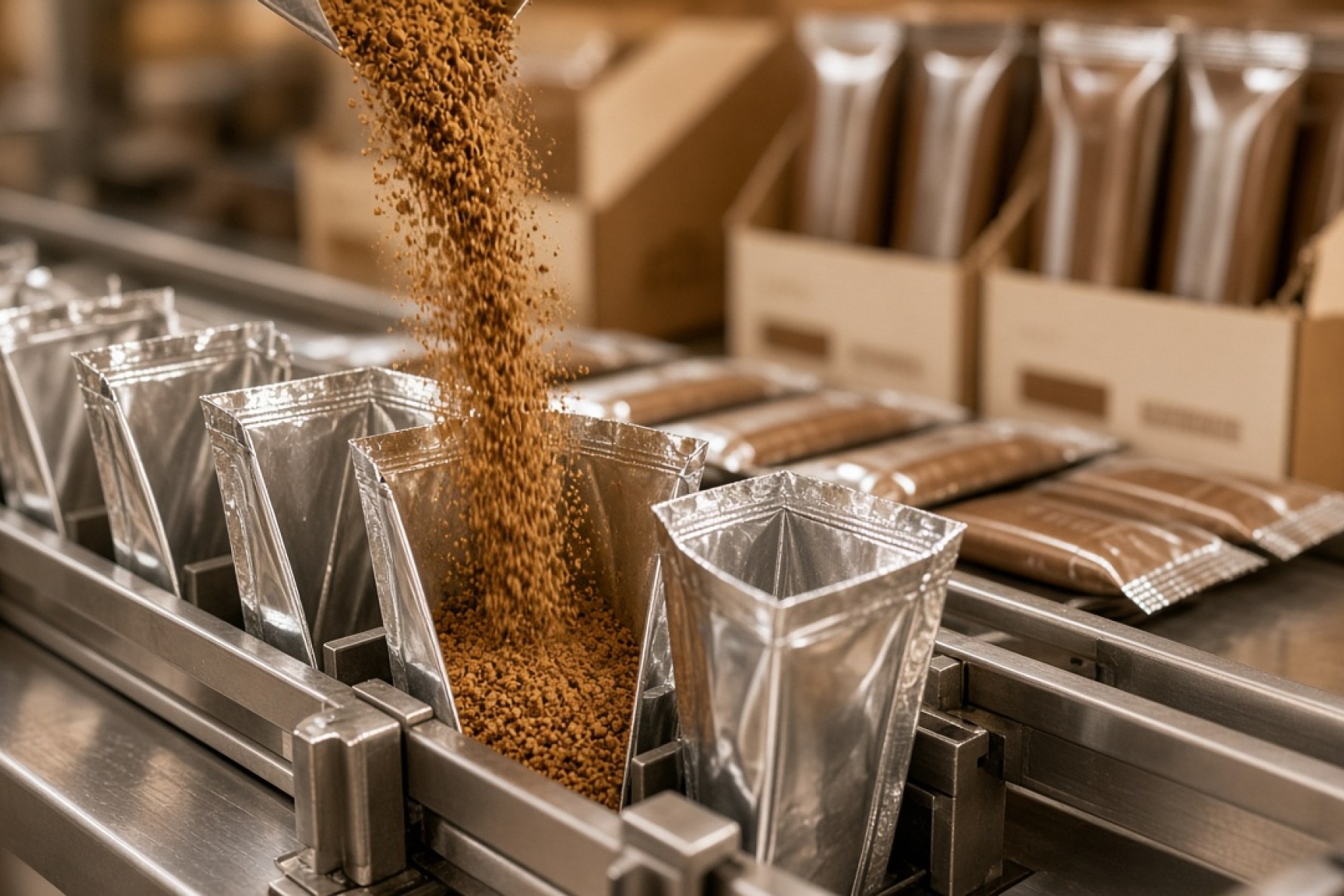
Classic 3in1: The best-selling export SKU. High sweetness and a creamy body align with Iraqi and Afghan taste. Common sachet weights are 12, 18, and 20 g, typically packed in display boxes of 20, 24, or 30.
2in1: Coffee and creamer without sugar—or with a low-calorie sweetener—for health-oriented markets and hotels. Caking control and solubility are more sensitive in this category because sugar, a flow aid, has been removed.
Spray-dried vs freeze-dried (Gold): Spray-dried coffee costs less, yields a darker color, and underpins most volume mixes. Freeze-dried (Gold) coffee is more expensive, holds aroma better, and has a crystalline appearance; it is used in premium and strong formulations for Russia and the Gulf.
3. Technical Specs and Quality Control Parameters
Wholesale purchase contracts should lock measurable numeric parameters. Deviations in moisture or bulk density disrupt sachet filling, shelf life, and mouthfeel.
| Indicator | Target range | Commercial importance |
|---|---|---|
| Moisture | Max 3.5–4% | Prevents caking and microbial growth |
| Bulk density | 0.45–0.65 g/cm³ | Sachet weight accuracy and box fill |
| Solubility | Under 20 seconds at 80°C | End-consumer acceptance |
| Total fat | 9–13% | Creamy body and heat-melt risk |
| Caffeine | 0.4–0.8% | Classic vs strong differentiation |
| Acid-insoluble ash | Max 0.1% | Mineral impurity index |
| Solution pH | 5.5–6.5 | Flavor and emulsion stability |
4. Standards, Food Safety, and Microbial Limits
The primary national reference for blended coffee and coffee mix is Iranian National Standard ISIRI 11137, which sets maximum moisture under 4%, heavy metal limits, and labeling requirements. A manufacturing license and health oversight from Iran’s Food and Drug Organization are mandatory for formal export.
Emulsion and feathering: In sensory testing, powder must dissolve in hot water without fat separation or white floating particles (feathering). Emulsion instability usually traces to creamer quality, mixing temperature, or high film moisture.
- TPC: Max 10,000 cfu/g
- Coliform: Under 10 cfu/g
- Salmonella and E. coli: Negative in 25 g
- Mold and yeast: Max 100 cfu/g
- Ochratoxin A: Max 10 µg/kg
- Heavy metals: Lead, arsenic, cadmium, and mercury per national and destination MRLs
For EAC markets (Russia and the Eurasian Economic Union) and the GCC, a halal certificate—and in some cases regional conformity declarations—are requested in addition to Iranian COAs.
5. Sachet Film Engineering and Secondary Packaging
A 24-month shelf life for MAP sachets depends on film structure, oxygen permeability, and control of the internal package atmosphere. The common export structure is four-layer:
| Layer | Material / thickness | Technical role |
|---|---|---|
| Outer | PET 12 µm | Print, mechanical strength, gloss |
| Barrier | ALU 7–9 µm | Oxygen, light, and moisture barrier |
| Adhesive | PU 2–3 µm | Food-grade polyurethane laminate adhesive |
| Inner | LLDPE 30–35 µm | Heat seal and powder contact |
- Nitrogen MAP: Residual oxygen inside the sachet under 2% to limit fat oxidation and aroma loss.
- Secondary packaging: 12, 18, and 20 g sachets in display boxes of 20, 24, or 30; then five-layer export master cartons on pallets.
- Print and brand: Flexo or rotogravure print on PET; OEM options with barcode, destination language, and nutrition claims.
6. Target Export Markets and Local Requirements
Four primary exit markets for Iranian coffee mix differ in taste profile, pack format, and competitive set:
| Market | Dominant taste | Packaging | Labeling | Competitors |
|---|---|---|---|---|
| Iraq | Sweet, creamy, classic | 18–20 g, box 24/30 | Arabic + solar/Gregorian dates | Turkey, UAE re-export |
| Afghanistan | High sweetness, medium coffee | 12–18 g, box 20/24 | Dari / Pashto / English | Pakistan, India |
| Russia / CIS | Strong, Gold, less sweet | Premium sachet, tin | EAC, Russian | European brands, Vietnam |
| Gulf | Diet, flavored, halal | 12–20 g, stylish box | Arabic/English, GSO | Malaysia, Indonesia, Europe |
Iraq: Mehran, Parvizkhan, and Bashmaq land routes are the main exit corridors. Transit speed and FCA/DAP border delivery are key advantages versus Southeast Asian sea freight.
Afghanistan: Dogharoon and Mahirood are common routes. Formulations are often sweeter than the Iraq standard, and packaging must withstand dust and temperature swings.
Russia and CIS: EAC marking and declaration documents are required. Anzali and Noshahr ports for Caspian containers, plus northern rail/road corridors, are operational options. Taste leans toward strong and Gold.
7. HS Codes, Drawback, and Customs Documents
Correct tariff classification determines duty rates and the drawback path for imported inputs. Related lines in the coffee and coffee mix chain include:
- 09011100: Green coffee beans, not roasted, not decaffeinated
- 09012100: Roasted coffee beans
- 21011100: Coffee extracts, essences, and concentrates (pure instant powder)
- 21011200: Preparations based on coffee extracts — primary export code for coffee mix
Article 66 of the Customs Affairs Law (drawback): Where green beans or extract are legally imported and the finished product is exported, part of the import duties may be refunded. Accurate recording of import permit numbers on the export declaration is a condition for claiming drawback.
| Document | Use |
|---|---|
| Health / sanitary certificate | Issued by health authority; required for destination clearance |
| Certificate of Origin (COO) | Chamber of commerce; possible tariff preferences |
| Commercial invoice | Value, Incoterms, goods description |
| Packing list | Carton count, net/gross weight, pallets |
| Halal certificate | Islamic and Gulf markets |
| Laboratory COA | Moisture, microbes, metals, Ochratoxin A |
8. Competitive Comparison of Regional Producers
Source selection should weigh FOB price, delivery time to the target market, and OEM flexibility—not unit sachet price alone.
| Origin | Strength | Limitation | Best-fit market |
|---|---|---|---|
| Iran | Land border, flexible OEM, domestic sugar, energy | Dependence on green bean imports | Iraq, Afghanistan, CIS |
| Turkey | Branding, Europe logistics, film quality | Higher price, intense domestic competition | Northern Iraq, Eastern Europe |
| Malaysia / Indonesia | Access to palm oil and local coffee | Long sea transit to West Asia | Gulf, Africa |
| Vietnam | Cheapest robusta, high scale | Less small-OEM flexibility, long transit | CIS, volume markets |
9. Logistics, Container Capacity, and Temperature Control
Powdered fat in coffee mix softens and can migrate into the film above 38°C. Storage and transport in hot Middle Eastern seasons require thermal control.
- 20-ft container: About 1,100 to 1,250 cartons; approximate net weight 11 to 13 tons
- 40HC container: About 2,400 to 2,600 cartons; approximate net weight 21 to 23 tons
- Cargo sweat: Day/night temperature swings cause moisture to condense on cartons. Mitigations: thermal liner, 1 kg desiccant bags per 3 m³ of void space, and shrink-wrapping pallets
10. Cost Structure and FOB Sachet Pricing Path
Final FOB sachet price is shaped by two layers—powder raw materials and conversion/packaging cost:
Powder materials
- London robusta (LIFFE)
- Palm oil / powdered creamer
- Domestic refined sugar
Conversion & packaging
- Multilayer foil and print ink
- Mixer and seal energy
- Filling-line MOQ
Price output
FOB sachet price = materials + conversion + margin + port/border logistics
London robusta and palm oil prices drive the largest short-term quote swings; domestic sugar and energy are usually more stable. Higher printed-film MOQs lower unit conversion cost but raise OEM brand inventory risk.
11. 12-Point Wholesale Buyer Checklist
- ☐Define product category (classic, strong, 2in1, flavored, cappuccino) and target coffee percentage
- ☐Request COA for moisture, fat, caffeine, microbes, and Ochratoxin A from the same sample batch
- ☐Test solubility under 20 seconds and check feathering in 80°C water
- ☐Confirm PET/ALU/PU/LLDPE film structure and MAP oxygen under 2%
- ☐Specify sachet weight and display box count (20/24/30)
- ☐Verify Food & Drug license, ISIRI 11137, and halal certificate
- ☐Align HS code 21011200 with the destination customs broker
- ☐Set Incoterms (FOB, FCA border, CIF) and border/port route
- ☐Commit to temperature control and data logging for summer shipments
- ☐Agree sachet weight and moisture tolerances in the contract
- ☐Review OEM capacity, minimum order, and printed-film lead time
- ☐Retain a sealed retention sample from the export batch through shelf life
12. Information Needed for an Accurate Price Inquiry (RFQ)
The more precise the RFQ, the faster and more comparable the FOB quote. Send at least the following:
- Target formulation (coffee / creamer / sugar percentages, or strong, diet, flavored type)
- Instant coffee grade: spray-dried or freeze-dried (Gold)
- Sachet weight (12, 18, 20 g, or custom)
- Secondary packaging: display box count and master carton type
- Preferred film structure or acceptance of factory proposal
- OEM or white-label brand; destination language and label requirements
- Pilot order volume and monthly/annual estimate
- Delivery destination and border/port
- Preferred Incoterms
- Lab and halal certificates required by destination
Sourcing Coffee Mix Through Iranco
Buying directly from filling lines without knowing real capacity, film quality, and batch stability raises return and insurance-claim risk. Iranco, as a food-industry trade gateway, connects wholesale buyers in Iraq, Afghanistan, Russia, the CIS, and the Gulf to Iranian producers with manufacturing licenses, ISIRI 11137 compliance, and OEM capability.
After technical specs are registered, sealed samples, COAs, and price offers are collected on a single formula so supplier comparison is transparent. To start a sourcing negotiation, use Iranco’s official contact channel.
Analytical Summary
Iranian coffee mix sits at the intersection of refined sugar access, competitive energy, polymer film industry, and West Asian land borders. Export success is not only unit sachet price—it hinges on destination taste fit, MAP structure, health documents, and thermal logistics control.
A professional buyer who locks moisture, density, solubility, microbial, and HS 21011200 parameters into the contract—and uses the right border channels per market—secures a more durable margin than volume imports from Southeast Asia, especially when lead time and custom OEM are decision criteria.
Frequently Asked Questions
1. What is the difference between classic coffee mix and Gold?
Classic is usually based on spray-dried coffee with higher sweetness and creaminess. Gold uses freeze-dried coffee with more stable aroma and a crystalline look, at a higher unit price—better suited to premium Russia and Gulf markets.
2. Is private-label OEM production possible in Iran?
Yes. Many sachet filling lines can print custom film, barcodes, and multilingual labels. Minimum order usually depends on printed-film run length and shift capacity and should be stated in the RFQ.
3. What is the correct HS code for coffee mix export?
Heading 21011200 applies to preparations based on coffee extracts (including three-in-one and two-in-one). Pure instant coffee is usually declared under 21011100. Tariff misclassification can stall destination clearance.
4. Which lab tests are essential before wholesale purchase?
Moisture, fat, caffeine, solubility, TPC, coliform, Salmonella/E. coli, mold and yeast, Ochratoxin A, and heavy metals. Preferably test a sample from the same export batch with an official COA.
5. What role do anti-caking agents play in coffee mix?
Permitted agents such as silicon dioxide, used in controlled amounts, preserve powder flowability—especially in sugar-free 2in1. Excess use can affect mouthfeel and solution clarity and must align with destination standards.
6. What is a typical minimum order quantity (MOQ)?
For ready factory brands, MOQ may start at a few pallets or one 20-ft container. For OEM with custom printed film, MOQ often equals a full rollstock run (thousands to tens of thousands of boxes). Confirm the exact figure when inquiring via Iranco.
7. How does a suitable Afghanistan formulation differ?
Higher sweetness, medium coffee percentage, and lighter sachets (12–18 g) are usually preferred. Packaging must resist dust and temperature swings on the Dogharoon/Mahirood route, and multilingual labels (Dari/Pashto/English) are recommended.
8. How do we submit a price request (RFQ) to Iranco?
Send formulation, coffee grade, sachet weight, packaging, volume, destination, and Incoterms via the Iranco contact page or email info@iranco.com so qualified lines can be matched and a price offer prepared.
Featured Products
Related Articles



