 Iranco Magazine Team
Physicochemical specs, modern packaging tech, sanitary market-entry standards and regional marketing strategies for wholesale buyers and trading firms
Export Guide · Pulses · Black-Eyed Peas
Iranian Black-Eyed Peas; Quality, Packaging and Export Sales Opportunities
A specialist review of physicochemical indicators, modern packaging technologies, sanitary market-entry standards and regional marketing strategies for wholesale buyers and trading companies.
Iranian black-eyed peas, with distinctive flavour, high protein, even cooking speed and hull integrity during processing, rank among Iran’s most valuable agricultural items in regional trade. This strategic article analyses grading indices, durable packaging methods, international quality standards, quarantine requirements and export opportunities for traders and processing industries.
| Key indicator | Value or reference ID | Commercial importance |
|---|---|---|
| Food customs tariff code | 07133590 | Determines duties and clearance at international customs |
| Maximum allowed moisture | Max 14% | Controls microbial activity and shelf life |
| Optical-sort purity | Min 99.2–99.8% | Removes broken, spotted seeds and foreign matter |
| Crude protein range | 22–26% dry basis | High nutritional value for packaging and food processing |
International pulse trade, a vital pillar of global food security, has seen structural demand shifts: plant-protein diets, ready meals and canning growth across West Asia and North Africa have elevated dry legumes from traditional goods to strategic industrial inputs. Black-eyed peas (Vigna unguiculata), with essential amino acids, soluble fibre and a low glycemic index, are expanding across the Middle East and Central Asia.
Iran’s ecological diversity, strong sunlight and alluvial southern river basins support high food-grade seed. A thin yet resilient hull, bright creamy colour, natural gloss and intact structure after cooking outperform thicker-hulled African and Southeast Asian types. Proximity to Gulf and Iraqi markets also keeps transit costs competitive.
Sustainable export presence requires moving beyond traditional bulk sales to modern trade mechanisms. International buyers and canneries evaluate insect-damaged seed share, pesticide MRLs, water uptake and packaging resistance to container sweat before committing. This report dissects the technical, quality, logistics and marketing dimensions of Iranian export black-eyed peas.
1. Ecological Position and Production Advantages in Iran
Unlike pinto, red and white beans grown in temperate central and western climates, black-eyed peas are heat-loving, summer-adapted and tolerant of high temperature stress.
Major growing hubs in the south and southwest
Khuzestan is the undisputed production hub. Alluvial plains of Dezful, Shush, Shushtar and Gotvand—with rich loam-clay soils and Dez/Karun irrigation—record the highest yields. The crop is mainly a summer second planting in rotation with wheat and barley; biological nitrogen fixation restores soil structure and raises crude protein. Darab in Fars and Iranshahr/Zabol in Sistan and Baluchestan also hold significant acreage.
Planting, growing and harvest calendar
In the Khuzestan plain, sowing usually falls in July–August. Growth lasts 80–90 days; mechanised harvest runs in November–December. Fresh Iranian crop therefore enters commercial warehouses just as Northern Hemisphere stocks thin and seasonal demand in Arab markets peaks.
Climatic advantages and commercial position
Intense sunlight during ripening lowers tissue moisture before harvest and raises cotyledon dry-matter density. Iranian seed forms a bright creamy colour, without damp fungal shading, and a focused black hilum—read in Gulf markets as a freshness and quality signal. Unlike some pulses that need import top-ups, domestic black-eyed peas offer exportable surplus in premium grades thanks to superior sensory and cooking quality.
2. Typology and Morphological Specs
Separating types by appearance, hull thickness and biomechanical behaviour is central to grade and valuation. Mixed shapes or multi-variety blends heavily damage final price.
Hilum and coat structure
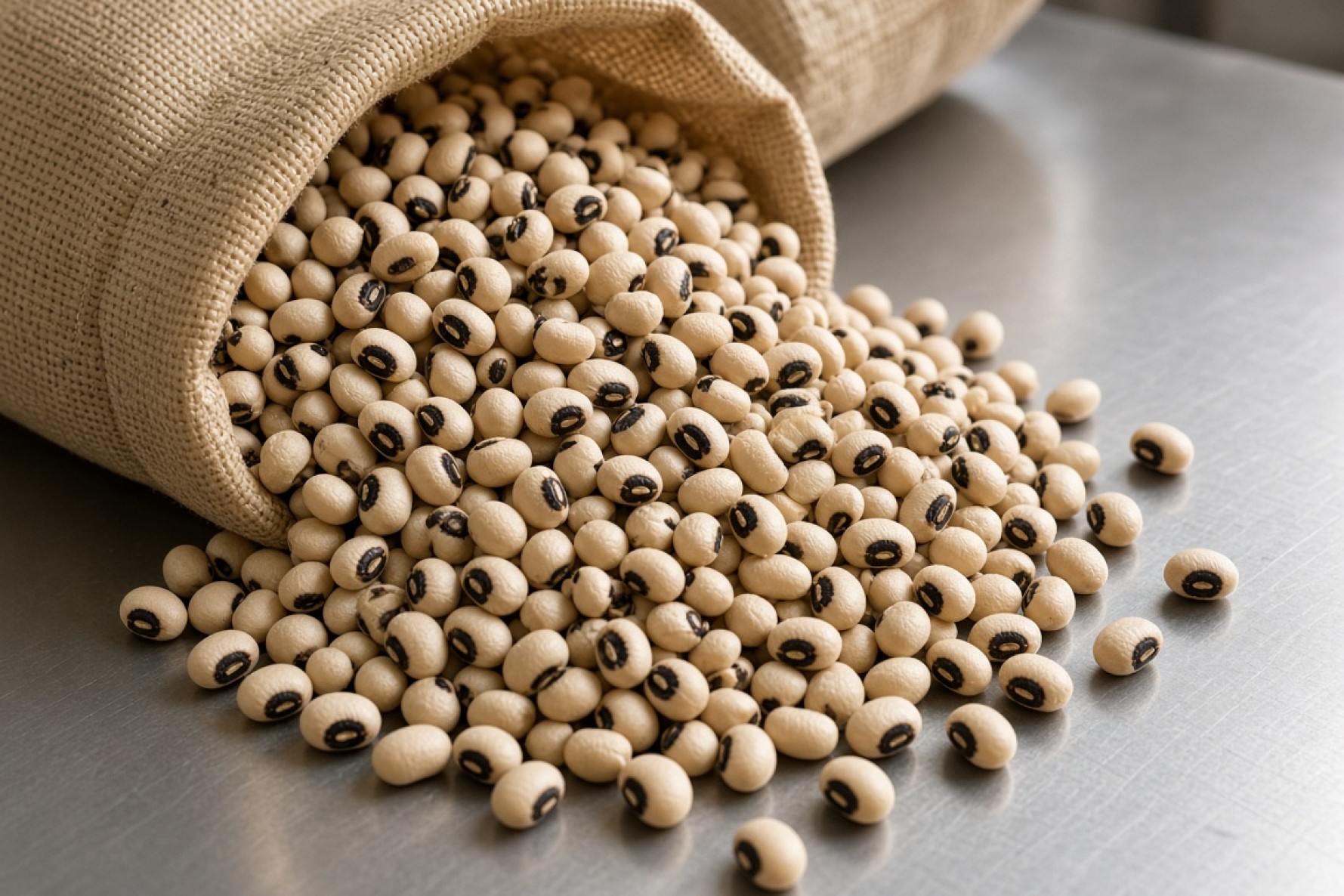
The key morphological marker is the hilum—the black “eye” that gives the crop its name. Authentic Khuzestan product shows a compact black ring with a sharp cream-hull boundary and no pigment bleed. A thin cuticle lets water enter quickly and evenly, shortening cook time without seed collapse.
Hundred-seed weight and calibration
Southern Iran hundred-seed weight sits at 18–24 g. Seeds of 6.5–7.5 mm drive strongest retail demand; 5–6 mm lots mainly feed canning lines.
| Criterion | Khuzestan (Dezful & Shushtar) | Myanmar | E./S. Africa (Madagascar) |
|---|---|---|---|
| Background colour | Very bright, clear creamy | Dull greyish-white or pale yellow | Dark cream to uneven light brown |
| Eye/hilum form | Compact black ring, geometric edge | Broad, sometimes elongated asymmetric blotch | Dark blotch with brownish margins |
| Hull surface | Fully smooth with natural sheen | Fine surface wrinkle lines | Dense, hard, thick leathery texture |
| Full cook time | 30–40 minutes | 45–60 minutes | 55–75 minutes |
| Post-cook integrity | Full form retained with soft interior | Tendency to split or break | Firm texture, uneven heat penetration |
| Organoleptic profile | Mild, buttery, no raw green note | Neutral starchy with slight astringency | Mild earthy taste, slightly coarse |
3. Technical Specs Expected by International Buyers
Importers and sourcing managers work to Codex Standard 171-1989 and Iranian national pulse standards. Clear pre-purchase definitions prevent disputes after discharge.
| Parameter | Premium export grade | Standard commercial | Test method | Buyer relevance |
|---|---|---|---|---|
| Moisture | Max 13.5% | Max 14.0% | Oven 105°C | Prevents mould; protects net weight |
| Mineral foreign matter | Max 0.05% | Max 0.15% | Gravity / sieve | Protects lines and consumer safety |
| Organic foreign matter | Max 0.2% | Max 0.5% | Pneumatic separation | Preserves commercial appearance |
| Insect-damaged seed | Max 0.5% | Max 1.5% | 100 g visual check | Passes destination quarantine |
| Broken / split | Max 0.8% | Max 2.0% | Slotted sieves | Avoids cook viscosity shift |
| Discoloured | Max 1.0% | Max 3.0% | Standard colour cards | Shelf appeal in clear packs |
| Shrivelled / small | Max 1.5% | Max 3.5% | 6 mm screen | Uniform cook time |
| Residual uric acid | < 10 mg/kg | Max 50 mg/kg | UV spectrophotometry (Codex) | Proves absence of pest residues |
| Germination (seed) | > 85% | > 75% | Petri-dish test | For agricultural seed orders |
4. Physical Defects, Quality Diagnosis and Cleaning Technology
Cowpea weevil (Callosobruchus maculatus)
The most destructive biological pest. Adults may lay eggs on ripening pods in the field; larvae bore into the seed and leave a round exit hole. The main risk is invisible eggs or larvae that mature during container transit and infest the entire lot.
Four-stage cleaning line
- Pre-clean & dusting: aspirated air and coarse screens remove straw and chaff.
- Vibro-destoning: density-based removal of stones and clods.
- Calibration sizing: rotary cylinders separate broken and immature seed.
- Optical / AI sorting: colour cameras and NIR sensors with high-pressure ejectors; purity up to 99.8%.
| Defect | Root cause | Use impact | Export acceptance limit |
|---|---|---|---|
| Insect holes | Field oviposition or store breeding | Nutrient loss; quarantine rejection | No live pests; max 0.5% holed |
| Splits / breaks | Combine pressure; drop-pipe impact | Excess slime; cloudy cook water | Max 0.8% by weight |
| Fungal spots / darkening | Late rain or high humidity | Bitter taste; mycotoxin risk | Max 0.5% by weight |
| Deep shrivelling | Early irrigation cut-off | Hard texture; uneven hydration | Max 1.0% by weight |
| Stones / mineral debris | Weak destoner performance | Dental injury; line stoppages | Max 0.05% by weight |
5. Laboratory Tests, Health Control and Food-Safety Criteria
Entry to advanced customs territories requires food-safety certificates and testing by ISO/IEC 17025-accredited labs.
- Pesticide MRLs: organophosphates (diazinon, malathion), pyrethroids and organochlorines via GC-MS and LC-MS/MS (ISIRI 13116).
- Mycotoxins: total aflatoxin 4–10 μg/kg; aflatoxin B₁ max 2–4 μg/kg (ISIRI 5925).
- Heavy metals: Pb max 0.2 mg/kg; Cd max 0.1 mg/kg.
- Microbiology: Salmonella absent in 25 g; E. coli absent in 1 g.
| Test | Reference standard | Max acceptance | Lab method |
|---|---|---|---|
| Total aflatoxin | ISIRI 5925 | 4–10 ppb | HPLC |
| Aflatoxin B₁ | ISIRI 5925 / Codex | 2–4 ppb | HPLC with fluorescence |
| Lead (Pb) | Food reference limits | 0.2 mg/kg | Graphite-furnace AAS |
| Cadmium (Cd) | International references | 0.1 mg/kg | ICP-MS |
| Pesticide residues | ISIRI 13116 | Per compound MRL table | GC-MS/MS & LC-MS/MS |
| Salmonella | Food micro standards | Absent in 25 g | Enriched culture |
| E. coli | Microbial monitoring | Absent in 1 g | Multi-tube / selective media |
6. Customs Coding Structure and International Clearance Documents
Dried shelled pulses fall under heading 0713:
- 07133500 — international code for black-eyed peas (Vigna unguiculata)
- 07133510 — treated / improved seed for planting only
- 07133590 — other; all food, industrial and bulk trade
Bambara groundnut under 07133400 is a different botanical class and must not be confused with black-eyed peas. Required documents typically include: phytosanitary certificate, phosphine fumigation certificate, independent inspection (e.g. SGS), COA, Chamber of Commerce certificate of origin, and commercial invoice with packing list.
7. Export Packaging Engineering and Physicochemical Stability
- Laminated woven PP bags: 25, 30 and 50 kg with inner PE liner for humid routes.
- Modified atmosphere (MAP): O₂ removal with CO₂/N₂ injection; 24–36 month shelf life and biological control of weevil life stages.
- Deep vacuum: 5–10 kg units in five-ply export cartons for premium lots.
- Retail: 500, 700 and 900 g zip BOPP/PE stand-up pouches with a clear window.
| Format | Layer build | Typical weights | Moisture/O₂ barrier | Target channel |
|---|---|---|---|---|
| Plain PP sack | Single-layer breathable weave | 25–50 kg | Low | Short dry land routes |
| Laminated + liner | Woven PP + PE film | 25–50 kg | Excellent | Gulf ports & sea transit |
| MAP | Five-layer barrier film | 5–10 kg | Complete | Organic nets & luxury hypermarkets |
| Formed vacuum | PA + elastic PE | 1–5 kg | Full seal | Premium food chains |
| Clear cellophane/pouch | Printed BOPP + PE | 500–900 g | Medium–good | Modern urban retail |
8. Logistics, Transport Chain Management and Container Damage Prevention
Iraq land corridors
Iraqi shipments mainly move via Mehran, Shalamcheh and Khosravi. Dezful/Shushtar to Shalamcheh is under 200 km, cutting transit to below 24 hours.
Sea FCL
20′ and 40′ containers sail from Bandar Imam Khomeini, Khorramshahr and Shahid Rajaee to UAE, Kuwait, Oman and farther destinations. A dry 20′ holds about 20–24 tonnes; palletising cuts payload to roughly 18–19 tonnes but speeds discharge and reduces bag tears.
Container sweat
When metal walls cool below the dew point, moisture condenses on upper tiers and fuels mould. Mandatory controls include:
- Calcium-chloride hanging desiccants with >200% self-weight absorption
- Multi-layer cardboard and thick kraft on the container floor
- Breathable non-woven polypropylene cargo blankets on top
- Fully dry wooden pallets only
- 30–40 cm headspace under the roof for ventilation
9. Demand Structure in Target Markets
Iraq is the core household and food-service demand centre (Basra, Dhi Qar, Baghdad, Najaf). The UAE is a re-export and bilingual Arabic–English retail hub. Qatar, Kuwait and Oman buy premium packaging. Russia and Central Asia are gradually adopting salad canning and jumbo bags.
| Country | Consumption hubs | Preferred grade | Typical packaging | Competitors |
|---|---|---|---|---|
| Iraq | Basra, Baghdad, Najaf, Dhi Qar | Large seed, bright cream, short cook | Laminated 30 & 50 kg | Myanmar, India, Turkey |
| UAE | Dubai, Sharjah, Abu Dhabi | Premium optical purity | 25 kg bulk & 900 g film | Myanmar, Madagascar, Peru |
| Kuwait & Qatar | Capital hypermarkets | Uniform ultra-premium calibre | 1–2 kg vacuum in cartons | USA, Australia |
| Oman | Muscat, Sohar, Salalah | Grade-1 food, moisture < 12% | Printed 25 kg bags | India, Myanmar, UAE packs |
| Russia | Moscow & food plants | Small–medium elastic seed | 1 t jumbo & 50 kg | Kazakhstan, Kyrgyzstan, China |
10. Iran’s Competitive Position versus Leading Exporters
Iran’s greatest edge is cookability: Khuzestan seed softens to a buttery texture in 30–40 minutes, while Myanmar and India need longer soaking and cooking. Challenges include fragmented farm plots and seasonal export-rule swings; optical sorting lines and long-term farmer contracts are the structural remedies.
| Country | Strategic strength | Structural weakness | Price tier | Organoleptic quality | Trade reach |
|---|---|---|---|---|---|
| Iran | Fast access, excellent cook, autumn harvest | Variable traditional packing cost | Mid to premium | Very high | Iraq, UAE, Gulf |
| Myanmar | Massive scale, low price | Hard seed, dull yellow colour | Economy | Medium–low | India, Bangladesh, value markets |
| Madagascar | Organic-leaning traditional culture | Long transit, high freight | Seasonally variable | Medium; leathery coat | Europe & East Africa |
| Peru | Calibration & advanced packing | Very high landed cost | Luxury | High | N. America, Spain, Portugal |
| India | Processing volume & trade network | Monsoon risk & domestic use | Volatile | Medium | MENA, UK, Malaysia |
11. Processing Potential and Industrial Applications
- Water hydration: 90–110% of dry weight in 8–12 h at 20–25°C.
- Retort stability: coat integrity at 121°C / 1.2 bar without splitting.
- Sauce turbidity: physical purity of Iranian seed minimises starch leak and gelled sauce.
- Protein & functional flour: 22–26% protein for gluten-free bread, pasta, snacks and plant-meat analogues; fines from optical sorting are ideal feedstock.
12. Fundamental Wholesale Price Drivers
- November–December new-crop supply (annual price floor) with gradual rise from spring
- Optical-sort precision (often 20–30% gap between ~96% traditional and 99.5% laser purity)
- Polymer bag and film costs tied to petrochemical markets
- Incoterms: EXW, FOB Bandar Abbas/Khorramshahr, CFR/CIF destination
- FX swings at origin
13. Importer Checklist before Firm Orders
- State scientific name Vigna unguiculata on the proforma
- Specify origin growing region (e.g. Khuzestan; Dezful or Shushtar)
- Cap moisture at 13.5% or 14% as an acceptance condition
- Set physical defect tolerances (broken, split, discoloured, stones)
- Obtain a sealed 1 kg dual-part reference sample
- Require phosphine fumigation protocol with dose and date
- Define bag specs (grammage, laminate, PE liner, stitch density)
- Match labelling languages to destination customs rules
- Name the independent inspection firm at origin (e.g. SGS)
- Clarify Incoterms and risk-transfer point
- Condition loading on valid lab COA
- Deliver original phytosanitary, COO and packing list with the B/L
14. How to Structure an Export RFQ
- Total tonnage and delivery schedule (single lot or weekly/monthly parts)
- Quality grade (99.5% laser optical, double-cleaned, or industrial)
- Seed calibre (e.g. above 6.5 mm)
- Pack type and unit weight (25/50 kg, 900 g retail, bulk or private label)
- Special protection: PE liner, MAP, container desiccants
- Delivery point and Incoterms (Iran border, southern FOB, or destination such as Jebel Ali / Umm Qasr)
- Extra sanitary certificates required by destination customs
Importers can send their required specs through Iranco so matching supply options are screened against the request.
15. Sourcing Export Black-Eyed Peas from Iranian Producers via Iranco
Deal success is not a simple price comparison. Uniform seed share, biological safety against hidden pest eggs, packaging performance against marine humidity and full sanitary-document compliance with destination customs decide whether a trade is profitable or loss-making.
Iranco is a specialist platform for Iranian food and agri supply—linking importers, foreign trading firms, packaging industries and modern sorting hubs, especially in Khuzestan. Supply-option evaluation, processing-standard oversight, reference-sample coordination and secure contract drafting are core services.
Informed buying rests on physicochemical mastery, laser cleaning and sorting systems, pest-control standards and modern packaging. Authentic Iranian seed—with thin hull and short cook time—has exceptional potential to win Middle East export markets.
FAQ
What distinguishes Iranian black-eyed peas from competitors?
Khuzestan seed has a thinner, more uniform hull that cooks in 30–40 minutes without texture loss. Bright creamy colour and a buttery taste contrast with firmer, duller Myanmar and African lots.
What is the maximum standard moisture to prevent spoilage in transit?
Under national standards and Codex 171-1989, moisture must not exceed 14%. For humid Gulf sea shipments, 12–13% is preferred.
What best controls cowpea weevil in export lots?
Official phosphine fumigation in sealed conditions plus MAP with CO₂ injection stops biological activity of pests, larvae and hidden eggs.
Which packaging is recommended for Gulf destinations?
Laminated polypropylene bags with impermeable liners at 25 or 50 kg, plus proper palletising, strapping and container moisture blankets.
How can buyers source directly from Iranian producers?
Register technical specs, tonnage, sort grade and pack type as a purchase request on Iranco so matching supply options can be identified.
What information is needed for an accurate price request?
Tonnage, grade and purity, seed size, bag type/grammage, retail vs bulk, destination and Incoterms (e.g. FOB or CFR).
What is the food HS tariff code?
International 07133500; in Iran 07133590 for food trade. 07133510 is reserved for agricultural seed.
What criteria do canneries apply?
Hull stability at 121°C retort, no seed disintegration, high hydration rate, and limited starch leach that would cloud or gel the sauce.
Featured Products


Related Articles



