 Iranco Magazine Team
Main markets for Iranian watermelon, quality indicators, sorting and packaging, logistics costs and what bulk buyers must define before placing an order
Export Guide · Fresh Fruit · HS 08071100
Iran Watermelon Export: Target Markets, Freight Cost and Buying Criteria
Main Iranian watermelon markets, quality indicators, sorting and packaging, logistics costs and what bulk buyers must define before placing an order.
In the first half of FY1403, Iran exported about 535.6 million kg of watermelon worth nearly USD 127.6 million. Iraq, the UAE and Oman were among the main destinations. Commercial standards set a minimum of 8° Brix as acceptable ripeness, and post-harvest references recommend roughly 10–15°C for proper storage.
Introduction
Watermelon export differs fundamentally from many dry or shelf-stable products. Shipment value is not only farm gate price: high weight, relatively low unit value, impact sensitivity, limited commercial life and transport time directly affect margins — logistics often drives profitability.
Low farm price can become uneconomic after sorting, packing, inland haul, border delays, international freight and shrinkage. Conversely, a higher farm price with uniform, sweet, sound fruit suited to the route can deliver more commercial value.
Iran’s geographic spread is an advantage. South Kerman is a key spring source with harvest from mid-Farvardin; warm Hormozgan, especially Minab, extends off-season and autumn supply from early Azar. That widens the export window.
Professional importers should ask not only “what is the per-kg price?” but what weight, sweetness, rind quality, uniformity, packaging, delivery terms and freight buy sellable fruit at destination.
1. Regional trade position of Iranian watermelon
Iranian watermelon mainly wins where haul distance from production is manageable. Iraq is the clearest road market; Oman, the UAE and Qatar also benefit from southern ports and mixed routes.
First-half FY1403 data show Iraq at about 246.5 million kg, the UAE over 161 million kg and Oman about 38.4 million kg among key destinations.
Commercial takeaway: Iran’s edge rests as much on fast access to nearby markets as on farm price alone.
Iraq
Iraq matters for high volume and road transport. Shorter chains allow delivery closer to harvest. Border queues, heat en route, poor loading and demand swings can erase the distance advantage.
United Arab Emirates
The UAE consumes and re-exports produce. Appearance, size uniformity, clean rinds and packaging weigh more. Fruit acceptable for Iraqi wholesale may not meet UAE retail chain specs.
Oman
Oman is a major regional market for Iranian fresh produce. Short sea legs from southern ports and supply from southern Iran suit regular export programmes.
Qatar and Eurasian markets
Qatar buys Iranian agricultural products including watermelon. Russia, Armenia, Georgia, Kazakhstan and some European markets appear in trade history, but longer distances tighten transport, sorting and shelf-life requirements.
| Market | Main route | Primary buyer focus | Commercial priority |
|---|---|---|---|
| Iraq | Road | Price, freshness, load weight and condition | High volume, fast delivery |
| UAE | Road / sea or sea | Appearance, uniformity, packaging | Wholesale and retail |
| Oman | Sea and mixed | Freshness, size, supply stability | Regular supply programmes |
| Qatar | Sea | Appearance and packaging | Higher unit-value market |
| Caucasus & Eurasia | Road | Shelf life and fruit firmness | Stricter cold-chain control |
2. Production areas and export season
Origin province alone is not a purchase criterion. Harvest timing, farm-to-sort distance, variety, weather in that window and time left until delivery matter more.
South Kerman is a main spring hub; in FY1405 authorities announced harvest from mid-Farvardin, naming Rudbar Jonub, Qaleh Ganj and Manujan as core zones.
Minab supports off-season supply; autumn harvest starts in Azar with part of volume exported.
- Production zone and loading point
- Approximate harvest date
- Harvest-to-loading interval
- Watermelon type
- Average fruit weight
- Sample Brix
- Rind appearance
- Sorting method
- Packaging and stacking
- Daily or weekly supply capacity
These details matter more for haul planning than a vague label such as “export grade one watermelon”.
3. Commercial types and weight for export
Markets split watermelon by shape, rind and flesh colour, seed status and weight. Buyers should fix the type before requesting prices.
Wholesale may prefer large fruit; chains often want uniform, consumer-friendly sizes. Seedless lines have their own retail niche.
Commercial standards size by unit weight; sized packs need weight uniformity — wide spread between lightest and heaviest fruit in one pack is undesirable.
| Attribute | Typical choice | Buying impact |
|---|---|---|
| Fruit weight | Small, medium or large | Sales channel and count per pack |
| Shape | Round or oblong | Market preference and stacking |
| Flesh colour | Red or other | Consumer demand |
| Seeds | Seeded or seedless | Target segment |
| Rind thickness | Suited to variety | Relative transport resistance |
| Uniformity | High or standard | Retail acceptance and price |
4. Export buying specifications
Export watermelon must be bought against measurable specs. Words like “sweet”, “grade one” or “large” are not enough for professional contracts.
International commercial standards require sound, clean, firm fruit without cracks, rot or serious pest damage and with adequate ripeness. Minimum Brix is 8°.
| Parameter | Define in order | Importance |
|---|---|---|
| Average weight | Defined kg range | Sales uniformity |
| Brix | Agreed minimum | Sweetness and ripeness |
| Rind soundness | No cracks or rot | Less shrinkage |
| Fruit shape | Matches approved sample | Market appeal |
| Rind colour | Uniform within natural range | Commercial look |
| Bruising | Defined tolerance | Transport damage control |
| Rot | Not accepted | Safety and shelf life |
| Surface cleanliness | Clean fruit | Market acceptance |
| Flesh colour | Per sample | Eating quality |
| Packaging | Exact type and net weight | In-transit protection |
Review samples before the main order. Cut several fruit from different parts of the sample: check Brix, flesh colour, texture, ripeness and uniformity. One sweet melon cannot represent a truck or container.
5. Defects that erode shipment value
Many fresh-fruit disputes appear after arrival — usually because quality was vague before loading.
Cracks and splits
Cracks hurt market appeal and invite decay. Cracked fruit is unsuitable for long hauls.
Bruising
Impact may damage flesh without obvious rind breaks. Throwing during loading, top-layer weight and load movement are common causes.
Wrong ripeness
Under-ripe fruit may look fine but fail Brix and taste. Over-ripe fruit is softer for long transport.
Sunburn and rind marks
Natural ground contact marks differ from rot. Buyers must separate natural traits from commercial damage.
A practical dispute reducer is a “reference sample” before loading — photos, weight, Brix and cut fruit recorded as the acceptance benchmark.
6. Packaging — from bulk to export cartons
Pack choice follows destination. Nearby wholesale may accept lighter packing; long routes and retail need more physical protection.
Watermelon is heavy. Uncontrolled pressure, movement and unloading impacts raise shrinkage.
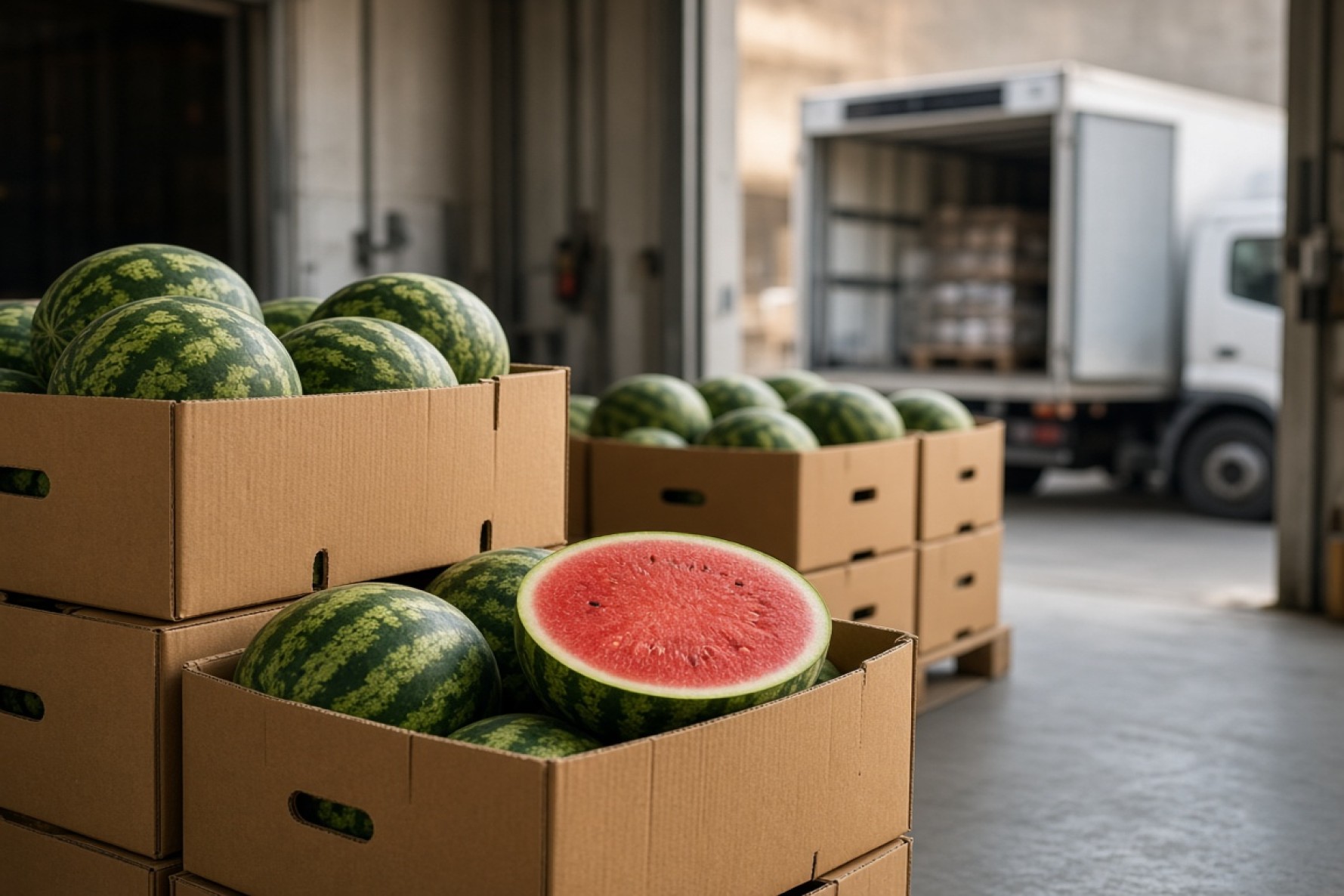
Common options include strong bulk bins, fresh-produce cartons, sturdy crates and controlled pallet stacking. Allow air flow, strong bases and prevent fruit shift.
Sensitive markets want labels with product name, origin, net weight, pack specs and packer/exporter details; destinations may add rules.
7. Transport temperature and post-harvest chain
Watermelon should not be held very cold. Low temperatures cause chilling injury, rind pitting, flavour loss and faster breakdown after cold storage.
About 10–15°C with roughly 85–90% relative humidity suits storage; shelf life is often around two weeks and can be longer in good conditions.
Practical point: a refrigerated truck for watermelon is not set like one for near-zero products.
- Product temperature at loading
- Compartment temperature
- Time from harvest before loading
- Air circulation
- Avoid direct sun during loading
- Border or port waiting time
- Floor and wall condition of vehicle
- Load securing method
8. How is watermelon freight cost calculated?
Freight is one of the largest parts of landed price. Because the product is heavy, a small change per tonne can move deal margin.
Real cost is not “truck hire” alone — it is everything from loading point to buyer delivery.
| Cost factor | Price impact |
|---|---|
| Farm to border or port distance | More fuel and time |
| Refrigerated transport | Higher freight vs better quality control |
| Border waiting time | Demurrage and product loss |
| Packaging | Higher upfront cost, less damage |
| Sea leg | Port and container handling added |
| Peak season | Higher truck and container demand |
| Net load weight | Freight per kg basis |
| Shrinkage % | Raises true cost of sellable kg |
Haul to Iraq
Direct road is usually the simplest structure. Origin-to-border distance, border choice and crossing time dominate.
Haul to Oman, UAE and Qatar
Sea freight is not the whole story. Farm-to-port, port ops, container, reefer power, documents, discharge and last-mile haul must be included.
Longer markets
Caucasus, Central Asia and distant buyers need stricter sorting and temperature control. Fruit fine for a short trip may fail on multi-leg routes.
9. Tariff code, documents and export QC
Fresh watermelon HS code in Iran’s trade classification is 08071100.
Export files need commercial invoice, packing list, transport documents, certificate of origin and phytosanitary papers as required by destination. Plant quarantine applies to fresh watermelon exports.
In strict MRL markets, agree which limits the lot will be tested against before purchase. Results must tie to that shipment or production batch — old reports from other lots do not control the load.
Retail and professional importers value traceability: farm or zone, harvest date, sort location and lot number ease quality claims.
10. What moves export watermelon price?
Export price is not one number for the whole season. Two “grade one” offers can differ for good reasons.
- Season and origin supply volume
- Production zone and distance to destination
- Fruit weight and uniformity
- Brix and ripeness
- Rind quality
- Allowed defect percentage
- Packaging type
- Order volume
- Labour and sorting cost
- Truck or container freight
- Border or port waiting time
- Delivery terms
- Required tests or certificates
Compare quotes at one delivery point. Farm gate from one seller vs border delivery from another is not a fair comparison.
11. Importer checklist before ordering
Before bulk purchase from Iran, fix the following:
- Define exact product type and appearance requirements.
- State the weight range per watermelon.
- Set the minimum acceptable Brix.
- Obtain and evaluate a real sample before the main order.
- Record acceptable rind defects and bruising limits.
- Treat rot and open cracks as reject criteria.
- Confirm packaging type and stacking method.
- Verify the supplier’s daily capacity.
- Define harvest-to-loading time.
- Put agreed transport temperature in the order.
- Set acceptable net weight per vehicle.
- List destination documents and lab tests before loading.
- Clarify delivery terms and who pays border/port costs.
- Contract a quality dispute process at destination.
- Before dispatch, receive loading photos and random product samples.
12. What to send for an accurate price
A professional RFQ is short but precise: type, fruit weight, minimum Brix, volume, packaging, destination city, transport mode, delivery terms, timing and required tests.
“Price of one truck of watermelon to Iraq” is not enough. “Defined weight, agreed minimum Brix, sorted load, Erbil destination, named delivery point” enables real comparison.
- Watermelon type and weight range
- Minimum Brix
- Order volume and number of loads
- Packaging type
- Country, city and delivery terminal
- Transport mode (road, sea or mixed)
- Delivery terms and Incoterms
- Required tests and certificates
Buyers exploring supply from Iran can enter the same details in an Iranco purchase request so matching options are reviewed against real needs.
Supplying export watermelon from Iran to buyer specifications
International watermelon buying without defined product specs is high risk. Weight, sweetness, rind condition, harvest timing, packaging, loading capacity and distance all shape the outcome.
Iranco lets buyers register requests with real order specs — destination, volume, fruit weight, quality criteria, packaging and timing — so available supply is screened accordingly.
For export loads, sample approval, acceptance criteria and transport conditions should be fixed before the order is final. That keeps quotes comparable on like-for-like product.
If you need Iranian watermelon, state target weight, volume, minimum Brix, packaging and destination in your request so supply can be checked on that basis.
Summary
Iranian watermelon export works when product, market and logistics align. Nearby Iraq benefits from road haul and faster turnover; Gulf states need tighter packing, sailing plans and port coordination.
For professional buyers, per-kg price is only the start. Brix, fruit weight, rind soundness, load uniformity, harvest timing, defects, packaging and condition at delivery define real value.
Freight should be calculated on sellable net weight. Cheap freight with long waits, weak loading or high shrink is not automatically economic. On heavy, perishable watermelon, a solid transport plan can matter more than a few percent on farm price.
Best practice is a spec-first order. When weight, Brix, quality, packaging, volume, destination and delivery are defined before quotes, Iranian supplier offers compare fairly and post-arrival disputes drop.
Frequently asked questions
Which countries are the main markets for Iranian watermelon?
Iraq, the UAE and Oman rank among the main destinations in trade statistics. Qatar, Turkey, Russia and several Caucasus and Central Asian markets also appear. Each market’s importance depends on season, price, import rules and local supply.
What Brix is suitable for export watermelon?
International commercial standards set a minimum of 8° Brix as a ripeness benchmark. Buyers can agree a higher level in contract. Sampling location and method must be consistent for comparable results.
What temperature should watermelon be shipped at?
Storage around 10–15°C is appropriate. Over-cooling can cause physiological chilling injury. Export routes also require attention to transit time, air flow and product temperature at loading.
How is freight to Iraq calculated?
Loading point, exit border, final destination, truck type, season, net weight and border waiting time are key. Compare economics by dividing total cost by sellable net weight at destination, not truck lump sum alone.
What packaging suits Gulf exports?
It depends on the sales channel. Wholesale may accept simpler packs; chain retail wants more uniformity, physical protection and labelling. Box strength and preventing movement between fruit matter greatly.
How can buyers check quality before loading?
Take random samples from different parts of the load. Check weight, Brix, shape, rind, ripeness, flesh colour, bruises and cracks. Photo and test records before loading help match delivery to the approved sample.
What information is needed for a price quote?
Product type, weight range, minimum Brix, order volume, packaging, destination city, transport mode, timing and delivery terms. The more precise the RFQ, the more valid supplier comparisons become.
How can export watermelon be sourced from Iran?
First fix weight, quality, volume, packaging and destination. Then review samples, capacity and transport. International buyers can submit the same details via an Iranco purchase request for matching supply options.
Featured Products











Related Articles



