 Iranco Magazine Team
Expert guide to Iranian fresh tomatoes and paste — uses, technical specs, export markets, quality control, packaging and bulk buying criteria
Iranian Tomatoes · Tomato Paste · Export Markets
What Types of Iranian Tomatoes and Tomato Paste Exist, How Do They Differ, and Which Countries Import Them?
A specialist guide to Iranian fresh tomato and paste types, application differences, technical specifications, export markets, quality control, packaging and bulk buying criteria — for importers, bulk buyers and procurement managers.
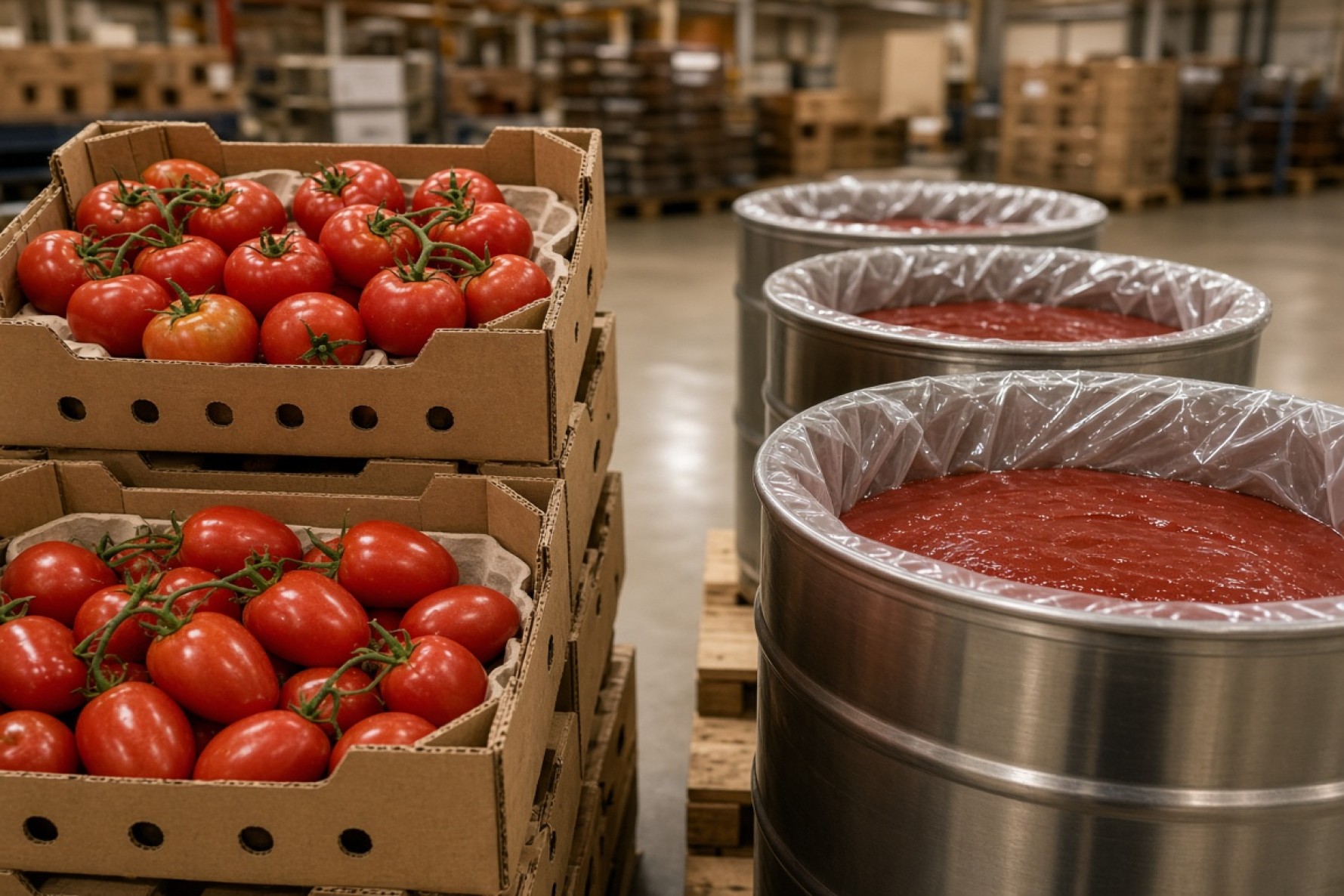
Iranian tomatoes cannot be treated as a single uniform product with one market. Part of output suits direct fresh consumption and wholesale fruit and vegetable supply; part is selected for fresh export; and another share goes to paste, purée, sauce and other tomato processing plants. That difference in use means selection criteria for a fresh tomato exporter are entirely different from those of a paste factory buyer.
Iran's climatic diversity allows tomato production across different seasons. Southern Iran, especially Bushehr, plays a major role in off-season production. For FY 1404–1403, about 660,000 tonnes of tomatoes were forecast for that province. In Fars, districts such as Marvdasht, Qir and Karzin, and Arsanjan are important production areas. In north-west Iran, East Azerbaijan also has significant field and greenhouse output.
In foreign trade, fresh tomatoes must be separated from paste. In 2022 trade data, Iraq, the UAE, Pakistan, Afghanistan and Qatar were the main recorded destinations for Iranian fresh tomatoes. Paste exports in recent years have relied on markets including Iraq, Russia, Afghanistan, Turkey, Armenia, Kazakhstan, the UAE, Oman and Jordan.
For a professional buyer, the product name alone is not enough. For fresh tomatoes, size, firmness, shape, ripeness stage, colour, skin condition, uniformity and shipping conditions must be defined. For paste, Brix, process type, viscosity, colour, pH, packaging format, microbiological status and end use all matter. It is these details that can make two apparently similar offers completely different in price and usability.
1. Iran's Tomato Production Position and the Role of Different Regions
Tomato production in Iran has two important commercial traits: geographic spread and differences in harvest season. Together they help supply the market for much of the year, although export volume and quality are not uniform across all seasons.
In the vegetable and field-crop production plan for FY 1403–1402, tomato output of about 3.632 million tonnes from roughly 67,000 hectares was forecast. That figure shows both production scale and the importance of crop planning for supply control and water use.
Bushehr: off-season supply
Bushehr is one of the most important winter and off-season production areas. For FY 1404–1403, about 12,000 hectares and nearly 660,000 tonnes were forecast for the province. Harvest comes from districts such as Deyr, Dashti, Dashtestan and Kangan.
This production pattern matters greatly to exporters, because Gulf and some neighbouring markets in months when their own domestic supply is tighter can connect to southern Iran's output.
Fars: fresh and industrial supply
Fars is another major production hub. In 1403, more than 210,000 tonnes from about 3,200 hectares were reported for Marvdasht, with part of regional output shipped to Iraq and the UAE. Qir and Karzin and Arsanjan also have significant production.
In Fars, both fresh consumption and factory use matter. Product specifications demanded by the buyer are therefore set from harvest stage onward.
East Azerbaijan: summer and factory supply
In East Azerbaijan, field production is mainly in the warm season and part of output enters paste plants. Provincial agricultural reports mention commercial cultivars such as Matin, 8320, Super Chief, Superstrain B, Urbana and Elisa.
In Fars, hybrids such as Matin, Brobio, 8320 and Sunseed have also been reported in different areas. These names show that seed and hybrid mix in Iran is not uniform; choice is linked to region, intended use, harvest timing and market.
2. Types of Iranian Tomatoes and What They Mean for Buyers
For trade, classifying tomatoes by end use is more useful than knowing seed names alone. A bulk buyer must know whether product is for fresh consumption, premium retail, restaurants or industrial processing.
| Commercial type | Shape and main trait | Suitable use | Key buying note |
|---|---|---|---|
| Round fresh-eating | Round to slightly flat, uniform appearance | Fruit market, retail and restaurants | Firmness, size uniformity and transit resistance |
| Elongated or meaty | Elongated, more flesh and less juice | Cooking, processing and some fresh markets | Flesh ratio, colour and ripeness |
| Cherry | Small and usually sweeter | Premium retail and salads | Skin condition and crack prevention |
| Cluster/on-the-vine | Sold with stem or cluster | Chain stores and premium market | Stem freshness, colour uniformity and attachment strength |
| Large salad | Large size suited to slicing | Restaurants, sandwiches and food service | Firmness and crush resistance |
| Processing/industrial | Selected for factory yield and process | Paste, purée and sauce | Solids, colour, texture and raw-material soundness |
Round fresh-eating tomatoes
Round tomatoes are the most common group in traditional and wholesale markets. Appearance should match the order in uniformity. For export, very soft fruit can carry higher risk even with good colour, because it bruises and leaks more quickly in transit.
From a QC perspective, product should be free of deep cracks, severe sunburn, rot, mechanical damage and insect injury. Post-harvest sources also cite proper shape, uniform colour, adequate firmness and absence of cracks and bruises as main fresh-tomato quality indicators.
Elongated tomatoes
Elongated tomatoes, including Roma-type families in international trade, are usually more attractive for processing. Shape alone is not decisive; the factory focuses more on usable flesh, colour, texture, product soundness and concentration yield.
For an industrial buyer, paying more only for very attractive appearance is not always logical, because some fresh-market criteria do not create economic value in the factory.
Cherry and cluster tomatoes
These two groups appear mainly in higher unit-value retail markets. For cherry tomatoes, size uniformity, flavour, cracking and pack quality matter greatly. For cluster tomatoes, green fresh stem material also helps commercial appearance.
They are not designed for cheap bulk export. If higher greenhouse, sorting and packaging costs are paid, the destination market must be able to absorb premium product.
Processing tomatoes
Processing tomatoes should be chosen by factory logic, not fruit-shop logic. Suitable red colour, adequate ripeness, absence of decay, appropriate solids, pulp yield and fast post-harvest processing are the main priorities.
The more water raw material contains, the more the factory must evaporate to reach target concentration. Raw tomato quality therefore affects energy use, line capacity, paste output and final cost.
3. What Types of Iranian Tomato Paste Exist?
Iranian export paste can be classified by concentration, thermal break type, packaging and end market.
Under Codex Standard CXS 57-1981, tomato concentrate with a minimum of 7% and less than 24% natural soluble solids falls in the purée group. To qualify as tomato paste, natural soluble solids must be at least 24%. pH under the same standard must be below 4.6.
In Iranian industrial trade, 28–30 and 36–38 Brix grades are widely offered in aseptic paste. These ranges are not a universal requirement for every order; contract specs should be set according to buyer use.
| Paste format | Main characteristic | Typical customer | Main advantage |
|---|---|---|---|
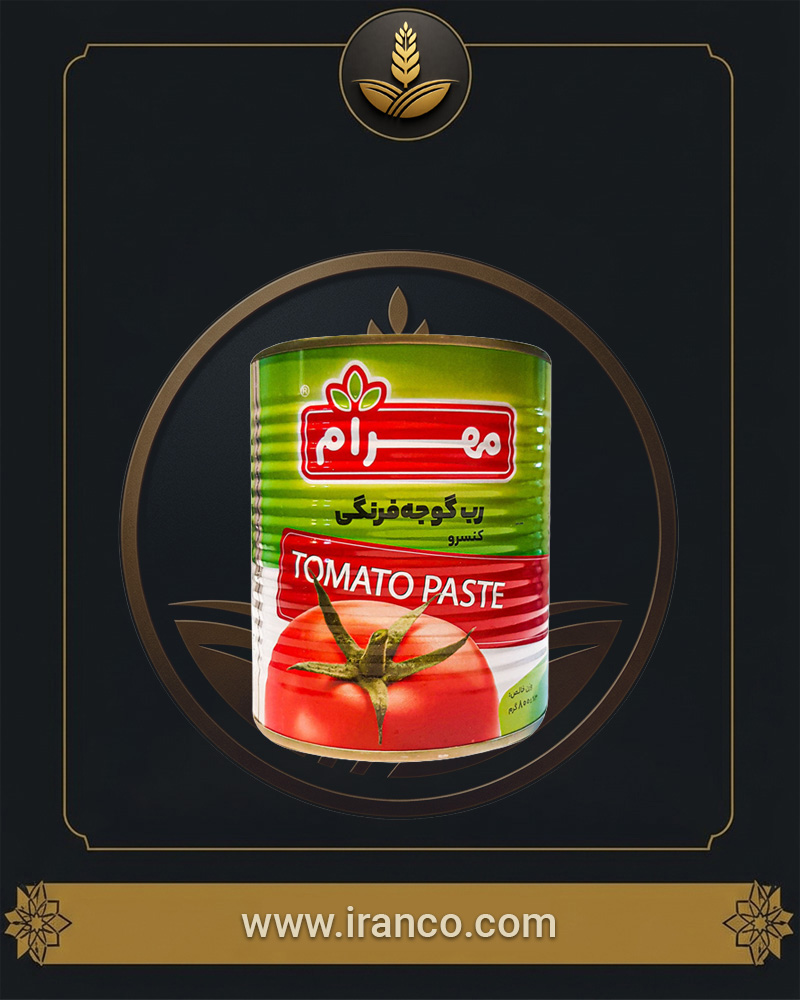
| Retail can or glass | Ready for consumer sale | Consumer-goods importer | Direct retail sale |
| Aseptic 28–30 Brix | Industrial concentrate in sterile bag-in-drum | Sauce, ready-meal and repack plants | Bulk shipping and storage |
| Aseptic 36–38 Brix | Higher concentration | Large food manufacturers | Less water shipped per unit solids |
| Hot Break paste | Higher viscosity | Ketchup and thick sauces | Better pectin structure retention |
| Cold Break paste | Lower viscosity and fresher traits | Tomato juice, thinner products and some sauces | Fresher colour and flavour |
Hot Break paste
In Hot Break processing, chopped tomatoes receive initial heat treatment at higher temperature. The main goal is rapid inactivation of enzymes that break down pectin. The result is preserved pectin structure and higher viscosity.
Tomato processing studies show Hot Break paste has higher viscosity than Cold Break at the same concentration and temperature. That makes it attractive for products such as ketchup and pizza sauce where body matters greatly.
Cold Break paste
In Cold Break, initial-stage temperature is lower. Greater activity of pectin-degrading enzymes reduces viscosity. In return, gentler processing can better preserve fresher colour and flavour traits.
This product suits applications where very high viscosity is not the main target, such as some beverages, tomato juice and formulations where body is adjusted later.
Why Brix alone is not enough for paste buying
Two lots can both be 28–30 Brix yet behave differently on the production line. The reason may lie in differences in Hot Break or Cold Break method, viscosity, colour, dark specks, heat load during processing, raw-material quality, acidity and pH, batch uniformity and aseptic process quality. Buying paste with the phrase "aseptic 28–30" alone is therefore an incomplete technical request.
4. Technical Specifications Buyers Should Define for Fresh Tomatoes and Paste
One cause of dispute between pre-shipment samples and commercial lots is vague specification. Phrases such as "Grade A export tomato" or "quality paste" are not measurable criteria.
Suggested fresh tomato specifications
| Parameter | Contract option or criterion | Why it matters |
|---|---|---|
| Product group | Round, elongated, cherry, cluster, etc. | Defines use and market |
| Size | Agreed diameter or weight range | Pack uniformity |
| Colour | Agreed ripeness stage | Shelf life and appearance |
| Firmness | Agreed sensory or instrumental criterion | Transit tolerance |
| Visible defects | Maximum cracks, bruises and misshape | Waste reduction |
| Decay | No active rot accepted | Safety and shelf life |
| Packaging | Carton, crate or retail pack | Product protection |
| Net weight | Exact weight per pack | Commercial control |
| Loading temperature | Matched to ripeness stage | Quality retention |
| Pesticide residues | Per destination rules | Clearance feasibility |
Suggested paste specifications
| Parameter | What to define | Why it matters |
|---|---|---|
| Brix | Such as 28–30 or 36–38 | Concentration and freight cost |
| Process type | Hot Break or Cold Break | Viscosity and application |
| pH | Contract limit | Stability and QC |
| Viscosity | Test method and range | Behaviour in final formula |
| Colour | Measurement method and acceptance limit | Final product quality |
| Acidity | Contract range | Flavour and formulation |
| Dark specks | Method and acceptance limit | Appearance and process quality |
| Mould | Test method and destination limit | Raw-material QC |
| Packaging | Aseptic, can, glass, etc. | Use pattern |
| Net weight | Weight per unit or drum | True price calculation |
| Production batch | Traceability requirement | Complaint and quality management |
| Shelf life | Per producer specification | Warehouse planning |
Codex for processed concentrate requires appropriate aroma and flavour, acceptable red colour and homogeneous texture, and practical freedom from undesirable peel, seed, extraneous plant matter and unsuitable dark particles. Mineral impurity must not exceed 0.1% of natural soluble solids, and total lactic acid is capped at 1% on the same basis.
5. Quality Control: How to Distinguish Good Tomatoes and Paste from Weak Lots
Fresh tomato assessment
Export tomato quality cannot be judged by redness alone. Product that is fully red and soft at loading may look attractive locally but be a poor choice for a multi-day route.
- Size and colour uniformity
- Adequate firmness and no deep cracks
- No crushing, bruising or rot
- Sound stem attachment
- No severe sunburn
- Cleanliness and no insect damage or open wounds
Tomatoes are sensitive to physiological chilling injury, and suitable temperature depends on ripeness stage. For mature-green fruit, post-harvest sources recommend 12.5–15°C; for pink stage 10–12.5°C; and for firm ripe fruit 7–10°C for shorter storage. Relative humidity of about 90–95% is also advised.
That means the fixed phrase "ship tomatoes at 5°C" is not a correct general instruction for every lot. Ripeness stage must be fixed before transport temperature is set.
Important tomato paste tests
For industrial buying, samples should be checked before contract and again at production or loading.
Brix: determines soluble solids and is one basis for pricing and formula design.
pH: Codex sets below 4.6 for tomato concentrate.
Viscosity: especially important for ketchup and sauce plants. Results must be interpreted with the agreed test method and conditions.
Colour: desirable red colour is a market indicator. Over-processing, weak raw material or poor storage can change appearance.
Dark specks and impurities: peel, seed, extraneous plant matter and burnt or dark particles must be controlled.
Mould: Codex leaves mould limits to retail-market country rules; buyers should not assume one number for all destinations.
Microbiological tests: packaging type and destination market determine the required programme. In aseptic paste, process integrity and pack integrity are especially important.
Pesticide residues and contaminants: for export these must match destination limits. Codex also provides contaminant and residue frameworks for this product.
A key point is that the seller's COA must relate to the actual batch. Using one general test certificate for all shipments through the year does not replace export-batch control.
6. Which Countries Import Iranian Fresh Tomatoes?
In official 2022 trade data, Iran exported about 691,918 tonnes of fresh or chilled tomatoes worth about $321.2 million. The five leading reported destinations were Iraq, the UAE, Pakistan, Afghanistan and Qatar.
| Market | Recorded volume | Recorded value | Market role |
|---|---|---|---|
| Iraq | approx. 252.4k t | approx. $114.4M | Major regional bulk market |
| UAE | approx. 158.4k t | approx. $77.3M | Consumption and regional distribution |
| Pakistan | approx. 111.3k t | approx. $50.1M | Large neighbouring market |
| Afghanistan | approx. 102.1k t | approx. $45.8M | Nearby land route |
| Qatar | approx. 38.1k t | approx. $19M | Food-import market |
| Russia | approx. 12.7k t | approx. $6.3M | Eurasian market |
| Oman | approx. 6.9k t | approx. $3.4M | Gulf market |
Table figures relate to 2022 and should be read as a clear historical picture of market structure, not as current order volume or price.
Iraq
Iraq has been a traditional destination because of proximity, land transport and large consumption. Even so, the market can be very sensitive to Iraq's own production season, import policy and supply swings.
In exports to Iraq, cargo speed and mechanical-damage control matter greatly. Product acceptable for a short border route is not necessarily suitable for a longer export lane.
UAE
The UAE has advanced distribution and wholesale structure beyond domestic consumption. Its markets can absorb products from economical bulk to premium packs. In the premium segment, appearance, grading, packaging and supply stability matter more than loose bulk sale.
Pakistan and Afghanistan
Land access is a major advantage for both markets. Even so, border conditions and truck waiting time directly affect fresh quality. Loading plans should allow margin for possible delays.
Qatar and Oman
These are food-import markets where Iranian tomatoes can compete because of relatively short geographic distance. Professional buyers there usually place high importance on pack uniformity, appearance, remaining shelf life and supply stability.
In 2023, importer-side statistics also show the UAE, Oman, Qatar, Pakistan, Iraq, Armenia and several other markets continued importing Iranian tomatoes, although mirror country data and direct Iranian export reports are not fully interchangeable and should be analysed separately.
7. Which Countries Import Iranian Tomato Paste?
The paste market differs fundamentally from fresh tomatoes. Paste is not a fast-spoiling product and, especially in aseptic packaging, can be shipped to more distant destinations. Paste trade radius is therefore much wider.
In 2023 and 2024, Iranian tomato paste exports reached about 235,000 to 240,000 tonnes. Trade reports place main markets across Eurasia and the Middle East. Russia, Afghanistan, Turkey, Armenia, Kazakhstan, Iraq, the UAE, Oman and Jordan are among important destinations. In recent years limited trade has also reached Italy, Romania, Libya, Côte d'Ivoire, Pakistan and Somalia.
For historical comparison, 2021 data show Iraq received more than 54,700 tonnes, Russia about 20,000 tonnes, Afghanistan about 13,700 tonnes, the UAE about 9,000 tonnes and Turkey nearly 6,000 tonnes under Iran's HS 200290 group.
| Market | Likely demand pattern | Iran advantage | Sensitive issue |
|---|---|---|---|
| Iraq | Industrial and retail paste | Land distance and trade history | Intense price competition |
| Russia | Food-industry raw material | Regional access | Quality stability and import rules |
| Afghanistan | Retail and industrial | Land transport | Price and packaging |
| Armenia | Industrial and re-export | Short land route | Consistent quality |
| Turkey | Industrial trade | Geographic proximity | Competition with domestic industry |
| UAE | Industrial and distribution | Sea access | Documentation and packaging |
| Oman | Industrial and retail | Regional sea route | Supply stability |
| Kazakhstan | Industrial | Eurasian market link | Freight cost and transit time |
An important feature of Iran's paste market is the difference between volume growth and export value growth. Volume exports reached about 240,000 tonnes in 2024, while paste trade surplus was reported at about $133 million. Average unit export value for Iran in 2022–2024 was about $557 per tonne, much lower than the 2014–2016 average. That indicator is not the price of one specific plant; it is a national trade average across mixed qualities and contracts.
Competition with China, Turkey and Mediterranean producers
In the global paste market Iran is not the only supplier. China has strong presence in large markets such as Iraq and Russia. In 2023, Iraq was the largest destination for China's HS 200290 exports and Russia was also a major buyer.
Turkey is both a tomato and tomato-product producer and has geographic advantage for Europe, Russia and the region. Italy, Spain and Portugal also have strong industrial history and access to European buyers.
Iran's advantage should therefore not be defined only as "lower price." Batch stability, colour, viscosity, aseptic process quality, ability to provide lab documents and regular supply matter more in industrial contracts.
8. Standards, Tariff Codes and Export Requirements
Fresh tomato tariff code
Fresh or chilled tomatoes are classified in the harmonized system under HS Code 070200. This code is used in Iran's international trade data for fresh tomatoes.
Paste and concentrate tariff code
Group HS Code 200290 covers tomatoes prepared or preserved otherwise than by vinegar or acetic acid, other than whole or in pieces, and most tomato paste trade is recorded under this code.
In practical customs declaration, national subcodes of origin or destination must also be checked. The six-digit international code alone is not enough to determine final destination duty.
Phytosanitary certificate for fresh tomatoes
Fresh tomatoes are a plant product, and quarantine pest control and origin are important in export. In announced rules for Bushehr product export in 1403, exporters were required to prepare an origin letter including producer name and production location for quarantine officers and related certificate issue.
In Marvdasht, emphasis was also placed on obtaining health identity for export producers.
Fresh tomato quality standard
UNECE Standard FFV-36 is one of the recognised international references for fresh tomato quality specifications. It can be used in trade to define quality, class and uniform presentation. The UNECE tomato standard listed with last revision in the organisation's catalogue relates to 2017.
For demanding markets, the contract should set measurable criteria alongside the reference standard.
Paste requirements
Codex Standard CXS 57-1981, revised through 2023, is an important international framework for tomato concentrate. Its requirements include:
- Minimum 7% soluble solids for concentrate definition
- Minimum 24% for tomato paste naming
- pH below 4.6
- Appropriate colour, flavour and odour
- Homogeneous texture
- Mineral impurity control
- Contaminant limits
- Pesticide residue limits
- General food hygiene principles
- Labelling requirements for retail and non-retail containers
Destination-country rules may add requirements on label language, nutrition, importer details, residues, heavy metals or microbiological criteria. Codex therefore does not replace destination regulation review.
9. Packaging and Shipping: A Fundamental Difference Between Fresh Tomatoes and Paste
Fresh tomato packaging
Fresh tomato packaging aims to prevent vertical pressure, abrasion, impact and temperature rise. The pack must withstand stacking while allowing air circulation.
- Ventilated cartons
- Reusable plastic crates
- Reinforced export boxes
- Small retail packs for cherry tomatoes
- Cluster packs for premium market
Over-packing, use of weak or wet cartons, or filling boxes so product sits under lid pressure can increase waste.
Fresh tomato transport
The basic principle for fresh produce transport is shorter transit time, impact prevention, temperature control, moisture-loss control and air circulation. FAO also treats these as core principles for fresh fruit and vegetable transport.
Tomato temperature should be set by ripeness stage. Post-harvest sources recommend 12.5–15°C for mature-green, 10–12.5°C for pink, and 7–10°C for firm ripe short storage. Relative humidity around 90–95% helps reduce water loss.
Tomatoes are ethylene producers, and storing them beside ethylene-sensitive products can create problems. This must be considered in mixed loads.
Aseptic paste packaging
In industrial trade, one common Iranian paste format is aseptic bag inside a metal drum. Iranian suppliers usually offer drums of about 220–240 kg for this market, although exact weight must be fixed in contract.
The advantage of the aseptic system is that product is filled into a sterile bag in a controlled environment after processing and sterilisation. This is far more suitable for a factory using paste as raw material than buying thousands of retail cans.
| Packaging method | Suitable customer | Advantage | Control point |
|---|---|---|---|
| Aseptic bag in drum | Food manufacturers | High volume and industrial use | Bag and drum integrity |
| Metal can | Retail and food service | Shelf life and strength | Seam and corrosion |
| Glass | Consumer market | Product visibility and premium look | Breakage and freight weight |
| Small packs | Retail | Easy consumption | Packaging cost |
| Bucket or food-service pack | Restaurants and industrial kitchens | Mid volume | Storage after opening |
Some Iranian producers declare up to 24 months shelf life for aseptic paste in product specs, but buyers should obtain actual shelf life from that factory's technical sheet for that pack type and not extend it to all market products.
10. What Determines the Price of Iranian Tomatoes and Paste?
Quoting one fixed price for "Iranian export tomatoes" or "Iranian tomato paste" has little commercial meaning. Two lots bought on the same day from the same region can differ in price because of quality and delivery terms.
Main fresh tomato price drivers
- Harvest season, production region and daily market supply
- Size, uniformity, ripeness stage and firmness
- Waste percentage, sorting method and carton or crate type
- Net weight, pre-cooling cost and freight
- Distance to border or port, lab requirements and order volume
- Delivery terms (Incoterms)
The fresh tomato market changes much faster than paste. Sudden harvest-season supply can cut farm price, while limited supply or higher export demand can move it the other way.
Main paste price drivers
- Brix, Hot Break or Cold Break, viscosity and colour
- Raw-material quality, packaging type and aseptic or non-aseptic
- Net weight per drum, drum and bag cost
- Order quantity, number of batches and laboratory tests
- Private label, destination, transport mode and delivery terms
- Buying time relative to processing season
Price comparison should be based on solids content, net weight and delivery terms. 36–38 Brix paste cannot be compared with 28–30 Brix paste on price per tonne alone, because usable solids and water content differ.
20-point importer checklist before ordering
- Define whether product is fresh, industrial paste or retail paste.
- For fresh tomatoes, set product group such as round, elongated, cherry or cluster.
- Specify target size or weight range.
- Define ripeness stage and acceptable colour at loading.
- Write maximum visible defects, cracks, bruises and rot into the contract.
- Specify packaging type, net weight and packs per pallet.
- For paste, fix exact Brix.
- Choose Hot Break or Cold Break according to final use.
- Include viscosity, pH, colour and other required technical parameters in the spec sheet.
- Obtain a representative sample and test it by the agreed method.
- Request COA linked to the production batch.
- Review destination residue and contaminant rules before production or packing.
- Define required label language and information.
- Check aseptic bag, drum or carton integrity before loading.
- State delivery terms clearly on an Incoterms basis.
- Specify non-conformance clause and destination sampling method in contract.
- Verify supplier's real capacity for the full order.
- Confirm production, loading and estimated transit times separately.
- For fresh tomatoes, set transport temperature according to ripeness stage.
- Use pre-contract samples as basis only when numerical specs are also written into contract.
11. Choosing Between Fresh Tomatoes and Paste for Export Trade
Fresh tomatoes and paste are entirely different chains. The choice depends on market, working capital, geographic distance and quality-control capability.
Who is fresh tomato trade suited to?
Fresh tomatoes can be attractive for an importer who has fast access to wholesale market, short or medium transport distance, daily distribution capability, suitable cold chain and fleet, and the ability to sell the lot quickly.
In this trade, one day of delay can change product value. Operational speed therefore matters as much as purchase price.
Who is paste trade suited to?
Aseptic paste is a more logical option for a factory or distributor who needs food-industry raw material, places large periodic orders, plans consumption over several months, has a destination farther from Iran and needs formula standardisation.
Paste also allows seasonal buying and gradual factory use, provided shelf-life and storage conditions from the producer's specification are respected.
What Information Is Needed for an Accurate Price Quote?
For fresh tomatoes, a price request should ideally include:
- Product group, size, colour and ripeness stage
- Expected firmness
- Order quantity, packaging type and net weight per carton or crate
- Special sorting requirement
- Destination country, delivery city, border or port
- Transport mode, required standard or test and delivery terms
For tomato paste, the following matter more:
- Target Brix and Hot Break or Cold Break
- Required viscosity, pH or other contract technical specs
- Packaging type and net weight per unit
- Total order volume and industrial or retail product
- Private label requirement, destination country and delivery port or city
- Required certificates and tests and delivery terms
Importers can include this information in an Iranco purchase request so supply options in Iran are reviewed against real product specifications, not just the generic names "tomato" or "paste".
Export Supply of Iranian Tomatoes and Tomato Paste
In international tomato and paste buying, the gap between two offers is usually more than price. For fresh tomatoes, size, firmness, colour, ripeness stage, defect percentage, packaging and distance from farm to destination all affect the outcome. For paste, Brix, Hot Break or Cold Break method, viscosity, colour, aseptic quality, drum weight and tests for each batch all matter.
That is why a purchase request should become a clear technical specification before contacting suppliers.
Iranco (iranco.com) lets buyers submit purchase requests with this information so supply options in Iran can be reviewed on the same basis.
For industrial paste orders, Brix, process type and packaging format are especially important. For fresh tomatoes, product group, size, ripeness stage, carton type and destination must be clear.
If you need Iranian fresh tomatoes or paste for your market, include technical specifications and approximate order volume in your purchase request so supply can be reviewed against your real need.
Conclusion
Iranian tomatoes are not one product with fixed specifications. The difference between fresh-eating tomatoes, premium greenhouse product and fruit suited to processing directly affects market, price, packaging and shipping method. For fresh tomato buyers, firmness, ripeness stage, size, uniformity, appearance and temperature management are decisive. Product that looks good at harvest but is unsuited to route length can become a high-waste lot at destination.
In tomato paste, the issue is more technical. Brix is the first indicator but does not define quality alone. Hot Break or Cold Break type, viscosity, colour, pH, raw-material quality, aseptic process integrity and batch uniformity must be reviewed together.
From an export-market perspective, two different routes exist. Iraq, the UAE, Pakistan, Afghanistan and Qatar were the main fresh tomato destinations in official 2022 data, while Iranian paste in recent years has also reached Russia, Afghanistan, Turkey, Armenia, Kazakhstan, the UAE, Oman and other regional markets beyond Iraq.
The best buying method is to compare suppliers against one shared technical specification. The more precise the purchase request, the more reliable price comparison, sample approval and final shipment control become, and the smaller the gap between sample and commercial lot.
Frequently Asked Questions (FAQ)
What are the main Iranian tomato types for trade?
Commercially, Iranian tomatoes divide into round fresh-eating, elongated/meaty, cherry, cluster, large salad and processing/industrial groups. Seed or hybrid name alone is not enough for buying; buyers work mainly with shape, size, firmness, colour, ripeness stage, skin condition and end use.
Which tomatoes are best for paste production?
Tomatoes suited to processing are fully ripe and sound, with suitable colour and good pulp and solids yield. For the factory, perfect fruit shape matters less than soundness, colour, usable flesh and processing yield. Watery tomatoes increase concentration cost.
What is the difference between Hot Break and Cold Break paste?
Hot Break is produced at higher initial processing temperature and creates higher viscosity by inactivating pectin-degrading enzymes faster. It suits ketchup and thick sauces. Cold Break usually has lower viscosity and suits products wanting fresher traits or lower body.
What Brix is suitable for export paste?
There is no single number for every contract. Codex defines tomato paste as at least 24% natural soluble solids. In Iran's industrial market, 28–30 and 36–38 Brix are common in aseptic paste supply. Choice should follow final product formula and freight cost.
Which countries import most Iranian fresh tomatoes?
In Iran's direct export data for 2022, Iraq, the UAE, Pakistan, Afghanistan and Qatar were the five main destinations. Russia, Oman, Armenia and several other markets also appeared. Market structure changes each year with destination domestic production and trade conditions.
Which countries import most Iranian tomato paste?
Recent important markets lie in Eurasia and the Middle East. Russia, Afghanistan, Turkey, Armenia, Kazakhstan, Iraq, the UAE, Oman and Jordan appear in Iran paste trade reports. Limited exports have also reached some European, African and Asian markets.
Which tests matter most for aseptic paste buying?
Brix, pH, viscosity, colour, acidity, extraneous matter, dark specks and microbiological indicators are among the most important. Depending on destination, contaminant and residue tests may also be required. Test method and acceptance limits should be written in contract and COA should relate to the same batch.
Why can two 28–30 Brix pastes have different prices?
Brix shows concentration only. Hot Break or Cold Break type, colour, viscosity, raw-material quality, microbiological status, aseptic bag type, drum weight, certificates, order volume and delivery terms also move price. Offers should therefore be compared with identical technical specs.
What information is needed for a tomato or paste price quote from Iran?
For fresh tomatoes, define product group, size, ripeness stage, order volume, packaging and destination. For paste, Brix, Hot Break or Cold Break, viscosity, packaging, unit weight, total volume and destination matter more. This information can be entered in an Iranco purchase request.
Is aseptic paste or canned paste better for a factory?
For high-volume industrial use, aseptic paste in drums is usually the more logical supply form because it is designed for factory use, warehousing and bulk transport. Canned or glass paste is more suitable when the final product is bought directly for retail or food-service consumption.
Featured Products


Related Articles



