 Iranco Magazine Team
Practical guide to export product selection, key markets, sorting, packaging, cold chain, shipping routes and logistics cost per kilo
Export guide · Fresh produce · UNECE FFV-36
Iran Tomato Exports: Target Markets, Packaging and Freight Costs
A practical guide to choosing export product, key markets, sorting, packaging, the cold chain, shipping routes and logistics cost per kilogram for wholesale buyers and procurement managers.
Fresh tomatoes are a major Iranian horticultural export. The main edge comes from off-season production in the south, proximity to regional consumption markets and the option of short road and sea legs. Export success is not only farm gate price: ripeness at harvest, size uniformity, flesh firmness, packaging, dwell time at borders and temperature management directly determine how much of the load arrives in saleable condition.
Recorded import value from Iran in 2024 places Iraq at the top of reported markets for Iranian fresh tomatoes. In the same year Oman, Pakistan, Armenia and Qatar were also significant buyers of Iranian product.
Introduction
Tomato export differs from many agricultural products. The exporter handles a living commodity that continues to respire and ripen after harvest and is highly sensitive to heat, pressure, impact, wrong humidity and long stops. The gap between a profitable load and a low-value shipment is sometimes only a few hours’ delay, a few degrees of temperature difference or the wrong carton.
Iran has a strong geographic advantage. Southern regions — especially Hormozgan — enter harvest when many regional markets rely more on imports for fresh vegetables. For crop year 1404, production of more than 750,000 tonnes of tomatoes from about 15,000 hectares is forecast in that province, with peak output in Bahman, Esfand and Farvardin. Minab, Bandar Abbas, Parsian, Bandar Khamir and Rudan are main production hubs.
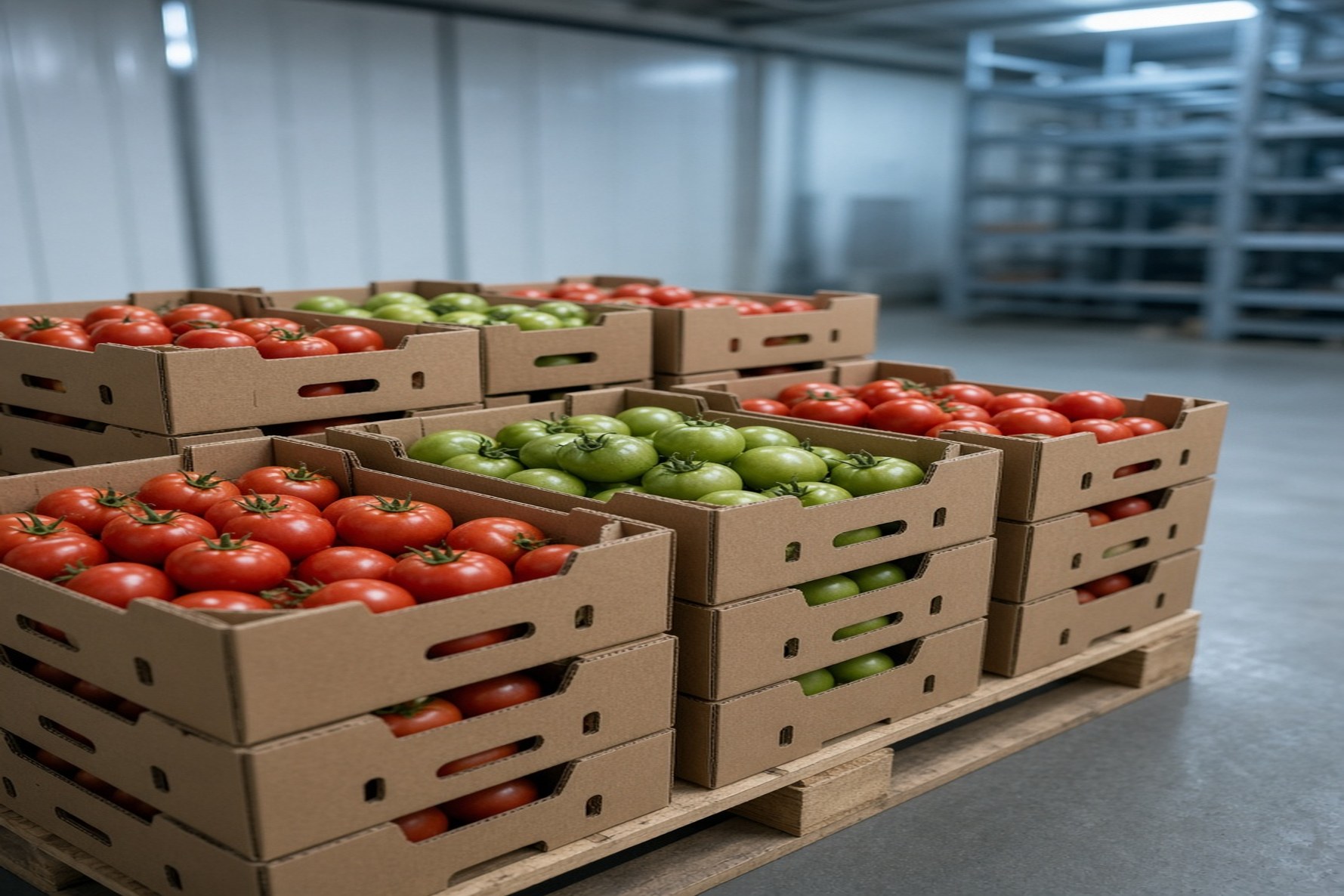
Aligning southern harvest with winter demand from neighbours creates trade opportunity, but distance only becomes real profit when the product is grown and picked for export from the start. For an overseas buyer, the right product is a set of measurable traits: uniform shape and size, intact skin, texture suited to the route, defined ripeness stage, no cracks or severe bruising, MRL compliance at destination and protective packaging.
1. Iran’s tomato position in regional export trade
The natural market for Iranian fresh tomatoes is overwhelmingly in neighbouring countries. Value per kilogram relative to freight is limited, and shelf life without a precise cold chain makes long distances uneconomic.
In 2024 trade data, Iraq, Oman, Pakistan, Armenia and Qatar were the leading recorded importers. Iran’s export footprint spans three axes: western land routes, the Persian Gulf and Sea of Oman, and eastern and northwestern road corridors.
| Market | Value (2024) | Main trait |
|---|---|---|
| Iraq | ~$37.6M | Large, nearby, road freight |
| Oman | ~$11.6M | Southern production + short sea leg |
| Pakistan | ~$9.6M | Volume, price-sensitive |
| Armenia | ~$5.9M | Land route, appearance matters |
| Qatar | ~$4.8M | Import-dependent, pack and quality |
*Figures based on reported foreign trade statistics; later revisions may adjust totals.
In Armenia, Iran supplied more than two-thirds of recorded fresh tomato import value in 2024. Qatar is also material: total fresh tomato imports in 2024 were about $19.5 million, with nearly $4.8 million from Iran; competitors include Jordan, Morocco, Oman and the Netherlands.
The UAE has a significant history of buying Iranian tomatoes. In 2023 UAE imports of Iranian tomatoes were about $16.5 million and Iran supplied roughly 31% of the UAE’s import value for this product — for domestic use and as a regional hub.
2. Production season and Iran’s off-season tomato advantage
One of Iran’s strongest competitive factors is supply across different parts of the year. Open-field and greenhouse production in various regions means harvest is not confined to a few months.
For winter export, southern provinces are critical. Main Hormozgan harvest in Bahman, Esfand and Farvardin coincides with periods when Gulf climate limits some local products and import demand rises.
Timing only pays when the sales plan is ready before peak harvest. A sudden large volume without contracts, suitable freight rates and sorting capacity depresses price. Aligning harvest with truck or vessel dispatch, reducing cold-store dwell and fast movement lowers the true cost per kilogram of sound fruit.
- Destination demand window
- Competitor supply situation
- Daily sorting and packing capacity
- Truck, vessel or reefer container schedule
Fresh product cannot be warehoused for weeks like dry goods. Sales timing must be managed before harvest.
3. Commercial tomato types and export use
UNECE standard FFV-36 groups fresh tomatoes by shape into round, ribbed, elongated and cherry types. It applies to fresh consumption and does not cover processing tomatoes.
| Type | Trait | Market |
|---|---|---|
| Round | General use, sorted by diameter | Wholesale, retail, household |
| Elongated | Meaty texture, uniform shape | Retail, foodservice |
| Ribbed | Distinct appearance | Specialty markets |
| Cherry | Small size, higher unit value | Modern retail, consumer packs |
For volume export to Iraq and Pakistan, price, flesh firmness and uniformity often matter more than premium packaging. For Qatar, the UAE and retail-oriented Oman, colour uniformity, skin appearance and clean packs carry more value. “Which type is best?” has no single answer — the right product matches transit time and the destination sales channel.
4. Technical specifications the buyer must fix before ordering
“Export grade one tomatoes” is not enough for a contract. Specifications must be measurable.
| Parameter | Options | Importance |
|---|---|---|
| Type | Round, elongated, ribbed, cherry | Market and pack |
| Size | Diameter or count per pack | Uniformity and price |
| Ripeness | Mature green, pink, firm red | Transit shelf life |
| Firmness | Approved sample | Handling tolerance |
| Colour | Min/max stage | Uniformity |
| Defects | Tolerance for cracks, scratches, spots | Avoid disputes |
| Net weight | Fixed per pack | Pricing and freight |
| Pack | Carton or plastic crate | Mechanical protection |
| Ventilation | Suited to cold chain | Respiration heat |
| MRL | Per destination | Customs clearance |
| Delivery temperature | By ripeness stage | Quality at destination |
Samples must represent the actual shipment. If the sample is taken from the best rows but defect and ripeness limits are not in the contract, mismatch between sample and final load is almost inevitable.
5. Sorting and criteria for export tomatoes
Export tomatoes must be separated before packing by health, size, shape, colour and ripeness. Mixing firm and partly ripe fruit with fully ripe fruit in one carton is one of the worst practices.
Under FFV-36, product must be sound, clean, fresh, practically free of pests, without abnormal external moisture and without foreign odour or taste, and must tolerate transport to destination in satisfactory condition.
Size uniformity
In diameter-sorted packs: if the smallest fruit is under 50 mm, diameter spread must not exceed 10 mm; for 50 to under 70 mm, 15 mm; for 70 to under 100 mm, 20 mm. Size codes include ranges above 40–47, 47–57, 57–67, 67–82 and 82–102 mm — more precise than “medium” or “large”.
- Remove decay, open cracks, severe bruising, deep insect damage, severe sunscald and excessive softness
- Quality control before packing — not only at loading
- Divert weak product off the export line at the packing station
6. Suitable packaging for export tomatoes
The pack must bear pallet pressure, prevent crushing and allow air movement. FAO technical sources stress strength, ventilation, rapid cooling and resistance to moisture.
Export cartons
Lightweight and suited to one-way shipment; strength drops in high humidity. Product must not sit wet directly in carton board. FAO guidance for fruits and vegetables suggests vent opening area of at least about 5% of box surface — ensure holes are not blocked in pallet stacking.
Plastic crates
Moisture-resistant, washable; upfront cost, return of empty crates and pack ownership should be in the contract. Smooth inner surfaces — sharp edges cause small wounds and early decay.
Very deep boxes suit pressure-sensitive fruit poorly. FAO indicates roughly 15–20 kg maximum for hand-packed trade cartons and 2–5 kg for retail packs. Final weight should follow tomato firmness, box height and buyer requirement — not maximum weight per carton regardless of fruit.
7. Cold chain: why tomatoes should not be over-chilled
Tomatoes are chilling-sensitive and the right temperature depends on ripeness stage. “The colder the better” is wrong.
| Stage | Suitable temperature |
|---|---|
| Mature green | 12.5–15°C |
| Light red | 10–12.5°C |
| Firm red (short term) | 7–10°C |
| Relative humidity | 90–95% |
One fixed temperature is not correct for every load. Low humidity causes shrivelling and weight loss; excess humidity with condensation promotes mould. Container air temperature is not the same as fruit core temperature — warm product on a reefer truck must be pre-cooled first.
8. Main export shipping routes
Iraq
Road freight is the main option — Shalamcheh for the south and routes matched to destination for central and northern Iraq. Advantage: no port; risk: border dwell. A few hours of warm delay for ripe fruit can cost more than freight rate differences.
Oman
Logical from Hormozgan: Bandar Abbas–Sohar (multi-day container) and short feeders from Qeshm/Jask to Al Suwaiq. Proximity makes Oman a natural outlet for southern produce.
Qatar
Sea route to Hamad Port; time from harvest to distribution centre is critical. Ripeness must be aligned with sea transit from the start.
Pakistan
Pakistan imported more than $52 million of fresh tomatoes in 2024; Iran at ~$9.6 million was the second recorded supplier after Afghanistan. Land access is an advantage; the market is price-sensitive — expensive packs eat margin, weak packs raise waste.
Armenia
Norduz border crossing; Iran was the main supplier of imports in 2024. For retail, size and appearance uniformity matter strongly.
9. Freight cost: logistics per kilogram
There is no fixed “freight rate”. True cost depends on origin, destination, vehicle type, refrigeration, season, border waiting, pack type and load weight.
Logistics cost per kg = (packing + sort + pre-cool + inland + international + border + unloading) ÷ net salable weight at destination
A cheap truck with 8% bruising is not necessarily cheaper than temperature-controlled haulage. The lowest nominal freight is not always the lowest true cost — stops, repeated handling and poor packs multiply waste.
| Component | Effect |
|---|---|
| Farm to packing | Distance and transfer frequency |
| Sort and pack | Box material and grade |
| Pre-cooling | Energy and operations |
| Haul to border/port | Production region |
| Refrigeration | Higher than ambient freight |
| Customs and terminal | Border or port |
| Ocean freight | Oman, Qatar, Gulf |
| Dwell and waste | Important hidden cost |
10. Standards, phytosanitary certificates and MRL
Fresh tomatoes fall under HS 0702. Check destination quarantine requirements before loading. ISPM 12 defines the phytosanitary certificate framework.
- Commercial invoice, packing list, certificate of origin
- Phytosanitary certificate for the destination
- Transport and customs documents
- MRL results when requested — with a defined substance list, not vague “pesticide test”
- Pack specifications and net weight
MRL limits differ by substance and product. Farm spray programmes must match export markets; testing hours before loading does not fix misuse weeks earlier.
11. Export pricing factors
- Season, production region, type and shape
- Size, uniformity, ripeness stage, acceptable percentage after sorting
- Pack material and weight, packing labour
- Haul to border, refrigeration need, testing and certificates
- Order volume, destination, Incoterms, expected waste rate
Domestic field price is not export price. Two quotes — mixed fruit in a heavy box versus sorted fruit in a shallow pack — are not directly comparable; price must sit on one fixed technical specification.
12. Pre-loading control
Final inspection when product is packed and ready to load. Sample from top, middle and bottom of the pallet — a few top boxes alone are not enough.
- Match type, size, colour, firmness; no decay; cracks and bruising
- Net weight, pack strength, vents open
- Count matches documents; product temperature; clean load space
- Reefer performance; data logger; seal after loading
On large contracts, photos and a pre-seal report help with disputes.
Importer checklist — 16 items
- Specify the commercial tomato type.
- Define size range or sizing method.
- State ripeness stage at delivery.
- Obtain a real sample from deliverable production.
- Record allowable appearance defects in the contract.
- Fix net weight per pack.
- Confirm pack material and dimensions.
- State destination labelling requirements.
- Define test list before harvest.
- Align MRL conditions with the seller.
- Set transport temperature by ripeness.
- Specify transport mode and entry border or port.
- Clarify freight and clearance cost responsibility.
- Define rejection or acceptance criteria.
- Document how weight or quality disputes at destination are handled.
- Coordinate harvest, packing and vehicle movement schedule.
Information required for a price request (RFQ)
| Field | Example |
|---|---|
| Product | Fresh tomatoes |
| Type | Round, elongated or cherry |
| Size | Diameter range or count per pack |
| Ripeness | At loading and delivery |
| Grade | Sample + defect tolerance |
| Pack | Carton / plastic, net weight |
| Volume | Tonnes or number of trucks/containers |
| Destination | Country, city, border or port |
| Transport | Road/sea, ambient/reefer |
| Testing and labels | MRL, phytosanitary |
| Delivery window | Preferred period |
Without this information, comparing two price offers can be completely misleading.
Sourcing with Iranco
The wholesale buyer’s challenge is often not finding a seller — it is access to product aligned with the market, transit time and packaging. Iranco is a platform to submit purchase requests and review supply options in Iran against real transaction specifications. Sample alignment, daily capacity, packing and loading should be coordinated before final harvest.
Summary
Iranian tomato export delivers real advantage when the right market, product for the route and fast controlled logistics are managed together. Iraq, Oman, Qatar, Pakistan and Armenia were key 2024 destinations; the UAE remains an important regional market. Size, firmness and ripeness uniformity must be measurable. Shallow packs with effective ventilation and temperature matched to ripeness — not indiscriminate chilling — mark professional practice. True cost is logistics per kilogram of sound product delivered at destination.
Frequently asked questions
Which countries receive most Iranian tomato exports?
In 2024 data, Iraq, Oman, Pakistan, Armenia and Qatar were among the leading recorded buyers. The UAE has also been an important market in recent years. Market choice depends on production region, season, freight cost and quality specifications.
Which tomatoes are best for export?
It depends on destination. For longer routes, firmer fruit at lower ripeness suits better. For nearby retail, uniform colour carries more value. Round fits general markets; cherry suits higher unit-value retail.
At what temperature are export tomatoes shipped?
Mature green about 12.5–15°C, light red 10–12.5°C, firm red short term 7–10°C; RH about 90–95%.
Can tomatoes be shipped near 0°C?
Not for typical fresh trade. Tomatoes are chilling-sensitive; prolonged low temperature causes chilling injury and poor ripening. Container set-point should follow ripeness stage.
What packaging suits export tomatoes?
Strong cartons with vent holes or smooth plastic crates. Packs must bear pallet load without transferring weight onto fruit. Excessive depth and over-packing are main causes of bruising.
How is freight cost determined?
Origin, destination, truck type, refrigeration, season, border waiting, weight and pack all matter. For economic comparison, divide total cost by net sound weight at destination.
What is the tariff code for fresh tomatoes?
HS 0702 for fresh or chilled tomatoes. Declarations must match documents and destination customs rules.
Are MRL tests important?
Yes. Each market has different limits. Testing should be designed around a defined substance list; control starts with the farm programme and interval from last application to harvest.
Why does ripeness at harvest matter?
Tomatoes continue to ripen after harvest. Fruit for a multi-day route should not be picked like same-day supermarket fruit. The longer the route, the more critical harvest stage and temperature control become.
Is the cheapest freight always the best choice?
Not for perishable product. Cheap haulage with stops, heat or weak packs can create waste many times the freight saving. The benchmark is sound product delivered.
Featured Products


Related Articles



