 Iranco Magazine Team
Value-chain analysis, seed calibration, laboratory evaluation, customs requirements, packaging standards and bulk-shipment logistics
Export Guide · Pulses
Iranian Pulses Export: Market Opportunities and Wholesale Trade Requirements
A comprehensive analysis of the value chain, seed calibration, laboratory evaluation, customs requirements, packaging standards and logistics for bulk shipments
Analytical Introduction
This specialist guide examines the structure of Iran’s pulses export market, grain-sizing criteria, quality and physicochemical control tests, customs regulations and priority regional markets. Trade managers, food-industry operators and wholesale buyers who study this report will identify contract requirements, logistics-chain risks and practical cost-management measures in an applied way.
International pulses trade—as a foundational pillar of plant-protein supply—is undergoing broad geoeconomic and climatic change. Rising animal-protein production costs, demographic shifts in West Asia and North Africa, and growing demand for ready-to-eat foods have elevated pulses from a traditional commodity to a strategic resource in food-security calculations. Iran’s plateau, with climatic diversity across the Zagros, Alborz foothills and fertile north-western basins, provides a natural base for producing valuable pulse species.
The competitive edge of Iranian pulses—especially white chickpeas and selected bean and lentil types—stems from soil characteristics and rainfed growing conditions. Dense texture, structural integrity during thermal processing and natural grain flavour are traits that distinguish these products in regional markets. Achieving a durable market share and moving beyond low-value bulk outlets, however, requires precise alignment with modern commercial standards.
In wholesale trade, general quality claims have given way to precise calibration metrics, useful and non-useful dockage calculation, pesticide-residue control and optical sorting lines. International traders and importers need reliable information on tariff regimes, product-supply windows, water-absorption behaviour on processing lines and methods to contain transport-chain losses. This analysis maps a comprehensive route for efficient entry into Iranian pulses wholesale deals.
1. Growing Geography, Agronomic Advantages and Harvest Calendar in Iran
Pulse production in Iran rests on rainfed and irrigated systems, with the majority coming from foothill rainfed farms. This production method creates marked differences in grain texture and physical traits compared with crops grown under intensive irrigation.
Regional Production Hubs
The mountainous west of the country is the main hub for rainfed grains:
- Kermanshah Province: With a large share of arable land devoted to chickpeas, it is known as the country’s chickpea capital and supplies about one-third of domestic output. Harvested grains from this region, owing to size and uniform hulls, are the primary reference for export pricing.
- Lorestan Province: Combining chickpea production in highlands with bean types in the fertile plains of Azna and Aligudarz, it plays a strategic role in balancing the pulses supply chain.
- East and West Azerbaijan Provinces: North-western plains, beyond quality lentil growing, focus on the industrial processing and split-chickpea hub of Azarshahr, converting yellow Desi chickpeas into commercial split peas (lappeh).
- Fars, Zanjan and Markazi Provinces (especially the Khomein area): With surface and groundwater resources, these lands are the largest suppliers of pinto, red and white beans for canning industries and household use.
Crop Rotation and Soil Sustainability
Pulses are grown in rainfed rotation with autumn cereals such as wheat and barley. Rhizobia symbiotic with plant roots biologically fix atmospheric nitrogen in the soil. This biological process minimises nitrogen fertiliser use, which directly reduces nitrate build-up and other synthetic residues in the grain tissue.
Seasonal Supply Calendar and Purchase Planning
Timing of cargo arrival on the market links directly to storage overheads and cooking quality:
- Spring crops (rainfed chickpeas and lentils): Sown in March and harvested mechanically or semi-traditionally in July–August. Peak physical supply of fresh crop falls in August–September—the best window for ordering with the lowest moisture dockage.
- Autumn and winter-sown crops: Certain cold-tolerant chickpea cultivars are planted in November and harvested in late May. Their early market entry enables supply during warehouse inventory lows.
- Irrigated crops (bean types): Harvest is concentrated from late September through November in temperate and cool regions.
2. Commercial Typology of Iranian Export Pulses and Physical Traits
In pulses trade literature, grain classification rests on geometric calibration, dimensional uniformity, colour and hull characteristics. Accurate assessment of each commercial category matters for importers aligning with distribution standards.
Large White Chickpeas (Kabuli Type)
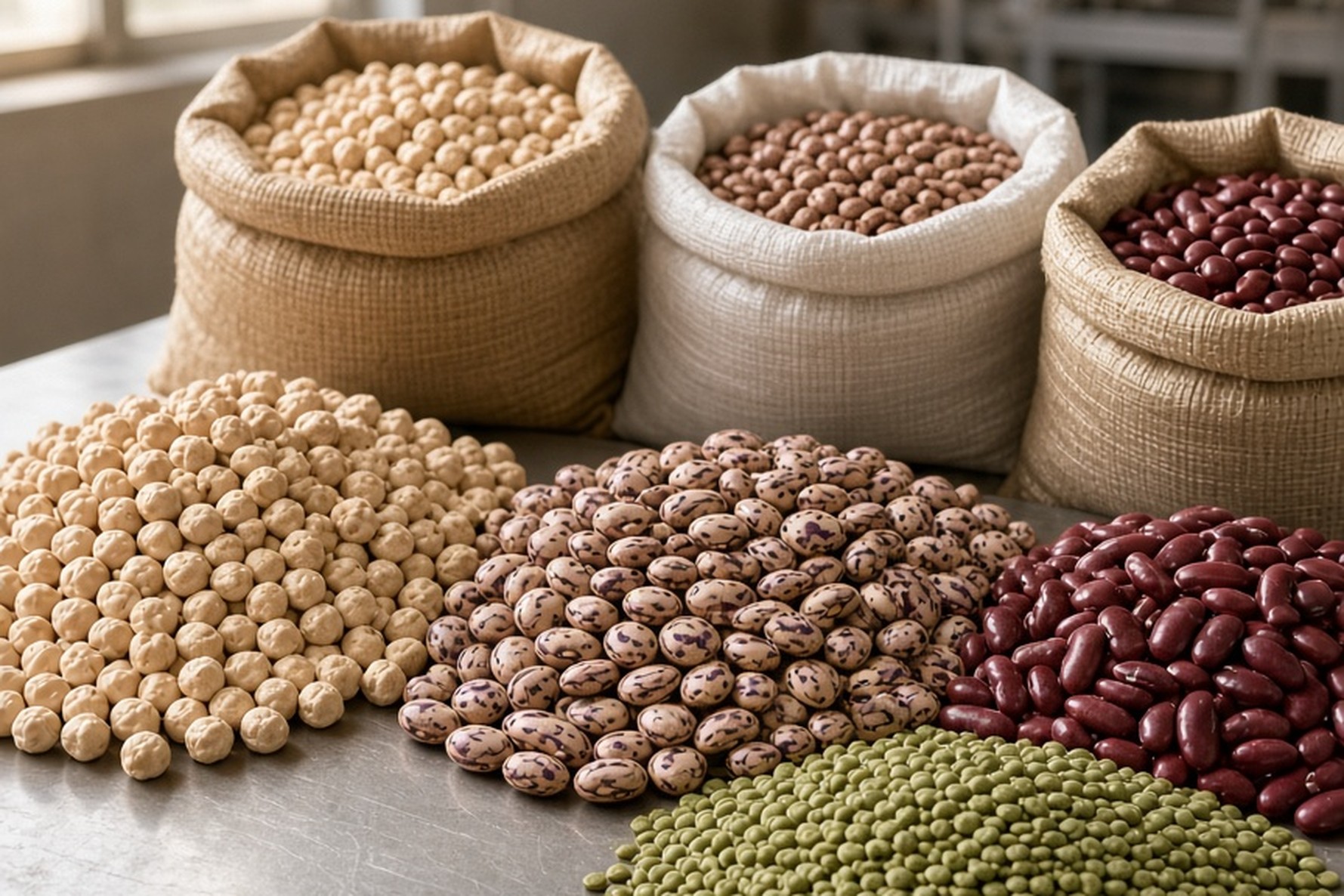
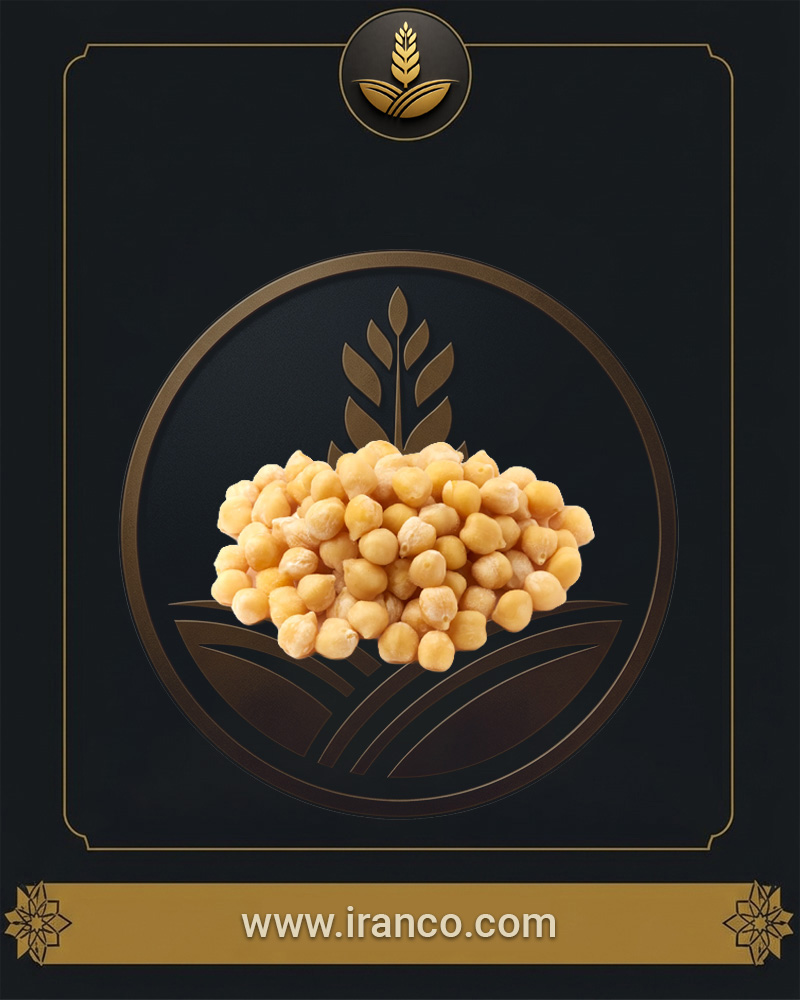
Kabuli chickpeas are the flagship item in Iran’s pulses export basket. The grain is known for a smooth or slightly wrinkled cream hull, a beaked oval shape and absence of dark pigments. On the Iranian market, the product is graded by millimetre sieve diameter:
- Tak-khan (calibre 10 mm and above): The largest grain produced, with limited output from premium farms; supplied to luxury retail and first-class Gulf hotels.
- Do-khan (mix of 8 and 9 mm calibres): A fifty-fifty blend of 8 mm and 9 mm sieve grains; balances visual appeal and landed cost, with strong demand in transparent retail packs.
- Se-khan (mix of 7, 8 and 9 mm): The base wholesale grade with at least 50% 8 mm calibre; exported in very high tonnages to markets such as Iraq, Oman and Afghanistan.
- Falafel chickpeas (calibre 5 and 6 mm): Small but fully sound, dense grains separated on the lower screens of cleaning lines; thin hulls and smooth grinding make them the main feed for semi-prepared product lines and food outlets.
Yellow Small Chickpeas (Desi Type)
This type has smaller spherical grains with dark yellow, brown or greenish hulls. Most production is used in traditional and industrial processing in Azarshahr, where wetting, dehulling, cotyledon separation and polishing convert it into Tabrizi split chickpeas (lappeh).
Bean Types
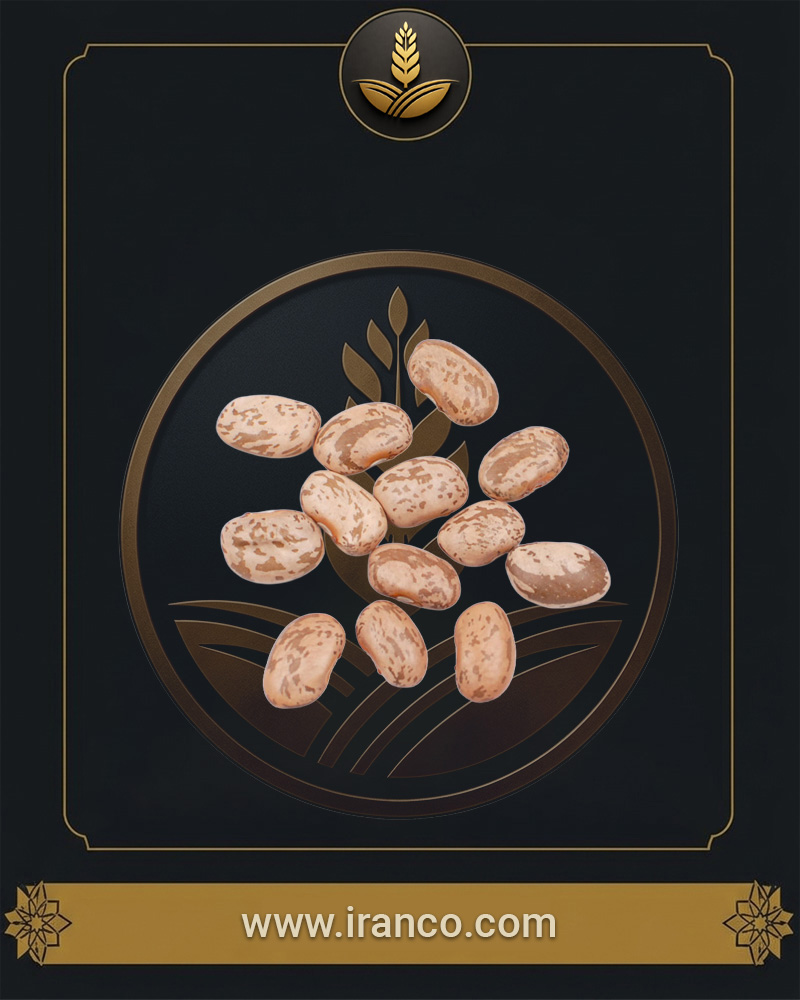
- Pinto beans: Bone-coloured background with irregular purple mottling, kidney or egg-shaped; Khomein harvests show high resistance to softening in cans thanks to suitable cell-wall thickness.
- Red beans: Offered as elongated kidney and small spherical types with glossy liver-red colour; neighbouring markets to the west and north strongly prefer the kidney type.
- White beans: Regular oval structure and dense texture; mainly used in brine canned goods and mixed cooked products.
Green Lentils and Broad Beans
Medium-calibre green lentils (5.5 to 6.5 mm) with olive-green colour and orange inner tissue are harvested in north-western rainfed areas. Large dried broad beans with flat wide seeds are mainly processed in Khuzestan and northern provinces and shipped in sack packs to Arab markets.
| Product name | Type / commercial category | Grain calibration (mm) | Main geographic origin | Fresh-grain supply season | Primary export target market |
|---|---|---|---|---|---|
| Premium white chickpeas (Tak-khan) | Large luxury Kabuli | Calibre 10 and above | Kermanshah | August to November | UAE, Kuwait, Qatar |
| Standard white chickpeas (Do-khan) | Large commercial Kabuli | Calibres 8 and 9 (equal ratio) | Kermanshah, Lorestan | August to December | UAE, Oman, Iraq |
| General white chickpeas (Se-khan) | Medium-calibre Kabuli | Calibres 7, 8 and 9 (size 8 dominant) | Kermanshah, Kurdistan | August through late autumn | Iraq, Afghanistan, Pakistan |
| Industrial falafel chickpeas | Small sound Kabuli | Calibres 5 and 6 | Kermanshah, Lorestan, Hamedan | Year-round | Iraq, Syria, Lebanon |
| Hand-picked pinto beans | Oval podded grain | Calibre 6.5 and above | Markazi (Khomein), Lorestan, Fars | October to February | Iraq, Turkey, Russia |
| Liver-red kidney beans | Elongated kidney | Calibre 6 to 8 | Zanjan, Lorestan | October to January | Iraq, Georgia, Armenia |
| Premium processed split chickpeas | Polished Desi cotyledons | Calibre 3.5 to 5 | East Azerbaijan (Azarshahr) | Year-round (factory) | Iraq, Pakistan, Afghanistan |
3. Technical Parameters, Laboratory Analysis and Physicochemical Specs Expected by International Buyers
Acceptance of bulk cargo in large contracts rests on analysis sheets issued by accredited laboratories. Quality inspectors audit shipments against two sets of physical and physicochemical indicators.
Physical Grain Indicators
- Free moisture (Moisture Content): Moisture must be held between 12% and 14%. Above 14% in closed warehouses or containers intensifies grain respiration, raises temperature, causes mould and activates pulse beetles. Below 9%, hulls crack during mechanical loading.
- Foreign matter (Foreign Matter): Includes harmless plant residues (pods, wood, dry leaves) and mineral matter (sand, clods, soil). Total foreign matter in premium grades must not exceed 1% by weight. Stone and clod particles, which damage the buyer’s packaging equipment, are held to the strictest tolerances (below 0.1%).
- Broken, split and dehulled grains: In sound chickpea and bean cargoes, broken grains above 1.5% sharply reduce commercial value.
- Damaged and shrivelled grains: Grains deformed by late-season heat stress or pest attacks have low water absorption and must stay below 2%.
Biochemical and Food-Safety Tests
- Pesticide residues (MRL): Cargo must be checked against the latest national standards and Codex rules for organophosphate, organochlorine insecticide and herbicide residues.
- Mycotoxins: Aflatoxin build-up (especially B1 and total aflatoxins) from Aspergillus activity in poor storage is monitored under health standards; the total aflatoxin limit is set between 4 and 10 ppb.
- Heavy metals: Lead and cadmium are the main contaminants measured by atomic absorption spectrometry, with maximum limits of 0.2 and 0.1 mg/kg respectively.
- Microbiological assessment: Absence of enteric pathogens such as Salmonella in 25 g test samples, plus monitoring of Bacillus cereus and coliform counts, is a precondition for release certificates.
| Laboratory parameter | Grade-one export standard | General commercial standard | Reference test method | Technical importance for the buyer |
|---|---|---|---|---|
| Relative grain moisture | Max 12.0% | Max 13.5% | Oven drying at 105°C | Warehouse stability and spoilage prevention |
| Grain purity by weight | Min 99.0% | Min 98.0% | Mechanical separation and precise weighing | Visual appeal and retail criteria compliance |
| Pebbles and hard foreign matter | Max 0.05% | Max 0.15% | Gravity separation on vibrating table | Prevent damage to customer processing equipment |
| Insect-damaged and holed grains | Max 0.2% | Max 0.8% | Physical inspection under magnifier | Avoid rejection by health quarantine |
| Discoloured grains | Max 1.0% | Max 2.0% | Optical sorting line scan | Colour stability in transparent film packs |
| Water absorption rate (12 hours) | Min 90% of dry weight | Min 80% of dry weight | Weighing before and after immersion | Economic yield on canning lines |
| Pesticide residues (MRL) | Compliant with international Codex | Below the permitted alert threshold | Tandem mass chromatography | Unhindered clearance at destination border customs |
4. Industrial Preparation, Cleaning and Optical Sorting Processes
Product bought directly from farm gates contains straw, clods, immature grains and foliage and is treated as “threshing-floor” cargo with no export capability. Refining and upgrading grain value in modern processing plants follows five engineered stages:
Industrial Pulses Processing Line Stages
- Pre-cleaning and air aspiration: Air suction separates light dust, field dust, straw and hollow hulls from the falling grain column.
- Coarse and fine particle separation on vibrating screens: Metal mesh plates with oscillating motion discharge objects larger than pulses (wood pieces, large clods) and material finer than grain (weed seeds, sand) in two stages.
- Gravity and hydrodynamic destoning: On destoners, a blower air stream is guided under a sloping perforated deck with vibration; lighter grains float in a layer and move down the deck, while pebbles with higher density are driven upward and removed.
- Calibration and size screening: Pulses enter drums or tiers of calibrated round sieves with precise diameters; for Kabuli chickpeas, for example, 6, 7, 8, 9 and 10 mm sieves route grains into separate fractions so contract size purity is achieved.
- Optical sorting and advanced laser sorting: In the final stage, the grain stream passes high-speed optical cameras; the system processes colour and geometry of each grain, detects visual defects such as spotted, black, mouldy or harvest-damaged grains, and ejects them into the waste channel with high-pressure pneumatic nozzles.
Common Defects and Acceptance Standards
Understanding grain defects is essential to avoid post-delivery disputes:
- Bruchid boring (Bruchus pisorum): The pulse beetle lays eggs on green pods and creates holes in the cotyledon; cargo with live infestation or high visible holes is destroyed or returned by all quarantine inspectors.
- Hard-to-cook and cooking failure: Prolonged storage in excessive heat makes grains impermeable to water; cooking time lengthens and industrial cooking value falls.
- Colour heterogeneity from mixed lots: Blending current-year crop with old warehouse stock causes large differences in softening time and stew or can texture.
| Quality defect type | Origin in the supply chain | Consequence in the destination market | Premium-grade tolerance limit |
|---|---|---|---|
| Insect boring | Field oviposition and lack of warehouse fumigation | Seizure at health quarantine | Max 0.2% by weight |
| Breakage and split grains | Harsh combine threshing or elevator impact | Price discount and visual non-uniformity | Max 1.0% by weight |
| Hard seed (low water absorption) | Cellular ageing from old stock | Canning-line and consumer dissatisfaction | Max 1.5% by weight |
| Black spots and rusting | Late rainfall and fungal infection | Rejection in retail sorting | Max 0.8% by weight |
| Dust and clod contamination | Weak destoner performance | Wear on sealing and packaging machinery | Max 0.05% by weight |
5. Customs Classification, Harmonized System Codes (HS Code) and Legal Clearance Requirements
Dried pulses are classified in the international tariff under Chapter 07, “Edible vegetables and certain roots and tubers,” main heading 0713. Mastery of the 6- to 8-digit structure of these codes underpins duty payment, permits and trade-rule compliance.
International Pulses Tariff Code Table
-
0713.20: Dried shelled chickpeas, whether or not skinned or split (Chickpeas).
- 0713.20.10: Split chickpeas (lappeh)
- 0713.20.30: Ordinary chickpeas (white Kabuli)
- 0713.20.40: Coloured chickpeas (Desi and dark types)
- 0713.20.90: Other chickpea types
- 0713.31: Green and black mung beans of the Vigna species.
-
0713.33: Common beans and white beans (Phaseolus vulgaris):
- 0713.33.10: Pinto beans with mottled grains
- 0713.33.20: Red kidney and spherical beans
- 0713.33.90: Other common beans including white beans
-
0713.40: Dried lentils (Lentils):
- 0713.40.20: Split red lentils (dal)
- 0713.40.90: Other rainfed and irrigated lentils (green and brown)
- 0713.50: Large dried broad beans and fodder beans.
Iran Trade Oversight Frameworks and Customs Rules
Export of staple agricultural goods in Iran is shaped by stockpiling policy, domestic market balance and inflation control. While items with a negative trade balance such as lentils and beans may face 30% export duties or temporary restrictions, white chickpeas—owing to structural surplus relative to the country’s roughly 2 kg per-capita consumption—are generally facilitated for export, and seasonal limits have been lifted through specialist authority follow-up.
Main requirements for lawful exit of goods include:
- Phytosanitary certificate: Sampling by quarantine officers at the origin warehouse or exit customs to confirm absence of pests and quarantine weed seeds.
- Foreign-exchange repatriation commitment: Settlement of foreign-currency proceeds from cargo sales in line with official Central Bank procedures.
- Customs valuation and carrier sealing: Accurate bag counts, pallet control and weighing on the customs weighbridge before sealing the truck body or container.
6. Regional Target-Market Analysis, Distribution Structure and Trade Opportunities
Geographic proximity, shared cuisine and high traditional consumption make Middle Eastern countries and Central Asian neighbours the main buying hubs for Iranian pulses.
Iraq Market
Iraq is the most strategic export market for pulses, especially white chickpeas and beans. Large pilgrim flows, a local diet based on traditional dishes (such as abgoosht and Najafi gheymeh) and widespread falafel consumption create continuous demand for Se-khan chickpeas and falafel-calibre grains.
Distribution in Iraq mainly runs through wholesalers in Baghdad’s Jamila district and wholesale markets in Najaf, Karbala and Basra. Road haulage via Mehran, Khosravi, Shalamcheh and Parvizkhan border terminals secures time proximity and low transit cost. Market entry requirements include cargo audits by trusted international inspection companies for pre-arrival certificates of conformity.
UAE and Gulf Markets
Led by Dubai, these markets serve two distinct roles: luxury domestic use and re-export to North Africa and India. Dubai importers strongly prefer ultra-large Tak-khan chickpeas (10 mm), Do-khan and hand-picked pinto beans in 25 kg packs.
Import rules follow municipal and customs food-health controls that require full bilingual labelling (Arabic and English) with production and expiry dates, nutrition table and full supplier details.
Pakistan and Afghanistan Markets
Pakistan, with a large consumer base, is a major destination for split pulses, Desi, lappeh and green mung. Karachi and Quetta wholesalers buy pulses in bulk 50 kg bags and redistribute on domestic packing lines. In Afghanistan, medium Se-khan chickpeas and red beans have wide traditional distribution in Herat and Kabul. Mirjaveh and Rimdan borders serve Pakistan; Dogharoun and Milak serve Afghanistan as main transit bases.
Russia, Caucasus and Turkey Markets
The Russian Federation and Caucasus countries buy substantial volumes of green lentils, red beans and broad beans in cold months when domestic output falls. Turkey, beyond domestic use, with large sorting complexes at Mersin port, absorbs part of Iran’s chickpeas to feed its own export factories during seasonal harvest shortfalls.
| Destination market | Priority demand types | Popular calibration and grade | Preferred packaging | Customs and inspection rules | Main consumption channels |
|---|---|---|---|---|---|
| Iraq | Se-khan chickpeas, falafel chickpeas, lappeh | 7, 8, 9 and 5–6 mm | PP bags 30 and 50 kg | Conformity certificates from inspection firms | Traditional wholesale, falafel shops, restaurants |
| UAE | Tak-khan, Do-khan, luxury pinto | 8, 9 and 10 mm | 25 kg laminated bags | Dubai municipality microbial standards | Retail chains, re-export |
| Pakistan | Yellow Desi chickpeas, lappeh, mung | Calibre 6 to 8 mm | 50 kg bags and big bags | Strict moisture control and phytosanitary certificate | Packaging industry, Lahore wholesale market |
| Afghanistan | Se-khan chickpeas, red beans, lentils | General medium calibre | 50 kg bags without pallets | Simpler border-terminal formalities | Traditional wholesale and local markets |
| Russia | Green lentils, red and pinto beans | Fully uniform grains | 1,000 kg big bags and cartons | Eurasian pesticide-residue standards | Canning industry, discount packaging |
7. Packaging Engineering for Bulk Export Cargo and Industrial Warehousing Requirements
Packaging in grain and pulses trade is an engineering tool to protect quality against climate swings, moisture ingress, lipid oxidation and storage-pest damage.
Commercial and Industrial Packaging Methods
- Polypropylene woven bags (PP Woven Bags): The base pack for bulk cargo. For loads crossing humid zones, an inner polyethylene liner (PE Liner) is recommended to block vapour exchange between atmosphere and the seed mass. Capacities of 25, 30 and 50 kg with double-chain industrial stitching provide strength against drop loads during manual handling.
- Flexible bulk bags (big bag / jumbo bag): Large fabric bags with four lifting loops and a bottom discharge spout, capacity 1,000–1,200 kg, are optimal for exports to processing plants. They cut labour cost and allow fast forklift container loading.
- Modified-atmosphere packaging (MAP): For luxury retail, pulses sit in three-layer polyethylene–polyamide packs with oxygen replaced by inert nitrogen. This technology zeroes the risk of hidden insect eggs or larvae multiplying and preserves hull gloss for up to two years.
Standard Warehousing Protocols
Holding cargo before loading requires hygiene rules in covered, thermally insulated warehouses. Warehouse temperature must stay below 20°C and relative humidity below 60%. Bags must sit on standard wooden or plastic pallets at least half a metre from walls and one metre from the ceiling to keep natural airflow.
Periodic phosphine fumigation (aluminium phosphide tablets) is carried out under authorised plant-protection experts so grain health and stability are secured until final loading.
| Packaging method | Material and technical structure | Unit capacity | Economic and technical advantage | Commercial use |
|---|---|---|---|---|
| Plain PP bag | Standard woven fabric | 50 kg | Lowest pack unit cost | Bulk road-transit loads |
| Double-layer laminated bag | Woven PP with nylon liner | 25 and 30 kg | Moisture and spill resistance | Sea cargo and tropical destinations |
| Industrial jumbo bag | UV-stabilised PP with lift loops | 1,000 to 1,200 kg | High-speed mechanised load/unload | Direct sales to canning industries |
| Master carton and vacuum | Vacuum nylon pouch in 5-ply carton | 5 to 10 kg | Stops grain ageing and colour change | Luxury stores and restaurant use |
| Cellophane MAP pack | Three-layer film with nitrogen flush | 400 to 900 g | Long shelf life without infestation | Direct supermarket shelf offer |
8. International Logistics Management and Mitigating Container and Road Transit Risks
Pulses logistics focuses on moving large volumes quickly while keeping pack integrity. Transit mode is chosen by destination location, cargo value and transit time.
Regional Road Haulage
Curtain-sided or secured flatbed transit trucks best connect to Iraq, Turkey, Caucasus and Central Asia. Two stowage methods are used in trailers:
- Manual bag stowage (loose stacking): Bags stacked crosswise to maximise trailer volume; up to 25 tons fit, but bag tears or spill risk when opening the rear door exist.
- Mechanised palletising: 40–50 bags per 100×120 cm pallet with stretch wrap and metal or plastic strapping; cuts border-customs dwell for unload/reload, though net truck capacity falls by about two tons.
Sea Carriage in Dry Containers (FCL)
Export cargoes to Gulf ports, India and the Far East load in ordinary 20-foot GP containers from Shahid Rajaee, Khorramshahr or Bushehr. Given high pulse bulk density (about 800 kg/m³), a 20-foot container reaches its standard weight limit at 24–26 tons; larger 40-foot containers are not economically justified.
Controlling Container Sweat (Cargo Sweat)
On sea voyages through warm waters into cooler night air, temperature swings evaporate inner moisture from the grain and condense it on container walls and roof. Drops fall on upper bags, causing souring, local mould and grain clumping. Mitigation measures include:
- Loading grain with moisture below 12% as the foundational cargo-safety indicator.
- Hanging calcium-chloride moisture-trap bags with starch gel in container corners.
- Laying kraft absorbent insulation blankets across the top cargo layer before sealing the metal box.
| Transit route | Mode and fleet type | Average transit time | Key risk-control points |
|---|---|---|---|
| Iran to Iraq (Baghdad / Basra) | Curtain-sided road transit truck | 2 to 5 days (border-dependent) | Customs delays, conformity-certificate checks |
| Iran to UAE (Jebel Ali) | Landing craft or container vessel | 3 to 7 days by sea | Moisture condensation in humid air, firm palletising |
| Iran to Russia (Astrakhan / Moscow) | Road truck or Caspian Ro-Ro | 5 to 10 days combined | Pesticide inspections, cold exposure en route |
| Iran to Pakistan (Quetta / Karachi) | Road transit truck | 3 to 6 days by road | Clean truck floor and dust ingress prevention |
9. Cost Structure, Pricing Variables and Regional Competition Matrix
Wholesale pulses pricing must cover the full preparation-chain cost. Base delivery rates follow Incoterms and include free on board at Bandar Abbas origin (FOB Bandar Abbas), free carrier at the border (FCA Border) or cost, insurance and freight to the destination terminal (CIF Port of Destination).
Components of Export Cost of Goods Sold
A trader modelling margin must build the following cost chain:
- Farm-gate raw crop price: Driven by annual rainfall and support prices for substitute crops such as wheat.
- Processing loss cost (Cleaning & Sorting Loss): Between 3% and 10% of raw weight leaves the premium grain stream during cleaning and laser sorting; this dockage is allocated to net ton cost.
- Packaging materials and industrial stitching: Quality bags and rot-resistant thread.
- Domestic transit and weighbridge: Transfer from origin-province warehouses (e.g. Kermanshah) to exit borders.
- Customs duties, clearance and document issue: Quarantine inspection, warehousing and any state levies.
- FX fees and currency-volatility cover: Cost of remitting sale proceeds and meeting trade-system commitments.
Iran’s Competitive Position Versus Global Suppliers
Iran ranks among key regional exporters of white Kabuli chickpeas. Flavour, cooking speed and grain glaze are strengths versus Australian and Russian cultivars. Turkey, however—with stable export rules and sorting mechanisation—is a serious rival in European and Gulf markets.
| Competitor country | Flagship export types | Commercial strengths | Competitive challenges | USD price range | Markets under influence |
|---|---|---|---|---|---|
| Iran | Large Kabuli chickpeas, pinto beans | Rich flavour, proximity, low transit cost | Export-rule volatility | Competitive / mid | Iraq, Pakistan, Gulf states |
| Turkey | Calibrated chickpeas, lappeh, red lentils | Modern packing industry, supply continuity | High energy and production cost | High / premium | EU, Middle East, North Africa |
| Russia | Small Desi chickpeas, lentils, mung | Vast acreage, machine-scale output | Smaller grain size and less uniformity | Cheap and low | Iran, Turkey, India, Central Asia |
| Canada | Green and red lentils, peas | Absolute standardisation, strict audit | Long sea distance and transit time | Aligned with global exchange indexes | India, China, Middle East, Colombia |
| Australia | Autumn Desi and Kabuli chickpeas | Modern fleets, precise sizing | High dependence on continental drought | Mid to high | India, Pakistan, Bangladesh |
10. Processing-Industry Quality Needs and Secondary Processing Uses
A large share of wholesale pulses flows into canning plants, flour mills and catering and restaurant networks. Industrial buyers scrutinise grain behaviour under processing more closely than household buyers.
Specific Requirements of the Canning Industry
Production of canned pinto beans, cooked chickpeas and mixed pulses depends on thermal grain performance:
- Hydration and water-absorption index: During pre-cook soaking the grain must absorb at least 90% of its initial weight in water so filler-line yield stays economic.
- Hull strength against autoclave rupture: Heating at 121°C under steam pressure may crack seed walls and release starch. Rainfed grains, with denser endosperm, show good thermal resistance against starch gelatinisation and sauce clouding.
- Cook uniformity across the lot: Age non-uniformity leaves some grains soft and mushy while others stay hard—a common cause of canning QC rejection.
Chickpea Flour and Split-Pea Processing Industries
On industrial chickpea-flour lines, aroma, protein percentage and absence of excess moisture matter. On traditional and modern Azarshahr split-pea lines, the hull-to-cotyledon ratio is decisive; yellow chickpeas must yield minimal starch dust and maximum sound, symmetrical halves during abrasion.
Restaurants, Hotels and Falafel Production Networks
Middle Eastern food chains demand falafel chickpeas with fast water uptake, easy grinding in industrial mincers and an airy texture when fried. Iranian 5 and 6 mm falafel chickpeas—avoiding a pasty feel and retaining a spongy texture after frying—are the first choice for production workshops in this segment.
11. Importer Checklist Before Order Placement and Cargo Delivery
Procurement managers and international trading firms should complete the following audit before paying deposits or signing final contracts:
- Draft precise grain-calibration specs: Avoid vague market terms such as “premium Se-khan” and record a millimetre-based calibre table (e.g. Kabuli chickpeas with at least 55% 8 mm, 35% 7 mm, 10% 9 mm and zero below 6 mm).
- Obtain a sealed representative sample of the whole warehouse: Random sampling to international standards from lower, middle and upper pallet layers, and seal three sample copies for testing, archiving and delivery matching.
- Laboratory grain-moisture test: Determine moisture by standard oven method and record a cancellation clause if moisture exceeds 12.5%.
- Hidden pest-incubation test: Hold part of the sample at 25°C for two weeks to confirm no live insect larvae emerge from the cotyledon.
- Set allowed visual-defect and split-grain thresholds: Insert an explicit percentage table for physical impurities, shrivelled, spotted and broken grains in contract terms.
- Field hydration and cooking test: Measure water-absorption index and cooking time of the lab sample to detect ageing and hard-to-cook seed.
- Pack print and film specification compliance: Check bag material (quality PP), strong stitching and label accuracy—production date, expiry and origin—against destination standards.
- Agree an independent third-party inspection firm: Nominate an official international inspector at the plant or loading terminal to confirm weighbridge weight, health status and issue a quality-assessment certificate.
- Audit customs clearance and quarantine documents: Verify validity of the phytosanitary certificate, commercial invoice and chamber-of-commerce-certified certificate of origin.
- Clarify Incoterms delivery terms and valid insurance: Define the risk-transfer boundary in the contract and obtain all-risk cover including moisture and transit damage.
12. Price Enquiry Guide and Mandatory Information in Purchase Requests
To receive a fast, accurate and trackable quote from credible Iranian production chains, vague general enquiries are ineffective. A wholesale buyer must include the following technical data on the formal RFQ sheet:
- Exact product name and crop type: Clear commodity definition (e.g. white Kabuli chickpeas, pinto beans or green lentils).
- Commercial grade and millimetre calibration mix: Specify minimum grain size and dominant size-percentage ranges.
- Sorting and industrial processing level: State expected cleaning—standard cleaning, two-stage destoning or dual-camera laser sorting.
- Maximum moisture ceiling: State the moisture limit (e.g. below 12%).
- Order volume and delivery calendar: Record exact first-lot tonnage and loading schedule for subsequent lots.
- Bag and film specs: Net weight per bag (25, 30 or 50 kg), single or double laminated layer, and custom or standard print design.
- International delivery term (Incoterms): Define the delivery point of obligations, such as ex works in Kermanshah (EXW), free carrier at Mehran or Bashmaq (FCA), or free on board at Bandar Abbas (FOB).
- Mandatory certificate list: Name the inspection firm issuing the conformity certificate and buyer-country phytosanitary requirements.
In international purchases, these details can be registered on the Iranco platform so cost estimation and technical product comparison proceed as quickly as possible.
13. Export Supply Path for Pulses from Iran
In pulses trade, the gap between two commercial offers is not limited to the price per ton. Grain-calibration uniformity across the lot, optical-sorting accuracy, moisture control and loading schedule adherence determine profitability of a large deal. Foreign traders without direct access to sorting and storage networks in producing provinces may face mismatch between delivered cargo and the original sample.
Iranco provides a specialist platform linking international buyers directly with plants equipped with modern processing lines in Iran. Importers can register technical specs—commercial grade, size mix, packaging type, allowed dockage ceiling and delivery border—as a purchase request.
The platform matches order data with supplier operating capacity and enables witness-sample receipt, transparent price enquiry and coordination of official independent inspections. For buyers targeting neighbouring and Gulf markets, this framework smooths access to standard, sustainable cargoes.
If you need Iranian pulses for your market requirements, register the technical specs, tonnage and delivery destination as a purchase request on Iranco so matching supply options can be reviewed.
14. Analytical Summary and Outlook for Large-Scale Pulses Trade
Iranian pulses export, grounded in quality rainfed grains, nutritional value, dense physical structure and geographic transit advantages, is a valuable pillar of regional trade. Raising this commercial position depends on fully shifting from traditional bulk dealing toward industrial process standardisation. Buyers and exporters today organise deals around laboratory tests, calibrated sizing tables, impermeable packaging and pesticide control.
The market’s future belongs to suppliers who can guarantee lot uniformity at high tonnages. Laser sorting, moisture control to curb sea-transit condensation, and alignment with destination health rules will secure export markets. With this structured approach, Iran’s pulses production potential can become a durable factor in meeting Middle Eastern and international food demand.
Frequently Asked Questions
What is the main difference between Do-khan and Se-khan chickpeas in export deals?
The fundamental difference is grain size and calibration. Do-khan is a fifty-fifty mix of 8 mm and 9 mm grains with a uniform look, used mainly in transparent retail packs. Se-khan includes 7, 8 and 9 mm grains with size 8 dominant and is the general option for very high-tonnage bulk export to high-volume markets such as Iraq.
What is the maximum allowed moisture for sea transit of pulses?
Commercial moisture is defined as 12–14%, but for long container sea voyages in tropical zones moisture must be held strictly below 12%. This prevents condensation and water drops on the container roof, mould and pulse-beetle activity.
Which chickpea type is preferred for falafel production on economic and technical grounds?
Small Kabuli grains known as falafel chickpeas at calibres 5 and 6 mm are the best choice. Besides lower unit cost, they have thinner hulls, grind easily and form a light texture after frying.
What documents are required to clear pulses cargo at Iraqi customs entry points?
Essential documents include the customs declaration, commercial invoice, chamber-of-commerce certificate of origin, international bill of lading, phytosanitary certificate stamped by the plant-protection authority, and a quality conformity certificate from trusted international inspection firms.
How can one ensure the cargo is free of pulse beetles?
Through laboratory sampling, incubation testing to detect hidden larvae, and standard phosphine fumigation with aluminium phosphide tablets in covered warehouses holding quarantine certificates.
What is the usual minimum order quantity (MOQ) in wholesale pulses trade?
On road routes the minimum is one transit truck of about 22–25 tons; for sea freight the base order is one 20-foot container loading 24–26 tons.
What information must be provided to receive an accurate pulses price quote?
The buyer must clearly state the exact pulse type, requested calibration and size in millimetres, sorting grade, target moisture, packaging type, bag weight, total tonnage and Incoterms delivery conditions. On Iranco an official request can be registered on these specs so matching supply options are reviewed.
What is the best packaging method to protect bulk loads on long routes?
Double-layer woven polypropylene bags with an inner polyethylene liner, firm palletising, standard strapping and moisture-absorbent bags inside the container are the safest logistics solution.
Featured Products



Related Articles



