 Iranco Magazine Team
Technical specs, grade A abattoir lines, −18°C cold-chain engineering, quarantine standards and regional logistics routes
EXPORT GUIDE · PACKAGING · COLD CHAIN · HYGIENE
Iran Poultry Export: Packaging, Cold Chain and Sanitary Requirements
Technical specs, grade A abattoir lines, −18°C cold-chain engineering, quarantine standards and regional logistics routes — a specialist guide for importers and procurement managers, published on Iranco Magazine.
Executive summary
This report maps Iran’s frozen chicken export supply chain from industrial slaughterhouses to destination markets: veterinary standards, freezer-stable packaging, cold-chain control, HS codes and regional market analysis for B2B decisions.
Analytical Introduction
Iran’s poultry farming and chicken meat industry is recognised as the country’s second-largest industry after oil and gas in terms of financial turnover and investment structure. With more than 20,000 active broiler farms, integrated production chains, parent-stock farms, animal-feed mills and an extensive network of industrial abattoirs equipped with modern technology, Iran’s annual production capacity has reached the range of 2.5 to 2.7 million tonnes. Beyond fully covering domestic demand, this production base creates a durable surplus for supply into regional markets.
Iran’s geographic position on the transit corridor linking the Middle East, Central Asia and the Caucasus provides direct access to high-demand markets such as Iraq, Afghanistan, the Persian Gulf states and the Eurasian Economic Union. Neighbouring countries, constrained by arid climates and limited water and feed resources, are net importers of protein products. Successful export in this sector, however, depends not only on surplus capacity but on compliance with strict veterinary organisation protocols, international health standards, halal requirements and frozen cold-chain management.
Large buyers, processing plants and distribution networks in target markets seek suppliers that can guarantee consistent quality, uniform carcass sizing, sanitary standards and biosafety of consignments. A careful review of abattoir line grading, destination-market regulations and logistics engineering rules forms the foundation of profitable and sustainable trade in frozen chicken meat.
1. Position of Iran’s Poultry Industry and Export Capabilities
Iran’s poultry industry has a fully specialised, integrated structure built on engineered infrastructure. Northern provinces such as Mazandaran and Golestan operate as the main hubs of industrial poultry production, while Isfahan, Fars, Razavi Khorasan and Kurdistan also contribute substantially to exportable chicken meat surplus. Concentration of modern broiler units, parent farms and feed mills in these regions has improved feed conversion ratios, optimised grow-out cycles and reduced disease prevalence.
The structural shift in the country’s industrial abattoirs from traditional methods to mechanised systems with automatic evisceration lines has delivered a qualitative leap in alignment with global trade indicators. Iran’s slaughter capacity currently supports hundreds of thousands of tonnes of export chicken at the highest sanitary grades. Year-round continuous production and packaging diversity have positioned Iran as a logistics hub for regional importers.
Iran’s transit advantage over distant exporters such as Brazil sharply reduces logistics costs and shortens delivery times from several weeks to several days. For capillary distribution networks in neighbouring countries, this is a decisive commercial advantage. International buyers can use the Iranco platform to review available options and submit purchase requests against their market standards, drawing on the capacity of verified production units.
2. Customs Tariff Codes and Commercial Classification of Chicken Products
Accurate identification of the Harmonised System code, or customs tariff code (HS Code), is the most fundamental step in determining import duties, customs charges, quarantine requirements and shipping documents for poultry product trade. Chicken products fall under Chapter 2 of the customs nomenclature (meat and edible offal) and under tariff heading 0207.
An incorrect tariff code on a proforma invoice or bill of lading can halt cargo at border points and trigger demurrage costs on refrigerated containers. The table below presents the specialised classification of customs tariff codes for chicken and its cuts:
| International Tariff Code (HS Code) | Product Title | Storage and Processing Status | Commercial Features and Applications |
|---|---|---|---|
| 0207.12 | Whole chicken meat without giblets | Frozen (−18°C or colder) | Highest-demand export item; individual packing; household and institutional use |
| 0207.11 | Whole chicken meat without giblets | Fresh or chilled (0 to 4°C) | Rapid road transit to nearby border destinations; maximum shelf life 72 hours |
| 0207.14 | Chicken cuts and edible offal | Frozen | Includes legs, fillet, breast, wings and drumettes for retail and foodservice networks |
| 0207.14.40 | Edible chicken feet | Frozen, without nails and yellow skin | High-value export item to East and Southeast Asian destinations |
| 0207.14.90 | Other cuts and by-products | Frozen | Liver, gizzard and heart for food use and industrial processing |
Related topics: Chicken Feet Export to China, Chicken Offal Export to Iraq, and technical requirements for industrial poultry abattoirs.
3. Carcass Quality Standards and Abattoir Line Differentiation (Grades A and +A)
Sanitary and quality grading of chicken carcasses in Iran is carried out by the national Veterinary Organisation based on slaughter-line technology, evisceration method and chilling systems. Active industrial abattoirs are classified in three ranks — B, A and +A — of which only ranks A and +A are eligible for an export licence.
Distinction Between Line One and Line Two Slaughter
In rank B abattoirs, evisceration is performed manually on line one. This method increases microbial load due to the risk of rupturing the bird’s digestive tract and contacting contaminated contents with the abdominal wall, and precludes issuance of an international health certificate.
By contrast, abattoirs holding ranks A and +A are equipped with fully automatic line-two systems. On these lines, without hand contact and using mechanical scoops and vacuum suction nozzles, the trachea, oesophagus, lungs, abdominal fat and digestive tract are removed in a fraction of a second, followed by pressurised internal carcass washing.
Process Differences Between Grades A and +A
The principal factor distinguishing grade A chicken from grade +A chicken is the carcass chilling method after washing:
- Grade A chicken: Carcasses are immersed in multi-stage water chillers. Even with hygienic control of chiller water, the carcass absorbs some water that exits as drip after defrosting.
- Grade +A chicken: The carcass is cooled on continuous overhead lines through sterile cold-air blast tunnels (Air Chilling). No water is absorbed into muscle tissue, shelf life is maximised and weight loss after thawing is near zero.
| Technical Assessment Indicator | Rank B Abattoir (Non-Export) | Rank A Abattoir (Standard Export) | Rank +A Abattoir (Premium Export) |
|---|---|---|---|
| Evisceration mechanism | Manual by worker (line one) | Automatic line two (full evisceration) | Fully automatic hydraulic, no hand contact |
| Carcass chilling technology | Traditional water chiller | Multi-stage channel water chiller | Air chiller with sterile air blast |
| Absorbed moisture percentage | More than 6 to 8% | Less than 5% | Zero (no excess water uptake) |
| Carcass visual condition | Possible wing breakage and bruising | No bruising; intact natural skin | Bright skin; dense breast muscle |
| Shelf life at −18°C | Maximum 9 months | Up to 12 months | Up to 18 months with sensory properties retained |
| Eligibility for target markets | No export authorisation | Permitted for Iraq, Oman, Qatar and Afghanistan | Approved for Eurasia and Russia |
4. Carcass Weight Calibration and the Commercial Concept of “Sized Chicken”
International demand patterns for chicken meat differ markedly from Iran’s traditional domestic market structure. Consumers in most foreign markets prefer lighter birds, known in trade as “sized chicken”. Carcasses heavier than 2,200 g carry a high share of subcutaneous and abdominal fat and deliver a weaker protein conversion ratio after cooking.
Carcass weight calibration is a core commitment in export contracts. Deviation from the agreed weight band can trigger financial penalties or cargo rejection. Commercial weight classification of carcasses is as follows:
Weight Band One (1,000 to 1,200 g)
Highest-demand band for household use, supermarket networks and individual packing in the Persian Gulf states and Iraq.
Weight Band Two (1,200 to 1,400 g)
Suitable for catering centres, restaurants and hotels while maintaining breast-to-leg meat balance.
Weight Band Three (1,400 to 1,600 g)
First choice for distribution chains in Russia and Caucasus countries for processing and whole-bird sales.
Weight Band Four (1,600 to 1,800 g)
Preferred for the Afghanistan market and industries producing meat products, sausages, cold cuts and nuggets.
5. Laboratory Tests and Carcass Quality Control Indicators
Export consignments of frozen chicken meat require official laboratory test results for clearance at origin and destination customs. These assessments confirm microbial safety, biochemical stability and fitness for consumption.
Biochemical and Spoilage Tests
- Total volatile basic nitrogen (TVB-N): This parameter indicates amino-acid degradation and protein breakdown in the carcass. In good-quality chicken meat, TVB-N must be below 20 mg per 100 g of tissue. Levels above 25 mg signal the onset of spoilage and non-acceptance of the consignment.
- Fat peroxide value: Indicates lipid oxidation during frozen storage. In frozen chicken fat this index must remain below 2 meq/kg.
- Acidity measurement (pH): The standard acidity range for chicken breast meat after rigor mortis is 5.7 to 6.2. Values outside this band cause tissue darkening or reduced water-holding capacity.
Microbiological Tests
Under international standards and destination sanitary rules such as Iraq’s IQS 2270-4, consignments must be free of enteric pathogens:
- Salmonella: Negative in 25 g of carcass meat tissue.
- Escherichia coli: Maximum fewer than 10 colonies per gram of sample.
- Staphylococcus aureus: Fewer than 100 colonies per gram of meat.
- Total plate count of mesophilic colonies (TPC): Maximum ≤10⁵ CFU/g.
- Psychrotrophic (cold-tolerant) bacteria: Bacterial load control to prevent skin sliminess after thawing.
| Assessment Parameter | Standard Test Method | Permitted Range in Export Consignment | Relevance for Buyers and Inspectors |
|---|---|---|---|
| Salmonella | Standard microbial culture | Negative in 25 g | Absolute sanitary requirement for all global markets |
| Escherichia coli | Direct enumeration method | <10 per gram | Indicates evisceration hygiene quality on the slaughter line |
| Staphylococcus aureus | Coagulase-positive identification standard | <100 per gram | Indicator of personal hygiene compliance among cutting-line workers |
| Volatile basic nitrogen (TVB-N) | Steam distillation | Less than 20 mg per 100 g | Absence of protein spoilage during storage |
| Peroxide in fat | Iodometric titration | Less than 2 meq/kg | Absence of fat oxidation and off-flavours from ageing |
| Chiller-related moisture percentage | Drip and gravimetric test | Less than 5% (zero in grade +A) | Prevention of weight shortfall after thawing |
| Core temperature of thigh and breast | Digital thermometer probe | −18°C or colder | Legal requirement for border entry and clearance |
6. Veterinary Health Certificates and Monitoring of Drug Residues
Export of chicken meat is not possible without organisational oversight and issuance of an international health certificate (Health Certificate) by the national Veterinary Organisation. The certificate is issued on the basis of ante- and post-mortem inspections and confirmation of flock health at origin.
Animal Quarantine System and Certificate Issuance
The sanitary inspection process is carried out in three successive layers:
- Flock monitoring at the broiler farm and issuance of a sanitary transport permit to an industrial abattoir holding grade A or +A.
- Clinical inspection of each carcass by the resident supervising veterinarian at the end of the evisceration line.
- Random sampling of the consignment after freezing, issuance of a certificate of analysis (COA) and finally issuance of an international health certificate bearing a government tracking barcode.
Maximum Residue Limits for Drugs and Pesticides (MRL)
Importing countries routinely test edible poultry tissues for drug residues. These requirements are applied rigorously in the Eurasian Union market under technical regulation TR EAEU 051/2021:
- Observance of drug withdrawal periods: Grow-out farms must fully observe the slaughter prohibition period after the last antibiotic dose.
- Nitrofuran antibacterial compounds: Use of the nitrofuran family (including furazolidone) in poultry farms is banned and the permitted limit is absolute zero; detection of even trace amounts leads to full consignment seizure.
- Heavy metals and pesticides: Concentrations of metals such as lead and cadmium in chicken breast and thigh meat must remain within approved standard ranges.
7. Islamic Slaughter Rules and Halal Mark Standards
Chicken meat produced in Iran holds a privileged position among Muslim consumers in the region due to compliance with Islamic slaughter rulings. All industrial export abattoirs operate under continuous supervision by Islamic slaughter overseers affiliated with the representative office of the Supreme Leader at the Veterinary Organisation.
Requirements of Technical Regulation GSO 993:2015
Member states of the Gulf Cooperation Council regulate Islamic entry requirements for meat products on the basis of regional standard GSO 993:
- Slaughterer competence: Birds must be slaughtered by a Muslim who is knowledgeable in Islamic rulings and properly trained.
- Slaughter method (Islamic tadhkiyah): The cut must be made on the front of the neck, severing the trachea, oesophagus and both jugular veins without cutting or breaking the cervical vertebrae before bleeding is complete and the bird has expired.
- Prohibition of high-voltage stunning: Electrical stunning is permitted only where it merely stuns the bird and in no case causes cardiac arrest or death before slaughter.
- Invocation of God’s name: Pronouncing “Bismillah, Allahu Akbar” at the slaughter of each bird is mandatory.
- Official halal certificate: Consignments must be accompanied by an official halal certificate recognised by national and regional authorities at destination for customs clearance.
Related topic: Analysis of Islamic slaughter standards and obtaining the international halal mark — for an export order, the halal certificate must align with the veterinary certificate and carton label.
8. Analysis of Target Export Markets for Iranian Chicken Meat
A review of the region’s commercial geography reveals marked differences among neighbouring markets in customs regulations, preferred consumption patterns and logistics practices.
Iraq Market
Iraq is the largest and most accessible market for Iranian export chicken meat. Annual chicken meat consumption demand in this country exceeds 700,000 tonnes, a large share of which is covered by imports.
- Border entry terminals: Mehran, Parvizkhan, Bashmaq, Khosravi and Shalamcheh are the main road-transit gateways for chicken meat into Iraq.
- Iraqi national standard (IQS 1847/2021): Under Iraq’s official quality-control rules, products for which more than 50% of the permitted shelf life from the production date has elapsed are not allowed to enter the country.
- Preferred size: Small carcasses of 1,000 to 1,300 g are the most desirable band for Iraq’s retail and foodservice markets.
Oman and Qatar Markets
Persian Gulf countries, with high per-capita incomes and climates unfavourable for agriculture, are major buyers of packaged protein products.
- Logistics routes: Southern Iranian ports such as Bandar Abbas, Bushehr and Jask enable fast sea shipment to Oman’s ports of Al Suwaiq, Sohar and Khasab within 12 to 36 hours.
- Quality requirements: These markets exclusively purchase calibrated grade A and +A chickens with bilingual Arabic/English labels under Gulf Standardization Organization regulations.
Russia and Eurasian Economic Union Markets
Sustained entry into the Russian and Central Asian markets presents a valuable commercial horizon, but requires advanced sanitary compliance.
- TR EAEU 051/2021 regulations: Acceptance of goods is conditional on absolute absence of drug residues, compliance with Eurasian microbial monitoring criteria and full product particulars in Russian.
- Registry approval: Abattoirs seeking to export to Russia must be inspected by Russian veterinary and phytosanitary oversight authorities and registered in the international Cerberus system. Product accepted in this market is grade +A carcasses chilled by air chiller.
Afghanistan and Central Asia Markets
Afghanistan, Turkmenistan and Uzbekistan have effective trade routes owing to contiguous eastern and northern borders with Iran.
- Origin terminals: Dogharoun, Milak, Mahiroud and Incheh Borun are land-export gateways.
- Consumption pattern: Demand is higher for heavier carcasses (1,400 to 1,800 g) compared with the Persian Gulf states.
| Destination Country | Preferred Weight Range | Accepted Sanitary Grade | Package Labelling Language | Dominant Transport Mode |
|---|---|---|---|---|
| Iraq | 1,000 to 1,400 g | Grade A and grade +A | Arabic and English (required under IQS 1847) | Road, equipped refrigerated trailer |
| Oman and Qatar | 1,000 to 1,300 g | Exclusively grades A and +A | Arabic and English with halal mark and GSO | Sea, reefer container (southern ports) |
| Russia and Eurasia | 1,200 to 1,600 g | Exclusively grade +A (air chiller) | Russian and English per TR EAEU 051/2021 | Combined Caspian sea or rail/road |
| Afghanistan | 1,300 to 1,800 g | Grade A | Persian/Dari and English | Road via eastern border crossings |
9. Competitor Analysis and Competitive Position of Iranian Chicken Meat in the Region
In the West Asian international chicken meat market, Iranian exporters compete with two traditional poles of the industry: Brazil and Turkey. Brazil, as the world’s largest chicken meat exporter, benefits from low input costs and mega-scale farms. However, Brazil’s geographic distance from Persian Gulf markets means sea transit takes 35 to 45 days. That long lead time consumes half the permitted shelf life under some customs rules and raises the risk of cold-chain shock on ocean routes.
Turkey is the main regional competitor in northern Iraq and the Caucasus. Turkey’s strength lies in packaging quality and coherent marketing. Rising fuel and transit charges, together with longer overland distances from Turkey to southern Iraq, Oman and Qatar, nonetheless give Iran an advantage in landed freight cost.
In addition, traditional hand slaughter on all Iranian export lines is assessed by a large share of the region’s traditional and religious communities as more reassuring than competitors’ mechanical slaughter.
| Exporting Country | Operational and Logistics Strengths | Limitations and Challenges | Product Price Level | Transit Time to Regional Destinations |
|---|---|---|---|---|
| Iran | Geographic proximity, very low freight cost, hand Islamic slaughter | Cyclical fluctuations in domestic supply–demand balance | Economic and competitive | 1 to 5 days |
| Brazil | Large production scale; stable supply of heavy tonnages | Very long sea transit; risk of temperature fluctuation on ocean voyages | Low and volume-oriented | 35 to 45 days |
| Turkey | Efficient packaging technology; overland access to northern Iraq | High overland transit fuel costs | Medium to high | 3 to 7 days |
10. Export Packaging and Labelling Requirements
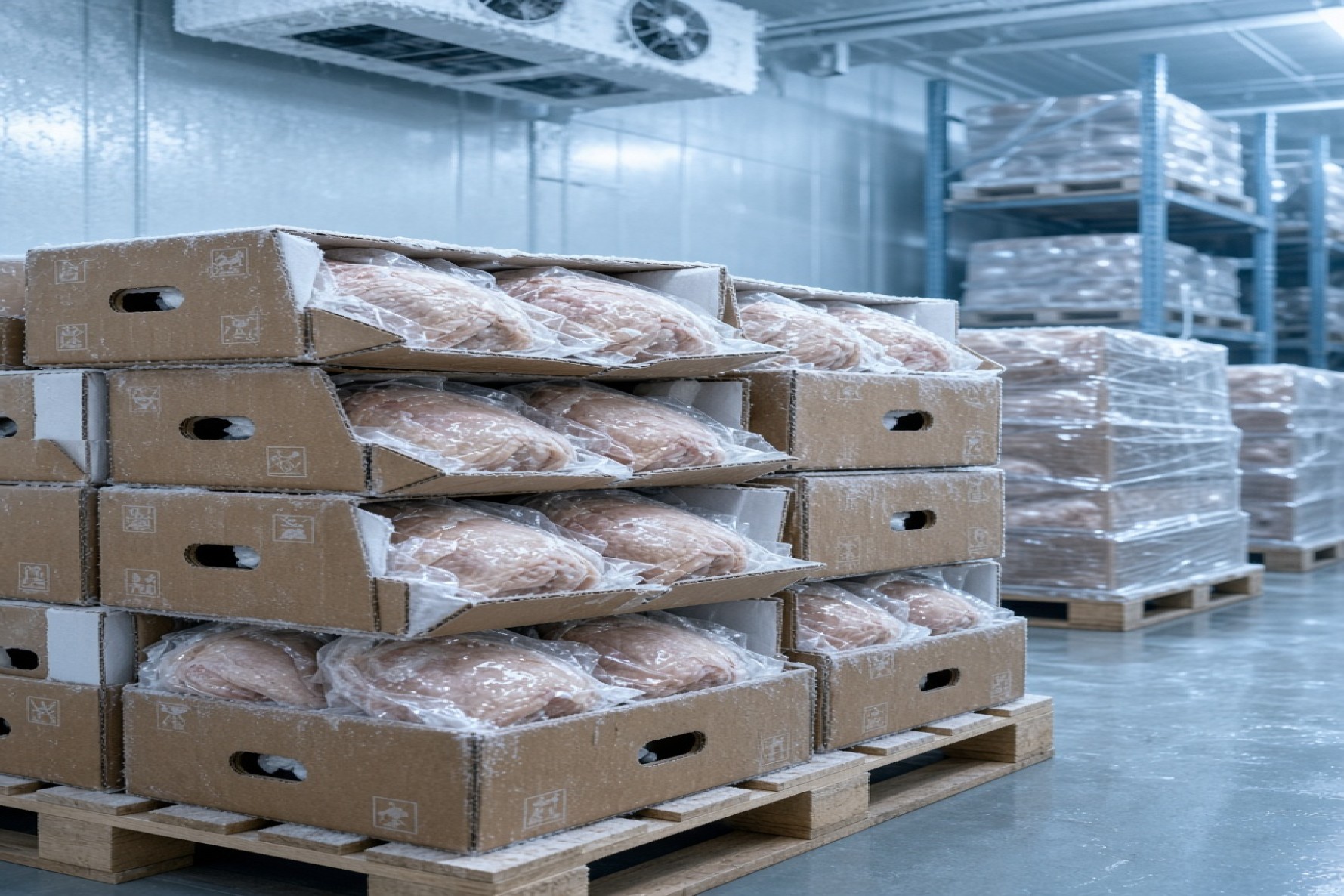
Packaging of frozen chicken meat plays a fundamental role in sanitary integrity, prevention of freezer burn (Freezer Burn) and resistance to container transport shocks. If water-vapour permeability of the primary pack is not controlled, sublimation of muscle moisture at freezing temperatures forms internal frost crystals and dark, dry spots on the carcass surface.
Primary Packaging Structure (Primary Packaging)
After pre-cooling, each carcass is placed individually in vacuum or shrink polyethylene bags of 35 to 50 microns thickness. These films must retain mechanical flexibility at −40°C and resist puncture from bone tips. Bags are then sealed airtight by evacuating internal air and heat-sealing or aluminium clips.
Master Carton (Secondary Packaging)
Export cartons are made from die-cut five-ply kraft board with waterproof adhesive so that box compressive strength does not decline under cold-store humidity. Carton designs are typically telescopic (separate lid and base) or four-flap with ventilation openings for cold-air exchange. Standard export carton capacity is 10 to 15 kg and, depending on carcass weight calibre, holds 8 to 12 birds.
Labelling Requirements (Labeling)
Labelling content on the individual bag and on both side faces of the master carton must be printed in Arabic, English or Russian. Loose paper labels affixed to frozen chicken are rejected at destination customs. Information on the label includes:
- Exact product name and cut according to the customs tariff code;
- Abattoir sanitary rank (grade A or +A);
- Abattoir name, sanitary licence number and Veterinary Organisation supervision code;
- Exact slaughter, freezing and expiry dates in year/month/day format;
- Storage temperature conditions (−18°C or colder);
- Exact net weight of each carcass and total master carton weight;
- Official halal mark together with the statement of hand Islamic slaughter;
- Country of origin: Product of Iran (Product of Iran).
11. Frozen Transport Engineering, Cold Chain and Container Logistics
Maintaining continuous refrigeration throughout the logistics chain is the guarantee that frozen chicken meat quality attributes will not change. Any temporary rise above −12°C initiates recrystallisation of water and, with rupture of muscle cell walls, quality loss occurs.
Pre-Cooling (Pre-Cooling)
After washing, carcasses enter pre-cooling halls so that within less than 60 minutes the breast muscle core temperature falls below +4°C. This stage ensures removal of the bird’s metabolic heat and prevents drip exudation and microbial spoilage.
Blast Freezing Tunnel (Blast Freezing)
Freezing must be applied rapidly at air temperatures of −35 to −40°C with air velocity of 2.5 to 4 metres per second. Process duration is set at 12 to 24 hours until the geometric centre of the carcass reaches −18°C. Rapid freezing prevents formation of large needle-like ice crystals and preserves muscle tissue density.
Reefer Container Rules (Reefer Containers)
Road transport uses refrigerated trailers; sea transit uses 40-foot cubic containers. Technical requirements are as follows:
- Refrigeration system operating temperature: The cooling unit must be set to −20 to −24°C so that carcass core temperature does not rise above −18°C.
- Digital temperature monitoring: Placement of at least two digital temperature recorders (Data Logger) in the first and middle pallets is mandatory so that the temperature graph can be downloaded and checked at destination.
- Pallet stowage pattern: The container must be pre-cooled to −18°C before loading begins. Pallets must be positioned so that ventilation air circulates uniformly through floor channels of the cargo hold and does not exceed the permitted load line (Load Line).
| Operational Stage | Process Ambient Temperature | Target Temperature Deep in Meat | Process Time / Engineering Rule |
|---|---|---|---|
| Pre-cooling | 0 to +2°C | Below +4°C | 40 to 60 minutes with sterile air chiller |
| Blast freezing tunnel | −35 to −40°C | −18°C at carcass core | 12 to 24 hours with high-velocity air fans |
| Storage cold room | −20 to −24°C | Uniform −18°C | Pallets on stainless-steel racking |
| Container transport | −20°C or colder | Minimum −18°C | Digital data logger and customs lead seal |
Related topic: Cold-chain engineering and monitoring of reefer containers in international transit — carcass core temperature must not rise above −18°C.
12. Analysis of Factors Affecting the Export Pricing Formula
The final export quotation for frozen chicken meat is the product of grow-out costs, processing, quality control and cold-chain logistics variables:
- Feed and animal-input rates: Maize and soybean meal account for roughly 65 to 70% of the farm-gate live bird cost. Currency fluctuations and global input prices directly shift the base price.
- Abattoir carcass yield loss: Meat yield after plucking, evisceration of entrails, trachea and lungs, and removal of head and feet is 72 to 75% of live bird weight; thus each tonne of ready-to-pack meat equates to about 1,350 to 1,400 kg of live bird.
- Processing and line-two equipment costs: Production in grade +A abattoirs requires continuous electricity for air chillers and deep freezing tunnels, creating higher overhead than traditional lines.
- Packaging and polymers: Prices of polymer resins, nylon films and die-cut five-ply board are calculated against polymer market rates.
- Veterinary fees and laboratory tests: Costs of sanitary audits, drug-residue monitoring, microbial sampling and issuance of international health certificates are included in the final cost.
- Freight and Incoterms: There is a marked difference between ex-works delivery, free on board at southern ports or delivery at border customs, which adds reefer container freight to the base rate.
13. Importer Checklist Before Placing an Order
To ensure a secure, lawful purchase aligned with quality specifications, procurement managers and importing trading companies should verify the following before signing a formal contract and remitting advance payment:
- Verify the abattoir’s official grade: Obtain confirmation of the abattoir’s quality rank from the national Veterinary Organisation to ensure automatic line-two capability and grade A or +A.
- Check official registration in the destination country: Confirm the abattoir name appears in the buyer country’s official import system (such as the Cerberus registry in Russia or Iraq’s approved veterinary lists).
- Align carcass weight band (size): Specify the exact carcass weight range (e.g. 1,000 to 1,200 g) and record a maximum weight tolerance of 5% in the purchase contract.
- Confirm structural carton and film specifications: Define five-ply carton type, cold-store compressive strength and primary polyethylene film thickness.
- Provide graphic label artwork: Approve bilingual label drafts before carton and pack printing begins, observing day/month/year date format.
- Set permitted laboratory test limits: Record ceilings for TVB-N, microbial load and Salmonella absence per the destination national standard.
- Identify the body overseeing halal certification: Ensure the issuing centre for the Islamic slaughter certificate is accepted at destination customs.
- Define cold-chain transit conditions precisely: Require the supplier to use reefer containers equipped with data loggers set to −20°C.
- Calculate remaining shelf life to the destination border: Ensure loading and clearance are planned so that more than half the shelf life remains.
- Set third-party inspection rules: Arrange for international inspection company experts to control calibration and loading at the plant.
- Define settlement method and Incoterms: Clarify freight, insurance, demurrage and the exact point of risk and document transfer.
14. What Information Should Be Sent to Receive an Accurate Price?
Calculating the final quotation per tonne of frozen chicken meat requires precise technical and logistics particulars. Vague general requests prevent competitive pricing. Buyers should include the following parameters in writing in their official inquiry:
- Exact product title and cut specifications: Frozen whole chicken without entrails and giblets, or separated cuts (leg, skinless boneless breast, fillet, wing or chicken feet).
- Desired quality grade: Explicitly state demand for grade A (standard water chiller) or grade +A (air chiller with no added water).
- Weight range per carcass (chicken size): Specify the desired band such as 1,000 to 1,200, 1,200 to 1,400 or 1,400 to 1,600 g.
- Order volume: Total tonnage demanded and number of weekly or monthly loading lots (number of 40-foot reefer containers).
- Master carton specifications: Carton weight (10, 12 or 15 kg), telescopic or glued type and any custom print demand.
- Label language and rules: State mandatory labelling languages (Arabic, English, Russian) and information printed on packs.
- Final delivery point: Name of border customs terminal, destination port or buyer warehouse.
- International trade rule (Incoterms): Define delivery method (ex works, free on board at southern ports or delivery at destination border).
- Specific tests required: State any supplementary antibiotic or heavy-metal tests if needed.
International buyers can send these specifications through Iranco so that price inquiry and matching of the request to abattoir capacity can be assessed directly.
Request a Quote from Iranco15. Direct Supply of Export Chicken Meat from Iran with Iranco
International supply of frozen chicken meat from Iran requires knowledge of equipped abattoirs, review of sanitary grade, assurance of carcass health and continuity of the cold chain. Differences among commercial offers are not limited to price alone; chiller type, tissue moisture, precise weight calibration and compliance with destination customs regulations are the variables that shape transaction profitability.
Iranco, as a sourcing platform for Iran’s food industries, enables review of production capacities and connects buyers to integrated chains and industrial abattoirs holding ranks A and +A. Importers can register their requested specifications — including sanitary grade, weight range, master carton packaging and destination country — through Iranco so that the most suitable supply options are assessed and introduced.
By overseeing coordination of product specifications, sampling, production-line inspection and review of quarantine and refrigerated transport documents, Iranco minimises quality and commercial risks in the order process. Buyers seeking a sustainable supply programme need only register their technical specifications and purchase volume on the Iranco platform.
16. Analytical Conclusion
Trade in Iranian frozen chicken meat rests on solid advantages including production scale, geographic access, low transit costs and hand Islamic slaughter. Growth of transactions in this sector depends on understanding technical differences among slaughter lines, sanitary standards and reefer container logistics management.
Using modern line-two abattoir capacity at grades A and +A, continuous monitoring of drug residues, control of chemical spoilage indicators such as TVB-N, five-ply moisture-resistant packaging and maintaining refrigeration stability at −18°C create the conditions for success in Middle Eastern and Eurasian markets. Traders who structure contracts on clear technical specifications and destination-market standards will experience sustainable and profitable commerce in this field.
Related topics for further reading: Guide to Chicken Feet Export to China, Rules for Offal Export to Iraq, sanitary audit requirements for industrial poultry abattoirs, and registering protein product supply requests from Iranian producers.
Frequently asked questions
1. What is the main difference between export grade A and grade +A chicken?
The core difference is chilling: grade A uses water chillers (moisture uptake up to ~5.1%); grade +A uses Air Chilling with uptake below 1.5%, preserving texture and shelf life.
2. What is the shelf life of frozen ready-to-cook chicken?
Grade A/+A carcasses held at −18°C core temperature may be stored up to 12 months from slaughter under national standard 1948; grade B lines are limited to 6 months and are not export-eligible.
3. What is a viable minimum order volume?
Typically one 40 ft reefer container (~24–26 t) or one refrigerated road trailer (~20–24 t net cartoned carcasses) to protect cold-chain integrity and economics.
4. Which documents are required for Iraqi border clearance?
Veterinary health certificate with IR code, halal slaughter certificate, commercial invoice, packing list, certificate of origin, international waybill and data-logger printouts for Mehran, Parvizkhan and Shalamcheh corridors.
5. How can importers finalize orders with reliable Iranian suppliers?
Define calibre, abattoir grade, carton type and delivery point, then register on Iranco so IR-certified plants and commercial coordination can be matched to your RFQ.
6. Why do GCC regulators require animal-protein-free poultry feed?
Under GSO and SFDA rules, diets must be free of recycled animal protein (APFF) to safeguard hygiene and halal purity.
7. How is freezer burn prevented?
40–60 µm barrier film, full vacuum, and uninterrupted −18°C handling without positive temperature excursions limit moisture sublimation and fat oxidation.
8. What details are needed for an accurate export quotation?
Product type, grade A/+A, weight band, master carton, label languages, shipment lots and Incoterms (FCA border, FOB port, CIF destination); Iranco evaluates requests on this basis.
Featured Products


Related Articles



