 Iranco Magazine Team
From Malas Saveh and Rabab Neyriz to market choice, sorting, MRL control, export packing and cold-chain management
Pomegranate export · FFV-64 · CXS 310 · Cold chain
Iran Pomegranate Export: Cultivars, Markets, Buyer Specs and Cold Chain
From Malas Saveh and regional competition to buyer spec tables, Codex and UNECE rules, EU MRLs, 3.5–4 kg cartons and pre-cooling — a professional importer guide.
Iranian pomegranate is a flagship orchard crop: FY1404 output is reported at about 1.357 million tonnes on roughly 96,700 hectares, with FY1403 exports near 39,000 tonnes worth about USD 18 million. Export success depends on named cultivars, grading, Brix, MRL testing, phytosanitary certificates, pack quality and storage at 90–95% RH and 5–7.2°C — not farm-gate price alone.
1. Production and export position
Iran reports about 1.357 million tonnes in FY1404 on nearly 96,700 ha — among the world's largest producers. FY1403 exports were about 39k t (~USD 18m); customs and re-export flows can shift recorded totals.
Fars dominates output; Saveh/Central for Malas Saveh, Neyriz for Rabab, Ferdows for Shisheh-cap and Yazd for Malas Yazdi. Origin must be stated in the RFQ because flavour and colour differ by cultivar.
2. Commercial cultivars and orchards
| Cultivar | Region | Trait | Export use |
|---|---|---|---|
| Malas Saveh | Saveh / Central | Dark red, soft arils | Core export line |
| Rabab Neyriz | Neyriz / Fars | Sweet, thin skin | Gulf & Iraq |
| Malas Yazdi | Yazd | Uniform colour | Retail & bulk |
| Shisheh-cap Ferdows | Ferdows / Khorasan | Glassy crown | Display retail |
| Naderi | Fars & Central | Good size | Fresh & processing |
| Yusufkhani | South Fars | Early maturity | Near markets |
| Khazar | North coast | Humidity tolerant | Select export |
| Wonderful | New plantings | Deep red, global brand | EU & Korea |
The term export pomegranate is too vague without a cultivar. Wonderful serves markets expecting deep red arils; Iranian landraces remain strong in Iraq, Pakistan and the Gulf.
3. Wholesale order specifications
| Parameter | Contract spec | Importance |
|---|---|---|
| Cultivar | Malas Saveh / Wonderful / contract | Flavour, colour, shelf life |
| Size | Diameter or unit weight; FFV-64 class | Price & uniformity |
| Grade | Extra / I / II or contract | Defect tolerance |
| Skin & aril colour | Deep red, no green tinge | Retail acceptance |
| Crown | Sound, no deep splits | Display & decay |
| Ripeness | Brix & cut tests | Taste & cracking |
| Net weight | Typical 3.5–4 kg carton | Logistics |
| Count per carton | 8–12 or agreed | Customs count |
| MRL | EU 396/2005 & destination list | Clearance |
| Transport temp | 5°C short; 7–7.2°C long | Cold chain |
Every row in the spec table must be agreed before final price. Approval samples must represent the lot — not only the best orchard block.
4. Export markets and channels
| Market | Channel | Note |
|---|---|---|
| Pakistan | Road / bulk | Volume & price |
| Iraq | Fast road | Fresh arils & FX |
| Russia | Road & sea | Uzbek competition |
| Armenia | Land border | Medium lots |
| Central Asia | Transit | Standards & MRL |
| UAE & Gulf | Sea / air | Look & pack |
| South Korea | Reefer sea | Wonderful & strict QC |
| Europe | Sea | 0810907530 & EU MRL |
Pakistan and Iraq rely on fast road turns. Russia and Central Asia compete with Uzbekistan. South Korea and the EU demand strict QC, MRLs and unbroken cold chain.
5. Regional competition
| Country | Strength | Vs Iran |
|---|---|---|
| Turkey | EU proximity | Iran: colour & local cultivars |
| India | Volume & price | Iran: Gulf & Iraq access |
| Spain | EU standardisation | Iran: season & landed cost |
| Egypt | Overlapping season | Iran: flavour & Saveh types |
| Uzbekistan | Russia & Central Asia | Iran: southern routes |
Turkey and Spain sit close to EU retail; India and Egypt compete on volume and price. Iran should position Saveh/Neyriz types, aril colour and southern logistics.
6. Defects, grading and QC
| Defect | Effect | Action |
|---|---|---|
| Skin/crown cracks | Value loss | Numeric cap in contract |
| Black spot / rot | Partial reject | Cut inspection |
| Dry or green arils | Retail complaint | Colour sort |
| Bruises / crushing | Early decay | Carton layering |
| Pest & webbing | Quarantine | Orchard & packhouse |
| Out of size | Price dispute | Calibrate pre-load |
MRL, Brix and cut tests at the packhouse must link to batch codes. Contract defects need numeric caps for defensible border inspection.
7. Standards and customs codes
Codex CXS 310-2013 frames international quality for fresh pomegranate. UNECE FFV-64 defines Extra, Class I and II for size, soundness and defects.
HS 081090 covers fresh pomegranate; EU 0810907530 applies for fresh fruit. Phytosanitary certificates and EU 396/2005 MRL compliance are required for Europe.
8. Packing, pre-cooling and cold chain
| Stage | Temp | RH | Note |
|---|---|---|---|
| Pre-cooling | Core to 5°C | — | Before loading |
| Short haul (<7 d) | 5°C | 90–95% | Iraq & Pakistan |
| Long haul | 7–7.2°C | 90–95% | Russia & EU |
| Staging store | 5°C | 90–95% | Forced airflow |
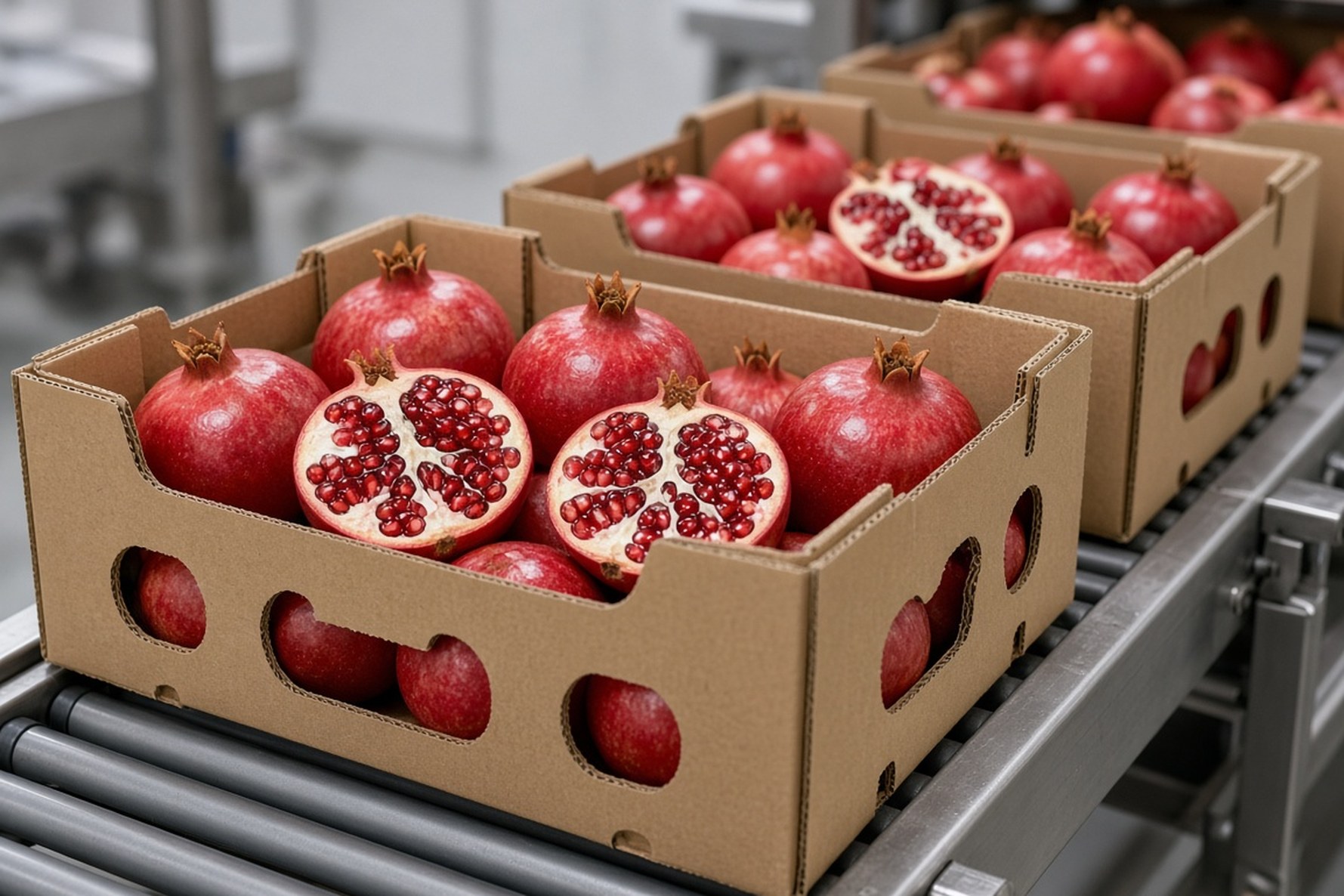
| Packing | — | — | 3.5–4 kg cartons |
3.5–4 kg cartons are typical. Loading warm fruit without pre-cooling causes condensation, pressure damage and early decay.
9. Export pricing drivers
Cultivar, size, grade, season, sorting cost, MRL tests, pack, distance and transit temperature all move price. Landed cost is the comparison basis.
10. Professional RFQ data
Include cultivar, calibre, grade, count per carton, destination, Incoterms, MRL panel, phytosanitary needs and delivery window.
11. QC at loading
Final checks: calibration, surface defects, carton moisture, core temperature and label match to invoice and certificates.
12. Sourcing on Iranco
Iranco connects international buyers with Iranian pomegranate suppliers for purchase requests, samples, specifications and pack coordination.
State cultivar, volume, destination and laboratory requirements upfront for comparable quotes.
Importer pre-order checklist (18 items)
- Cultivar and orchard region (Fars, Saveh, Khorasan).
- Size or unit-weight band and UNECE FFV-64 class.
- Quality grade and max out-of-calibre %.
- Skin and aril colour; approved cut sample.
- Crown condition and crack tolerances.
- Minimum Brix and agreed ripeness.
- Carton net weight (typically 3.5–4 kg) and tolerance.
- Fruit count per carton.
- Liner type and crush resistance.
- MRL panel (EU 396/2005 or destination).
- Phytosanitary certificate and HS 081090.
- For EU: subheading 0810907530 where applicable.
- Pre-cool to 5°C core before loading.
- Transit: 5°C short haul; 7–7.2°C long haul.
- Store and reefer RH 90–95%.
- Shipping mode and delivery port.
- Sampling plan and final acceptance criteria.
- Batch traceability linked to MRL tests.
FAQ
Main Iranian export cultivars?
Malas Saveh, Rabab Neyriz, Malas Yazdi, Shisheh-cap Ferdows, Naderi, Yusufkhani, Khazar and Wonderful are traded regionally and internationally.
Leading production areas?
Fars is the largest producer; Saveh/Central, South Khorasan (Ferdows) and Yazd are also key.
HS code for fresh pomegranate?
HS 081090 for fresh fruit; EU subheading 0810907530 — customs description must match documents.
Storage and transport temperatures?
Pre-cooling is essential; about 5°C for short routes and 7–7.2°C for long haul with 90–95% RH.
Reference standards?
Codex CXS 310-2013 and UNECE FFV-64 for grading; EU MRLs under Regulation 396/2005.
Primary export markets?
Pakistan, Iraq, Russia, Armenia, Central Asia, UAE/Gulf, South Korea and Europe.
Loading QC?
MRL, Brix, cut tests, defect sort and calibration — numeric limits in contract.
Iran vs Turkey and India?
Iran leads on local cultivar flavour, aril colour and land access to Iraq/Gulf; rivals win on volume or EU standardisation.
Typical export pack?
3.5–4 kg cartons with liners and controlled venting; often 8–12 fruit depending on size.
Summary
Iranian pomegranate exports scale when bulk unspecified lots become standardised supply with cold chain, MRL compliance and HS/Codex/FFV-64 documentation. Sustainable advantage comes from clear cultivars, repeatable QC and reliable delivery timing.
Featured Products




Related Articles



