 Iranco Magazine Team
Benin pasta market analysis, competition with Turkey and North Africa, entry requirements, tariffs, packaging, sea freight to Cotonou and export profit determinants
Export Guide · Pasta · Benin
Iranian Pasta Export to Benin: West African Market Entry, Container Shipping & Profit Margins
A practical guide to entering Benin’s dry pasta market — from 2024 import data and HS code 190219 to competition with Turkey, import tariffs, export packaging, sea freight to Cotonou port, and landed-cost profit analysis.
Four Key Indicators — Benin Pasta Market
The statistics above are based on Benin’s 2024 foreign trade data for uncooked pasta without egg (HS 190219). Benin is a notable dry pasta import market in West Africa, where Turkey supplied more than 22 million kg in the same year — roughly 70% of recorded imports. Export success depends on landed cost competitiveness, packaging durability, document compliance, and reliable container logistics to Cotonou.
At first glance, Iranian pasta export to Benin may look like a straightforward transaction: a dry, shelf-stable product with no cold chain and well suited to container shipping. The real economics are far more complex. Benin sits in a market where large low-cost pasta suppliers — especially Turkey — have spent years building price advantage, distribution networks, economical packaging, and container-scale sales.
In 2024 Benin imported more than 31 million kg of uncooked pasta without egg under HS 190219. Of that volume, over 22 million kg was recorded from Turkey in Benin’s import statistics. An Iranian exporter therefore enters a market where the main competitor is not merely a product seller but a supplier with large export scale and extensive experience across Africa.
Iran’s potential advantage should not be sought in product price alone. Mass production of dry pasta, factory flexibility on pack weight, private-label capability, access to sea containers, and the ability to adjust formula and quality for the target market are tools that can create value in negotiation with a Beninese importer.
The core issue, however, is not “ex-factory price.” A Beninese buyer must see product cost after sea freight, insurance, import duty, taxes, Cotonou port charges, clearance, warehousing, and distribution. An Iranian exporter can build sustainable trade only when landed price and distribution-chain margin are understood from the outset.
This guide focuses on that point: how Iranian product should be defined, packaged, priced, and shipped for the Benin market so that entry — and repeat orders — become possible.
1. How large is the Benin pasta market and what is its structure?
For Iranian pasta export to Benin, the most important fact is that this is a genuine import market. In 2024 Benin reported approximately 31.6 million kg of imports under tariff line 190219 — uncooked pasta without egg or intermediate ingredients — worth roughly USD 15.5 million.
This line covers most common export products such as spaghetti and various dry pasta shapes and is the closest commercial indicator for the product under discussion.
Turkey — the main price benchmark in the market
In the same year, Benin’s recorded imports from Turkey in this line were approximately 22.15 million kg worth more than USD 10.5 million. Tunisia, Togo, Morocco, Singapore, France, and Egypt also appeared among registered suppliers.
This mix carries several important messages for the Iranian exporter.
- Benin’s market is not dominated only by expensive European brands. Much of the competition centres on economical product suitable for mass distribution.
- Geographic distance alone is not a barrier to entry. The strong presence of Turkey and North African countries shows that competitive sea supply can generate high volume.
- A Beninese importer will likely compare Iran’s offer with prices from Turkey, Morocco, Tunisia, and Egypt — not merely with Iran’s domestic selling price.
Benin is not only a 14-million population market
Looking only at Benin’s domestic population may understate the commercial scale of Cotonou port. Benin’s geographic position beside Nigeria and its links with landlocked West African countries give Cotonou a logistics role beyond domestic consumption.
Re-export or transit should not be treated as guaranteed sales without a specific contract. If the buyer orders for the Benin market, pricing and packaging must be built on that market. Any regional distribution is a separate commercial analysis stage.
2. Which pasta is most suitable for the Benin market?
In this market, “best pasta” does not necessarily mean the product with the highest production cost. Suitable product has acceptable cooking quality, sufficient transport resistance, economical packaging, and a competitive final price.
For export negotiations, products are best reviewed in practical groups:
| Product | Market use | Commercial advantage | Key buyer note |
|---|---|---|---|
| Spaghetti | Household and food-service consumption | Well known with high turnover | Breakage resistance |
| Short shaped pasta | Family consumption | Shape variety and packaging options | Shape uniformity and cooking time |
| Economy pack | Price-driven market | Lower unit price | Pack strength and net weight |
| Branded retail pack | Supermarket and store sales | Brand-building opportunity | French label design |
| Buyer private label | Large importers | Greater market control | Minimum order and print design |
Spaghetti — a suitable product to start
Spaghetti is a good option for first negotiations because of consumer recognition, production simplicity, and direct comparability among suppliers. However, strand breakage is one of its main risks in sea transport and container discharge.
The exporter must specify what level of breakage is acceptable at packing and what the destination acceptance criterion is.
Shaped products
Short products are less visually sensitive to breakage than spaghetti, but shape, thickness, and product uniformity still affect cooking time and consumer perception of quality.
In export orders the buyer should approve a sample from the same production die before bulk manufacturing.
3. Technical specifications to define before pricing
One common mistake in pasta trade is requesting a price based only on the phrase “spaghetti for Benin.” Such a request is insufficient for professional supplier comparison.
The buyer should define at least the following:
| Parameter | Contract option or criterion | Importance |
|---|---|---|
| Product shape | Spaghetti or defined short shape | Production line and die selection |
| Base formula | Per agreed recipe | Cooking quality and price |
| Pack weight | Per market requirement | Direct effect on consumer price |
| Packs per carton | Agreed quantity | Transport and distribution |
| Net weight | Explicit in contract | Dispute prevention |
| Visual quality | Uniformity, no abnormal defects | Market acceptance |
| Breakage | Agreed criterion | Critical for spaghetti |
| Cooking time | Per approved sample | Consumer experience |
| Moisture | Per product spec and test report | Shelf life |
| Microbiological status | Per product and destination requirements | Food safety |
| Production and expiry dates | On pack | Clearance and sales |
| Label language | Per Benin requirements | Legal market supply |
| Brand | Factory or private label | Commercial model |
| Master carton | Agreed dimensions and strength | Container performance |
All these items should appear on a technical specification sheet attached to the contract. The approved sample should carry a code, date, and specifications traceable to final production.
Buyers seeking multiple offers from Iran can submit this information in an Iranco purchase request so received proposals are comparable on pack weight, product, packaging, and quality level.
4. How is export pasta quality evaluated?
Quality in this product should not be judged by dry-pack appearance alone. A wholesale buyer must assess three stages: dry product, cooking behaviour, and packaging condition after transport.
Dry product appearance
Product should be uniform in shape with no abnormal breakage, foreign particles, or noticeable colour variation. For spaghetti, strand length uniformity and mechanical strength matter more. Very brittle strands may look fine at loading but develop heavy breakage after several handling stages.
Cooking quality
A cooking test is far more important for a consumer-market buyer than many visual indicators. Sample evaluation should cover:
- Time to reach desired texture;
- Stickiness of strands or pieces;
- Shape retention after cooking;
- Excessive softening;
- Natural taste and odour;
- Cooking uniformity across different packs.
A sample that looks acceptable but performs poorly in the pot will likely generate low repeat purchase in the market.
Breakage
For sea export, breakage percentage must move from a vague phrase to a contractual criterion. Buyer and seller should agree on sampling method and breakage definition. It must also be clear whether control is at the factory or whether destination results form part of acceptance.
Related tests
For commercial shipments, an analysis certificate or test report may include moisture, relevant physicochemical parameters, and required microbiological tests depending on the contract. Benin’s food import requirements also anticipate test reports and health certificates in the agricultural and food product import licensing process.
5. Iran’s competition with Turkey, Morocco, Tunisia, and Egypt
An Iranian exporter in Benin must analyse the market from two angles: “competitor on the shelf” and “competitor on the import invoice.”
2024 data show Turkey was by far Benin’s main import origin in line 190219. Tunisia, Togo, and Morocco follow in Benin’s import statistics. Egypt also has recorded presence.
| Origin | Likely competitive position | Iran’s challenge |
|---|---|---|
| Turkey | High volume and strong African market presence | Landed price and scale |
| Tunisia | Closer to West Africa | Freight cost |
| Morocco | Suitable sea access to Africa | Logistics time and cost |
| Egypt | Regional production and shorter route | Price and transit time |
| Iran | Production capacity and packaging flexibility | Shipping route and sales network development |
Iran should not rely on being only cheaper
If the Iranian offer is only a few dollars per tonne cheaper but has less reliable transit, weaker cartons, or harder payment terms, it may not attract the importer.
Real comparison must be on final price in Cotonou:
- Product price;
- Packaging;
- Domestic transport in Iran;
- Port operations;
- Sea freight;
- Insurance;
- Destination charges;
- Duty and taxes;
- Clearance cost;
- Working capital.
Only after summing these components can it be determined whether Iranian product is truly competitive.
6. Tariffs and entry requirements for pasta in Benin
For ordinary dry pasta without egg classified under 190219, Benin’s customs tariff in the ECOWAS Common External Tariff (CET) lists an import duty of 35%. This rate is critical for import economics. Other taxes and charges also form part of Benin’s import structure.
5% special tax
Benin’s tax law sets a 5% special tax on imported pasta. The 2026 tax law version retains this rate. Exporters should not assume the importer adds only freight and 35% duty to the purchase price.
Value added tax
Benin’s general VAT rate is 18%. How it applies in final import calculation depends on the declaration and the shipment’s tax structure as calculated by the importer and customs broker.
This gap between “Iranian export price” and “real cost of market entry” is one of the main reasons West African importers are highly sensitive to purchase price.
| HS code | Description | Benin import duty (CET) |
|---|---|---|
| 190219 / 1902.19.00.00 | Uncooked pasta without egg or intermediate ingredients | 35% |
Final classification must be verified against the actual composition and shape of the exported goods. Classification errors can halt clearance and trigger additional document requests.
7. Food permits, documents, and clearance process
Imported food in Benin is subject to control by the country’s food safety authority. Official Benin government services for agricultural and food product imports include an import permit process.
The declared document list for this permit includes items such as:
- Import permit application;
- Importer professional and registration documents;
- Delivery document or shipment papers;
- Certificate of origin;
- Relevant health certificate;
- Test report.
Product registration and market authorisation for imported product are also provided for under official Benin services.
Why this must be resolved before loading
A costly mistake is for the factory to produce and load a container first, then for the importer to seek product registration, label approval, or health documents afterward.
The correct sequence is:
- Define product and tariff code;
- Review importer requirements;
- Approve label;
- Approve sample and test report;
- Review health documents;
- Finalise contract;
- Production;
- Inspection;
- Loading;
- Document dispatch.
Benin Customs describes pre-declaration and document value confirmation for Cotonou port clearance through foreign trade and customs control systems. The import declaration is then processed through the customs system and may enter various control channels.
Practical note: Clearance delays at Cotonou port often stem from incomplete permits, label mismatches, or late document arrival — not from the pasta product itself. Resolve registration and label approval before the vessel sails.
8. Labelling and packaging for the Benin market
Pasta packaging for Benin is not only a design issue. It has three simultaneous functions: protect product on the sea route; convey required information; and compete on shelf.
Label language
French is Benin’s official language. For goods intended for retail in this country, pack design must align with importer needs and local requirements. Information such as product name, net weight, ingredients, production date, expiry date, batch number, storage conditions, origin, and supplier or importer details should be aligned with the Beninese party before final printing.
The best time to approve the label is before ordering print film — not after product manufacture.
Primary wrap
Wrap must block ambient moisture and normal physical damage and have stable seals. Seal failure in container transport can make an entire carton unsellable.
Master carton
Weak cartons create serious risk in sea export to hot, humid regions. Common problems include:
- Crushing of bottom cartons;
- Pack deformation;
- Tearing during discharge;
- Moisture ingress;
- Damage from poor stowage.
| Packaging factor | Risk if poorly chosen | Appropriate action |
|---|---|---|
| Wrap thickness | Tearing or puncture | Sample testing |
| Seal quality | Pack opening | Line control |
| Carton strength | Crushing | Practical stacking test |
| Empty space in carton | Pack movement | Correct dimensions |
| Printing | Market or clearance problem | Importer approval of artwork |
| Pallet or floor loading | Capacity and cost change | Define before final price |
For this reason carton samples should be reviewed together with product samples. Five-layer cartons with adequate compression strength are recommended for sea transport to Cotonou.
9. Container shipping of pasta from Iran to Cotonou port
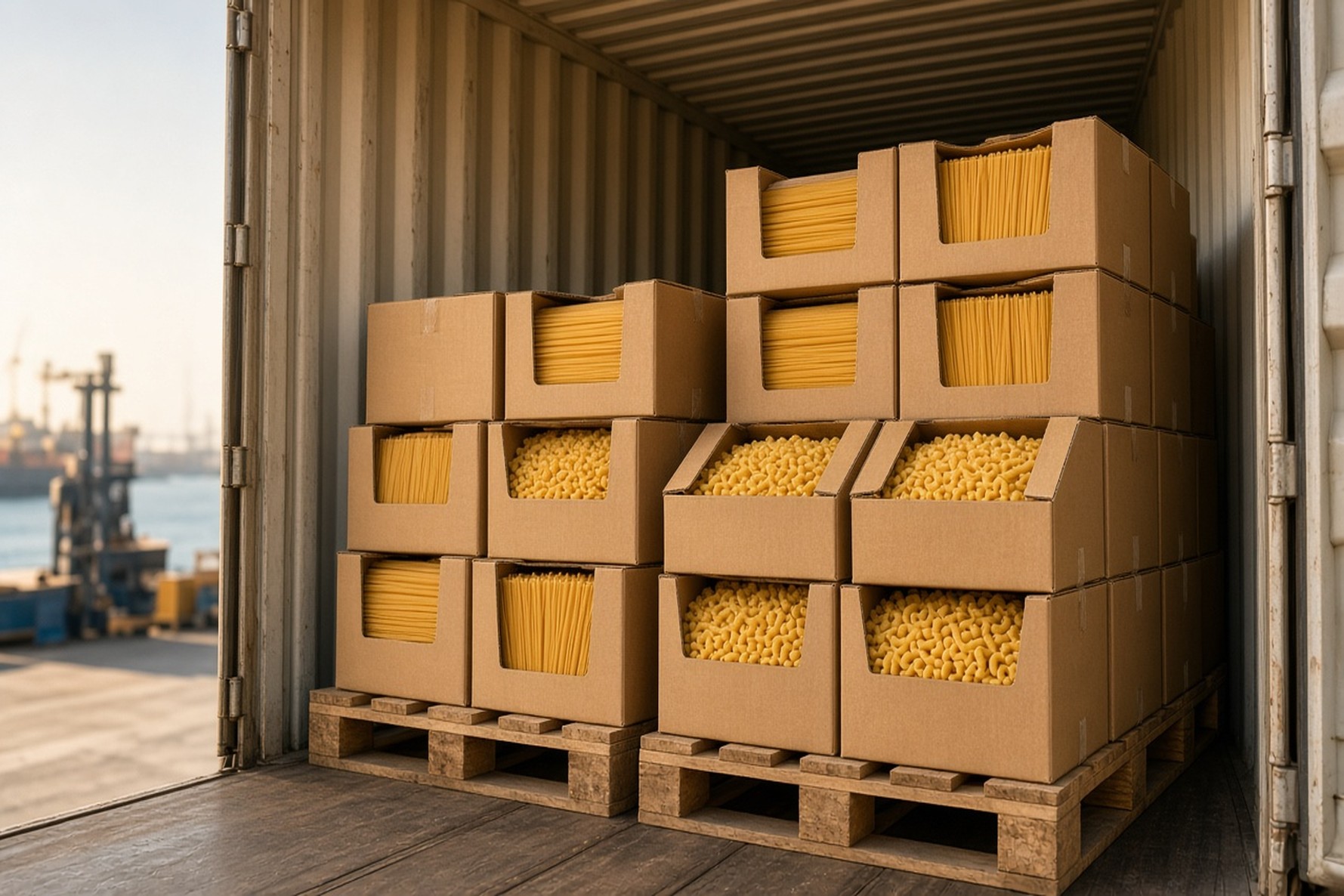
Dry pasta for Benin usually requires a standard dry container; refrigerated containers are not normally justified for this product. The main challenge is not temperature but humidity, condensation, contamination, carton damage, and product breakage.
Sea route
In export from Iran, Bandar Abbas is the usual point for container shipping review. Depending on the shipping line, service to Cotonou may involve one or more transshipment stages.
“Fixed transit time” should not be promised in a contract unless the same line’s schedule for the specific sailing has been confirmed.
Before purchase the importer should know at least:
- Loading port;
- Destination port;
- Shipping line;
- Number of transshipments;
- Free time at destination;
- Local destination charges;
- Bill of lading issuance conditions;
- Weight limits;
- Vessel schedule.
Humidity and container sweat
A dry container is not a completely moisture-free space. Day-night temperature changes and differences between cargo temperature and container wall temperature can cause condensation. To control risk:
- Container must be dry and leak-free before loading;
- Floor must not be wet or contaminated;
- Cartons must not enter the container wet;
- Appropriate desiccants may be used where needed;
- Cargo must not contact wet points directly.
Container inspection
Before loading, the following checks are essential:
- No holes in roof or walls;
- Sound door seals;
- No chemical odour;
- No oil traces or contamination;
- Dry floor;
- Sound lock and door;
- Container number and seal recorded.
This simple control can prevent loss of an entire shipment.
10. How is pasta export profit margin to Benin calculated?
Profit margin in this trade cannot be stated as a fixed percentage. Small differences in several factors can completely change the profit on one container. Calculation must be done from both sides.
Calculation from the Iran side
First the exporter’s real cost is calculated:
- Product cost;
- Film and carton;
- Custom printing;
- Packing;
- Transport to port;
- Export operations;
- Documents;
- Inspection or testing;
- Financial cost;
- Sea freight if sold on delivered terms.
Then the exporter’s target margin is added.
Calculation from the Benin side
The importer must work backward from market selling price:
Consumer price minus retail margin, wholesale margin, distribution cost, warehousing, clearance cost, taxes and duty, port charges, and sea freight = maximum tolerable purchase price.
If the Iranian factory price exceeds this figure, the deal is uneconomic even if the factory accepts a very low margin.
Import duty has a large effect
With the 35% duty on line 190219 and the 5% special tax on imported pasta, every increase in origin price can have a larger effect on the importer’s required capital after entry. Reasonable packaging cost reduction, appropriate pack weight selection, and optimising cartons per container are sometimes more important than cutting factory margin.
Cheap price does not always mean higher profit
A very cheap product sold at discount because of breakage, weak packaging, or poor cooking quality may show a high nominal importer margin but real profit is destroyed by waste and slow sales. A limited increase in cost for a stronger carton or better wrap can reduce damage rate.
11. Entry strategy for an Iranian brand in Benin
Successful entry to the Benin market is best done in stages.
Stage one: understand the reference price
Before making an offer, several similar products should be reviewed by pack weight, market position, and country of origin. The goal is not merely to record shop price but to identify which part of the market is economy, mid-range, or premium import.
Stage two: choose one core product
Starting with many shapes, pack weights, and print designs complicates capital and inventory. For the first shipment, a limited product selection usually simplifies quality control and sales.
Stage three: real factory sample
The sample must come from the same formula and line that will produce commercial volume. After approval its specifications should be recorded so commercial production is traceable.
Stage four: controlled commercial trial order
In a new market, one controlled order generates information no market report can replace:
- Sales speed;
- Packaging response;
- Breakage level;
- Taste and texture acceptance;
- Clearance quality;
- Real port cost;
- Wholesale performance.
Stage five: stabilise distribution
If the product repeats sales, the next stage is negotiation on regular order programme, private-label packaging, and freight cost optimisation.
12. Is Benin a gateway to West Africa?
Cotonou port, besides Benin’s domestic trade, plays a role in regional transit activity. Benin Customs defines separate regulations and processes for international transit and movement of goods under customs control to other countries.
This feature is attractive for Iranian exporters, but it should not lead to the oversimplified conclusion that every shipment entering Cotonou will automatically distribute across West Africa. Regional markets require a separate network.
Final destination country affects:
- Tariff;
- Permits;
- Product registration;
- Packaging language;
- Payment terms;
- Transit route;
- Consumer price;
- Competitors.
Benin can therefore be a practical starting point for understanding West African trade, but expansion planning must be country by country.
13. Importer checklist before placing an order
A professional importer should finalise at least the following before paying a deposit:
- Specify the exact tariff code. Differences in composition or preparation can change classification.
- Define product shape precisely. Spaghetti, short pasta, or other product must not be ordered by generic name only.
- Set pack weight.
- Record packs per carton.
- Receive and approve a real producer sample.
- Conduct a cooking test.
- Define breakage criterion in the contract.
- Review required test report and health documents.
- Approve final label artwork before printing.
- Set production date and minimum remaining shelf life at loading.
- Approve master carton quality.
- Specify container stowage method.
- Write delivery terms precisely in the contract.
- Obtain destination port charges from local broker.
- Include Benin duty and taxes in pricing model.
- Verify import permit and product registration before shipment.
- Define payment method and bank or counterparty document requirements.
- Write quality discrepancy handling method in advance.
This checklist ensures supplier comparison is not based on “dollars per tonne” alone.
14. Information needed for an accurate pricing quote
A professional pasta export quote request for Benin should include:
- Product shape;
- Formula or required quality specifications;
- Weight per pack;
- Packs per carton;
- Order volume;
- Number of containers;
- Factory brand or private label;
- Required language on pack;
- Carton specifications;
- Required test reports;
- Destination port: Cotonou;
- Delivery terms;
- Preferred loading time;
- Sample requirement;
- Special importer requirements.
A request stating only “price for one container of pasta to Benin” is insufficient for professional comparison. Differences in product, packaging, and shipping terms can completely change comparison results. Buyers can submit this information in an Iranco purchase request so review of Iranian supply options is based on a single specification set.
15. Main transaction risks and how to reduce them
Pasta export does not carry rapid spoilage risk like fresh product, but commercially it still has several sensitive points.
Freight rate volatility
Container rate changes can quickly alter landed price. The validity period of the freight offer should therefore be stated on the proforma invoice.
Sample vs production mismatch
A laboratory sample or hand-picked sample is not a suitable contract basis. The sample must represent real production.
Breakage in transport
This risk relates to product quality, wrap, carton, stowage, and number of handling stages.
Document delay
If original or required document copies reach the importer late, port charges and clearance delay risk increase.
Label error
Printing tens of thousands of packs with unapproved artwork is one of the most expensive food export mistakes.
Wrong price comparison
A 500 g product price cannot be compared directly with a different weight or weaker packaging. Price must be standardised to net weight, packs per carton, product quality, and delivery terms.
16. Export pasta supply from Iran tailored to the Benin market
In international pasta procurement, the difference between two offers is not only price per tonne. Product shape, cooking quality, breakage level, pack weight, packs per carton, printing, carton strength, and delivery terms can change the financial outcome of an order.
The first step for the buyer should therefore be a precise purchase request.
Iranco can serve international buyers as the channel to register such requests. The importer can provide product shape, pack weight, order volume, brand type, packaging specifications, destination, and required terms so available supply options in Iran are reviewed on that basis.
Where samples are needed, they should be selected against the same specifications that will appear in the final contract. Comparison of several producers then moves from general discussion to measurable product basis.
To review Iranian pasta supply for the Benin market, product specifications, pack weight, approximate order volume, preferred brand, and destination port should be included in the purchase request from the outset.
Conclusion
Iranian pasta export to Benin has commercially reviewable market size, but it is not an easy market. More than 31.6 million kg of recorded imports in line 190219 during 2024 shows genuine import demand, while Turkey’s high supply volume confirms that competition on price and distribution is very serious.
For an Iranian exporter, three factors matter more than others.
First, landed price in Cotonou. The 35% duty on line 190219 and the 5% special tax on imported pasta mean origin price differences gain importance after entry.
Second, correct product definition. Pack weight, cooking quality, breakage, wrap, carton, and label must become contractual criteria before production.
Third, logistics and document management. An economical product remains competitive only when it is not damaged in the container, its documents are complete, and the importer does not face unforeseen cost at Cotonou port.
Iran’s export advantage in this market is shaped not by pure undercutting but by combining competitive production, packaging flexibility, consistent quality, and precise final-cost calculation. If these four factors are controlled together, Benin can move from a trial destination to a market for repeat orders.
17. Frequently asked questions
Is Benin a large market for pasta imports?
In foreign trade terms it is a notable market. In 2024 Benin imported approximately 31.6 million kg of uncooked pasta without egg or intermediate ingredients under line 190219. This volume shows the market is not based on small shipments alone and large suppliers are active in it.
Which country is the main competitor to Iranian pasta in Benin?
In 2024 import statistics, Turkey was the main origin with more than 22 million kg recorded supply in line 190219. The Iranian offer should therefore be compared with Turkish product on price, packaging, and commercial terms before market entry.
What is the tariff code for ordinary dry pasta without egg?
For uncooked pasta without intermediate ingredients and without egg, line 190219 applies. Benin’s tariff based on HS 2022 shows this line as code 1902.19.00.00. Final classification must be verified against the actual composition and shape of the exported goods.
What is the import duty on pasta to Benin?
Under the Common External Tariff used by Benin, import duty on line 1902.19.00.00 is 35%. In addition, the import tax structure includes other taxes, and Benin tax law sets a 5% special tax on imported pasta.
Is a food permit required for pasta in Benin?
Imported agricultural and food products fall under the permit and control process of Benin’s food safety authority. For import permits, documents such as certificate of origin, health certificate, and test report appear on the official list. The importer should finalise product registration and permit status before loading.
How is pasta shipped to Benin?
The practical method for commercial orders is sea transport in a dry container to Cotonou port. The product needs no cold chain, but the container must be dry, clean, and leak-free. Humidity control, carton quality, and stowage are critical to prevent breakage and pack damage.
What factors affect Iranian pasta export price to Benin?
Price depends on product formula, pasta shape, pack weight, wrap quality, carton, private label, order volume, printing cost, factory location, container freight, and delivery terms. For real comparison, final price to Cotonou and then cost of market entry must be calculated — not factory price alone.
What packaging is suitable for the Benin market?
Packaging should first be set according to the importer’s sales channel. For retail, pack weight and consumer price matter greatly. Wrap must have strong seals and master cartons must withstand sea transport and container stowage. Print artwork must be approved by the importer before production.
How can pasta be sourced directly from Iran for Benin?
The buyer should first define product shape, pack weight, order volume, quality specifications, brand, packaging, and destination port. Then comparable samples and prices should be obtained from producers. These specifications can also be registered as an Iranco purchase request so available Iranian supply is reviewed against buyer needs.
Does pasta export to Benin offer a high profit margin?
There is no fixed profit percentage for this trade. Profit depends on purchase price, freight, tariff, taxes, port cost, distribution network, and final selling price. Given intense Turkish competition and high import duty, margin calculation should work backward from real Benin market price to tolerable purchase price.
Related Articles



