 Iranco Magazine Team
Iraq, Pakistan, Oman, Kuwait and Qatar (2024), FFV-25, mesh bags, 0°C storage at 65–70% RH, HS 070310 and B2B contracts
Export Guide · Fresh Onion · Regional Markets
Iran Onion Exports: Target Markets, FFV-25 Sorting, Mesh Bags & Cold Storage
B2B guide for Iranian exporters: Iraq, Pakistan, Oman, Kuwait and Qatar (2024 data), sorting lines, mesh bags, storage at 0°C and 65–70% RH, transport, HS 070310, pricing and contracts
Four Operational Metrics — Onion Export Chain
Neighbouring countries and the Gulf are Iran’s main onion export destinations. Success depends on uniform sorting (FFV-25), ventilated mesh-bag packing, storage at 0°C with controlled humidity, transport discipline, and HS 070310 alignment in customs documents — not farm-gate price alone.
Onion is one of Iran’s steadiest fresh vegetable export items. Climatic diversity, production from Hormozgan to Azerbaijan, and long experience in overland trade to Iraq and Pakistan give Iran a defined role in regional supply. Each destination differs in quarantine rules, packaging preference, distribution channels, and price sensitivity.
This guide is for export managers, traders, and quality engineers to align target market, sorting line, bag type, storage conditions, and transport mode with the buyer before signing a contract.
1. Iran Onion Export Target Markets (2024)
Based on 2024 foreign trade statistics, the five destinations below are among the largest for Iranian onion exports in West/South Asia and the Gulf. Volumes are approximate for capacity planning; each shipment must match HS codes and origin documents.
| Destination | Approx. 2024 volume | Main entry channel | Commercial note |
|---|---|---|---|
| Iraq | ~38.3M kg | Land border; Baghdad & northern wholesale | Largest market; price and delivery speed |
| Pakistan | ~22.1M kg | Taftan land border; partial sea | Seasonality; neck dryness critical |
| Oman | ~16.7M kg | Sohar and Salalah ports | Quarantine docs; national HS subcodes |
| Kuwait | ~9.4M kg | Shuwaikh port | Sort quality; 25 kg mesh bags |
| Qatar | ~6.8M kg | Hamad port; transit legs | Supply continuity; full documentation |
Iraq at roughly 38.3 million kg in 2024 remains the single largest market. Pakistan and Oman form the second tier; Kuwait and Qatar offer smaller volumes but often better margins for FFV-25 sorted product in standard mesh bags.
Market prioritisation for exporters
- Iraq: High volume, price pressure, fast border logistics and repeatable quality.
- Pakistan: Seasonal demand; competes with domestic crop in some months.
- Oman, Kuwait, Qatar: Emphasis on documents, precise sorting, traceable packing.
2. Sorting and FFV-25 Standard
“Grade 1” without a technical reference is meaningless in onion export. National/export standard FFV-25 (fresh fruits and vegetables) frames grading, defect limits, size uniformity, and appearance for B2B contracts. The sorting line must separate by calibre, dry neck, firmness, sound skin, and freedom from sprouting before final packing.
| Line stage | Operation | Output |
|---|---|---|
| Receiving & pre-sort | Remove soil, tops, gross defects | Even flow to sizer |
| Size sort | Calibre grades (e.g. 55–75 mm) | Uniform bags and pricing |
| FFV-25 inspection | Dry neck, firm, no mould/sprout | Contract-grade export lot |
| Weigh & pack | Fill mesh bags, lot labels | Load-ready pallets |
Export contracts should state allowed defect percentage, calibre range, and reference to FFV-25. The buyer’s approved sample must be checked at pre-shipment inspection against the same parameters.
3. Mesh Bag Packaging
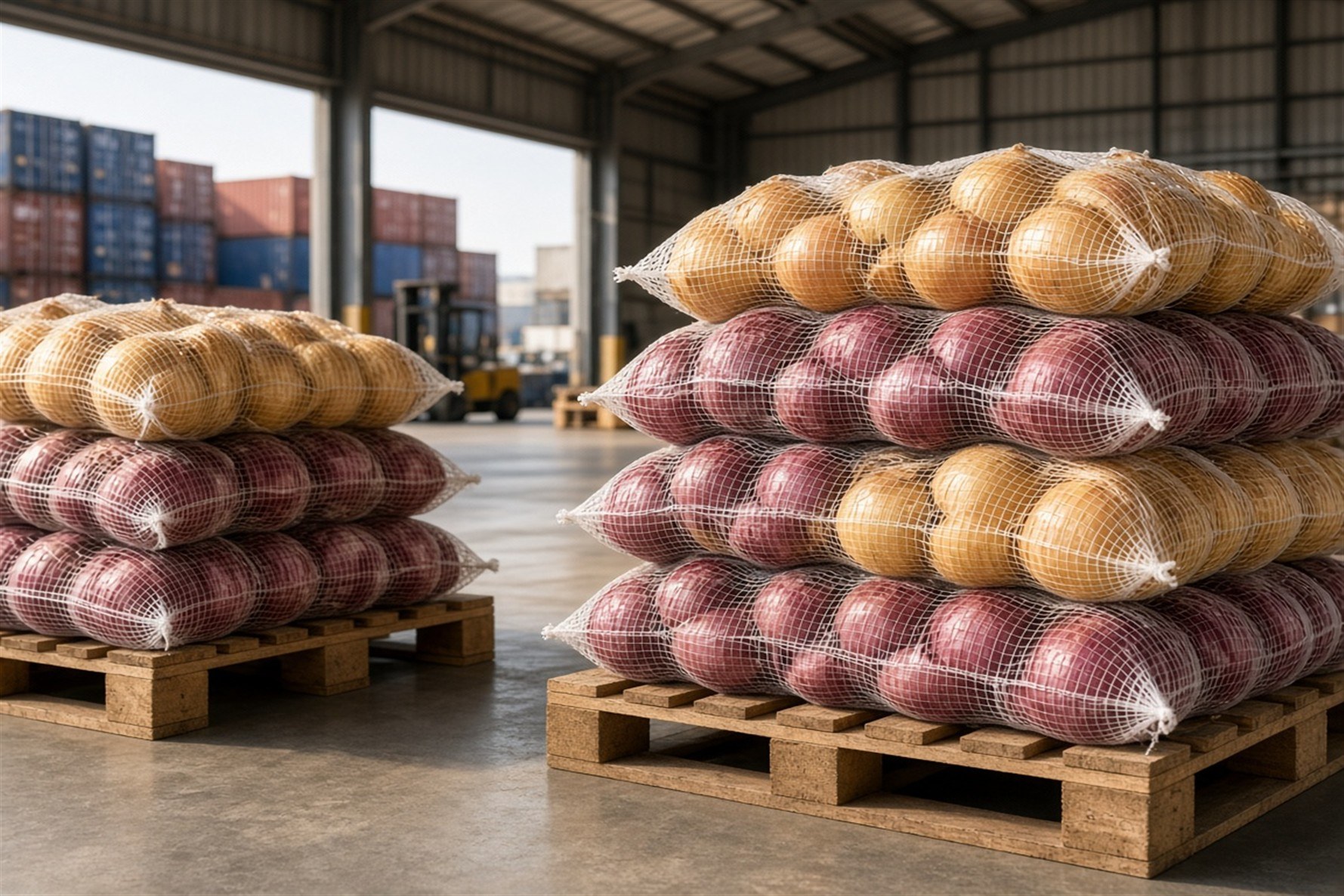
PP mesh bags are the most common export pack for Iraq, Pakistan, and the Gulf. Side ventilation, declared net weight (typically 20, 25, or 50 kg), and origin/grade labels support both customs and destination wholesale.
- Contract net weight with a small agreed tolerance.
- Strong stitching; no tears during pallet stacking.
- Standard wooden pallets, stretch-wrapped, with air gaps between layers.
- Labels: product, Iran origin, calibre, lot number.
4. Storage: 0°C and 65–70% RH
To extend shelf life after harvest and before loading, cold storage at about 0°C (without freezing) and 65–70% relative humidity is recommended. Higher humidity increases neck mould risk; very low humidity causes skin loss and weight shrink. Even airflow and avoiding CO₂ build-up matter.
Export cold-store checklist
- Calibrated temperature and RH loggers with daily records.
- Lot segregation and FIFO for dispatch.
- No loading of wet-neck or sprouted onions.
5. Transport and Logistics
Mode depends on destination: refrigerated or ventilated trucks for Iraq and Pakistan; ventilated or temperature-controlled sea containers for Oman, Kuwait, and Qatar. Goals: keep necks dry, avoid condensation in reefers, and prevent excessive pallet compression.
| Destination | Main mode | Note |
|---|---|---|
| Iraq | Overland, western/northern borders | Plan border waiting time |
| Pakistan | Taftan overland | Summer temperature control |
| Oman / Kuwait / Qatar | Sea + local haulage | Quarantine papers with cargo |
6. HS Code 070310
In the Harmonized System, Chapter 07 covers fresh vegetables. Subheading 070310 covers fresh onions and shallots. Destination countries may apply more detailed national codes (e.g. 07031011 for non-seed fresh onion in some Gulf tariffs). Commercial invoice, declaration, and phytosanitary certificate descriptions must match the actual product to avoid clearance holds.
7. Pricing and Contract Clauses
Export onion price depends on colour/type, calibre, allowed defects, volume, harvest season, packaging, Incoterms (FOB, CFR, CIF), and border or port of delivery. Compare offers on delivered price with identical specifications.
- Proforma with FFV-25 specs, calibre, bag weight, destination.
- Payment terms (advance, LC, credit period).
- Pre-shipment inspection and approved sample reference.
- Penalties or allowances if defect rate deviates from contract.
- Document responsibility: phytosanitary certificate, CO, commercial invoice.
Frequently Asked Questions
Which market was largest for Iranian onion exports in 2024?
Iraq, at roughly 38.3 million kg, was the largest single destination. Pakistan, Oman, Kuwait, and Qatar followed in lower tiers.
What role does FFV-25 play in onion sorting?
FFV-25 provides the grading and quality framework for fresh produce, defining export grade, allowed defects, and calibre uniformity in contracts.
What are ideal storage temperature and humidity for onions?
About 0°C with 65–70% relative humidity, plus good airflow and fully dry necks, supports longer storage before export loading.
Why are mesh bags common for export?
Ventilation, standard weights, fast palletisation, and wholesale acceptance make mesh bags cost-effective for high-volume flows to Iraq and the region.
How does HS 070310 differ from 07031011?
070310 is the 6-digit international heading for fresh onions and shallots; importing countries may use 8- or 10-digit national codes such as 07031011 for non-seed fresh onion. Documents must match the destination tariff line.
Is a reefer container always required for Gulf shipments?
Not always. Ventilated containers suffice on shorter routes; in summer or long transit, a reefer with mild setpoint and no condensation may be needed. Specify equipment in the contract.
How should FOB and CFR prices be compared?
FOB covers cost to load at origin; CFR includes freight to destination port. Compare freight, insurance, clearance, and identical product specs for a fair delivered-price view.
How can we source contract-spec export onions from Iran?
Submit destination, volume, calibre, FFV-25 grade, pack type, and Incoterms in an Iranco purchase request. The Iranco team aligns supply options from Iranian growers and exporters accordingly.
Featured Products
Related Articles



