 Iranco Magazine Team
Target markets, supply timing, export quality, Russia standards, packaging, cold chain and professional buying criteria for Iranian mandarins
Export Guide · Mandarin · Russia & Neighbors
Iran Mandarin Export: Opportunities in Neighboring Markets and Russia
From Mazandaran orchards and 5–8°C cold stores to RFQ tables in Moscow, Baku and Baghdad — market rings, HS 080520/080521, Turkey and China competition, EAEU FTA, packaging, cold chain and a professional buyer checklist.
Iranian mandarins have long moved in domestic trade and informal orchard surplus sales, but formal export to Russia, Iraq, the Caucasus and Central Asia requires a shared contract language: cultivar, size uniformity, pre-cooling, phytosanitary certificates and transport that holds 5–8°C at 90–95% RH. This report is for procurement managers, importers and exporters who want to read 2024 neighbor trade data and Iran’s place in Russia’s supply mix alongside Turkey, China and Egypt before the next season.
Iranco publishes this guide as a B2B reference for sourcing export mandarins from Mazandaran and other citrus regions — turning vague “export grade” claims into measurable specifications.
Introduction
The gap between “orchard surplus sales” and “commercial export” is sorting, pre-cooling, documentation and volume consistency. Local or border wholesale may absorb loads with weak size uniformity or warm loading temperature; Russian, Iraqi or Armenian buyers typically require samples, defect tables, phytosanitary certificates and weekly delivery plans before payment. Exporters active only at harvest peak negotiate RFQs poorly against Turkish suppliers who serve Moscow year-round.
Geographically, Iran’s mandarin core is on the southern Caspian coast — especially Mazandaran — with Gilan, Fars and parts of Khuzestan in other windows. For foreign buyers, “Iran” must mean cultivar, harvest week, packing region and distance to border or port.
In 2024 neighbor trade, fresh citrus in HS 080520 shows measurable Iranian flows: Armenia, Iraq, Georgia, Azerbaijan, Uzbekistan and Kazakhstan. Russia is larger and harder: imports of mandarins and oranges combined reach hundreds of thousands of tonnes; Turkey, China and Egypt dominate; Iran is a developing supplier, not the incumbent.
From 15 May 2025 the Iran–EAEU comprehensive FTA is in force. Importers in Armenia, Kazakhstan, Russia (under EAEU rules) and some Caucasus scenarios must check preferential tariffs, exact HS codes and CT-3 origin — but FTA does not replace phytosanitary control or quality specs.
Key message: size uniformity and cold-chain stability often matter more to Russian and Iraqi buyers than absolute fruit size. A good average diameter with high size scatter triggers downgrade or rejection at destination sorting lines.
1. Three market rings and 2024 exports (HS 080520)
Ring 1 — close neighbors with short land haul (Iraq, Armenia, Azerbaijan, Georgia). Ring 2 — Central Asia (Uzbekistan, Kazakhstan, Turkmenistan) with longer transit and stricter pre-cool. Ring 3 — Russia and EAEU markets with global competition and tighter quarantine.
| Destination | Approx. 2024 volume | Commercial note |
|---|---|---|
| Armenia | ~7,103 t | Land border; shorter window |
| Iraq | ~4,072 t | Autumn–winter demand; wholesale |
| Georgia | ~819 t | Transit and local consumption |
| Azerbaijan | ~747 t | Competes with Turkey |
| Uzbekistan | ~629 t | Land route; sort quality |
| Kazakhstan | ~572 t | Cold season; EAEU & FTA |
These figures reflect current trade scale, not theoretical potential. Volume growth without QC and logistics erodes exporter margin. RFQs should ask what share of weekly volume comes from which cultivar and caliper band.
2. Mazandaran cultivars, harvest windows and ripeness
Mazandaran is Iran’s main mandarin hub: roughly 20,000 ha of orchards in 1403 and provincial output in the hundreds of thousands of tonnes, part of national production near 750,000 t. Export cultivars include Japanese types such as Iyomaki, Miyagawa, Okitsu and Takano in early, mid and late orchards. Contract text must name the cultivar and harvest week, not only a Farsi market name.
| Window | Timing | Export use |
|---|---|---|
| Early | Oct–Nov (Aban–Azar) | Iraq, neighbors; vs Turkey |
| Mid-season | Dec–Jan (Dey–Bahman) | Main export volume; RFQ sorts |
| Late | Feb–Apr (Esfand–Farvardin) | Season extension; cold store critical |
- Skin color: minimum orange/red surface vs approved sample
- Brix: numeric minimum (often 10–11+ for export; define in contract)
- Acidity (TA): flavor balance for Japanese types
- Firmness: penetrometer range at loading
- Weight/diameter: caliper tolerance per carton
- Stem/pedicel: green and fresh; dry stem = rot risk
3. Iraq, Armenia, Azerbaijan and Georgia
Iraq: Stable autumn–winter demand for fresh citrus. Baghdad, Erbil and Basra wholesale channels want competitive unit price and bright appearance. Payment, documents and border timing must be agreed pre-season. Iranian mandarins can beat Turkey on distance when QC matches.
Armenia: 2024 HS 080520 volume shows Iran as a key supplier. Land border, FTA from May 2025 and Yerevan-centric distribution suit trial programs. Buyers often start with smaller, regular loads.
Azerbaijan & Georgia: Smaller markets but useful for price benchmarking against Turkey and for Russian-speaking buyer contacts in Baku and Tbilisi. Clarify re-export labeling if applicable.
4. Russia supply; competitors and FTA
Russia is among the world’s largest citrus importers. Approximate supplier volumes to the Russian mandarin/orange market include Turkey ~350,000 t, China ~94,000 t, Egypt ~71,000 t; Iran is developing — opportunity exists but share is not fixed.
| Origin | Volume to Russia | Competitive note |
|---|---|---|
| Turkey | ~350,000 t | Dominant logistics, familiar brand |
| China | ~94,000 t | Price and volume |
| Egypt | ~71,000 t | Season and variety mix |
| Iran | Developing | Proximity, flavor; needs QC & docs |
The Iran–EAEU FTA from 15 May 2025 can offer preferential duty for many agricultural lines, but mandarin entry still requires EAEU phytosanitary compliance, correct TN VED/HS and quarantine lists. Confirm eligibility with a Russian broker before promising duty-free price.
5. Technical order specifications
| Parameter | Define as | Why it matters |
|---|---|---|
| Cultivar | Exact name + reference sample | Flavor and appearance |
| Size class | Diameter or count/carton | Sorting line uniformity |
| Grade | Extra / I / II or contract | Defect tolerance |
| Brix | Numeric minimum | Ripeness |
| Skin color | % colored surface | Retail acceptance |
| Defects | Oleocellosis, scars, sunburn limits | Reject or penalty |
| MRL | Destination list (EAEU / Iraq) | Food safety |
| Net weight | kg/carton ± tolerance | Unit pricing |
| Loading temp. | 5–8°C after pre-cool | Shelf life |
6. QC defects, laboratory tests and EAEU phytosanitary
Export QC runs at orchard/sort line, at loading (pulp temperature, random caliper) and optionally at an independent lab. Common downgrade causes: oleocellosis, medfly damage, mechanical injury, severe sunburn, soft fruit, dry or rotten stems.
- MRL testing aligned with destination limits
- Brix / TA by batch or pallet sampling plan
- Penetrometer firmness at loading
- Internal cut for dryness or hidden decay on sensitive programs
Fresh plant products entering EAEU space (including Russia) need valid phytosanitary certificates from Iran’s national plant health authority, pest declarations and border inspection. Loads without correct documents are held or destroyed — a cost invisible in FOB unless the contract assigns liability.
7. HS 080521 vs 080520, documents and quarantine
HS 080520 covers fresh citrus including mandarins; 080521 is the mandarin/clementine subheading. Misclassification affects duty, FTA preference and inspection. Exporter and importer must align codes.
- Commercial invoice and packing list with net weights
- Certificate of origin (CT-3 if claiming FTA preference)
- Phytosanitary certificate
- CMR or bill of lading for land/sea leg
- MRL analysis if requested
- Insurance and INCOTERMS (FCA, CPT, DAP, etc.)
8. Export packaging
| Pack type | Use | Technical note |
|---|---|---|
| 10–15 kg ventilated carton | Standard wholesale/retail | Vent holes; ECT crush strength |
| Carton with tray/cells | Premium Russia retail | Point pressure reduction |
| Wooden crate | Some CIS channels | ISPM-15 if wood |
| Mesh bag | Low-cost bulk | Higher bruise risk |
| 80×120 pallet | Warehouse/cross-dock | Stretch wrap + corner boards |
9. Cold chain: 5–8°C, pre-cooling and four transport rules
Mandarins respire after harvest; field heat must leave quickly. Export cold stores typically run 5–8°C at 90–95% RH. Lower temperature without humidity control can harm peel; higher temperature shortens shelf life.
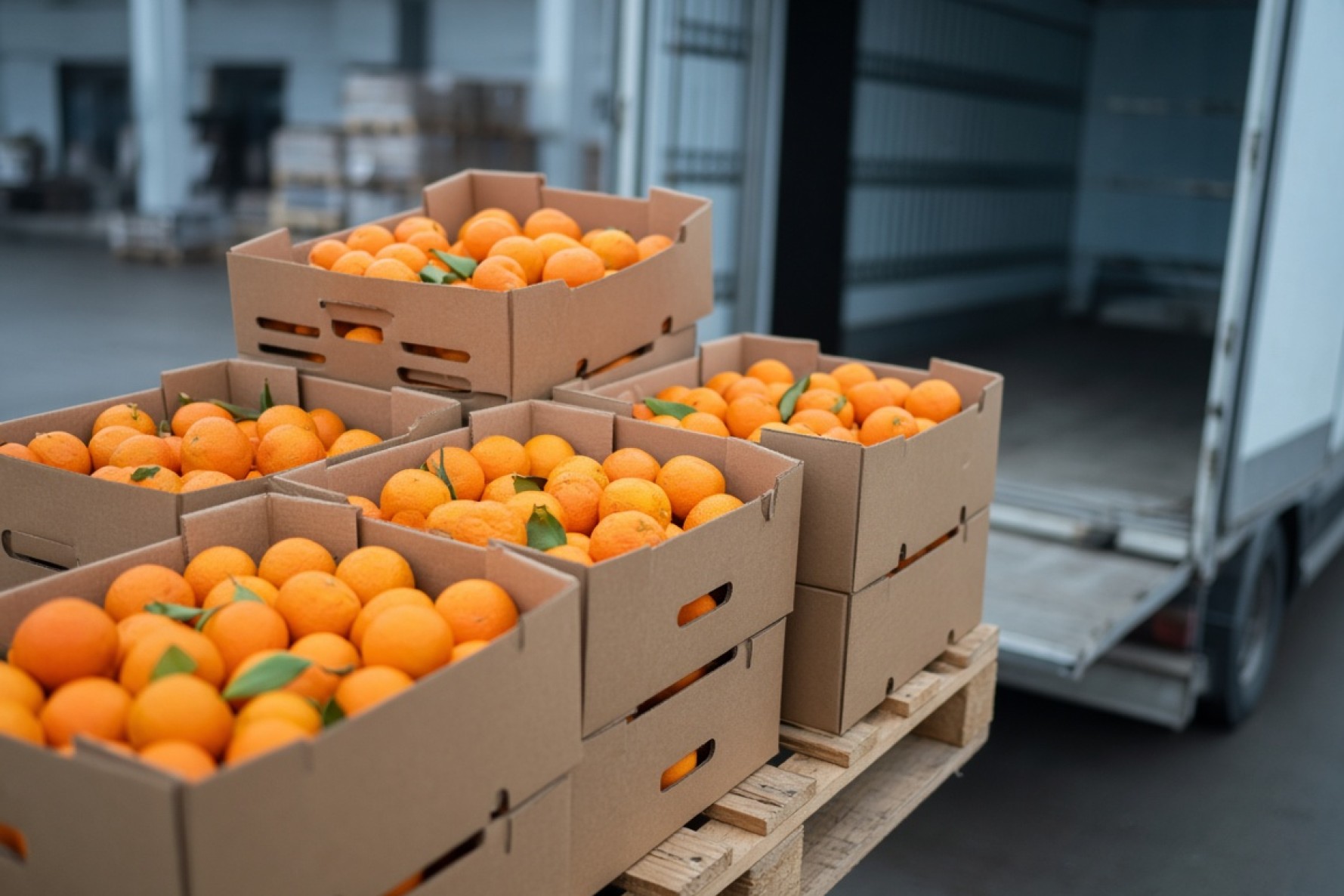
- Pre-cool before loading — not only a “cold truck”
- Hold set-point 5–8°C with data logger records
- Even air flow — do not block vents with pallets
- Minimize border dwell time with running reefer or cold transit
10. Export routes: Russia, Iraq, Armenia/Caucasus
Russia: Land routes via the north Caucasus plus optional southern port legs; transit time and temperature risk differ. Russian importers usually name a cold hub in Moscow or Rostov.
Iraq: Western and northern border crossings; shorter haul allows some flexibility but standards are tightening.
Armenia & Caucasus: Southern Armenian border and routes through Georgia/Azerbaijan — ideal for QC pilots before scaling to Russia.
11. Pricing factors
FOB/CPT price depends on cultivar, season week, size class, skin color, sorting/packing cost, pre-cool, testing, carton type, weekly volume, route, FX and payment terms. Cheaper quotes often hide irregular caliper or warm loading. Model Russian landed cost with importer fee, customs, destination lab and sorting waste. FTA may cut duty but not QC cost.
12. Russia market entry strategy
Professional path: (1) Caucasus/Armenia QC and document test; (2) Russian importer with cold-chain network; (3) pilot 1–2 container or truck equivalents with waste KPI; (4) seasonal contract with stepped volume/price; (5) buyer meetings at fairs such as WorldFood Moscow. Without a local partner, direct retail entry is very difficult. Sell predictability in caliper and temperature, not only “cheaper than Turkey.”
Importer checklist (15 items)
- Register approved cultivar and reference sample.
- Align HS code 080521/080520 with destination customs.
- Verify FTA preference and CT-3 rules.
- Numeric size class and caliper tolerance per carton.
- Minimum brix and firmness at loading.
- Skin defect and bruise limits.
- MRL and batch testing plan.
- Carton type, net weight and count.
- Contractual pre-cool and 5–8°C loading requirement.
- Mandatory data logger or temperature record.
- Phytosanitary and supporting documents before dispatch.
- INCOTERMS, insurance and cold-chain liability.
- Weekly delivery schedule and min/max volume.
- Reject criteria and sampling protocol.
- Payment terms linked to QC report, not verbal promises.
Information for a pricing inquiry
- Cultivar, size class, grade, minimum brix
- Weekly/season volume and pack type
- Destination city, INCOTERMS and transport mode
- MRL/brix tests and extra certificates
- Delivery start date and contract length
Iranco sourcing path
Iranco connects B2B buyers with mandarin growers and packhouses in Mazandaran and other regions. Purchase requests should include technical specs so quotes are comparable.
The Iranco team helps coordinate samples, spec review, pre-cool capable packing lines and export documentation for neighbor and Russia programs.
Summary
With ~750,000 t production and Mazandaran as the orchard core, Iran can supply Iraq, the Caucasus, Central Asia and, longer term, Russia. 2024 HS 080520 data shows active neighbor markets; Russia is large with Turkey, China and Egypt ahead. Success depends on 5–8°C pre-cooled chains, 90–95% RH, uniform sizing, phytosanitary documents and smart use of the 15 May 2025 FTA.
FAQ
Which tariff code applies to export mandarins?
Fresh mandarins typically use 080521 (mandarin subheading) or 080520 (fresh citrus) depending on declaration practice. Exporter and importer must match codes and FTA lists.
Which regional markets are most real for Iran today?
2024 volumes point to Iraq, Armenia, Georgia, Azerbaijan, Uzbekistan and Kazakhstan for near-term trade; Russia for scale with a local partner.
What storage and transport temperature?
5–8°C at 90–95% RH after pre-cooling. Loading warm fruit from the orchard without pre-cool sharply reduces shelf life.
What does Russia/EAEU phytosanitary control require?
Valid phytosanitary certificate, pest status, EAEU plant health rules and border inspection. FTA does not waive quarantine.
Best export timing?
Mid-season (Dec–Jan) for stable volume/quality; early for Iraq/neighbors; late with strong cold storage. Align with destination demand peaks.
Is entering Russia easy?
No — large market, strong Turkey/China supply, strict documents and QC. Pilot via Caucasus and a Russian importer is recommended.
Which laboratory tests are needed?
MRL, brix (and TA if needed), firmness, visual and internal inspection; mandatory phytosanitary certification. Lab reports must match the shipped batch.
Recommended packaging?
10–15 kg ventilated cartons with tight size sort for most buyers; trays/cells for premium; crates only by buyer agreement. Palletize with stretch film and corner boards.
Why is size uniformity more important than large fruit?
Destination sorting and retail pricing assume consistent caliper. Mixed large/small downgrades the load and increases waste.
How is export price calculated?
From cultivar, season, grade, brix, packaging, pre-cool, volume, route, testing, INCOTERMS and tariff preference. Quotes without specs are not reliable.
Mandarin export advice for Russia, Iraq and neighboring markets — submit a sourcing request
Contact Irancoinfo@iranco.com · WhatsApp: +98 913 104 4182 · Telegram: @irancofood
Featured Products











Related Articles



